

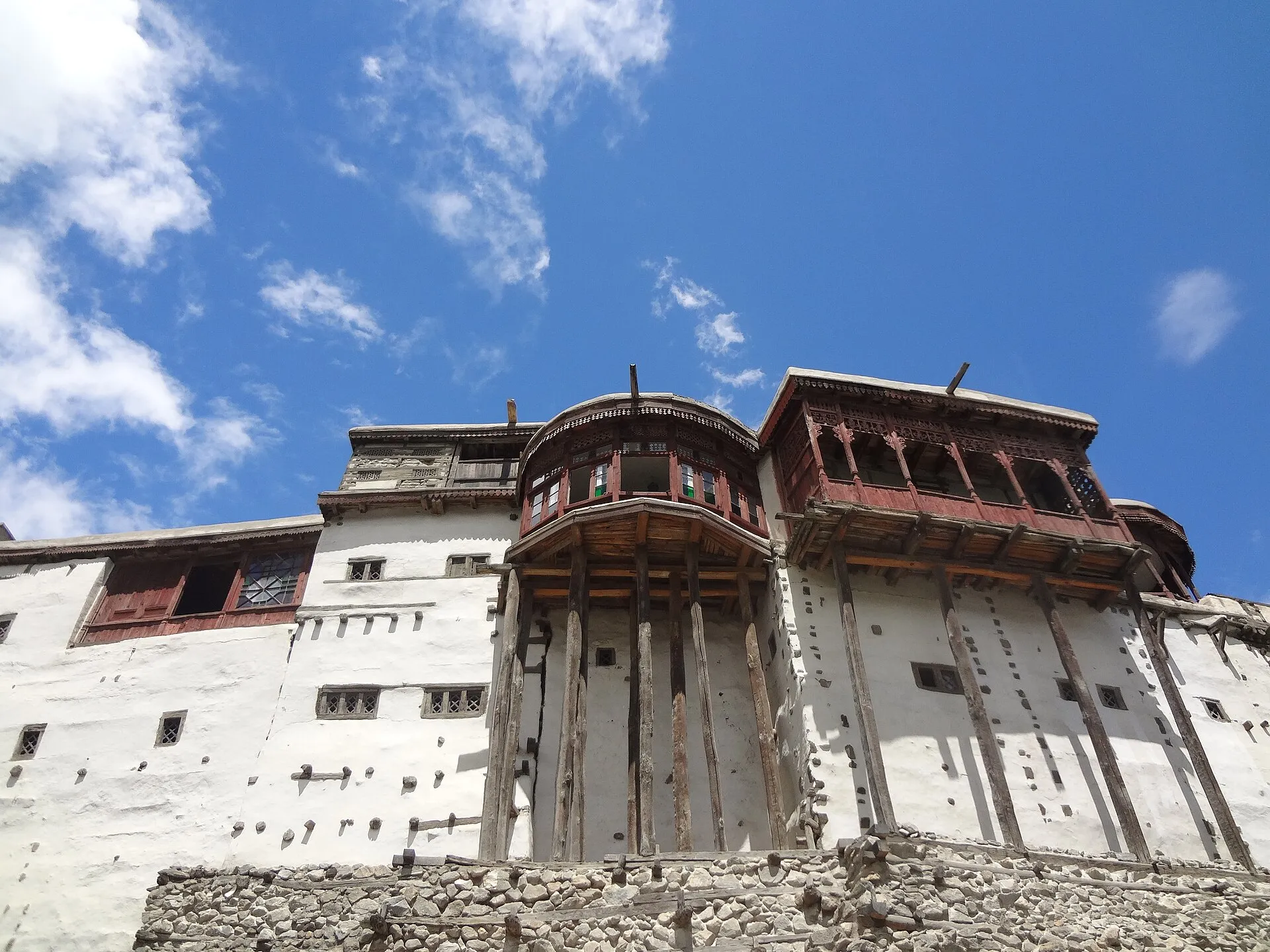
Photo: MuhammadUsama25, with thanks · CC BY-SA 4.0 · via Wikimedia Commons · temporary stand-in photo

Baltit Fort
A restored fort and museum above Karimabad in Hunza, once the home of the Mirs of Hunza. Its core is centuries old and it has been on UNESCO's tentative list since 2004.
Overview
Baltit Fort stands on a spur above Karimabad, the main town of the Hunza valley. For centuries it was the seat of the Mirs of Hunza. Today it is a museum and cultural centre run by the Baltit Heritage Trust. The Tibetan-influenced timber and stone building looks across the valley to Ultar Sar and Rakaposhi and is the most visited monument in Hunza.
Plan your visit
- Nearest town
- Karimabad
- Getting there
Karimabad is on a side road off the Karakoram Highway, about 100 km north of Gilgit, and is the usual base for Hunza. Shared vans and private cars run from Gilgit; a drive takes a few hours. More
Best months
Apr – Oct
- Baltit Fort
- Related places nearby: Gilgit, Attabad Lake, Ganish Village (Ganish Khun), Hunza
History
Conservation work in the 1990s dated the oldest stone-and-timber tower to about the 8th century CE. The fort grew over time. In the 16th century Mir Ayasho II married Shah Khatun, a princess from Skardu; her family sent Balti craftsmen who rebuilt the fort, and a cannon dated 1539 is said to have come as part of her dowry. In 1945 the Mirs moved to a new palace lower down the hill, and the fort began to decay.
Sources differ on the fort's age. Wikipedia's Baltit Fort article dates the core to about the 8th century, while its Karimabad article describes a fort of the 17th century built in Balti style by artisans who came with the Skardu princess. Both agree on the Balti link and on later changes.
Mir Nazim Khan had the interiors refitted with wallpaper, curtains, fireplaces, balconies and tinted glass windows, and the outside whitewashed. He also built a raised platform on the terrace for council meetings. When the family moved down the hill in 1945, the fort was stripped of its fittings, and by 1984 it stood empty.
Hunza was an independent principality for more than 900 years under the Ayasho dynasty, and Baltit was its capital for over 750 years. British forces took control in 1891 after the Anglo-Brusho war, and the state was abolished in 1974.
After a survey by the Royal Geographical Society, the Aga Khan Trust for Culture (AKTC) led a restoration, completed in 1996. The project won a UNESCO Asia-Pacific Heritage Conservation award in 2004, and Wikipedia lists a Time Asia Best of Asia award in 2005. Wikipedia's Karimabad article says the rebuilding ran from 1990 to 1996, following the original plan with earthquake risk taken into account.
UNESCO status
Baltit Fort has been on Pakistan's UNESCO Tentative List since 2004. It is not yet a World Heritage Site.
What to see and do
- The museum rooms: carved wooden pillars and windows and displays on Hunza life; the building itself is the main exhibit. Some rooms show dresses, pictures, old vessels and furniture donated by local people. Simple stained-glass windows can be seen.
- The cannon and old weapons: including antique Russian rifles gifted to the Mir of Hunza.
- The roof terrace: one of the best viewpoints in the valley, with Ultar Peak towering above the fort and Spantik to the south-east.
- Karimabad old town: the lanes below the fort, with Altit Fort a short drive away.
Allow about an hour. Guided visits are usually available.
When to visit
April to October has the easiest weather and clear views. Winters are cold and some services in Karimabad close.
Where to stay and eat
Karimabad has a wide range of guesthouses and hotels, and restaurants and cafes along the main lanes. Book ahead in July and August.
Good to know
- Entry and opening hours: a ticket is charged, but no official current fee or hours were confirmed. Current fees will be added soon. Opening hours are posted at the fort; hours differ between summer and winter and between sources, so check before climbing the hill.
- Dress and behaviour: dress modestly, leave shoes where staff ask and keep your voice low inside the old rooms.
- Photography: usually fine for personal use; ask about flash and tripods.
- Climb: the lane from Karimabad is steep and cobbled.
Highlights
- Restored seat of the Mirs of Hunza
- Core tower dated to about the 8th century
- Restored by the Aga Khan Trust for Culture, completed 1996
- Roof views of Ultar Sar and Rakaposhi
Getting there
Karimabad is on a side road off the Karakoram Highway, about 100 km north of Gilgit, and is the usual base for Hunza. Shared vans and private cars run from Gilgit; a drive takes a few hours. From Karimabad's main bazaar, the fort is a short, steep walk or drive up the hill.
Tips
- Walk up in the cool morning and take a guide for the stories.
- Pair it with Altit Fort the same day.
- Wear shoes that are easy to take off.
- Check with your hotel for current hours.
Photos we still need: Baltit Fort roof terrace view toward Ultar Peak. Send us yours
Sources and last checked
Last checked Confidence medium6 sources3 still to check
- Last checked
- Method
- Desk research from published sources
- Confidence
- medium
- Checked by
- trek.pk research team
Researched from published sources; not yet checked on the ground by our team. Spot something out of date? Report a mistake.
Sources
- Baltit Fort (Wikipedia) · Wikipedia · checked
- Conservation and development in Gilgit-Baltistan · Aga Khan Development Network · checked
- Baltit Fort (Tentative List 1882) · UNESCO World Heritage Centre · checked
- Baltit Fort (OpenStreetMap place data) · OpenStreetMap / Nominatim · checked
- Karimabad, Gilgit-Baltistan · Wikipedia · checked
- Hunza District · Wikipedia · checked
Still to be checked on the ground (3)
- Current opening hours (sources conflict; neither Wikipedia nor AKDN gives hours)
- Current ticket price (no official page reachable)
- Fort's age: Wikipedia gives the 8th century in one article and the 17th century in another
Nearby and related

Gilgit
Gateway to Gilgit-Baltistan on the Karakoram Highway: a busy mountain town with the Kargah Buddha and the base for Hunza, Naltar and Skardu.

Attabad Lake
A turquoise lake about 21 km long in Gojal, Hunza. It formed when a landslide blocked the Hunza River on 4 January 2010. The Karakoram Highway now passes it through five tunnels.
Gilgit-Baltistan
Pakistan's far north: three great ranges meet here, with K2, Nanga Parbat, giant glaciers, the Karakoram Highway and the valleys of Hunza, Skardu and Gilgit.
Ganish Village (Ganish Khun), Hunza
Ganish Khun is described as the oldest settlement in Hunza, at least 1,000 years old, with old watchtowers and restored mosques. It won a UNESCO Asia-Pacific heritage award for conservation.