

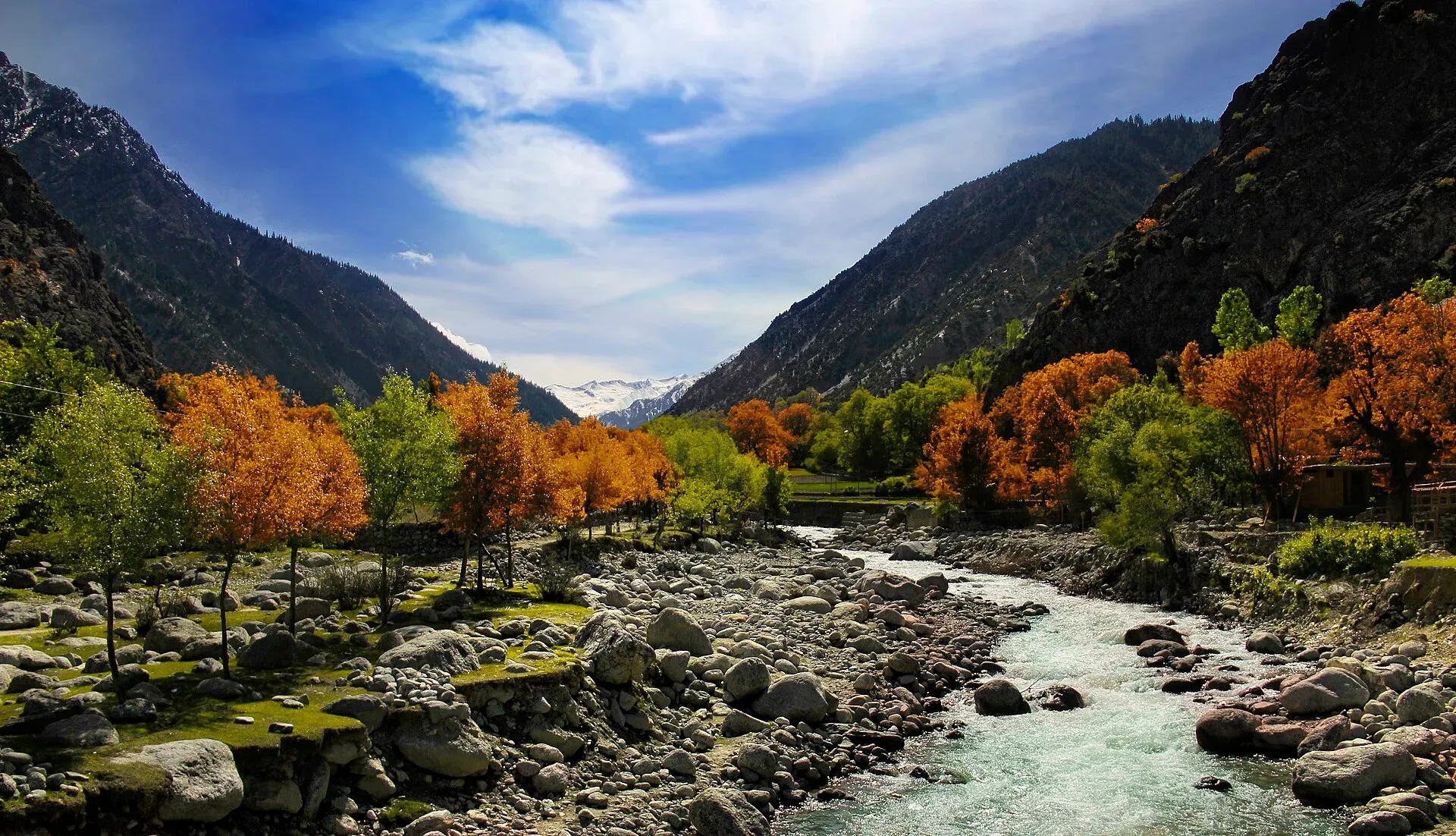
Photo: Hassan Ali (Hsnbook), with thanks · CC BY-SA 3.0 · via Wikimedia Commons · temporary stand-in photo

Bumburet Valley
The largest of the three Kalash valleys, about 20 km south of Chitral town. Home to Kalasha villages, the Kalasha Dur museum, walnut and apricot orchards and the spring festival.
Overview
Bumburet (Kalasha name Mumuret) is the largest valley of Kalash Desh, in Lower Chitral District. Wikipedia places it about 20 km south of Chitral town, downstream along the Kunar River, and gives 2,288 m at the village of Ayun, where the valley meets the Kunar valley. A pass at about 4,500 m at the head of the valley leads towards Nuristan in Afghanistan.
The valley has streams, meadows and walnut and apricot orchards, and it is the most developed of the three Kalash valleys for visitors. The Kalasha Dur Museum is here. Floods in July and August 2015, caused by heavy rain and a glacial outburst, destroyed much of the region's infrastructure.
For the wider picture, including Rumbur and Birir, festivals and culture, see Kalash Valleys.
Plan your visit
- Nearest town
- Chitral
- Getting there
From Chitral town south to Ayun, about 20 km, then up the side road to Bumburet. Allow 1.5 to 2 hours by jeep or car. Local vehicles run from Chitral and Ayun. More
Best months
Apr – Oct
- Bumburet Valley
- Related places nearby: Kalash Valleys (Bumburet, Rumbur, Birir), Chitral, Rumbur Valley
The Kalasha people
The Kalasha live in three valleys of Chitral District: Bumburet (Mumuret), Rumbur (Rukmu) and Birir (Biriu). Their villages lie at roughly 1,900 to 2,200 m (Wikipedia). The 2023 census counted 7,466 people who speak Kalasha as their first language. Kalasha is an Indo-Aryan language closely related to Khowar, the main language of Chitral. Most Kalasha are now Muslim, and a minority follow a traditional faith with its own deities and rituals, often held without temples, using fire and sacred wood. Visitors are guests in a community that has faced pressure and attacks in the past, and the Pakistani government has acted to protect it.
Traditionally, the Kalasha were goat herders and subsistence farmers. Walnuts, apricots, grapes, wheat and maize are among the crops, and wine has a sacred place in ritual. Tourism is now a large part of the cash economy, which is why guest houses and shops have grown. Visitors pay a toll to the government, which is meant to support Kalasha culture.
What to see and do
- Kalasha villages. Wooden houses, terraced fields and orchards.
- Kalasha Dur Museum. A small museum of Kalasha life.
- Festivals. Three main festivals are held: Chilam Joshi in spring (around May), Uchau in autumn, and Chaumos at midwinter, which lasts about two weeks around the winter solstice (roughly 7 to 22 December) and is the most important (Wikipedia). Pul is tied to the September full moon. Dates follow the Kalasha calendar and the moon, so ask locally. Some rites are private; watch from where hosts invite you.
- Graves. The dead are buried above ground in carved wooden coffins. The graveyards are sacred, so ask before approaching and do not photograph them without permission.
- Walks. Paths follow the stream and lead to side hamlets.
Getting there
Take the road south from Chitral to Ayun, about 20 km, then follow the side road up the valley. Our Kalash Valleys page gives about 30 km and 1.5 to 2 hours by jeep from Chitral. Local transport runs from Chitral and Ayun.
When to visit
April to October. The spring festival is the busiest time. Winter is very cold.
Where to stay and eat
Bumburet has the widest choice of guest houses among the Kalash valleys. Food is simple: bread, cheese, walnuts and fresh fruit.
Good to know
- Security advice. For foreign visitors: the UK FCDO advises against all travel on the N45 highway from north of the Mardan ring road to the edge of Chitral City, including the Kalash valleys (updated 27 October 2026, checked 17 November 2026). Read the live page and ask local sources before you go.
- Respect local custom. Some altars and houses are private or sacred. Dress modestly and ask before taking photographs of people.
- Fees and permits. A visitor entry fee has been charged by the Chitral district administration. Current fees will be added soon; check with them.
Highlights
- Largest of the three Kalash valleys
- Kalasha villages and Kalasha Dur Museum
- Walnut and apricot orchards
- About 20 km south of Chitral
Tips
- Ask before photographing people, houses or shrines.
- Check festival dates locally.
- Dress modestly and use local guides.
- Check security and permit rules before you travel.
Photos we still need: Kalasha Dur Museum (no open-licence image found). Send us yours
Sources and last checked
Last checked Confidence low3 sources5 still to check
- Last checked
- Method
- Desk research from published sources
- Confidence
- low
- Checked by
- trek.pk research team
Researched from published sources; not yet checked on the ground by our team. Spot something out of date? Report a mistake.
Sources
- Bumburet · Wikipedia · checked
- Foreign travel advice: Pakistan · UK FCDO · checked
- Kalash people (Wikipedia) · Wikipedia · checked
Still to be checked on the ground (5)
- Current road condition and journey time
- Whether any security or permit rule applies to foreigners at the time of travel
- Current museum opening and entry arrangements
- Entry fee
- Festival dates for the coming year and any visitor rules for festivals
Nearby and related

Kalash Valleys (Bumburet, Rumbur, Birir)
Three side valleys of the Chitral River, home to the Kalasha people, who keep their own religion, language and festivals. Visit with respect and check security advice first.

Chitral
The main town of Lower Chitral District, at about 1,500 m on the Chitral River, with a historic fort, a royal mosque and views of Tirich Mir. The base for the Kalash valleys.
Rumbur Valley
A smaller, quieter Kalash valley north of Bumburet. Kalasha and Kho families live here, with traditional wooden houses.