

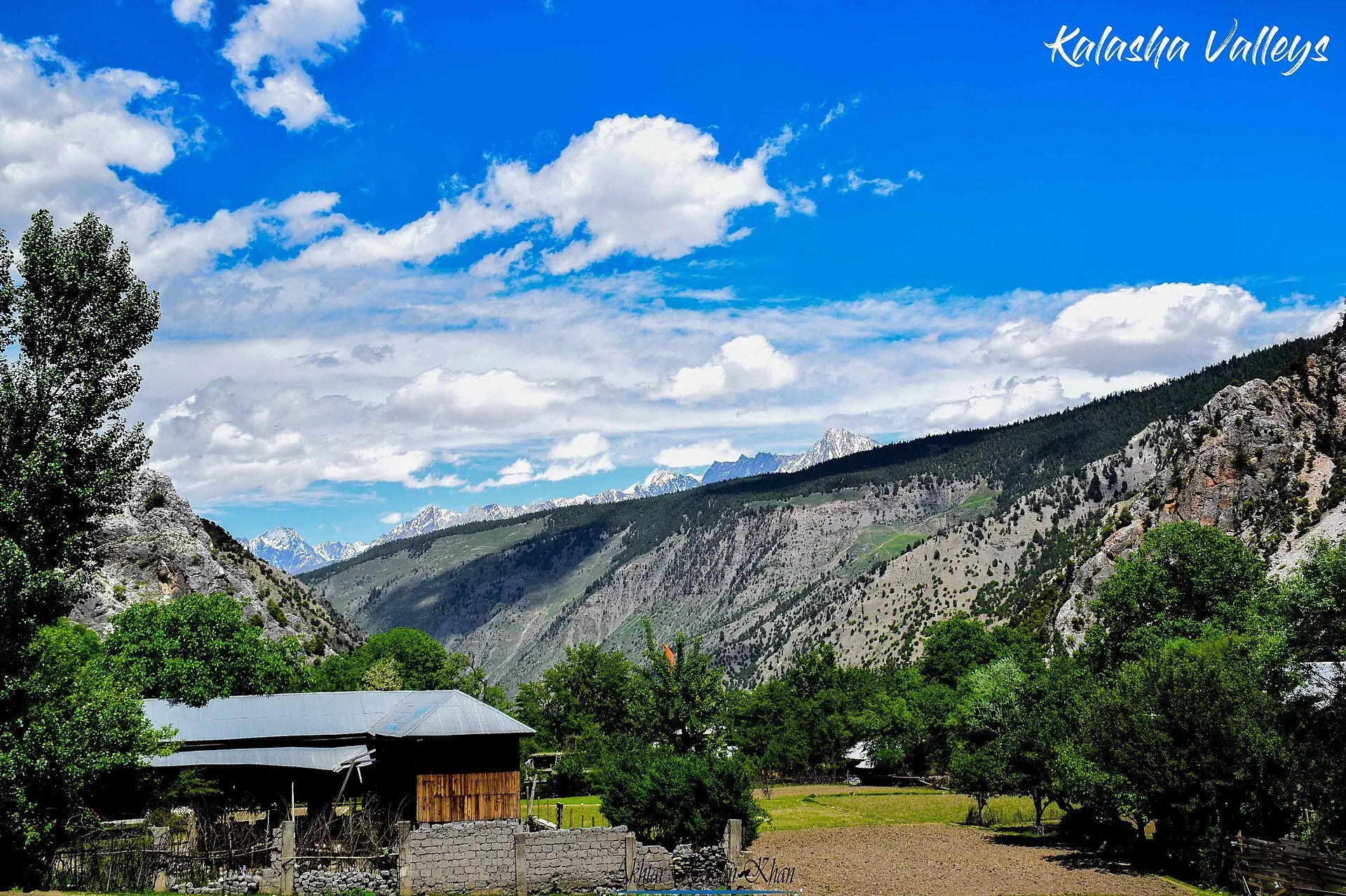
Photo: Akhtar Hassan, with thanks · CC BY-SA 4.0 · via Wikimedia Commons · temporary stand-in photo

Kalash Valleys (Bumburet, Rumbur, Birir)
Three side valleys of the Chitral River, home to the Kalasha people, who keep their own religion, language and festivals. Visit with respect and check security advice first.
Overview
The Kalash valleys are three narrow side valleys in Lower Chitral: Bumburet (Mumuret), Rumbur (Rukmu) and Birir (Biriu). Bumburet is the largest. Rumbur is a side valley to its north, and Birir lies south of Bumburet, with its own opening to the main river. The Kalasha villages stand at roughly 1,900 to 2,200 m among terraced fields, oak and walnut trees and vines. Wikipedia describes the Kalasha as the smallest ethnoreligious group in Pakistan, with their own language, Kalasha-mondr, and a religion that is distinct from the Muslim majority around them.
The 2023 census counted 7,466 people who gave Kalasha as their mother tongue (Wikipedia). That figure counts language speakers, not religion.
Most Kalash gradually converted to Islam after the 14th century, and the remaining community is now confined to these three valleys. A large part of the Kalasha-speaking population today is Muslim, and Muslims and Kalash live side by side here. The valleys also hold smaller Kho and Gujar communities.
Plan your visit
- Nearest town
- Chitral
- Getting there
From Chitral town south down the main valley to Ayun, about 20 km, then up the side valley to Bumburet or Rumbur (OSRM Chitral to Bumburet about 30 km, 0.7 h; allow 1.5 to 2 hours). More
Best months
Apr – Oct
- Kalash Valleys (Bumburet, Rumbur, Birir)
- Related places nearby: Chitral Valley, Chitral Gol National Park, Drosh, Kalasha Dur Museum, Bumburet Valley, Rumbur Valley
Getting there
Take the road south from Chitral town, down the main valley to Ayun (Ayrun), about 20 km, where the Bumburet and Rumbur roads leave the highway. OSRM gives Chitral to Bumburet at about 30 km and 0.7 hours. OSRM times are optimistic. Allow 1.5 to 2 hours by jeep or car, because the side roads are narrow and rough. Birir opens to the Chitral River further south, near Gabhirat. Local transport leaves from Chitral and Ayun, and drivers know all three valleys.
Villages and sights
- Bumburet. The main valley, with the most guest houses and craft shops.
- Rumbur. Smaller and quieter, with traditional wooden houses and a long side valley.
- Birir. Farm villages and orchards among conifers, with a route to Bumburet over a pass at about 3,000 m.
- Houses and shrines. Wikipedia mentions shrines, altars and goat stables as part of village life. Many villages also run guest houses and small craft shops.
- Community spaces. Some houses, altars and festival grounds are private or sacred. Ask before approaching and follow your guide.
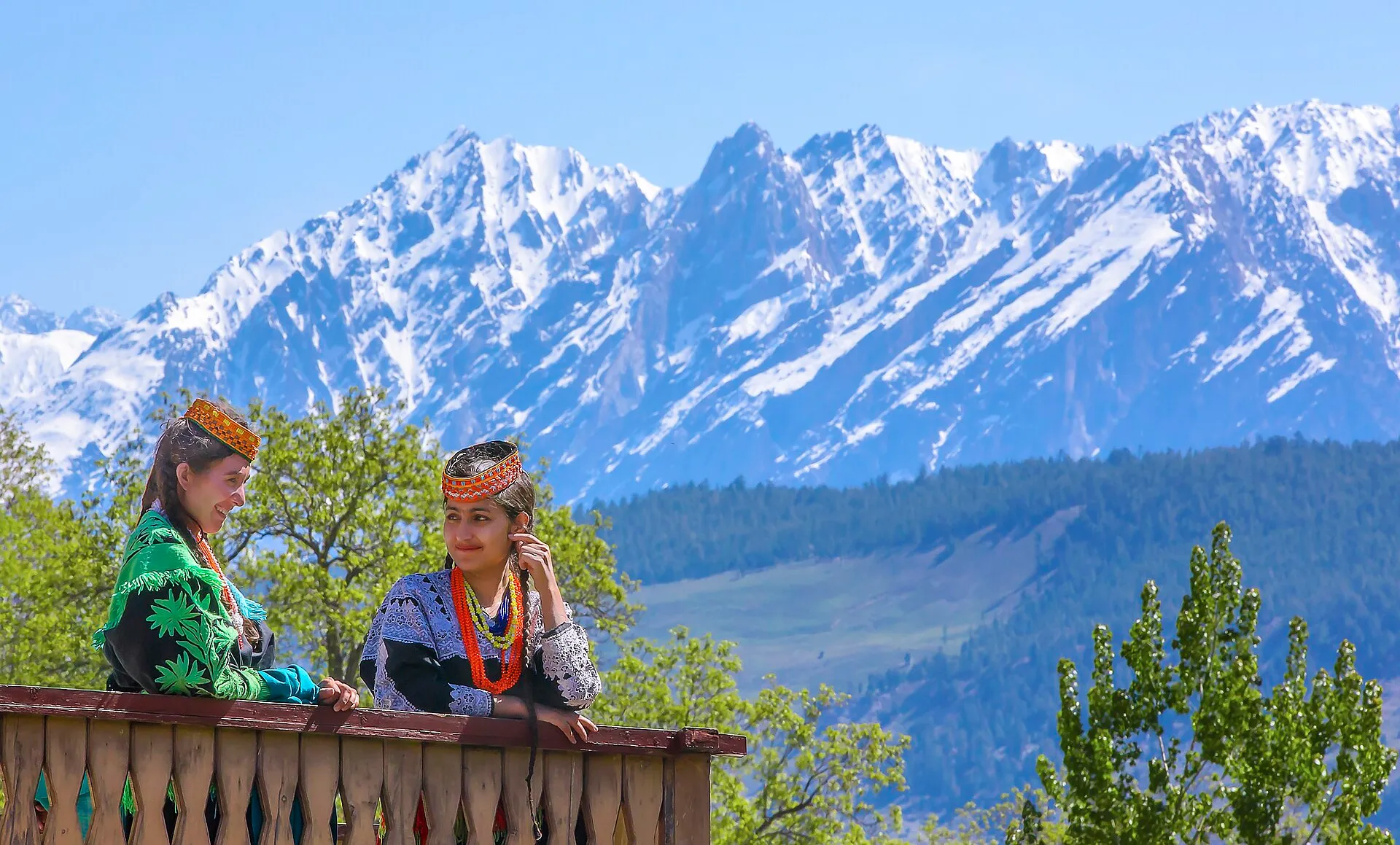
Photo: Tahsin A Shah, with thanks · CC BY-SA 4.0 · via Wikimedia Commons · temporary stand-in photo

Festivals
The Kalash year has three main festivals. Dates move each year and change with the weather and harvest, so ask locally:
- Chilimjusht (Joshi), spring. Usually around mid-May, with dancing, songs and offerings. One news report listed 12 to 16 May for a recent year.
- Uchau, late summer or autumn. A harvest festival, usually August or September, according to operators.
- Chaumos, midwinter. The most important festival, held in December; sources give start dates between 7 and 15 December, and Wikipedia says it runs for two weeks around the winter solstice, roughly 7 to 22 December.
The Pakistan Tourism Guide 2021 describes the spring welcome, the harvest festival and the winter festival, held in the Kalash valleys near Chitral. Wikipedia describes Chilimjusht as a spring festival of dancing and singing, with a first day called Milk Day, when milk is offered. Chaumos marks the end of the agricultural year, with music, dancing and goat meat. Parts of Chaumos are closed to people who are not initiated, and outsiders are regarded as impure in some ritual settings, so visitors should expect to be kept away from some ceremonies. Visitors during festivals should follow the community's rules on photography and areas closed to outsiders.
When to visit
April to October for the valleys. The spring festival draws many visitors and is the busiest time. Winter is very cold, and the winter festival is for those who accept basic conditions. Summers are mild: Wikipedia gives average maxima of 23 to 27 C.
Where to stay and eat
Bumburet has the widest choice of guest houses, followed by Rumbur and Birir. Food is simple: bread, cheese, walnuts, fresh fruit, and local dishes.
Culture and languages
Kalasha is an Indo-Aryan language, most closely related to Khowar, the main language of Chitral, and many people also speak Khowar and Urdu. Wikipedia describes the traditional religion as built around nature, with sacrifices and festivals giving thanks for the valleys' resources. Women commonly wear long black robes embroidered with cowrie shells,. The Kalasha tradition includes sacred places, seasonal festivals and goat-herding. Crops include grain, maize, grapes, apples, apricots and walnuts. Some places, such as altars and certain women's houses, are closed to visitors; your guide will tell you which. Dress modestly, ask before taking photographs of people, and do not enter or photograph shrines or festival grounds without permission. Tourism is now a main source of income, alongside work in the army, police and border forces. Many Kalasha families rely on guest-house income, so use local guides and buy local crafts.
Safety and practical points
- Security advice. The UK Foreign Office advises against all travel on the N-45 from Mardan to the edge of Chitral City, including the Kalash valleys (last updated 27 October 2026, checked 16 November 2026). Read the advice and ask local sources before you go.
- Entry toll. Wikipedia says visitors pay a toll to the government on entering the valleys, and that the revenue is meant to support the Kalash and their culture.
- Security history. Wikipedia reports attacks and threats in the past, and says the government has increased security around Kalash villages.
- Entry fee. A visitor entry fee has been charged by the Chitral district administration. Current fees will be added soon; check with the Chitral district administration.
- Permits and registration. Sources disagree on whether foreign visitors need a permit. Ask a licensed operator and your guest house, who usually record passport details.
- Rivers and roads. Side-valley roads are narrow, and rivers rise in summer.
Highlights
- Kalasha villages, wooden houses and terraced fields
- Festivals: Chilimjusht, Uchau and Chaumos
- Bumburet, Rumbur and Birir valleys
- Local crafts and music
- Short drive from Chitral town
Tips
- Ask before photographing people, houses or shrines.
- Check festival dates locally; they change each year.
- Dress modestly and use local guides.
- Check security and permit rules with a local operator.
Photos we still need: a Kalasha festival, taken with the community's permission; Bumburet or Rumbur village street. Send us yours
Sources and last checked
Last checked Confidence medium7 sources4 still to check
- Last checked
- Method
- Desk research from published sources
- Confidence
- medium
- Checked by
- trek.pk research team
Researched from published sources; not yet checked on the ground by our team. Spot something out of date? Report a mistake.
Sources
- Kalash Valleys (Wikipedia) · Wikipedia · checked
- Kalasha people (Wikipedia) · Wikipedia · checked
- All set to hold Chilimjusht festival from May 12-16 · The News · checked
- Pakistan travel advice (last updated 27 October 2026) · UK FCDO · checked
- Pakistan Tourism Guide 2021 · TDAP · checked
- OSRM routing · Project OSRM · checked
- Kalasha Valleys · Wikipedia · checked
Still to be checked on the ground (4)
- Current entry fee and permit rules (Wikipedia says a toll is charged but gives no amount; the Lower Chitral district portal opened without useful content)
- Festival dates for the coming year (Wikipedia: Chilimjusht mid or end of May, Uchau in autumn, Chaumos about 7 to 22 December; no official calendar found)
- Jeep and car travel times on the side roads (OSRM only)
- Which areas are closed to visitors (only the general rule to ask the guide; no official source)
Nearby and related

Gokhshal An and Dooni An

Other treks in Chitral

Chitral Valley
The long Chitral River valley at the foot of the Hindu Kush, with Chitral town's fort and Shahi Mosque, the Lowari Tunnel route, Tirich Mir views and side valleys leading to Kalash and Shandur.

Chitral Gol National Park
A mountain park beside Chitral town, set up in 1984 to protect the markhor. About 78 square kilometres rising from 1,450 m to 5,000 m, with snow leopard and ibex.

Khyber Pakhtunkhwa
Mountains, Buddhist ruins and old bazaars in north-west Pakistan: Swat, Kaghan, Chitral, the Kalash valleys, the Khyber Pass and Peshawar.

Drosh
A river town at about 1,359 m in Lower Chitral, on the N-45 road south of Chitral city. It is the largest town in Lower Chitral after Chitral itself and a common stop on the way to the Kalash valleys.

Kalasha Dur Museum
A cultural centre and museum in Bumburet, the largest of the Kalash valleys, with about 1,300 objects from Kalash life and the wider Hindu Kush.

Bumburet Valley
The largest of the three Kalash valleys, about 20 km south of Chitral town. Home to Kalasha villages, the Kalasha Dur museum, walnut and apricot orchards and the spring festival.
Rumbur Valley
A smaller, quieter Kalash valley north of Bumburet. Kalasha and Kho families live here, with traditional wooden houses.