

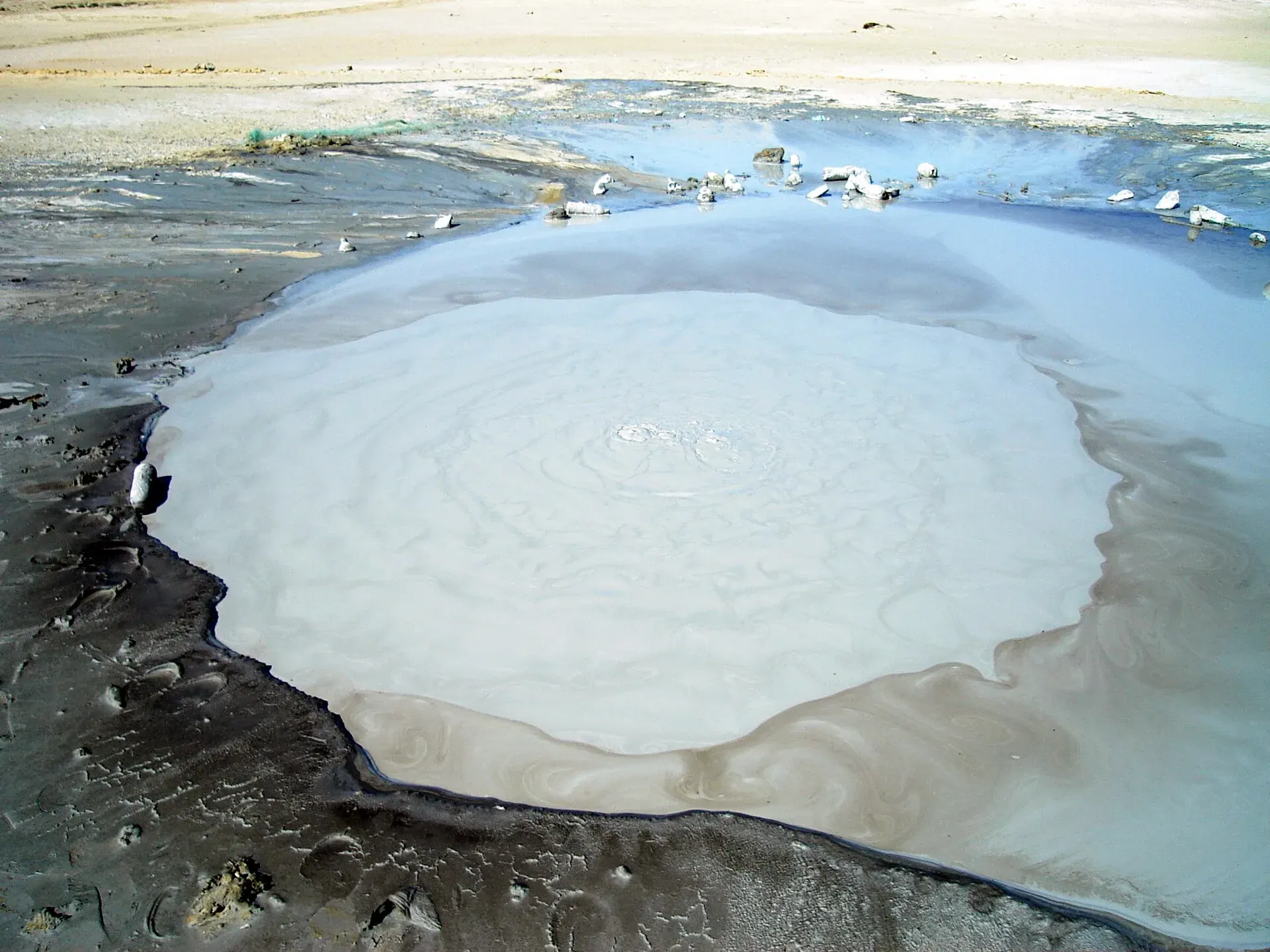
Photo: Mabdullah, with thanks · CC BY-SA 3.0 · via Wikimedia Commons · temporary stand-in photo

Chandragup Mud Volcano
A mud volcano in Hingol National Park, close to the Makran Coastal Highway, and a holy site for Hindu pilgrims on the way to Hinglaj Mata. For foreign visitors: the UK FCDO advises against travel to Balochistan.
Overview
Chandragup is a group of mud volcanoes in Hingol National Park, Lasbela District, Balochistan, about 100 km from Uthal, the district headquarters. Hingol is the largest national park in Pakistan, and the Makran coast around it is known for mud volcanoes: Wikipedia says the park has about ten clusters, of which Chandragup and Khandewari are the most important. Chandragup itself is a complex of three main cones (Chandragup 1, 2 and 3) plus several smaller ones.
In a mud volcano, cold mud and gas rise through a vent rather than lava. Here the mud bubbles slowly in the crater at the top of the cone. Published heights disagree: figures of 100 m, about 300 ft (90 m) and 58 m all appear. Treat any single figure with caution.
Plan your visit
- Nearest town
- Uthal
- Getting there
By road Chandragup is about 196 km and 2 hours 35 minutes from central Karachi (OSRM, checked 16 November 2026), following the Makran Coastal Highway towards Gwadar. The site is about 1 km off the highway. More
Best months
Oct – Apr
- Chandragup Mud Volcano
- Related places nearby: Hingol National Park, Princess of Hope and the Sphinx (Hingol), Hinglaj Mata Temple
Finding the site
The volcanoes lie about 1 km off the Makran Coastal Highway between Lasbela and Gwadar. They are not on the main road and are not signed from it. Local people can point out the track, and a Sui Southern Gas Company (SSGC) installation is a landmark. The site is part of the same landscape as the Princess of Hope and the Sphinx rock formations and the Hinglaj Mata temple, both in Hingol National Park. See Hingol National Park for the wider area.
What to see and do
Visitors look at the cone from its base and watch the mud bubble. The surface can be soft and slippery, so stay on firm ground and keep back from the crater edge.
A holy site for Hindu pilgrims
Hindus call the volcano Baba Chandragup (also written Chandrakup) and worship it as a form of Shiva. Pilgrims believe they must pay respect here before they enter the Hinglaj Mata temple. The pilgrimage, the Hinglaj Yatra, is a four-day gathering held in April; Wikipedia gives no exact dates.
Wikipedia describes the ritual as follows. The night before the ascent, pilgrims fast, stay awake and reflect on the sins they will confess. The group bakes roti from ingredients that all pilgrims contribute. Next day they climb the slope and offer the roti. Coconuts, betel nut and dal are now also offered, and coconuts are thrown into the craters. At the top each pilgrim gives their full name and place of origin and confesses their sins aloud. Wikipedia says a ritual official (a charidar) then reads the bubbling of the mud and the movement of the wind to judge whether the sins are forgiven.
Visit respectfully. Keep back from worship, and do not photograph people at prayer without asking.
When to visit
Pilgrimage days in April are crowded. Outside April, October to March is cooler. No source gives other seasonal advice.
Where to stay and eat
There are no facilities at the site. Hotels are in Karachi, Uthal and Gwadar. Bring water and food.
Good to know
- Safety. For foreign visitors: the UK FCDO page for Pakistan (updated 27 October 2026, checked 16 November 2026) advises against all travel to Balochistan. Read it and local news first.
- Entry rules and fees are not confirmed; current fees will be added soon.
Highlights
- Active mud volcano complex in Hingol
- Holy to Hindu pilgrims (Baba Chandragup)
- About 1 km off the coastal highway
- Annual pilgrimage in April
Getting there
By road Chandragup is about 196 km and 2 hours 35 minutes from central Karachi (OSRM, checked 16 November 2026), following the Makran Coastal Highway towards Gwadar. The site is about 1 km off the highway. There is no public transport to it, so most visitors use a private car with a local guide.
Tips
- Ask locals for the turn-off; it is not on the main road.
- Respect pilgrims and worship areas.
- Stay on firm ground around the mud.
- Carry all water and food.
Photos we still need: the Chandragup cone and crater, and pilgrims at the site (with permission). Send us yours
Sources and last checked
Last checked Confidence medium4 sources5 still to check
- Last checked
- Method
- Desk research from published sources
- Confidence
- medium
- Checked by
- trek.pk research team
Researched from published sources; not yet checked on the ground by our team. Spot something out of date? Report a mistake.
Sources
- Hingol mud volcanoes (Chandragup) · Wikipedia · checked
- Foreign travel advice: Pakistan · UK FCDO · checked
- OSRM routing · OSRM / OpenStreetMap · checked
- Hingol National Park · Wikipedia · checked
Still to be checked on the ground (5)
- Cone height (58 m to 100 m between sources; Wikipedia lead also says 300 ft)
- Exact access track and entry rules
- Security and road conditions
- Whether the photo shows Chandragup or another Hingol mud volcano
- Pilgrimage organiser and exact Hinglaj Yatra dates
Nearby and related

Hingol National Park
Pakistan's largest national park, about 6,100 square kilometres along the Makran Coastal Highway: desert canyons, mud volcanoes, the Hingol River, the Princess of Hope rock and the Hinglaj Mata temple.

Princess of Hope and the Sphinx (Hingol)
Two wind-carved rock formations inside Hingol National Park, seen from the Makran Coastal Highway near Buzi Pass. Balochistan travel is advised against by the UK FCDO.

Hinglaj Mata Temple
A cave shrine in a gorge on the Hingol River in Hingol National Park, Balochistan. Hindus revere it as a Shakti peeth, and local Muslims know it as Nani Mandir. The annual Hinglaj Yatra in April is Pakistan's largest Hindu pilgrimage.