

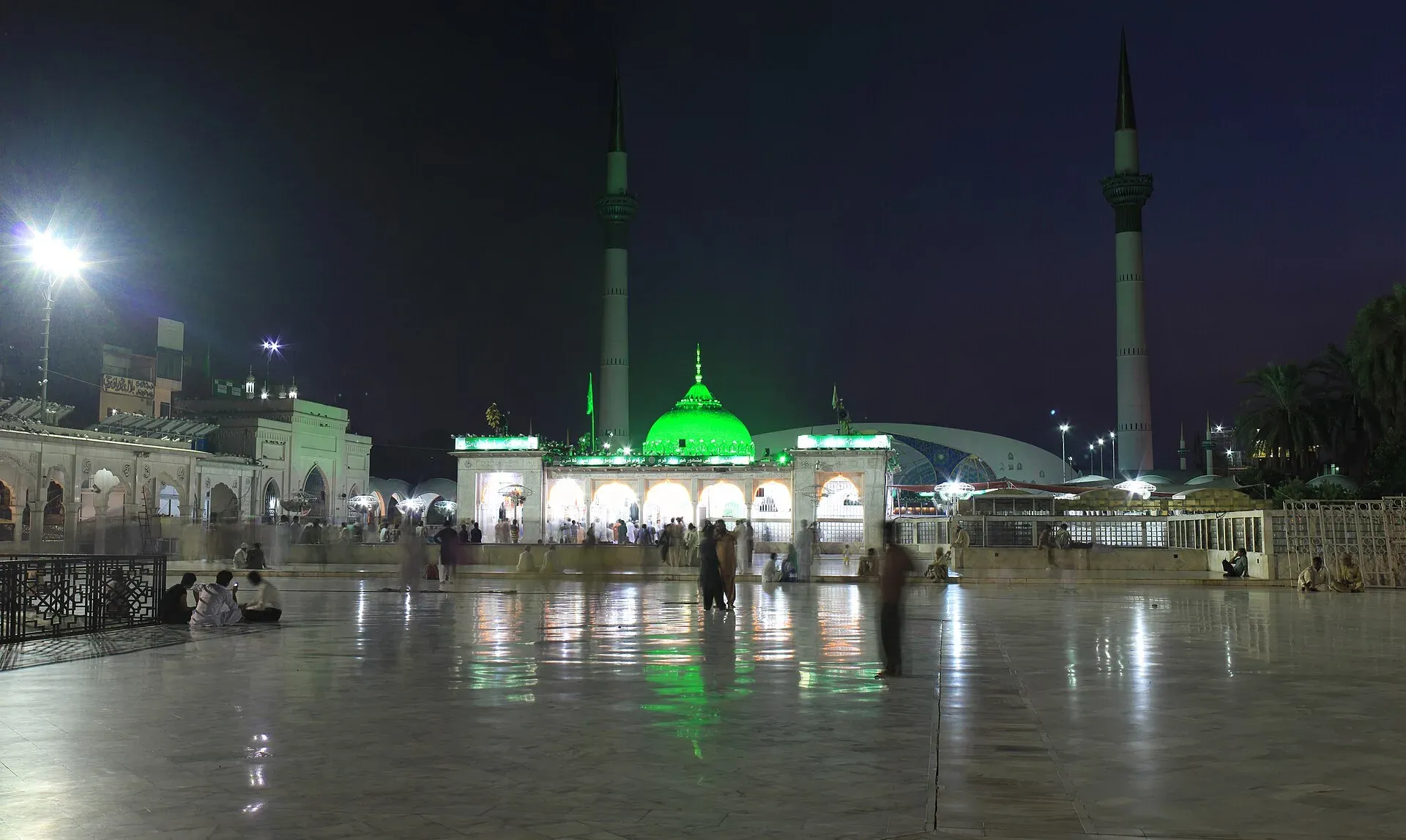
Photo: Meemjee, with thanks · CC BY-SA 3.0 · via Wikimedia Commons · temporary stand-in photo

Data Darbar
The shrine of the Sufi saint Ali al-Hujwiri (Data Ganj Bakhsh) in Lahore, the largest Sufi shrine in South Asia and the most sacred place in the city. A working shrine with free food and nightly crowds.
Overview
Data Darbar is the shrine of Ali al-Hujwiri, known as Data Ganj Bakhsh or Data Sahib, a Sufi saint who came to Lahore from Ghazni in the 11th century. It lies in the centre of the Walled City of Lahore, beside Lower Mall Road, Bhati Gate and Gawalmandi. It is the largest Sufi shrine in South Asia and is considered the most sacred place in Lahore. People of all backgrounds come, rich and poor, many to pray, ask for a blessing or eat at the free kitchen. Wikipedia counts roughly 30,000 to 60,000 visitors a day, and the Punjab Auqaf department calls it Pakistan's largest shrine by annual visitors.
Plan your visit
- Nearest town
- Lahore
- Getting there
Data Darbar is in central Lahore, about 3 km (roughly 5 minutes by car) from Lahore Railway Station (OSRM, checked 16 November 2026). The shrine is served by the Bhatti Chowk station of the Lahore Metrobus. More
Best months
Oct – Mar
- Data Darbar
- Related places nearby: Lahore, Badshahi Mosque, Walled City of Lahore
Who was Ali Hujwiri
Ali al-Hujwiri was born around 1009 in Hujwir, a suburb of Ghazni in what is now Afghanistan. He was a Sunni scholar of the Hanafi school and travelled widely, spending time in Baghdad, Nishapur and Damascus, where he met leading Sufis. He settled in Lahore and died there around 1072, with a reputation as a preacher and teacher.
His one surviving work is Kashf al-Mahjub ("Unveiling of the Hidden"), described as the earliest formal treatise on Sufism in Persian. It sets out the principles of orthodox Sufism and gives biographies of great saints. His teaching criticised practices such as drug use and dancing, and held that Sufi saints are bound by the demands of Islam like everyone else. For that reason he is respected by reformist Muslims who dislike much Sufi practice as well as by traditionalists who revere shrines. Wikipedia lists Baba Farid, Mu'in al-Din Chishti, Nizamuddin Auliya, Dara Shikoh and Allama Iqbal among those who paid their respects at the tomb.
History of the shrine
The shrine began as a simple grave next to a mosque that Hujwiri built on what was then the edge of Lahore. By the 13th century the idea that a saint's spiritual power lives on at his tomb was widespread, and a larger shrine was built in the Mughal period. It was expanded in the 19th century and the mosque was rebuilt. Some historians doubt that this is the saint's actual grave, and suggest it was a place where he came to worship, with the true grave hidden in Lahore Fort.
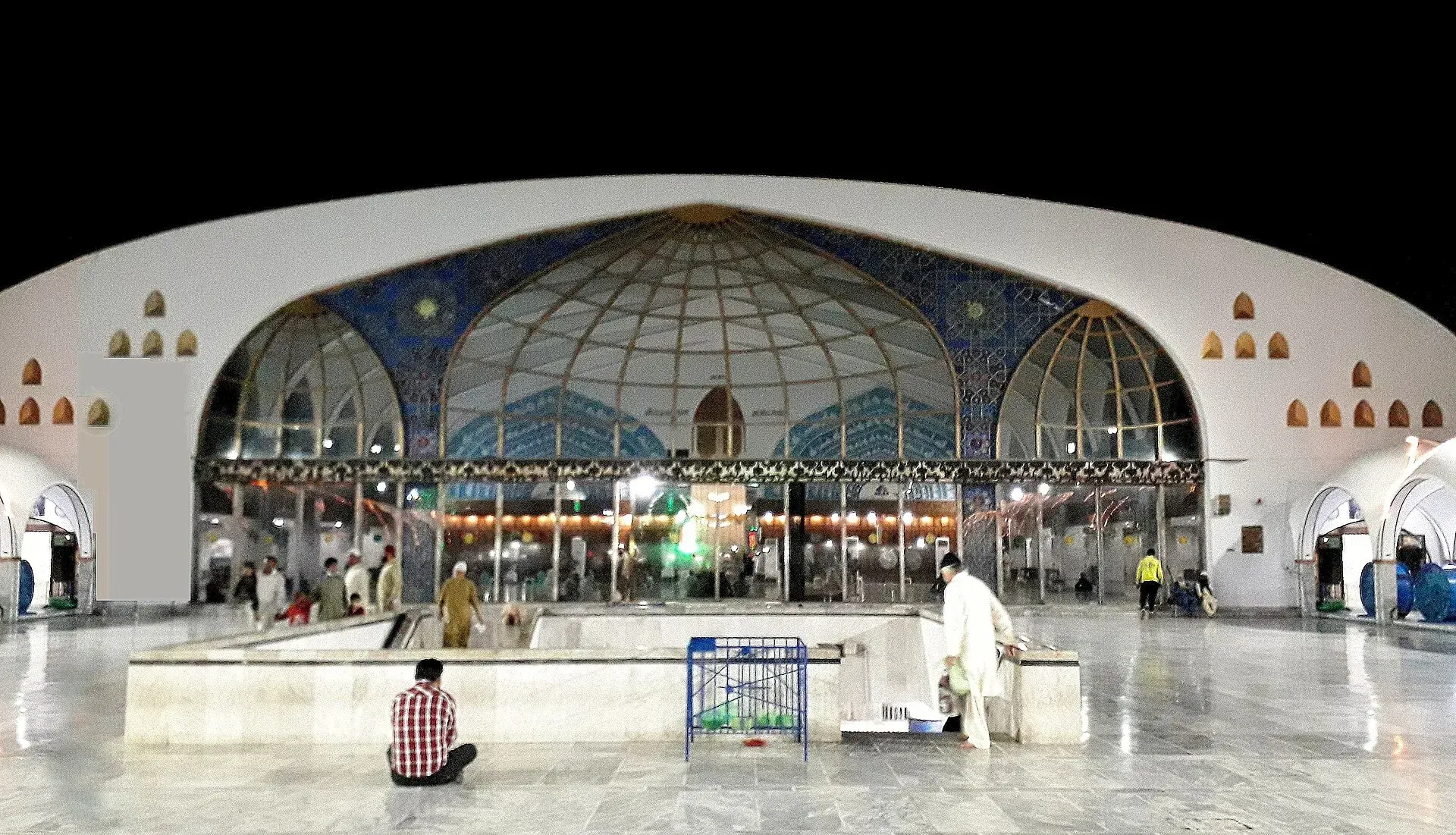
Photo: King Eliot, with thanks · CC BY-SA 4.0 · via Wikimedia Commons · temporary stand-in photo

Since the Auqaf Ordinance of 1960 it has been run by the Punjab government's Auqaf department. In the 1980s it was greatly enlarged, with a library, a madrasa, a car park and a new free kitchen, so most of what you see is modern. Since 1965 a two-day qawwali festival, the mehfil-e-sama, has been held next to the shrine; in 1992 it moved to a nearby school.
Security is tight. Two suicide bombers attacked the shrine on 1 July 2010, killing at least 50 people, and an explosion on 8 May 2019 killed twelve.
What to see and do
- The tomb chamber. A Mughal-style tomb of carved white marble inside a large marble courtyard. At night the complex is lit with green lights.
- The free kitchen (langar). Free food has been given here for centuries; Wikipedia says up to 50,000 people a day are fed. Patrons often give money or labour to the kitchen's fund.
- Qawwali. Sufi devotional music is performed regularly, especially on Thursday evenings and special nights. Thursday is the traditional night for visiting shrines.
- The Urs. The annual death anniversary of the saint draws up to a million visitors. In 2016 the government declared 21 November a public holiday for the start of the three-day Urs. The date changes from year to year.
- The mosque and the busy bazaar around the complex.
The shrine also supports students' education in nearby schools and helps fund local hospitals. Wikipedia describes it as one of the few places in Lahore where rich and poor share space. About 200 full-time staff work for it, excluding security.
Around the shrine
Data Darbar stands just outside Bhati Gate on the western side of the Walled City, and the area inside the gate is known for food. Nearby Lohari Gate is named for the blacksmiths' workshops that once stood outside it. Wikivoyage describes Gawalmandi Food Street, in one of the quarters around the shrine, as a stretch of 200 to 300 m of restored old houses with about a hundred restaurants. Dishes it lists across the old city include nihari (slow-cooked beef or mutton stew), siri paye (trotters), chappal kebabs, mutton karahi and sajji (roast lamb or chicken). Mochi Gate, also in the Walled City, is known for dried fruit, kites and fireworks.
For one day, an honest plan runs like this. Visit the shrine in the morning, when it is quieter. Spend the afternoon in the Walled City, see Badshahi Mosque and the other sights on the Walled City of Lahore page, and eat in the old city. Return in the evening if you want to see the shrine at its busiest.
When to visit
Daytime is quieter. Thursday evenings and the Urs are packed but are when the shrine feels most alive. Cooler months, October to March, are easier on foot.
Where to stay and eat
Hotels and old-city eateries are all around Lahore; the Walled City is a short ride away. The shrine serves free food, but do not treat it as a restaurant.
Good to know and etiquette
- This is an active religious site. Dress modestly. Women cover their hair and shoulders; men wear long trousers and shirts with sleeves.
- Remove your shoes at the entrance and leave them at the counter.
- Do not photograph people praying. Ask before taking any photograph inside.
- Expect bag checks and metal detectors at the gates. Carry little and keep valuables safe in the crowds.
- Wikipedia says the shrine remains open at all hours and that visitors freely enter, but there is no known official statement of hours, women's arrangements or charges. Ask the Auqaf department (Lahore, phone 042 99210872-3, per its website).
Highlights
- Largest Sufi shrine in South Asia
- Shrine of Ali al-Hujwiri, 11th century
- Free kitchen feeding thousands daily
- Thursday-night qawwali
- Annual Urs festival
Getting there
Data Darbar is in central Lahore, about 3 km (roughly 5 minutes by car) from Lahore Railway Station (OSRM, checked 16 November 2026). The shrine is served by the Bhatti Chowk station of the Lahore Metrobus. Rickshaws and ride-hailing cars drop at the main gate.
Tips
- Dress modestly and remove shoes.
- Expect security checks; carry little.
- Do not photograph worshippers.
- Go on Thursday evening for the atmosphere, in daytime for calm.
Photos we still need: the langar (free kitchen) and the marble courtyard by day; the langar (free kitchen) and the marble courtyard by day. Send us yours
Sources and last checked
Last checked Confidence medium7 sources4 still to check
- Last checked
- Method
- Desk research from published sources
- Confidence
- medium
- Checked by
- trek.pk research team
Researched from published sources; not yet checked on the ground by our team. Spot something out of date? Report a mistake.
Sources
- Data Darbar (Wikipedia) · Wikipedia · checked
- Auqaf and Religious Affairs Department, Government of Punjab · Government of Punjab · checked
- Pakistan Tourism Guide 2021 · TDAP Pakistan (Trade Development Authority of Pakistan) · checked
- OSRM routing (road distances) · Project OSRM · checked
- Ali Hujwiri (Wikipedia) · Wikipedia · checked
- Walled City of Lahore (Wikipedia) · Wikipedia · checked
- Lahore (Wikivoyage) · Wikivoyage · checked
Still to be checked on the ground (4)
- Visiting hours and arrangements for women (Wikipedia says the shrine is open at all hours; no official hours or women's arrangements published)
- Dates of the Urs (Islamic calendar) (no opened source gives them)
- Security rules at the gates (no official published rules)
- Any entry charge (Wikipedia says visitors freely enter; no official statement)
Nearby and related

Lahore
Punjab's capital and Pakistan's cultural city: Mughal forts, mosques and gardens, a lively Walled City, and some of the best food in the country.

Badshahi Mosque
Lahore's great Mughal mosque, built for Emperor Aurangzeb in 1671-73 from red sandstone and marble. It faces Lahore Fort and has been on UNESCO's tentative list since 1993.

Walled City of Lahore
Lahore's old core: lanes, gates and Mughal and Sikh-era monuments around the Royal Road, including Wazir Khan Mosque, Delhi Gate and the Shahi Hammam. Its lanes are best explored on foot.