

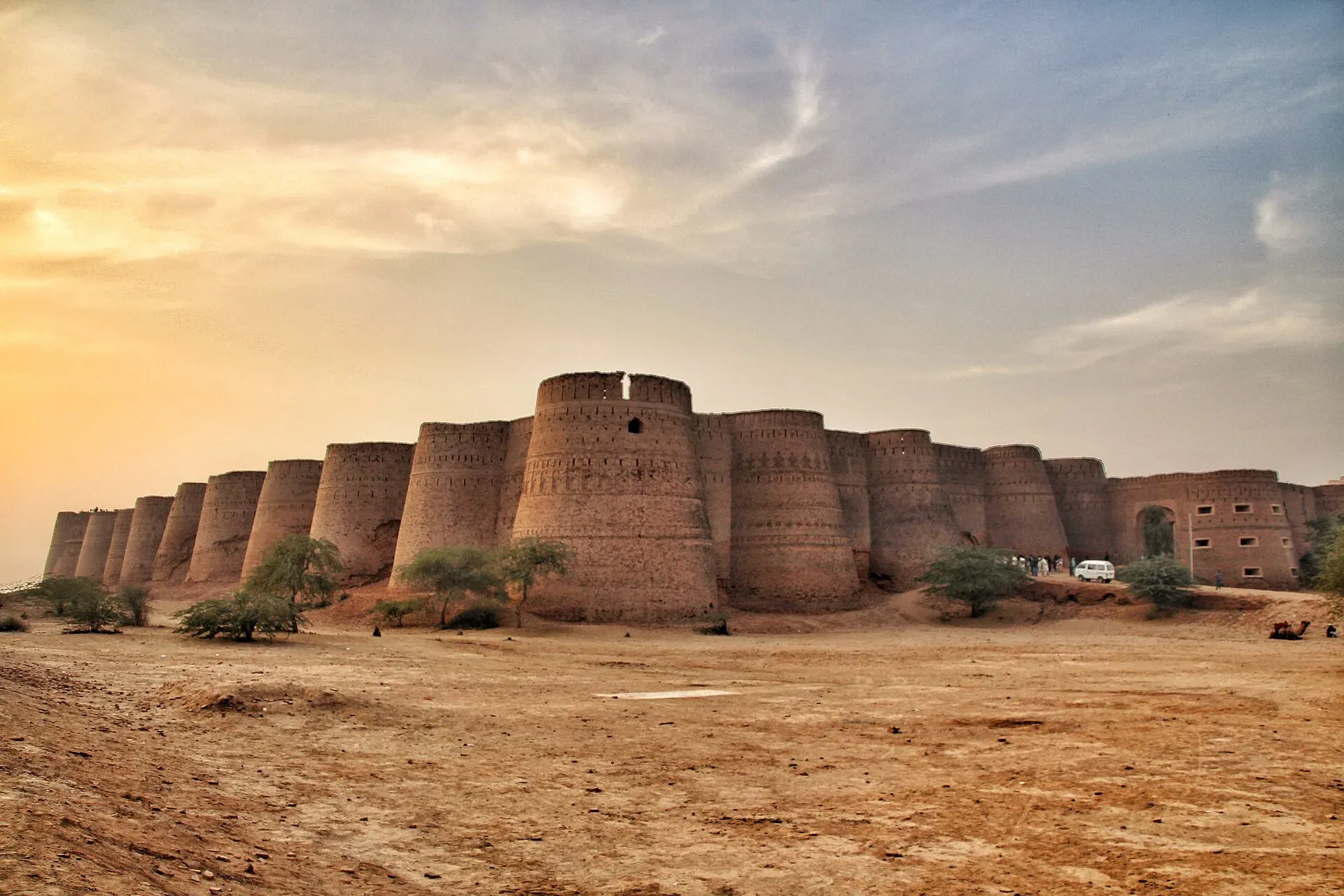
Photo: Fassifarooq, with thanks · CC BY-SA 4.0 · via Wikimedia Commons · temporary stand-in photo

Derawar Fort
A square mud-brick fort of 40 round bastions in the Cholistan Desert, south of Ahmedpur East. Dated to the 9th century, rebuilt in 1732, and on UNESCO's tentative list since 2016.
Overview
Derawar Fort rises out of the sand of the Cholistan Desert, about 20 km south of Ahmedpur East in Bahawalpur district. Its high brick walls and forty round bastions can be seen from a long way off. The fort is the best preserved of the many desert forts of Cholistan, and it is the most visited. Nawabs of Bahawalpur lived here, and the last ruler of the state, Sadeq Muhammad Khan V, was born in the fort in 1904.
Plan your visit
- Nearest town
- Ahmedpur East
- Getting there
Derawar Fort is about 20 km south of Ahmedpur East, on the edge of the Cholistan Desert. From Bahawalpur the road runs south via Ahmedpur East, and the final stretch crosses desert terrain; More
Best months
Oct – Mar
- Derawar Fort
- Related places nearby: Bahawalpur, Ahmedpur East
Setting
The Cholistan Desert was once part of the Indus Valley culture, which relied on the Hakra river. Wikipedia says the river changed course around 600 BC and disappeared, and the land turned arid. Derawar later lay on a trade route between Central Asia and the Indian subcontinent and on a pilgrim route towards Mecca. It is one of a chain of desert forts, which also includes Bijnot, Islamgarh, Maujgarh and Marotgarh, and it is regarded as the best preserved.
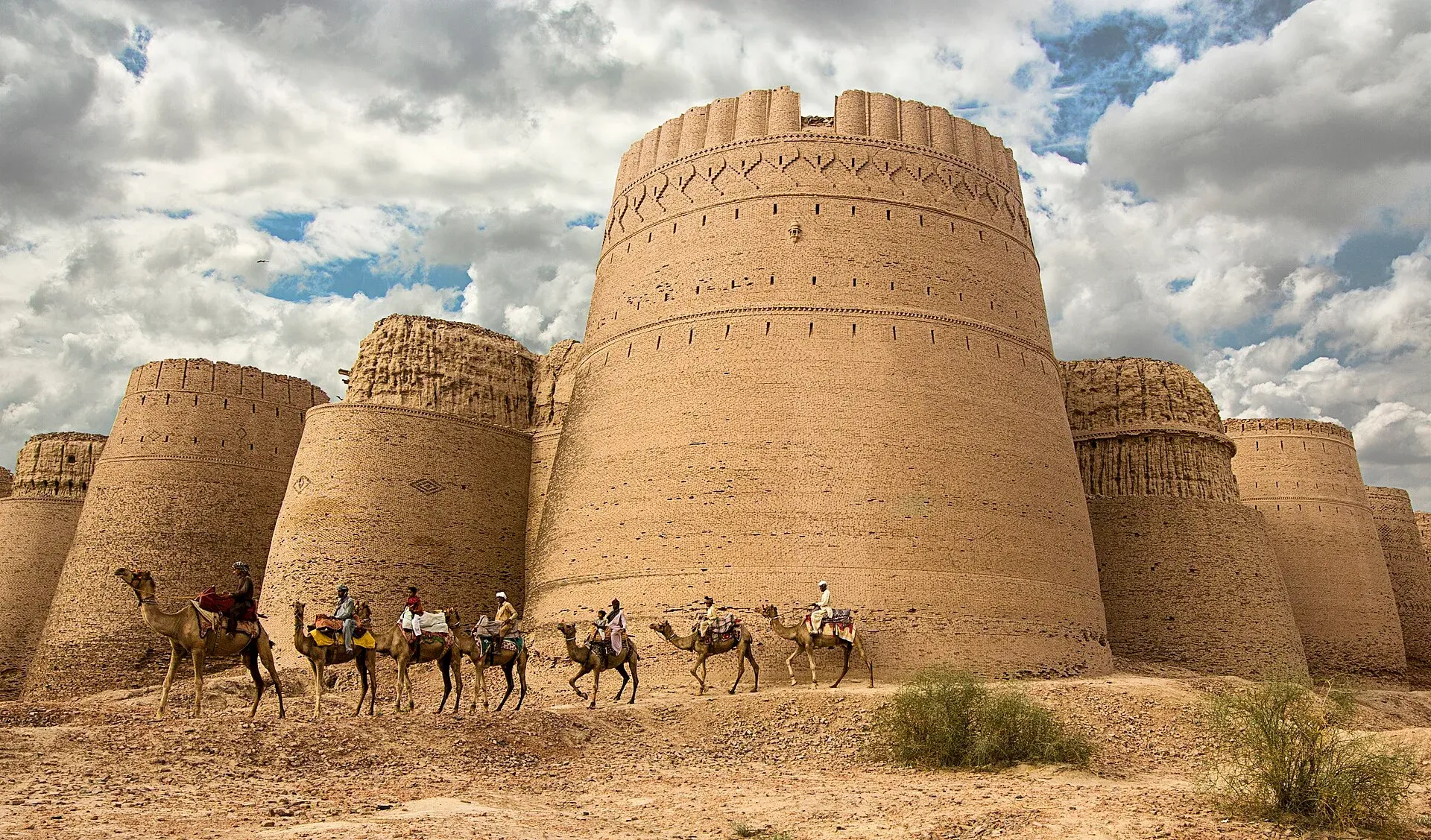
Photo: Tahsin Shah, with thanks · CC BY-SA 4.0 · via Wikimedia Commons · temporary stand-in photo

History
The fort is said to have been built in 858 (Wikipedia gives this as the founding date; it is not independently dated) by Rai Jajja Bhati, a Rajput ruler of the Bhati clan, as a tribute to Rawal Deoraj Bhati, and was first called Dera Rawal. Over the centuries the name became Derawar. In 1732 the Abbasi ruler Nawab Sadeq Muhammad rebuilt the fort. It passed out of the family's hands in 1747 and was retaken by Nawab Mubarak Khan in 1804. The British later used the fort as a prison. Catapult shells, described as about 1,000 years old, have been found in debris near a decaying wall. Buildings inside were cleared during the 1965 war so the area could be used for training.
Pakistan placed "Derawar and the Desert Forts of Cholistan" on its UNESCO tentative list in 2016. The listing is for a group of desert forts, not the single fort, and it is not a World Heritage Site.
What to see and do
- The walls and bastions. The fort is roughly square and covers about 35 acres. The walls are about 1,500 m around and up to 30 m high. There are ten round bastions on each side, and the brickwork has cut decorative patterns.
- The gate and interior. Much of the wood and flooring inside has been lost, but you can still see patterned brickwork and traces of tile and painted plaster. Some underground chambers survive.
- The Abbasi Mosque. Built in 1849 for Pir Ghulam Farid, the Nawab's religious adviser, near the fort. Wikipedia also lists the Moti (Pearl) Mosque.
- The Nawabs' graveyard. The cemetery of the Abbasi nawabs, with white marble tombs, lies just east of the fort. A domed marble mausoleum there is for the last Nawab's English wife.
- The desert. Sunset over the sand dunes is a highlight; the fort also hosts the annual Cholistan Jeep Rally.
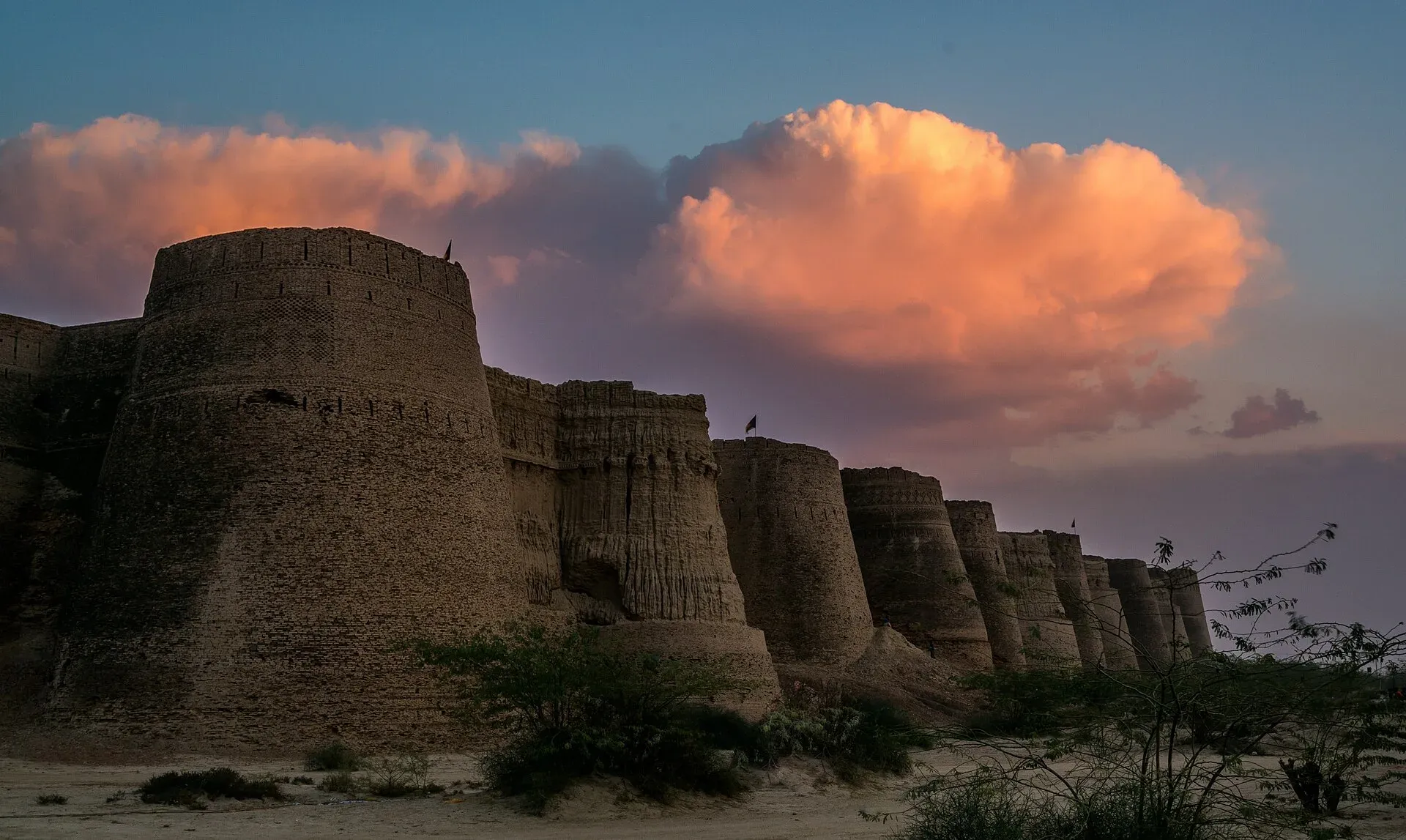
Photo: Muhammad Ashar, with thanks · CC BY-SA 3.0 · via Wikimedia Commons · temporary stand-in photo

Getting there
From Bahawalpur the OSRM routing service gives about 96 km and 1 hour 40 minutes by road (an estimate, which will be longer on desert tracks). From Ahmedpur East it gives about 49 km by road, although Wikipedia describes the fort as about 20 km south in a straight line. Ask your driver which approach is currently best, because the Cholistan tracks vary with the sand and the season.
When to visit
October to March is the only comfortable time. Summers in Cholistan are extremely hot, and desert roads can be difficult.
Where to stay and eat
Stay in Bahawalpur or Ahmedpur East. Expect very limited food and drink near the fort, so bring water and snacks.
Good to know
- Walls and floors are fragile. Do not climb on damaged sections.
- Many visitors go with a local driver or guide who knows the desert tracks. In 2019 the Punjab government set aside Rs46 million for conservation, and Wikipedia lists repairs to bastions, walls near the main gate and a grain warehouse outside the fort. It still describes the interior woodwork as almost gone and the floor as badly damaged.
- Ask permission before photographing local people.
- Opening hours and any ticket price were not confirmed by an official source when this page was written. Current fees will be added soon; check with the Punjab Archaeology Department.
Highlights
- 40 round bastions on walls up to 30 m high
- Traditionally dated to 858; rebuilt in 1732
- Cholistan Desert setting
- Abbasi Mosque (1849) and Nawabs' cemetery nearby
- On UNESCO's tentative list since 2016
Tips
- Visit only in the cooler months and bring plenty of water.
- Hire a local driver or guide who knows the desert tracks.
- Go late in the day for the best light and cooler walking.
- Do not climb on fragile walls.
Photos we still need: the Abbasi Mosque and the Nawabs' graveyard; the fort's gate and interior brickwork. Send us yours
Sources and last checked
Last checked Confidence medium4 sources4 still to check
- Last checked
- Method
- Desk research from published sources
- Confidence
- medium
- Checked by
- trek.pk research team
Researched from published sources; not yet checked on the ground by our team. Spot something out of date? Report a mistake.
Sources
- Derawar and the Desert Forts of Cholistan (Tentative List 6108) · UNESCO World Heritage Centre · checked
- Derawar Fort · Wikipedia · checked
- Pakistan Tourism Guide 2021 · Tourism Development Corporation of Pakistan (TDAP) · checked
- Driving distance Bahawalpur to Derawar Fort, measured 17 November 2026 (estimate) · OSRM / OpenStreetMap · checked
Still to be checked on the ground (4)
- Opening hours and entry fee
- Road condition and best approach from Ahmedpur East
- Current condition of the interior (Wikipedia: extreme deterioration; Rs46 million conservation funds earmarked in 2019; no recent site report found)
- Which road approach is best from Ahmedpur East (OSRM gives about 49 km by road; Wikipedia says about 20 km straight-line south)
Nearby and related

Bahawalpur
Former capital of a princely state on the edge of the Cholistan Desert: Nawabi palaces, a museum, desert crafts, and a base for Lal Suhanra, Derawar Fort and Uch Sharif.

Lal Suhanra National Park
A desert and forest park about 35 km east of Bahawalpur, covering roughly 516 square kilometres. A UNESCO biosphere reserve with blackbuck, chinkara, nilgai and Patisar Lake.
Bijnot Fort
A ruined desert fort in Cholistan, Bahawalpur district, dated to the 8th century and damaged by shelling in 1971. About 23 km from the Indian border.

Cholistan Wildlife Sanctuary
A very large desert sanctuary in Bahawalpur District, Punjab, in the Cholistan Desert. Wikipedia lists caracal, chinkara, houbara bustard and many reptiles. Facilities are limited; Derawar Fort is the usual visitor stop.
Islamgarh Fort
A Rajput-built desert fort of 1665 in Cholistan, near Khanpur in Rahim Yar Khan district, originally called Bheem War. It was renamed in 1780.
Moj Garh Fort
A ruined 1743 brick and mud fort at Thandi Khoi in the Cholistan Desert, Bahawalnagar district, about 70 km from Bahawalnagar. The Desert Rangers have started preservation work.
Ahmedpur East
Cotton and handicraft town in Bahawalpur District, built in 1748 and the usual stop on the way to Derawar Fort and the Cholistan desert.