

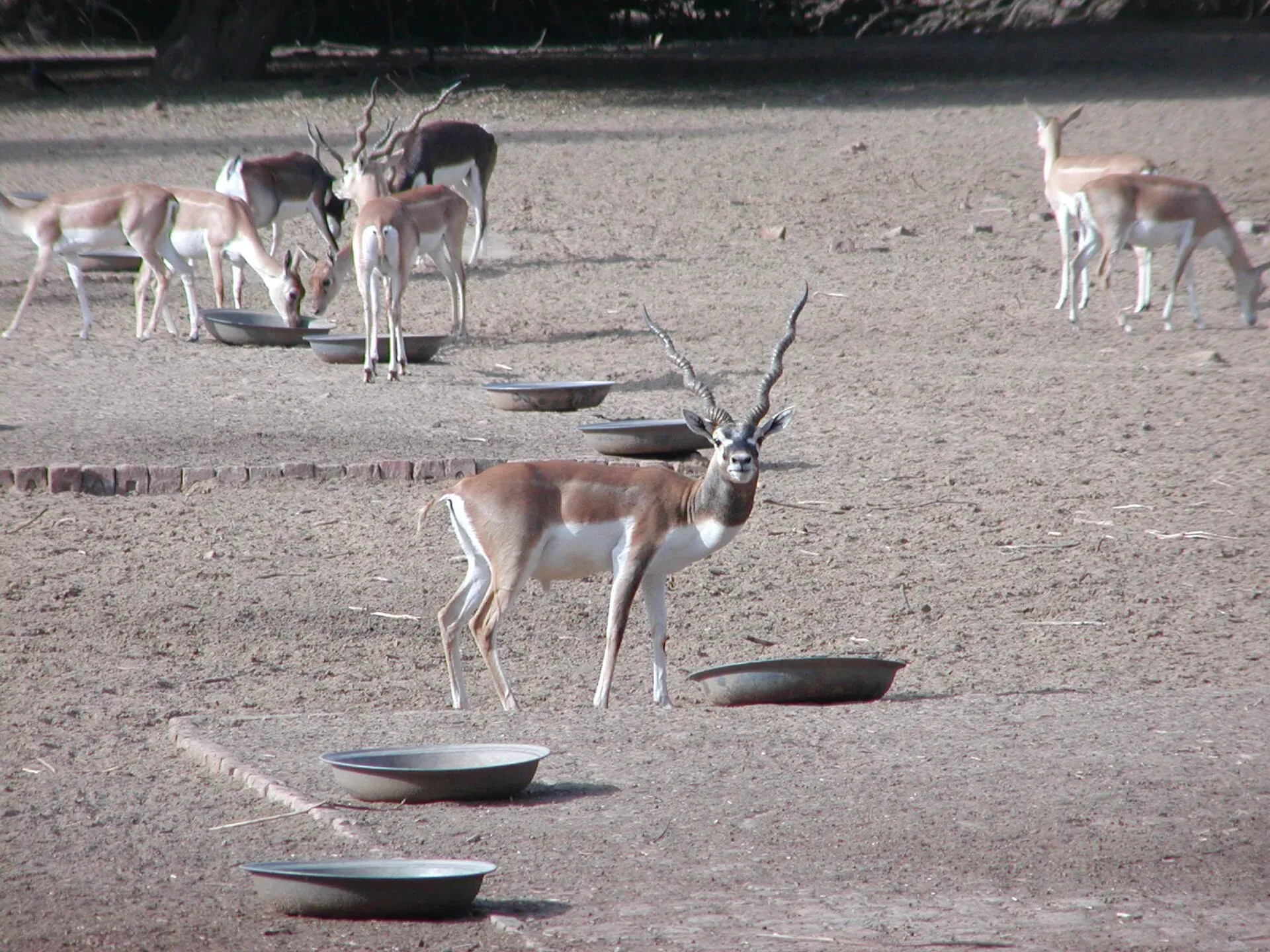
Photo: Shaviree, with thanks · CC BY-SA 3.0 · via Wikimedia Commons · temporary stand-in photo

Lal Suhanra National Park
A desert and forest park about 35 km east of Bahawalpur, covering roughly 516 square kilometres. A UNESCO biosphere reserve with blackbuck, chinkara, nilgai and Patisar Lake.
Overview
Lal Suhanra National Park lies east of Bahawalpur in Punjab, where irrigated forest meets the edge of the Cholistan desert. It was developed in 1972 and covers about 51,590 hectares (516 square kilometres) in the Wikipedia text and BirdLife's factsheet. Wikipedia's headline figure and the biosphere-reserve list give about 658 square kilometres, so treat the area as approximate. The park straddles the Desert Branch canal and is the site of one of Pakistan's first UNESCO biosphere reserves, approved in 1977 (Ziarat Juniper Forest followed in 2013).
Plan your visit
- Nearest town
- Bahawalpur
- Getting there
About 36 km north-east of Bahawalpur, reached by the Khairpur road and then a dirt track beside the desert feeder canal (Wikivoyage). A guide is advised to find the entrance. More
Best months
Nov – Mar
- Lal Suhanra National Park
- Related places nearby: Bahawalpur, Bahawalpur Museum
Landscape
The park has three kinds of ground. About 8,488 hectares is irrigated plantation, 41,167 hectares is desert and 1,930 hectares is wetland, including Patisar Lake. The land is flat, with sand dunes up to about 4 m high. The dry bed of the Ghaggar-Hakra river crosses the reserve. Wikivoyage notes more than 400 archaeological sites, mostly of the Indus civilisation, along the river's roughly 500 km dry course in Cholistan.
Wildlife
Mammals listed for the park include Indian hog deer, chinkara (a gazelle), blackbuck, nilgai, Indian wolf, wild boar, white-footed fox, Asiatic wildcat and Indian hare. Chital have been introduced. Wikivoyage says a project is reintroducing blackbuck, and that about 30 can be seen in a fenced enclosure just inside the forest plantation.
Birds include bulbul, common quail, pied cuckoo, parakeets, Sind woodpecker, black kite, shikra, steppe eagle, Eurasian griffon vulture and peregrine falcon. Great Indian bustard is also on Wikipedia's list, but its current status here is unconfirmed. Reptiles include spiny-tailed lizard, monitor lizard, Russell's viper, saw-scaled viper and Indian cobra. Watch where you step and do not handle snakes.
What to see and do
- Wildlife drives and walks. Dawn and dusk are the best times for deer and birds.
- Patisar Lake. A small lake that attracts birds. Wikivoyage reports plenty of duck on it in winter.
- The blackbuck enclosure. A fenced reintroduction area just inside the plantation.
- Birdwatching. Raptors, parakeets, quail and desert birds.
- Bahawalpur and Cholistan. The city has palaces, a museum and a zoo; Derawar Fort is about two hours away on a sealed road. See Bahawalpur and the Cholistan Desert.
Getting there
Wikivoyage places the park about 36 km north-east of Bahawalpur. It describes leaving on the Khairpur road, then forking right after roughly 30 km onto a dirt track that joins the desert feeder canal, and advises hiring a guide to reach the entrance. Road conditions are not confirmed, so ask in Bahawalpur before you set out.
When to visit
November to March, when days are mild. Summers are extremely hot.
Where to stay and eat
Wikivoyage says a rest house can be booked through the Park Office in Bahawalpur, and that camping is possible. Most visitors stay in Bahawalpur, where there are hotels and restaurants. Services inside the park are limited, so bring food and water.
Good to know
- A fee may apply. Current fees will be added soon; check with the park office or the provincial wildlife department before you go.
- Follow the standard park rules: take your litter out with you, do not light fires outside marked sites, do not pick plants or disturb animals, and do not hunt. Hunting and trapping inside a national park are offences. Ask the park office before flying a drone; many parks need written permission and drones are banned near borders and sensitive sites.
- Bring water and sun protection, and check opening times before you travel.
Highlights
- Desert and forest park near Bahawalpur
- Blackbuck, chinkara and hog deer
- Patisar Lake birdlife
- UNESCO biosphere reserve
Tips
- Visit in winter
- Carry water and sun protection
- Go early or late for wildlife
- Check opening hours
Wildlife
Facilities
- Tracks
- Patisar Lake
- Hotels in Bahawalpur
Photos we still need: Patisar Lake. Send us yours
Sources and last checked
Last checked Confidence medium5 sources6 still to check
- Last checked
- Method
- Desk research from published sources
- Confidence
- medium
- Checked by
- trek.pk research team
Researched from published sources; not yet checked on the ground by our team. Spot something out of date? Report a mistake.
Sources
- Lal Suhanra National Park (Wikipedia) · Wikipedia · checked
- Pakistan Tourism Guide 2021 · TDAP Pakistan · checked
- Biosphere reserves of Pakistan (Wikipedia) · Wikipedia · checked
- Lal Sohanra National Park IBA factsheet · BirdLife International · checked
- Bahawalpur (Wikivoyage) · Wikivoyage · checked
Still to be checked on the ground (6)
- Area: Wikipedia infobox 657.91 sq km vs text 51,590 ha (516 sq km); no official figure found
- Fees and opening hours
- Whether great Indian bustard still occurs (Wikipedia lists it; BirdLife factsheet did not load)
- Exact road beyond '35 km east of Bahawalpur'
- Road to the park entrance: current condition of the dirt track and whether a guide is still needed (Wikivoyage, undated)
- Rest house booking through the Park Office in Bahawalpur (Wikivoyage, undated)
Nearby and related

Bahawalpur
Former capital of a princely state on the edge of the Cholistan Desert: Nawabi palaces, a museum, desert crafts, and a base for Lal Suhanra, Derawar Fort and Uch Sharif.

Derawar Fort
A square mud-brick fort of 40 round bastions in the Cholistan Desert, south of Ahmedpur East. Dated to the 9th century, rebuilt in 1732, and on UNESCO's tentative list since 2016.
Cholistan Desert
Cholistan is a desert of about 25,800 km2 in Punjab's Bahawalpur Division, with dunes, seasonal ponds called tobas, camel herders and Derawar Fort. Visit October to March.

Bahawalpur Museum
A regional museum in Bahawalpur with galleries on the Pakistan Movement, Islamic arts, archaeology, Cholistan crafts, coins and the last Nawab, Sir Sadiq Khan Abbasi.