

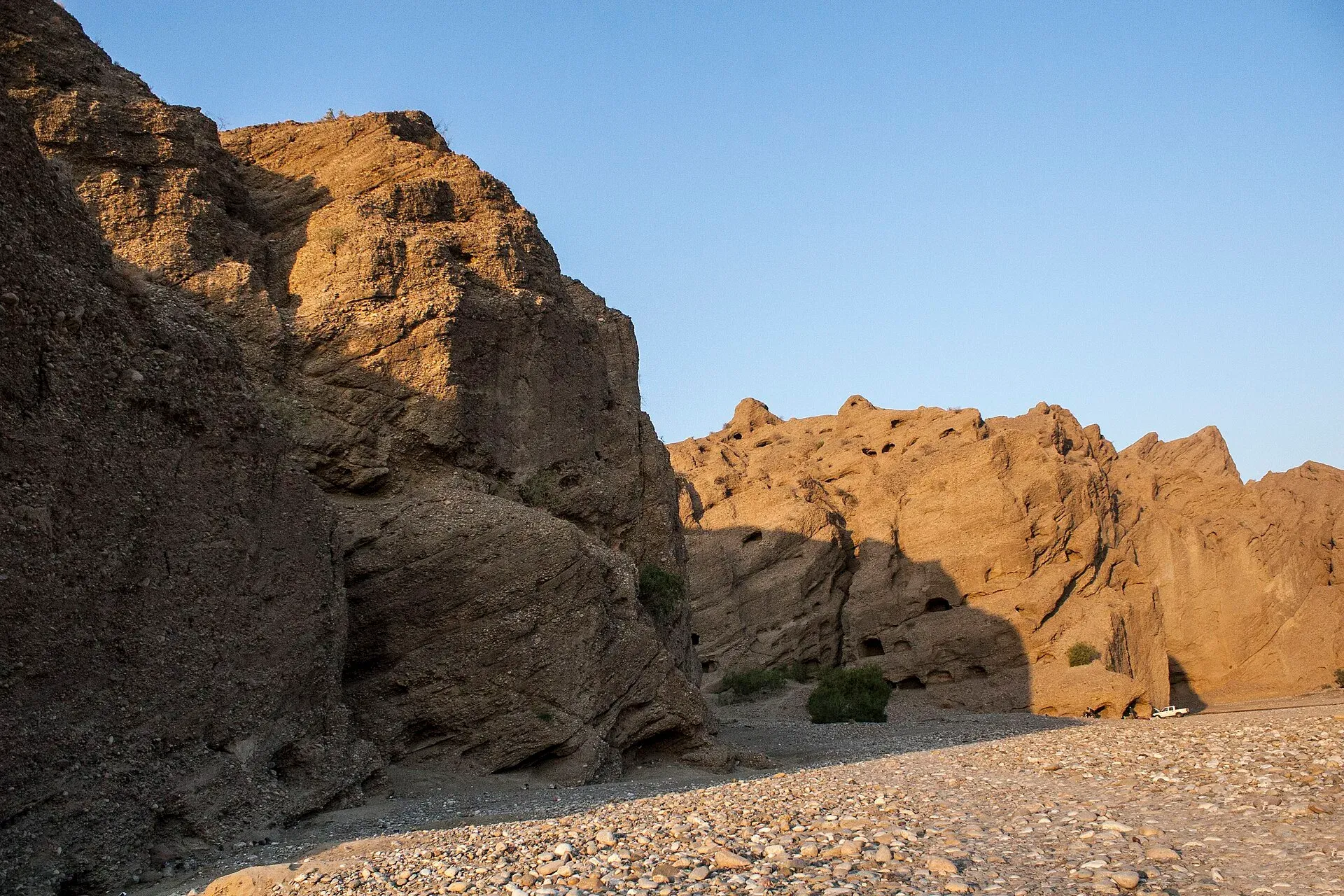
Photo: Muhammedadeel, with thanks · CC BY-SA 4.0 · via Wikimedia Commons · temporary stand-in photo

Gondrani Caves
A cluster of hand-cut caves on a hillside north of Bela in Lasbela, Balochistan, often called the Cave City. Their origin is uncertain and they are eroding. For foreign visitors: the UK FCDO advises against all travel to Balochistan.
Overview
Gondrani, also called Shehr-e-Roghan or the Cave City, is a group of caves cut into soft conglomerate rock on a hillside north-west of Bela in Lasbela District (Wikipedia says about 20 km, and quotes other sources at 15 and 18 km), Balochistan. Wikipedia gives the position as 26.394 N, 66.213 E. Dawn lists other names: Puranay Ghar ("old houses"), House of Spirits and City of Mai Gondrani.
Plan your visit
- Nearest town
- Bela
- Getting there
From Karachi take the N-25 highway north to Bela, about 179 km and just over 2 hours by road (OSRM). From the bridge over the Porali River at Bela, head west; More
Best months
Nov – Mar
Getting there
Dawn (31 January 2016) describes the journey from Karachi, about 180 km and three hours by car. The road is smooth from Hub onwards. At Winder it passes oases, chikoo orchards and mustard and cotton fields, and Zero Point is a rest stop for tea. In Bela, cross the bridge over the Porali River and head west towards Gondrani. The paved road becomes a dirt track, then gravel, then ends at a riverbank, where visitors continue by jeep or on foot. See the N-25 road page, and the pages on Bela and Hub.
Bela is an old town about 88 m above sea level, with about 29,400 residents at the 2023 census, most of them Balochi speakers. Wikipedia connects it with Alexander the Great's campaign in 325 BC and with the Arab campaign of 711, and the tomb of the general Muhammad ibn Haroon is there.
What to see and do
The landscape on the approach is rolling golden grassland, purple-grey hills and dry riverbeds where sheep graze. The River Kurd is the only water source for drinking, cooking and washing in the gorge, which is lined with multicoloured pebbles.
The caves are on several levels joined by paths, from the base to the hilltop. Dawn describes each as small, around four square metres, many with a hearth, wall niches for lamps and a porch. Some are single rooms; others are suites with a living room, bedrooms, a kitchen with grain storage and a veranda. A large cave at the top is said to be a palace. Near the gorge entrance are a sandy beach on the River Kurd and a large cave with stalactites and stalagmites, and there is also a graveyard. Wind erosion has worn the upper caves into shallow pits, while the lower ones are in better shape. Some have graffiti.
History and legend
Nobody can say for certain who made them. Wikipedia says historians believe the site was a Buddhist monastery of about the eighth century, but scholars disagree and there is no official excavation record. Counts differ. Both Wikipedia and Dawn say about 1,500 caves were found in the British period (Dawn dates this to 1838). Wikipedia says about 500 remain; Dawn says about 600 remained a quarter of a century before 2016 and fewer than 100 by 2016. Either way, the site is eroding.
Local tradition links the place to Mai Gondrani, a holy woman said to have given her life to rid the town of evil spirits; Dawn also gives a version in which she drove them out and lived there until she died. Her grave nearby is a local shrine. Another tale tells of Princess Badiul Jamal, whose father ruled the area in the time of King Solomon, and Prince Saiful Muluk, who slew seven demons that desired her and then ruled the Cave City with her. These are stories, not documented history.
When to visit
Come in the cooler months, November to March. Summers in Lasbela are very hot. Heavy rain can cut the dirt tracks.
Where to stay and eat
Facilities at the site are very limited; bring your own water and food. Bela has basic shops, and most visitors return to Karachi or Hub for lodging.
Good to know
- Travel advice: For foreign visitors: the UK FCDO (updated 27 October 2026, checked 17 November 2026) advises against all travel to Balochistan Province. Read the live page before any plan.
- Both Wikipedia and Dawn (2016) say no conservation effort has been made to protect the site. There are no official visiting hours, entry policy or fees that could be confirmed. Ask the Balochistan tourism authorities or the Lasbela district administration.
- Go in daylight, with a local guide and a 4x4, and tell someone your route.
- The floors and ledges are crumbling. Do not climb on weak walls, carve into them or move stones.
- Show respect at the shrine of Mai Gondrani. Take all litter away.
Highlights
- Hand-cut caves on several levels
- Possible Buddhist monastery of about the eighth century
- Local legend of Mai Gondrani
- Eroding site with no confirmed conservation
Tips
- For foreign visitors: the UK FCDO advises against all travel to Balochistan; check the live page
- Use a 4x4 and a local guide for the last stretch
- Bring water and food
- Visit in daylight in cool months
Photos we still need: the approach track and riverbed, and the interior of a cave (only one photo of the site found). Send us yours
Sources and last checked
Last checked Confidence medium4 sources3 still to check
- Last checked
- Method
- Desk research from published sources
- Confidence
- medium
- Checked by
- trek.pk research team
Researched from published sources; not yet checked on the ground by our team. Spot something out of date? Report a mistake.
Sources
- Gondrani · Wikipedia · checked
- Travel: Land before time (31 Jan 2016) · Dawn · checked
- Pakistan travel advice · UK FCDO (updated 27 October 2026) · checked
- Bela, Pakistan · Wikipedia · checked
Still to be checked on the ground (3)
- Current road condition and security (Dawn, January 2016, describes the road turning to dirt and gravel and ending at a riverbed; no recent report found)
- Number of surviving caves (Wikipedia: about 500; Dawn 2016: fewer than 100)
- Whether any entry rule or official protection has been added since 2016 (Wikipedia and Dawn say none)