

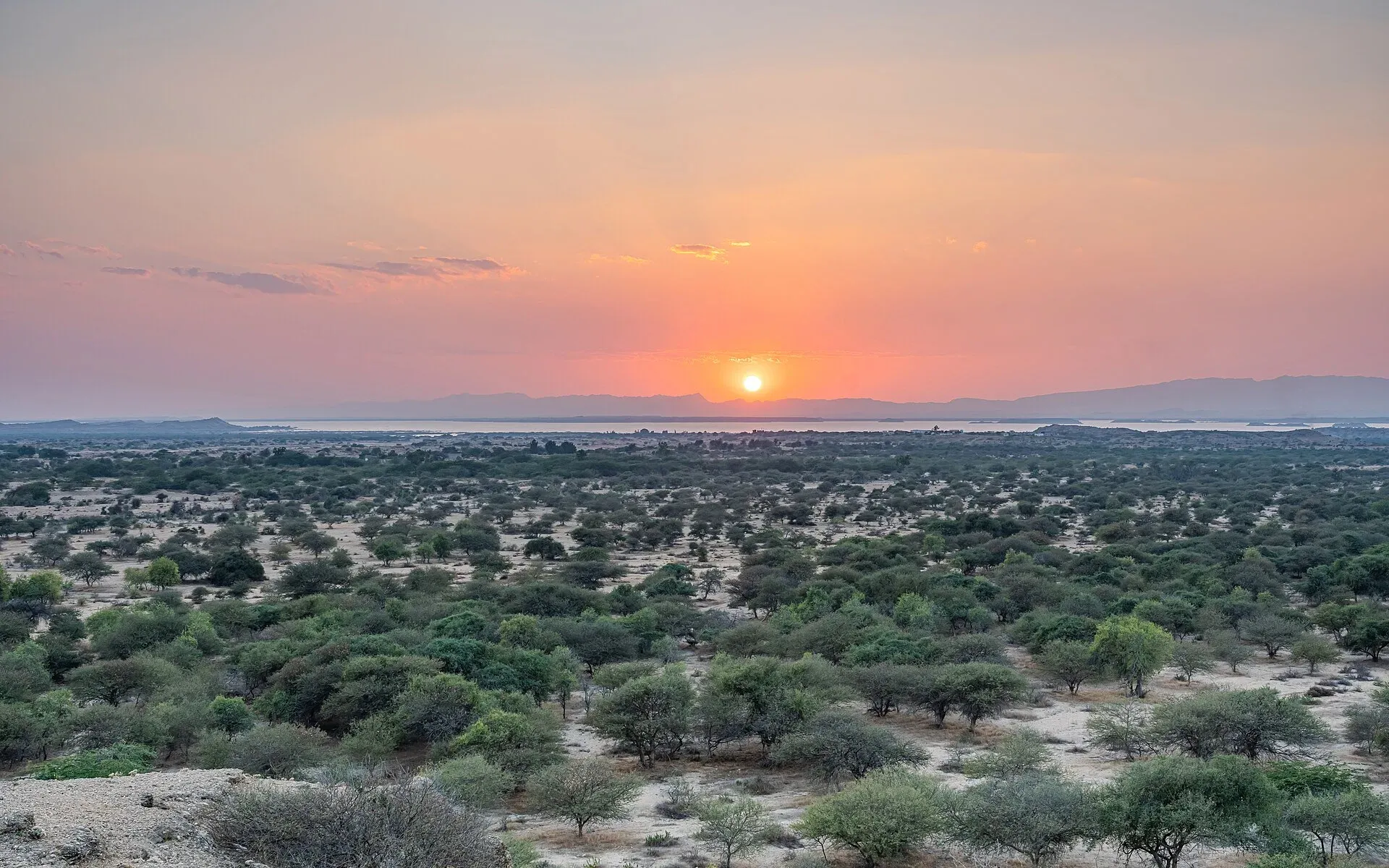
Photo: A.Savin, with thanks · Public domain (CC0) · via Wikimedia Commons · temporary stand-in photo

Hub Dam Wildlife Sanctuary
A 27,000-hectare reservoir on the Sindh and Balochistan border, about 55 km from Karachi: Ramsar site no. 1064 (2001) and a winter stop for pelicans, ducks, grebes and coots. Check access and safety first.
Overview
Hub Dam is a large reservoir on the Hub River, on the border between Sindh and Balochistan, about 55 km north-west of central Karachi. Construction began in 1963 and the dam opened in 1981. Its main job is to supply drinking water to Karachi, but the reservoir and its shores are also a wildlife sanctuary and a Ramsar wetland of about 27,000 hectares, listed on 10 May 2001 as site no. 1064.
Sources give the sanctuary's establishment as 1972 and as 1974, so the year is unconfirmed. The site lies partly in Karachi District (Sindh) and partly in Lasbela District (Balochistan). The dam itself is operated by WAPDA. A management plan was prepared jointly by WWF-Pakistan, the Sindh Wildlife Department, the Balochistan Forest and Wildlife Department, the Zoological Survey Department and WAPDA, so the sanctuary falls under both provincial wildlife departments.
Plan your visit
- Nearest town
- Karachi
- Getting there
Hub Dam is on the Hub River north-west of Karachi. OSRM models about 54 km and 1.1 hours from central Karachi. Public transport to Hub town exists, but you will need a taxi or your own vehicle for the dam road. More
Best months
Nov – Feb
- Hub Dam Wildlife Sanctuary
- Related place nearby: Karachi
The dam and reservoir
Hub Dam is an earth-fill dam operated by WAPDA. Construction began in September 1963 and it opened in June 1981. The reservoir has a surface area of about 75 sq km and a catchment of about 8,800 sq km, and it is ranked Pakistan's fifth-largest reservoir. Its main purpose is municipal, industrial and irrigation water, and it is an important drinking-water source for Karachi.
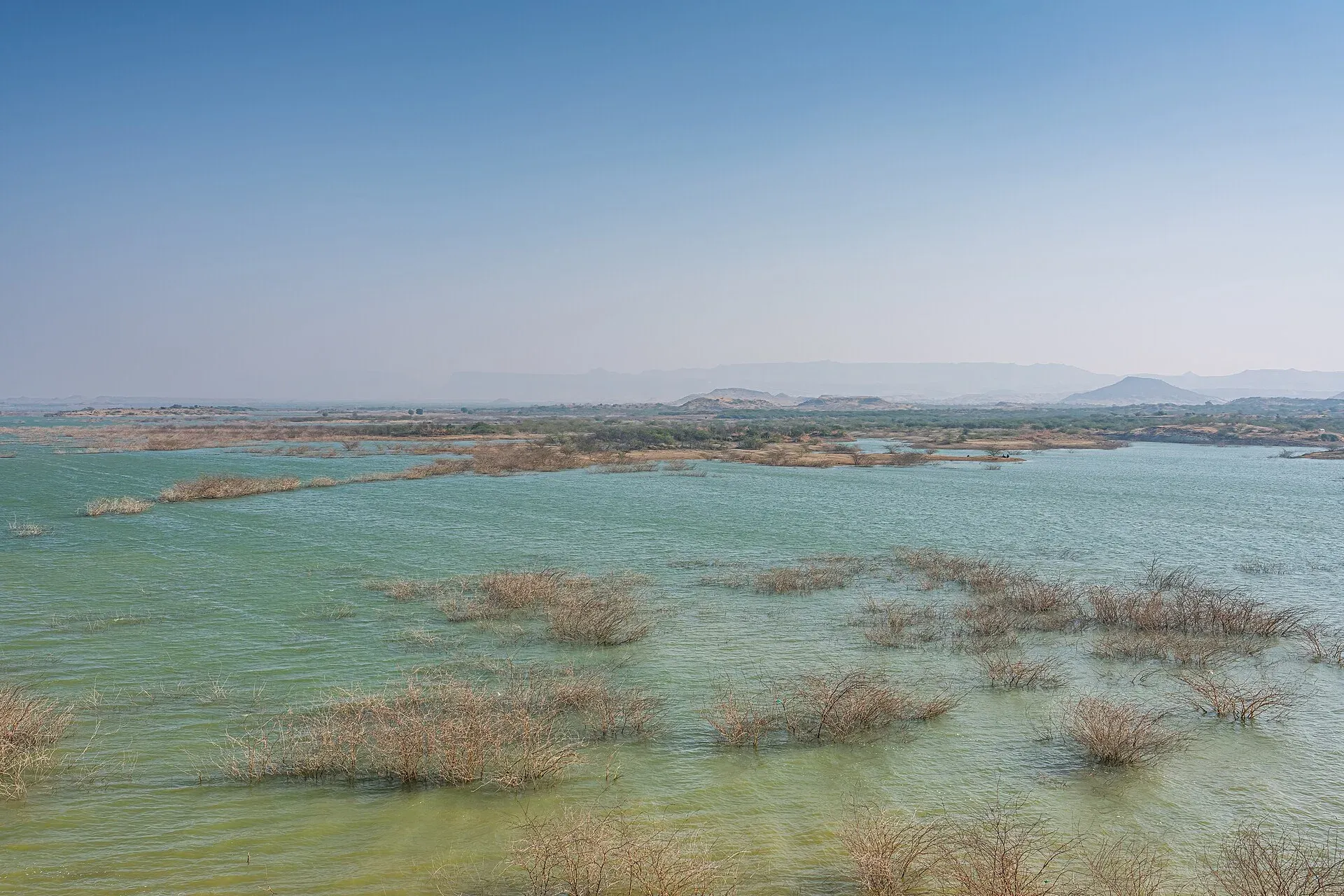
Photo: A.Savin, with thanks · Public domain (CC0) · via Wikimedia Commons · temporary stand-in photo

Water levels swing a good deal. The level fell to 276 ft before the rains of February and March 2019 and rose to 348 ft by 3 March that year, and the reservoir neared its maximum in August 2020 after about 13 years. In August 2018 WAPDA announced plans to raise storage and build a small hydroelectric project; no ground work had started by August 2020. Sources give the distance from Karachi as 45 km or 56 km.
What to see and do
- Waterbirds. The Ramsar sheet calls Hub an important staging and wintering area for grebes, pelicans, ducks, cranes and coots. More than 52,000 waterbirds were counted in the 1987 to 1991 winter censuses, 89,133 in 1992, and over 45,000 in a January 2000 survey. These are older figures; counts fall in drought years.
- Pelicans. Great white pelicans have been counted in the hundreds, and the sheet records an appreciable number of Dalmatian pelicans, which the IUCN Red List now lists as Near Threatened.
- Coots and diving ducks. Eurasian coot is the most numerous bird, with pochard and tufted duck also common.
- Bird list. About 128 bird species had been recorded at the site by 2000.
- Picnics and fishing. The reservoir is a weekend picnic spot for Karachi families and the fishery is a local source of income, and visitors also swim there. Fishing is controlled, so ask who issues permission.
When to visit
Come between November and February for migratory waterbirds. Summers are very hot, often above 36 degrees Celsius. Water levels drop sharply in dry years, which reduces both birds and fish.
Where to stay and eat
WAPDA has a rest house at the dam; ask WAPDA about booking rather than assuming it is open to the public. Otherwise this is a day trip from Karachi, with simple food available on the road. Carry water.
Good to know
- Check who controls access when you arrive. The dam is a WAPDA installation and the reservoir supplies drinking water, so follow staff instructions on swimming, fishing and photography. Ask the Sindh Wildlife Department in Karachi about entry arrangements. A fee may apply: current fees will be added soon.
- Hunting, trapping and disturbing birds are not allowed in a sanctuary. Take litter away, and ask before flying a drone.
- Ask the district administration or local police about current conditions before you go. Safety. For foreign visitors: the UK FCDO page (updated 27 October 2026, checked 16 November 2026) advises against all travel to Balochistan. The dam straddles the Sindh and Balochistan border, so check which side you will be on and read the current advice and local conditions before you plan a visit. Do not travel on to Balochistan roads beyond the dam.
- The Ramsar sheet (2001) described the access road as unpaved; confirm the current road locally. Travel in daylight.
Highlights
- Ramsar site no. 1064, designated 10 May 2001
- Staging and wintering site for grebes, pelicans and ducks
- About 128 bird species recorded by 2000
- Karachi's main drinking-water reservoir
- Under both Sindh and Balochistan wildlife departments
Getting there
Hub Dam is on the Hub River north-west of Karachi. OSRM models about 54 km and 1.1 hours from central Karachi. Public transport to Hub town exists, but you will need a taxi or your own vehicle for the dam road. Confirm the route and which side of the border it uses before you go.
Tips
- Visit November to February
- Ask WAPDA or the Sindh Wildlife Department about entry
- Check the FCDO advice for Balochistan first
- Travel in daylight and carry water
- Do not fly a drone without permission
Wildlife
Facilities
- WAPDA rest house (ask before assuming availability)
- Picnic area
Photos we still need: waterbirds (pelicans, coots, ducks) on the reservoir in winter. Send us yours
Sources and last checked
Last checked Confidence medium6 sources5 still to check
- Last checked
- Method
- Desk research from published sources
- Confidence
- medium
- Checked by
- trek.pk research team
Researched from published sources; not yet checked on the ground by our team. Spot something out of date? Report a mistake.
Sources
- Ramsar Sites Information Service: Hub Dam (site 1064) · Ramsar Convention Secretariat · checked
- Ramsar Information Sheet: Hub (Hab) Dam · Ramsar Convention Secretariat / IUCN-Pakistan · checked
- Hub Dam · Wikipedia · checked
- Dalmatian pelican · Wikipedia (cites IUCN Red List assessment) · checked
- Pakistan travel advice · UK Foreign, Commonwealth & Development Office (FCDO) · checked
- OSRM routing (driving distance and time estimates) · OpenStreetMap / Project OSRM · checked
Still to be checked on the ground (5)
- Year the sanctuary was notified (1972 per Ramsar sheet, 1974 per Wikipedia; Ramsar site pages returned errors on 17 Nov)
- Which agency grants entry and any fee
- Current water level and bird counts
- Whether the WAPDA rest house can be booked by visitors (Wikipedia confirms it exists)
- Whether the visitor road is within Sindh (Wikipedia: reservoir lies on the Sindh-Balochistan border)
Nearby and related

Karachi
Pakistan's largest city and main port: colonial buildings, museums, beaches, busy bazaars and some of the country's best food.

Sindh
Pakistan's south-east: Karachi's beaches and markets, the Indus Valley city of Moenjodaro, Thatta's Makli tombs, Sufi shrines, the Thar desert and the Indus delta.

Balochistan
Pakistan's largest and least populated province: Quetta's high valleys, Ziarat's juniper forest, the Makran coast, Hingol and Gwadar. Security and permission rules need checking first.

Hingol National Park
Pakistan's largest national park, about 6,100 square kilometres along the Makran Coastal Highway: desert canyons, mud volcanoes, the Hingol River, the Princess of Hope rock and the Hinglaj Mata temple.