

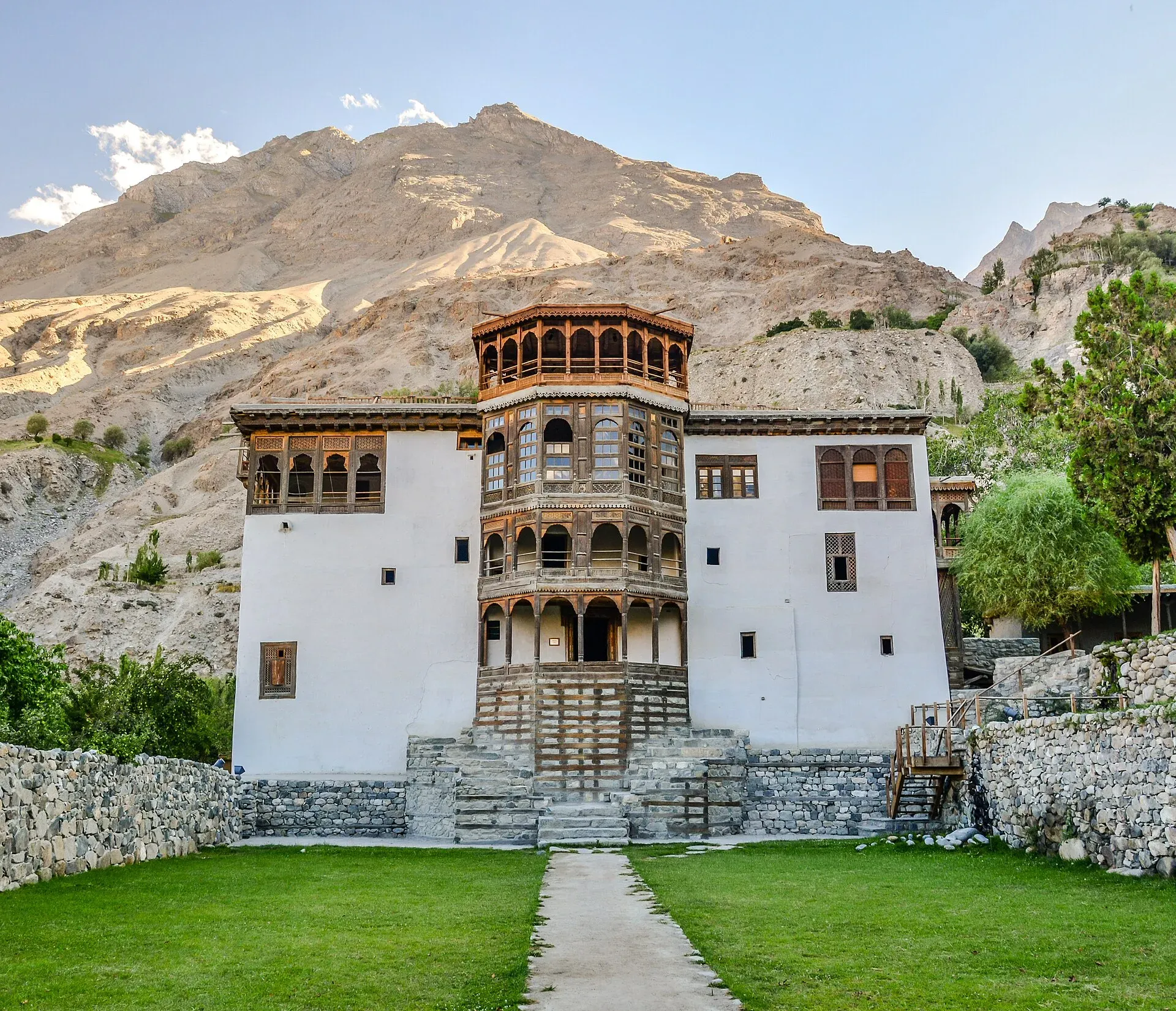
Photo: Muhammad Ashar, with thanks · CC BY-SA 3.0 · via Wikimedia Commons · temporary stand-in photo

Khaplu Palace (Yabgo Khar)
The 1840 palace of the Yabgo rajas of Khaplu, restored by the Aga Khan Trust for Culture (2005-2011) and now a museum and heritage hotel facing the Karakoram.
Overview
Khaplu Palace, also called Yabgo Khar, stands north of Khaplu town above the Shyok River, at about 2,600 m. It was the home of the Yabgo rajas of Khaplu. After a long restoration it reopened in July 2011 as a heritage hotel, with part of the building given to a museum on Baltistan's history and culture.
Plan your visit
- Nearest town
- Khaplu
- Getting there
Khaplu is in Ghanche District, east of Skardu in Baltistan. The road from Skardu follows the Indus and then the Shyok, and the drive is about 114 km (OSRM models under two hours, but real journeys usually take several… More
Best months
May – Oct
- Khaplu Palace (Yabgo Khar)
- Related places nearby: Satpara Lake, Gilgit-Baltistan, Khaplu
History
The palace was built in 1840 by Raja Daulat Ali Khan, after the Dogra rulers of Jammu had taken over the region and moved the seat of government from the older fort nearby. The older fort nearby was taken by Murad Khan of the Maqpon dynasty in the 1590s after a three-month siege, Wikipedia says. The Yabgo family continued to live there after the kingdom was abolished in 1972. The last raja to live in it, Fatah Ali Khan, died in 1983. The Aga Khan Trust for Culture restored the palace between 2005 and 2011, with Norwegian funding. It received a UNESCO Asia-Pacific Heritage Award in 2013.
Architecture
The palace is built of timber, mud brick, clay and soil mortar. Wikipedia's text counts four floors, though its infobox says five. Kashmiri and Balti craftsmen worked on it, and the style mixes Tibetan, Kashmiri, Ladakhi, Balti and Central Asian influences. Wikipedia says the carved wooden gate was brought from a fort in Skardu by Raja Hatim Khan. A local story says the site was chosen by rolling a large stone down the cliff: it stopped at Doqsai village.
Several rooms keep Balti names: the royal meeting room (Chogoraftal), the royal balcony (Chogojarokh), the princess's dressing room (Lainakhang) and the queen's room. The ceiling is carved and painted and uses no nails. A hall on the top floor looks over the Karakoram.
The Aga Khan Trust for Culture restored the palace under the Aga Khan Historic Cities Programme. It was the second fort in Baltistan the Trust renovated. The work employed people from 400 local families and followed the Venice Charter's restoration standards. A survey with electronic distance-measuring devices, begun in 2005, helped establish the original state of decayed sections. USAID helped fund an exhibition centre.
What to see and do
- The carved wooden gate: said to have come from a fort in Skardu.
- The nailless wooden ceiling and the top-floor hall, with views across to the Karakoram.
- Royal rooms: the meeting room, balcony and queen's rooms.
- The museum: exhibits on the history and culture of Baltistan. Wikipedia says the exhibition centre takes up about two-thirds of the site.
- A walk behind the palace: Wikipedia says a track through a ravine behind the palace leads to Pari village in Skardu District. Ask locally about the route before setting out.
- The village: walk the lanes of Khaplu town; ask locally about visiting old mosques.
When to visit
May to October. Apricots blossom in spring and ripen in summer.
Where to stay and eat
The palace operates as a 21-room hotel run by Serena Hotels, with six of the rooms inside the palace building, and a restaurant. Guesthouses are available in Khaplu town.
Good to know
- Entry: contact the hotel for current visitor and museum rules. A fee has not been confirmed.
- Dress and behaviour: dress modestly and ask before entering mosques.
- Photography: fine in public areas; be discreet around guests.
- UNESCO: not a World Heritage Site; it holds a UNESCO conservation award.
Highlights
- Built in 1840 by Raja Daulat Ali Khan
- Restored 2005 to 2011 by the Aga Khan Trust
- Carved gate and nailless wooden ceiling
- UNESCO Asia-Pacific Heritage Award, 2013
Getting there
Khaplu is in Ghanche District, east of Skardu in Baltistan. The road from Skardu follows the Indus and then the Shyok, and the drive is about 114 km (OSRM models under two hours, but real journeys usually take several hours); check the road and security conditions in Skardu before travelling. Jeeps and vans run from Skardu.
Tips
- Walk the old lanes of Khaplu town.
- Book the hotel early for summer.
- Combine with stops in Skardu on the way.
- Bring warm clothes for evenings.
Sources and last checked
Last checked Confidence medium3 sources3 still to check
- Last checked
- Method
- Desk research from published sources
- Confidence
- medium
- Checked by
- trek.pk research team
Researched from published sources; not yet checked on the ground by our team. Spot something out of date? Report a mistake.
Sources
- Khaplu Palace (Wikipedia) · Wikipedia · checked
- Conservation and development in Gilgit-Baltistan · Aga Khan Development Network · checked
- Driving route Skardu to Khaplu · OSRM (OpenStreetMap routing) · checked
Still to be checked on the ground (3)
- Visitor fee and museum hours (Wikipedia gives none; no official source found)
- Current road condition between Skardu and Khaplu (on the ground)
- Palace visiting hours, museum entry and any fee (official source needed)
Nearby and related

Satpara Lake
A large lake at about 2,600 m, a short drive south of Skardu. It supplies Skardu's water and fed the Satpara Dam. Trout, a small island and the road to Deosai make it an easy half-day outing.

Deosai National Park
A vast high plateau at about 4,100 m above Skardu and Astore, covered in wildflowers in summer. Created in 1993 to protect the Himalayan brown bear. Open only in summer.

Gilgit-Baltistan
Pakistan's far north: three great ranges meet here, with K2, Nanga Parbat, giant glaciers, the Karakoram Highway and the valleys of Hunza, Skardu and Gilgit.

Khaplu
Administrative centre of Ghanche District in the Shyok valley at about 2,600 m, with a Tibetan-style palace, old mosques and the Hushe valley road for Masherbrum and Gondogoro La.