

Photo: Fassifarooq, with thanks · CC BY-SA 4.0 · via Wikimedia Commons · temporary stand-in photo

Cholistan Desert
Cholistan is a desert of about 25,800 km2 in Punjab's Bahawalpur Division, with dunes, seasonal ponds called tobas, camel herders and Derawar Fort. Visit October to March.
Overview
Cholistan is a desert in Punjab's Bahawalpur Division, part of the greater Thar Desert system. It covers about 25,800 km2 and runs roughly 480 km in length and 32 to 192 km in width. Bahawalpur city lies about 30 km from its edge. About 81 per cent of the ground is sandy; the rest is alluvial flats and low dunes.
The desert splits into two parts. Greater Cholistan, in the south and west up to the Indian border, covers about 13,600 km2. It has dunes over 100 m high and very salty soil. Lesser Cholistan, about 12,370 km2, lies north and east of the old Hakra riverbed. A canal system dating from British rule irrigates its northern part.
Plan your visit
- Nearest town
- Bahawalpur
- Getting there
Bahawalpur city is about 30 km from the edge of the desert (Wikipedia). By road, Derawar Fort is about 96 km and 1.6 hours from Bahawalpur, and Bahawalpur is about 422 km and 4.9 hours from Lahore (OSRM). More
Best months
Oct – Mar
- Cholistan Desert
- Related places nearby: Derawar Fort, Cholistan Desert Camp (Derawar), Bijnot Fort, Cholistan Wildlife Sanctuary, Ahmedpur East
Landscape and wildlife
Rainfall is up to about 180 mm a year, mostly in July and August, and droughts are common. Water that falls is caught in natural ponds called tobas or in man-made ones called kunds. Groundwater lies 30 to 40 m down, but it is usually brackish. In May 2022 heat and a shortage of water killed livestock at several tobas.
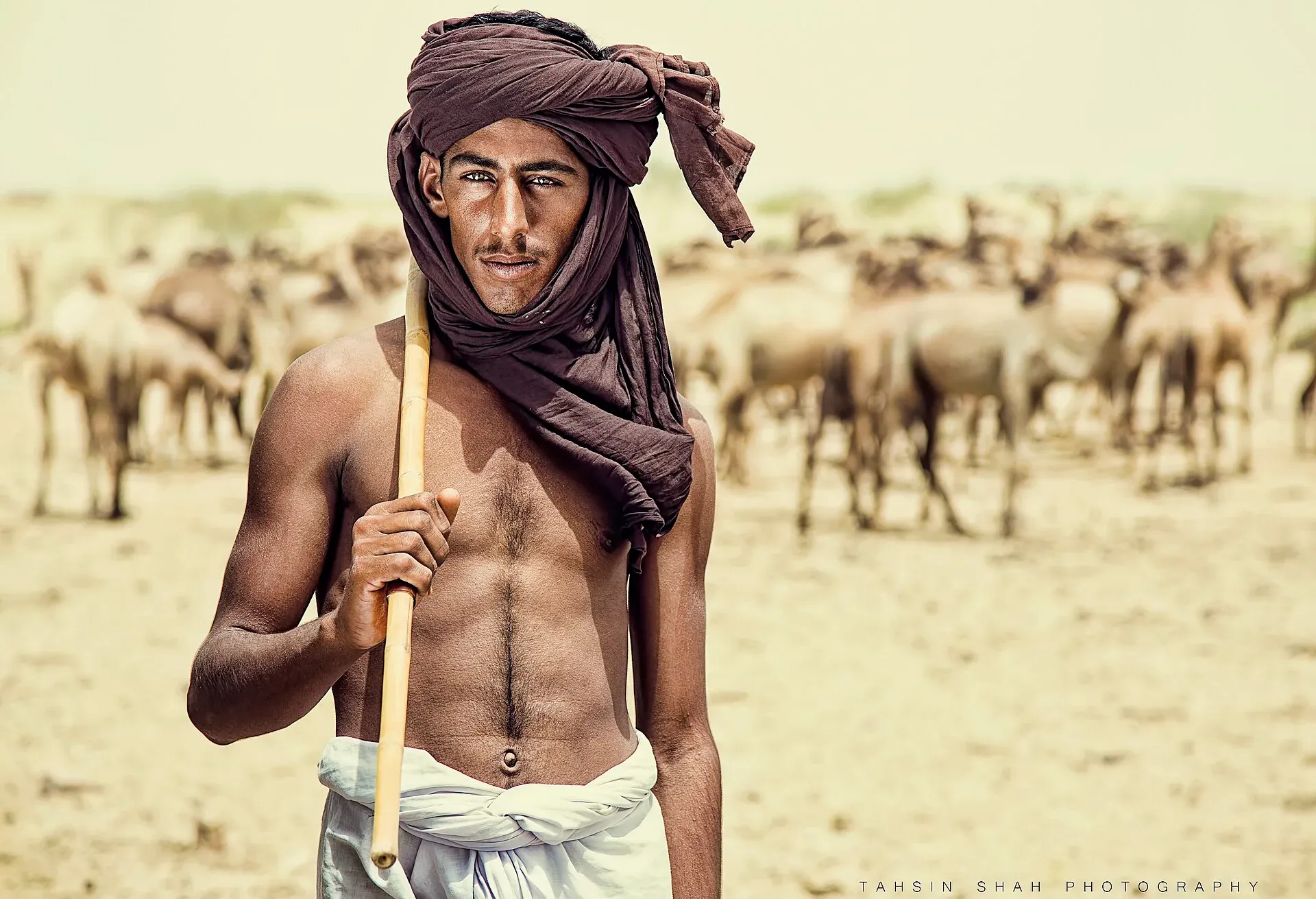
Photo: Tahsin Shah, with thanks · CC BY-SA 4.0 · via Wikimedia Commons · temporary stand-in photo

Plant life is sparse but varied: one survey counted 131 species. Common ones include a desert tree (Prosopis cineraria), a salt-tolerant shrub (Haloxylon salicornicum) and buffel grass. At Dingarh, a research body has turned over 100 hectares of dunes into a planted forest of ziziphus trees, date palms and grassland.
Wildlife includes the chinkara (a gazelle), the blue bull and the Great Indian Bustard. The houbara bustard arrives in winter. Its numbers have collapsed after heavy hunting, from 4,746 counted in 2001 to a few dozen in recent surveys. Chinkara fell from about 3,000 in 2007 to just over 1,000 in 2010. Our Lal Suhanra page covers the nearby national park, and the Cholistan Wildlife Sanctuary page covers the protected area in the desert.
People and culture
Wikipedia gives a 1998 census population of 128,019 and a 2015 estimate of 229,071, with about 70 per cent living in Lesser Cholistan. Herding is the base of the economy, with about 1.6 million livestock. Camels matter most. The marrecha breed is used for transport, racing and dancing; the berella is a milk camel giving 10 to 15 litres a day. Many families follow water and grass in a semi-nomadic way.
Local crafts are well documented. Wikipedia lists khes (a black-and-white blanket), pattu (a white-based blanket), embroidered and mirror-work gargas, chunri (a patterned scarf) and ajrak, a block print in indigo and red. Cholistani khusa shoes are embroidered with gold or bright thread. Potters make light, finely finished jugs and cups. Camel wool is woven into blankets and rugs, and camel leather is made into caps and lampshades. Camel racing and camel dancing are part of local entertainment.
History
The dry bed of the Hakra river runs through the desert. Settlements along it belonged to the Indus Valley (Harappan) culture and include the large site of Ganweriwal. More than 400 Harappan sites were listed in the 1970s and 37 more in the 1990s. The river is said to have supported settlement from about 4000 BCE to 600 BCE, when it changed course. See our Indus Civilisation route for the wider story.
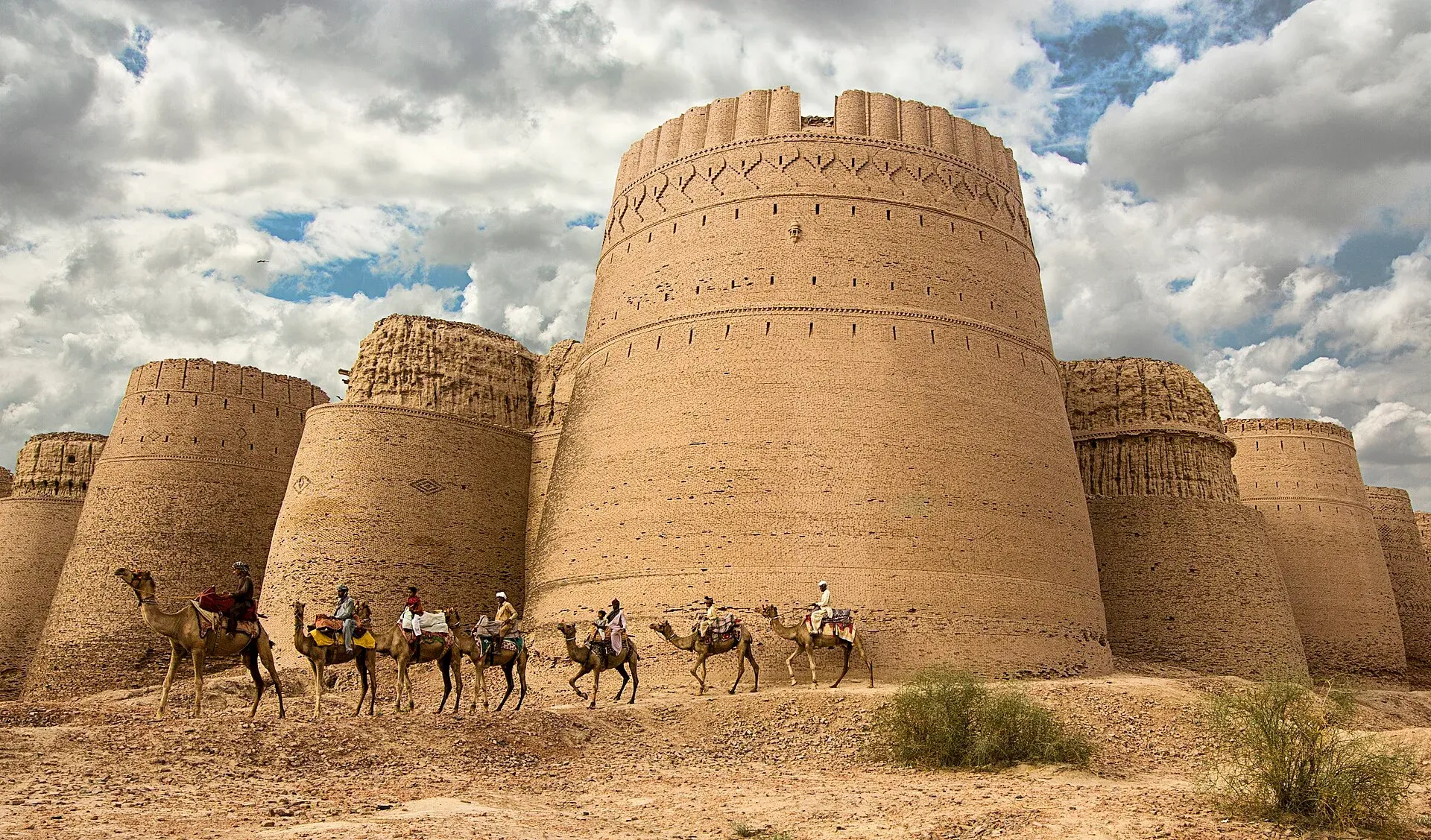
Photo: Tahsin Shah, with thanks · CC BY-SA 4.0 · via Wikimedia Commons · temporary stand-in photo

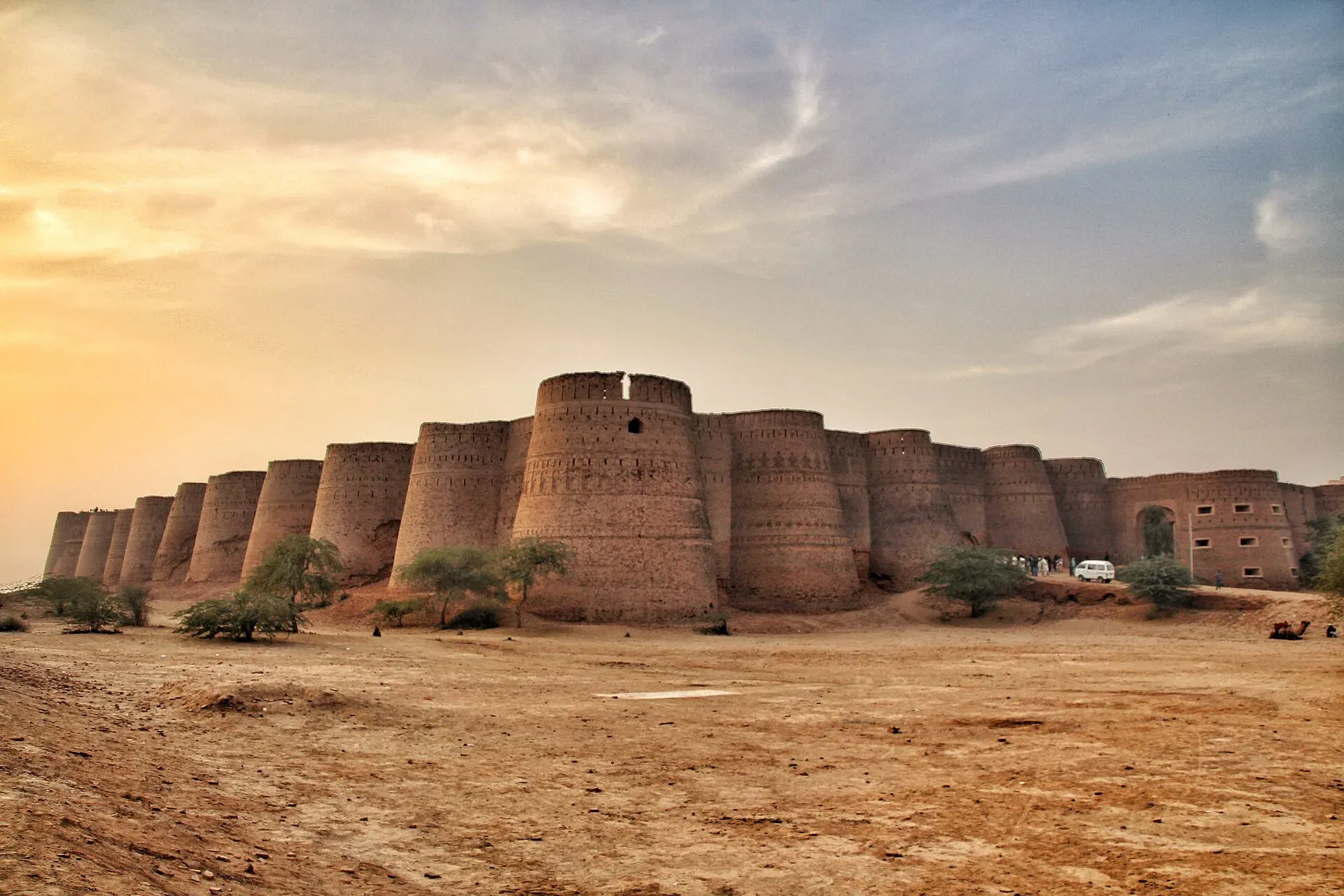
Cholistan was a caravan-trade region, and a chain of forts guarded the routes. Derawar is the best preserved. Wikipedia dates it to 858 and says it was renovated in 1732 under Nawab Sadeq Muhammad. It is square, with a perimeter of about 1,500 m and 40 round bastions, ten on each side, each about 30 m high. Other forts named in the desert include Marot, Maujgarh, Dingarh, Khangarh, Jamgarh and Bijnotgarh. Pakistan put "Derawar and the Desert Forts of Cholistan" on UNESCO's tentative list in 2016. See Derawar Fort and Bijnot Fort.
What to see and do
- Visit Derawar Fort and the surrounding desert.
- Join a guided jeep or camel trip on the dunes in winter.
- Watch the International Cholistan Desert Jeep Rally if you are visiting in February. The 21st edition was held in February 2026 (Dawn, ProPakistani). The rally has roots going back to 2005 and visits the desert forts; organisers set the dates each year, so check.
- Look for camel herds near tobas.
- Ask in Bahawalpur about local crafts such as khes, ajrak and khusa.
When to visit
October to March is best. July averages 38.5 C and summer highs exceed 46 C, sometimes passing 50 C in drought. Winter nights can fall to 0 C.
Where to stay and eat
Bahawalpur has the main hotels. Derawar has limited basic options and a campsite style stay may be arranged locally; see our Cholistan Desert Camp page.
Good to know
- Ask the district administration or local police about current conditions before you go. For foreign visitors: the UK FCDO advises against travel within 10 miles of the Line of Control and within 5 miles of the India border (checked 16 November 2026). Check where your route lies.
- Never pitch camp near a toba that livestock use; they are the only water for people and animals.
- Fees for fort entry and jeep tours will be added soon.
Highlights
- Derawar Fort, the best-known desert fort
- Dunes over 100 m in Greater Cholistan
- Camel herding and seasonal tobas
- The dry Hakra riverbed with ancient settlement mounds
- International Cholistan Desert Jeep Rally, held in February 2026
Getting there
Bahawalpur city is about 30 km from the edge of the desert (Wikipedia). By road, Derawar Fort is about 96 km and 1.6 hours from Bahawalpur, and Bahawalpur is about 422 km and 4.9 hours from Lahore (OSRM). Tracks beyond Derawar are unpaved; use a 4x4 with a local driver.
Tips
- Visit between October and March; summer highs top 46 C.
- Carry plenty of water and spare fuel; there are few services.
- Hire a local driver or guide with a 4x4 for dune tracks.
- Ask before photographing herders and women.
- Check locally for border-area restrictions and do not stray off known tracks.
Photos we still need: dunes in Greater Cholistan and a toba with water. Send us yours
Sources and last checked
Last checked Confidence medium8 sources4 still to check
- Last checked
- Method
- Desk research from published sources
- Confidence
- medium
- Checked by
- trek.pk research team
Researched from published sources; not yet checked on the ground by our team. Spot something out of date? Report a mistake.
Sources
- Cholistan Desert · Wikipedia · checked
- New dates announced for Cholistan Desert Rally · ProPakistani · checked
- 21st International Cholistan Desert Jeep Rally · Dawn · checked
- Pakistan Tourism Guide 2021 · TDAP Pakistan · checked
- OSRM driving route calculation · OpenStreetMap / OSRM project · checked
- Pakistan travel advice: warnings and insurance (updated 27 October 2026) · UK Foreign, Commonwealth & Development Office · checked
- International Cholistan Desert Jeep Rally 2026 · Tourism Development Corporation of Punjab · checked
- Derawar Fort · Wikipedia · checked
Still to be checked on the ground (4)
- Whether fees and permits apply for jeep tracks and camping (not covered by Wikipedia or the rally site)
- Distance of the route from the India-border 5-mile zone (no source gives a figure; the rally site lists Derawar, Dingarh, Marrot, Khan Garh, Bhijnot, Moujgarh and Jamgarh forts)
- Jeep rally dates for 2027 (the TDCP site lists the 21st edition, 10 to 15 February 2026, and nothing for 2027)
- Visiting arrangements for forts other than Derawar (Wikipedia names them but gives no access details)
Nearby and related

Derawar Fort
A square mud-brick fort of 40 round bastions in the Cholistan Desert, south of Ahmedpur East. Dated to the 9th century, rebuilt in 1732, and on UNESCO's tentative list since 2016.

Lal Suhanra National Park
A desert and forest park about 35 km east of Bahawalpur, covering roughly 516 square kilometres. A UNESCO biosphere reserve with blackbuck, chinkara, nilgai and Patisar Lake.

Cholistan Desert Camp (Derawar)
A camping area at the TDCP tourist resort beside Derawar Fort in the Cholistan Desert, about 96 km by road from Bahawalpur. Best from October to March.

Bahawalpur
Former capital of a princely state on the edge of the Cholistan Desert: Nawabi palaces, a museum, desert crafts, and a base for Lal Suhanra, Derawar Fort and Uch Sharif.

Uch Sharif Monuments
A cluster of tiled Sufi tombs and a mosque in the old town of Uch Sharif near Bahawalpur, dating from the 13th to 15th centuries. The group is on UNESCO's tentative list (2004).
Bijnot Fort
A ruined desert fort in Cholistan, Bahawalpur district, dated to the 8th century and damaged by shelling in 1971. About 23 km from the Indian border.
Fort Abbas
A small desert town in Bahawalnagar district, named after the Nawab's son, and a base for the ruined Pholra, Mir Garh and Jam Garh forts of Cholistan.

Cholistan Wildlife Sanctuary
A very large desert sanctuary in Bahawalpur District, Punjab, in the Cholistan Desert. Wikipedia lists caracal, chinkara, houbara bustard and many reptiles. Facilities are limited; Derawar Fort is the usual visitor stop.
Ahmedpur East
Cotton and handicraft town in Bahawalpur District, built in 1748 and the usual stop on the way to Derawar Fort and the Cholistan desert.