

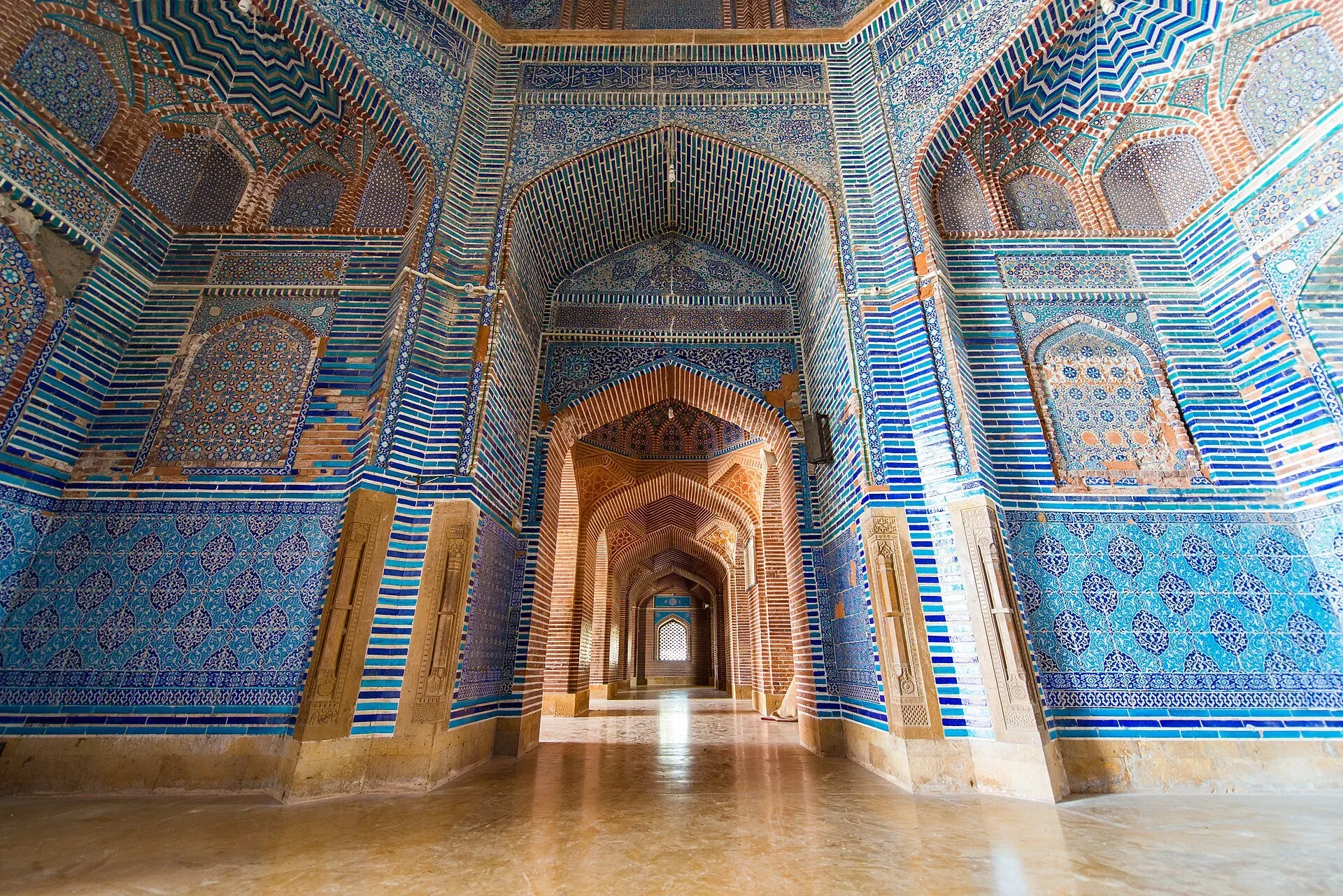
Photo: Asultan, with thanks · CC BY-SA 3.0 · via Wikimedia Commons · temporary stand-in photo

Shah Jahan Mosque (Thatta)
A Mughal-era Friday mosque in Thatta, built between 1644 and 1647, with some of the most elaborate tilework in South Asia, 93 domes and no minarets. On Pakistan's UNESCO tentative list since 1993.
Overview
The Shah Jahan Mosque, also called the Friday Mosque of Thatta, is the main congregational mosque of Thatta in Sindh. It is known for its blue and turquoise tilework, patterned brick and a very large number of domes, and is described as the most elaborate display of tilework in South Asia. It is still used for prayer. It stands in eastern Thatta, about 100 km from Karachi and not far from the Makli Necropolis.
Plan your visit
- Nearest town
- Thatta
- Opening hours
- Summer 08:00 to 19:00; winter 09:00 to 18:00 (Sindh antiquities website, checked 16 November 2026; confirm locally)
- Getting there
The mosque is in Thatta town, about 0.5 km from Thatta's centre (OSRM, checked 16 November 2026), and about 104 km (about 1 hour 45 minutes) from central Karachi by road. Buses and vans run from Karachi to Thatta; More
Best months
Nov – Feb
- Shah Jahan Mosque (Thatta)
- Related places nearby: Thatta, Makli Necropolis
History
Persian inscriptions show it was built between 1644 and 1647, during the reign of Mughal emperor Shah Jahan. The traditional story is that he ordered it as thanks for the hospitality he received in Sindh when he fled here after rebelling against his father, Jahangir. A storm in 1637 had also damaged Thatta badly, and the project may have helped the town recover. An eastern addition was finished in 1659 under Aurangzeb. Restorations followed in 1692 (Aurangzeb) and in 1812 (Murad Ali Khan Talpur).
Local tradition says the mihrab (prayer niche) was first misaligned and that the Sufi Makhdum Lutufullah corrected it through prayer, although records show the mihrab was rebuilt about a century later.
UNESCO status
The mosque has been on Pakistan's UNESCO tentative list since 1993. It is not an inscribed World Heritage Site (checked against the UNESCO list, 16 November 2026). Makli Necropolis nearby is inscribed (1981). It has not been conserved to the standard of the Wazir Khan and Badshahi mosques in Lahore.
Plan and domes
The plan follows a caravanserai (travellers' inn) pattern: a great courtyard of about 52 by 30 m, lined with arcades of 33 arches and enclosed by domed apartments, with four iwans (arched halls) and the main prayer hall on the west side. It has no minarets. It has 93 domes, the most of any structure in Pakistan; the Sindh antiquities page gives different counts, so treat the number as approximate. Its design draws on Central Asian Timurid, Turkic, Iranian and Safavid traditions.
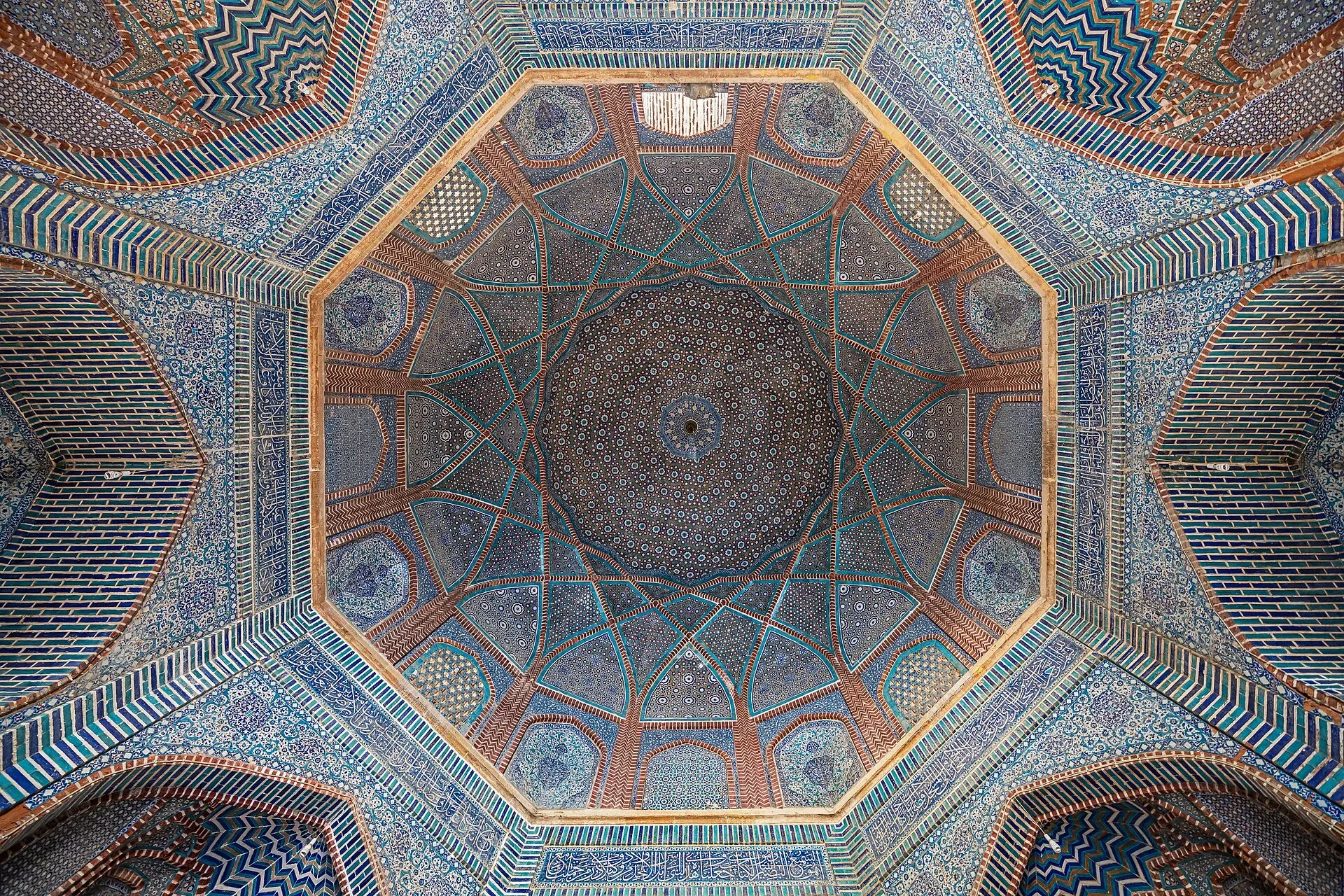
Photo: A.Savin, with thanks · Public domain (CC0) · via Wikimedia Commons · temporary stand-in photo

Tilework and brickwork
Cobalt blue, turquoise, manganese violet and white tiles cover the main dome and walls. Stars on the dome interior stand for the heavens, and calligraphy signed by Abdul Ghafur and Abdul Sheikh runs along the walls. Unlike the Wazir Khan Mosque in Lahore, it has no frescoes, and its tiles often combine several colours on one tile.
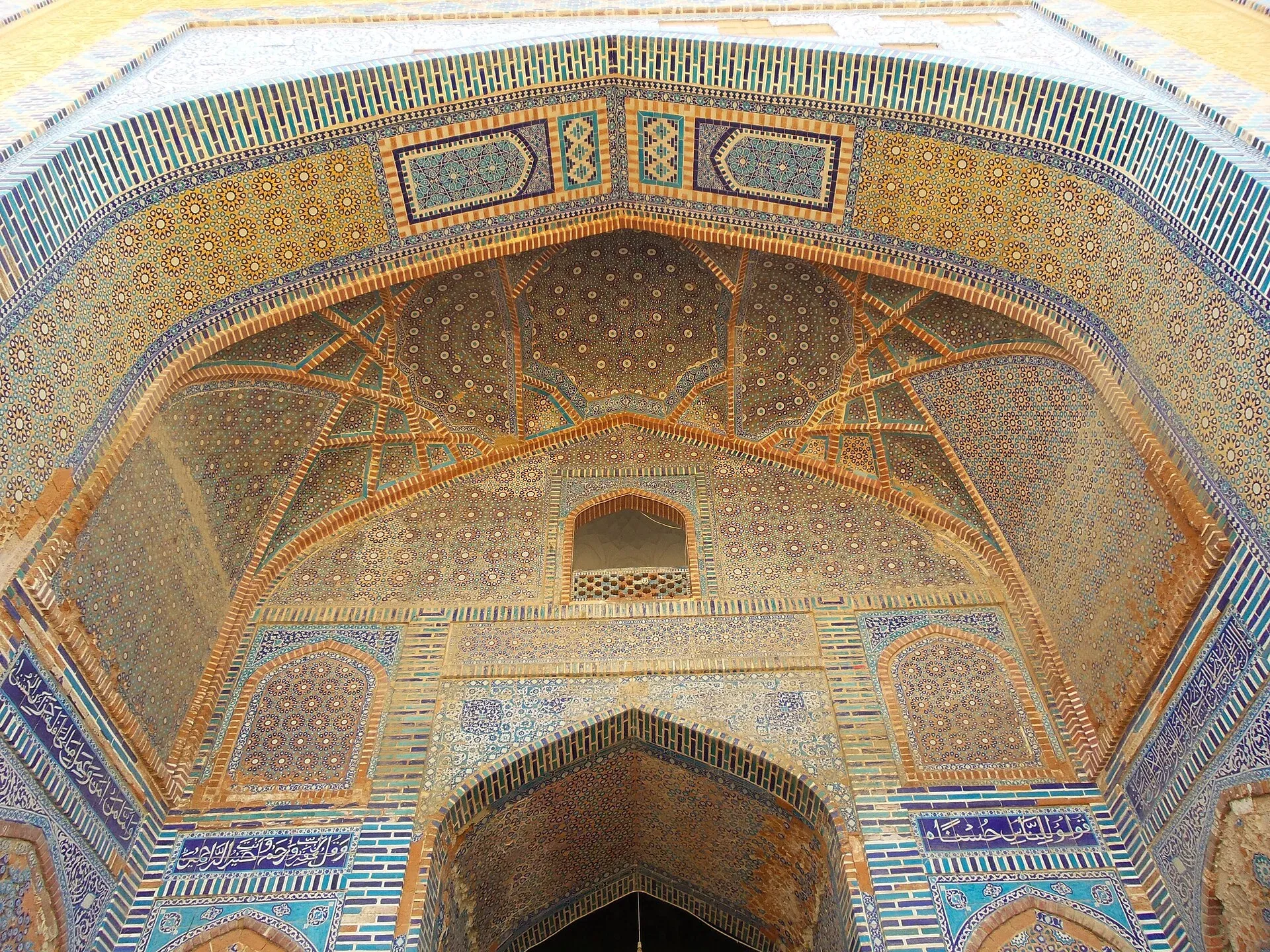
Photo: Madiha Salam, with thanks · CC BY-SA 4.0 · via Wikimedia Commons · temporary stand-in photo

Geometric brick patterns line the arcades. They are unusual for Mughal mosques, and concentric rings of brick decorate the underside of the smaller domes. The mihrab has pierced screens, which are more usual in Mughal funerary monuments than in mosques.
Acoustics
Speech above 100 decibels under the main dome can be heard at the far end, and a prayer led from the main hall carries throughout the building.
One or two days in Thatta
Visit the mosque in the morning, when the courtyard is cooler, then spend the afternoon at the Makli Necropolis, one of the largest burial grounds in the world. Many visitors do both as a day trip from Karachi. A second day can be spent elsewhere in Thatta.
When to visit
November to February. The courtyard heats up in the afternoon in other months.
Where to stay and eat
Thatta has small guesthouses and eateries. The Sindh antiquities page mentions a restaurant run by the Sindh Tourism Development Corporation near the mosque.
Good to know
- Hours (official). The Sindh antiquities website gives summer 8:00 to 19:00 and winter 9:00 to 18:00. It does not say which months count as summer or winter, and visits may pause around congregational prayers. Confirm locally.
- Fee. The page lists no admission fee. Current fees will be added soon; check with the Directorate General of Antiquities & Archaeology, Government of Sindh.
- Etiquette. This is an active mosque. Dress modestly with covered arms and legs, women should cover their hair, remove shoes at the entrance and keep your voice low. Ask at the gate whether visitors are allowed in the prayer hall and during prayer times.
- Safety. Thatta is not covered by the FCDO "against all travel" or "all but essential" lists (checked 16 November 2026); read the live page before you go.
Highlights
- Most elaborate tilework in South Asia, with a dome of blue-and-white stars
- 93 domes and no minarets
- Built 1644 to 1647 under Shah Jahan
- On Pakistan's UNESCO tentative list since 1993
Getting there
The mosque is in Thatta town, about 0.5 km from Thatta's centre (OSRM, checked 16 November 2026), and about 104 km (about 1 hour 45 minutes) from central Karachi by road. Buses and vans run from Karachi to Thatta; local rickshaws cover the last stretch. Makli Necropolis is a short taxi ride away.
Tips
- Visit in the morning and avoid prayer times.
- Dress modestly and remove shoes.
- Combine with Makli Necropolis, 4.5 km away.
- Official hours differ by season; confirm at the gate.
Photos we still need: the courtyard arcades and the dome interior. Send us yours
Sources and last checked
Last checked Confidence medium6 sources4 still to check
- Last checked
- Method
- Desk research from published sources
- Confidence
- medium
- Checked by
- trek.pk research team
Researched from published sources; not yet checked on the ground by our team. Spot something out of date? Report a mistake.
Sources
- Shah Jahan Mosque (Jamia Masjid), Thatta · Directorate General of Antiquities & Archaeology, Government of Sindh · checked
- Shah Jahan Mosque, Thatta · Wikipedia · checked
- List of World Heritage Sites in Pakistan (tentative list table) · Wikipedia (UNESCO site whc.unesco.org returned HTTP 403) · checked
- Pakistan Tourism Guide 2021 · TDAP (Trade Development Authority of Pakistan) · checked
- OSRM driving route calculation · OSRM (OpenStreetMap routing) · checked
- Pakistan travel advice (warnings and insurance), updated 27 October 2026 · UK Foreign, Commonwealth & Development Office · checked
Still to be checked on the ground (4)
- Exact season dates for the summer and winter hours (not stated on the Sindh antiquities page)
- Dome count (Wikipedia says 93; Sindh antiquities page says both 93 and 100)
- Whether visitors may enter the prayer hall (page says tourists can visit; no detail)
- Current fee, if any (none listed)
Nearby and related

Thatta
Sindh's medieval capital, home to the UNESCO-listed Makli Necropolis and the tiled Shah Jahan Mosque, about 100 km from Karachi and Hyderabad.

Makli Necropolis
One of the world's largest burial grounds, near Thatta in Sindh, with hundreds of thousands of graves and royal tombs from the 14th to 18th centuries. A UNESCO World Heritage Site since 1981.

Karachi
Pakistan's largest city and main port: colonial buildings, museums, beaches, busy bazaars and some of the country's best food.