

Photo: A.Savin, with thanks · Public domain (CC0) · via Wikimedia Commons · temporary stand-in photo
Mazar-e-Quaid Museum
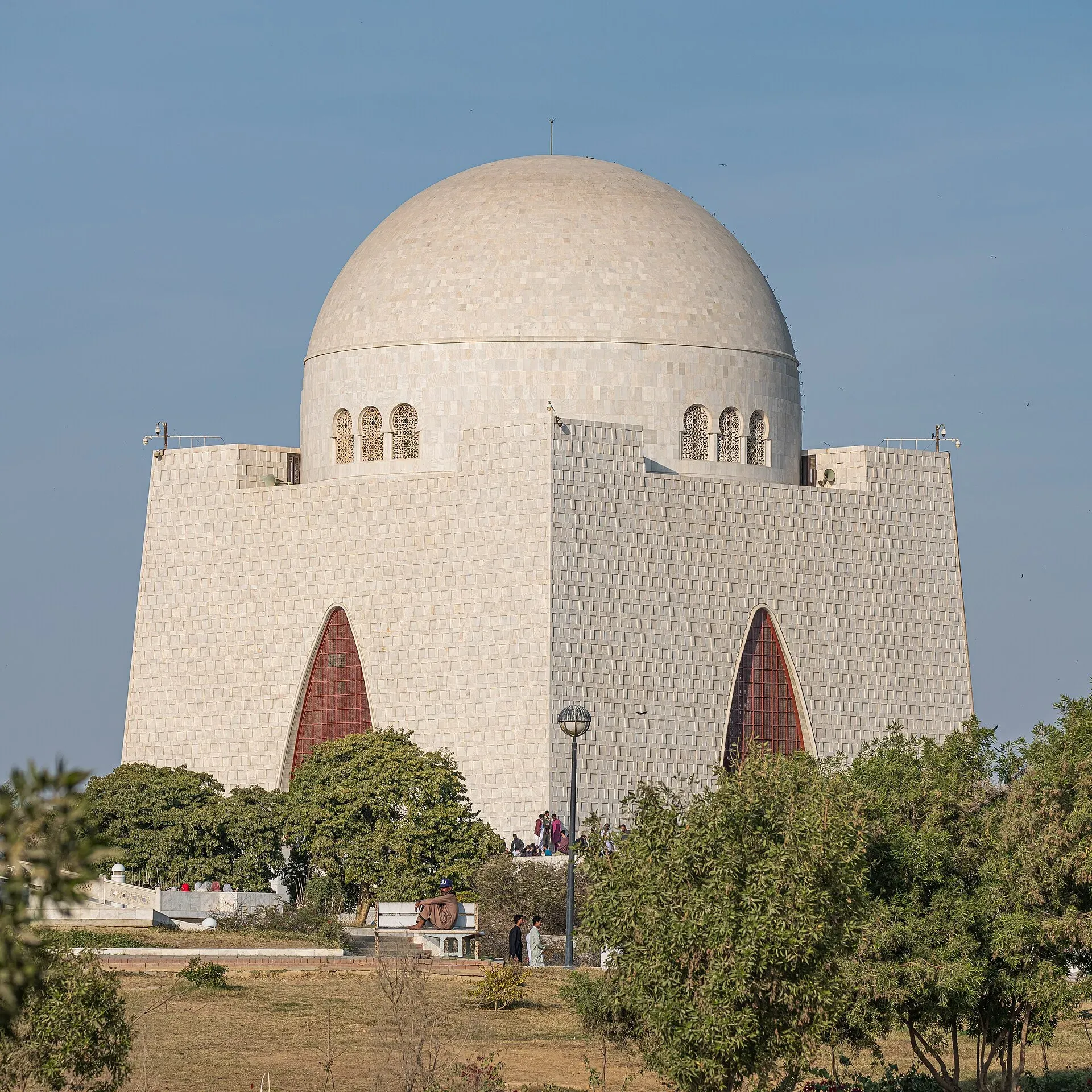
The white marble mausoleum of Muhammad Ali Jinnah in central Karachi, finished in 1971. Visitor accounts mention a small display of his belongings, but its status is unconfirmed.
Overview
Mazar-e-Quaid, also called the Jinnah Mausoleum or National Mausoleum, is the resting place of Muhammad Ali Jinnah, the founder of Pakistan, who died in 1948. It stands in the Jamshed Quarters of central Karachi, at the northern end of Muhammad Ali Jinnah Road, on the edge of the city's colonial core. It is one of Karachi's most visited landmarks. The main page for the monument is Mazar-e-Quaid; this page looks at the question of a museum display inside the complex.
Plan your visit
- Nearest town
- Karachi
- Opening hours
- Check before you go: no official hours confirmed.
- Getting there
The mausoleum is at the end of Muhammad Ali Jinnah Road in the Jamshed Quarters area of central Karachi, set in its own garden with traffic roundabouts at its corners. More
Best months
Nov – Mar
- Mazar-e-Quaid Museum
- Related place nearby: Karachi
History
Jinnah's grave was first marked by a marble slab on a plinth. The Quaid-e-Azam Memorial Fund was formed in 1949, and by 1952 a small dome had been added, though the site had fallen into neglect and drew public criticism. Early designs by an Indian architect (dismissed in 1954) and a Turkish architect (rejected in 1955) came to nothing.
An international competition in 1957 was won by the British architect William Whitfield. Fatima Jinnah opposed the choice and took charge of the project, commissioning the Bombay-based architect Yahya Merchant, a personal friend of Jinnah. Ayub Khan laid the foundation stone on 31 July 1960. The mausoleum was inaugurated on 18 January 1971, and the surrounding gardens were completed on 24 December 2000.
Architecture and setting
The monument is a white marble cuboid topped by a dome, 75 m by 75 m at the base and 43 m high, on a 4 m platform. It has curved arches and copper grilles, and each wall has an entrance. Critics describe the design as simple from a distance and intricate close up. Wikipedia says it was influenced by the Samanid Mausoleum in Bukhara, built between 892 and 943 CE. Fifteen fountains lead to the platform on one side, and terraced avenues reach the gates from every side.
Inside the inner sanctum hangs a four-tiered green crystal chandelier donated by China.
The tombs
Jinnah's sarcophagus is at the centre. It is a box-type tomb on a triple base. Fatima Jinnah, his sister, lies to the north, and her tomb has floral ornament at its base. A row of four graves holds Liaquat Ali Khan, Pakistan's first prime minister, and his wife Ra'ana Liaquat Ali Khan, side by side at one end, Nurul Amin, the eighth prime minister, in the middle, and Sardar Abdur Rab Nishtar at the other end. These graves are plain white marble with inscriptions in Urdu and Bengali.
Gardens and ceremonies
The mausoleum stands on a rise in a large park laid out in a neo-Mughal style. Sources give different figures for its size, from about 25 ha to 53 ha. There are large traffic roundabouts at three of the four corners, and at night spotlights light the white building. Families come in the evening.
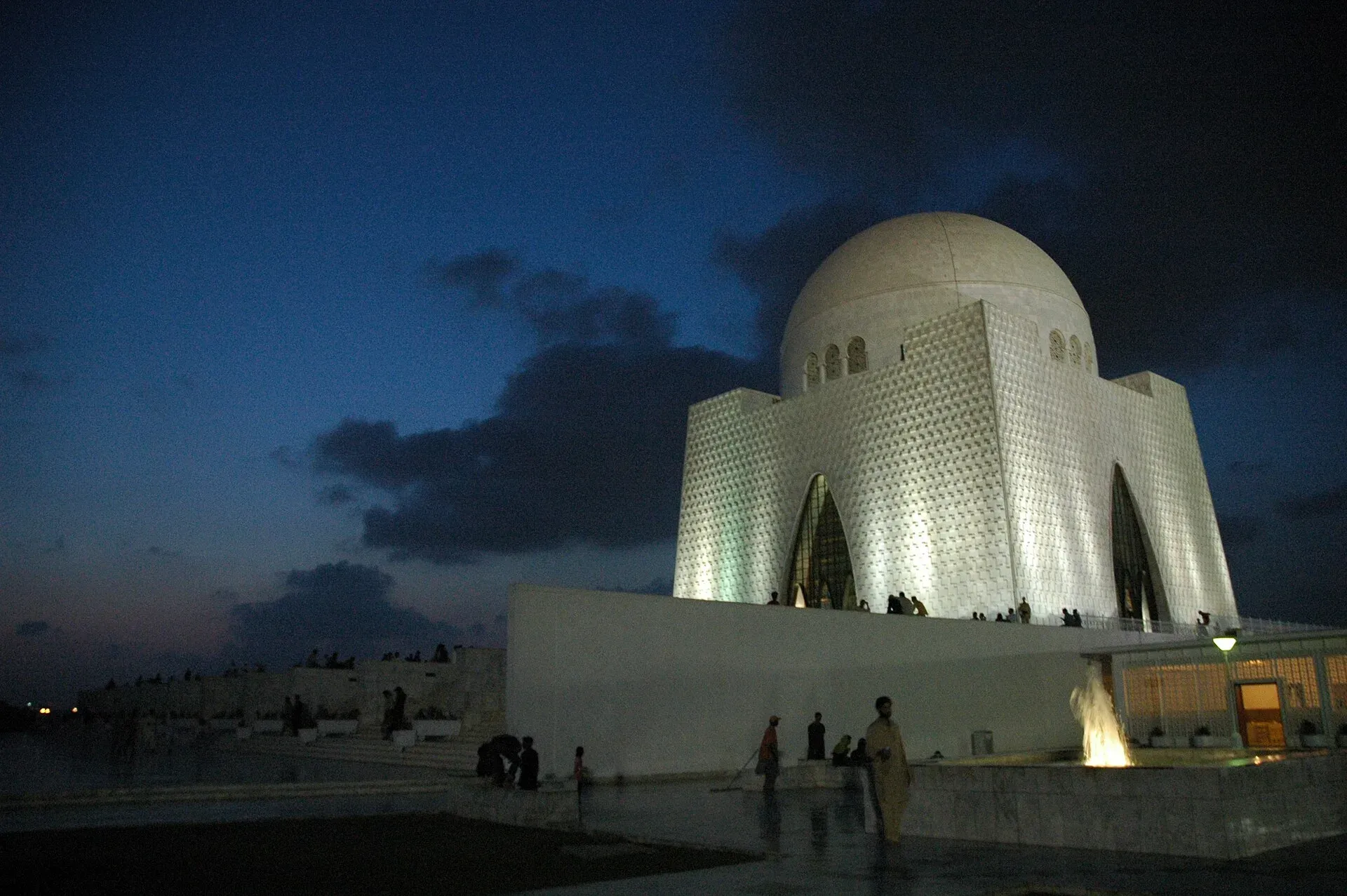
Photo: Besal1966, with thanks · CC BY-SA 4.0 · via Wikimedia Commons · temporary stand-in photo
Official and military ceremonies take place on 23 March (Pakistan Day), 14 August (Independence Day), 11 September (the anniversary of Jinnah's death) and 25 December (his birthday). On 14 August 2017 a projection-mapping show was staged on the building as a tribute.
The museum question
The mausoleum is not a museum in the usual sense, and Wikipedia does not describe one; it notes only a cabinet of Jinnah's personal effects near the grave by 1952. Wikivoyage's Karachi guide (undated) says a small museum in the complex shows items he used, including cars, dining sets, furniture, swords and guns. No official source confirms a current display, so treat it as a possible extra. For a proper collection of his possessions, visit Quaid-e-Azam House Museum (Flagstaff House), a separate museum.
When to visit
November to March has the best weather. Avoid 25 December, 14 August and 23 March unless the ceremonial crowds are the point.
Where to stay and eat
Hotels and restaurants are within a short drive in Saddar and along Shahrah-e-Faisal. Street food stalls surround the area; choose busy and clean ones.
Good to know
- Hours and tickets: not confirmed from an official source. Wikivoyage (undated) lists Saturday to Tuesday and Thursday 10 am to 1 pm and 2 pm to 5 pm, and Friday 9 am to 12 noon, with Wednesday not listed. A fee may apply; current fees will be added soon.
- Etiquette: modest dress, no loud behaviour, and follow the guards' instructions. Photography rules vary, so ask first, especially inside. Wikivoyage says the tomb is guarded at all times and the honour guard changes every 20 minutes.
- Nearby: see the Karachi page.
- Travel advice: Sindh south of Nawabshah is not among the areas the UK Foreign, Commonwealth & Development Office (FCDO) advises against (page updated 27 October 2026, checked 16 November 2026). Karachi has street crime and sometimes strikes or protests that close roads, so use ride-hailing or a trusted driver, keep phones and cameras out of sight in crowds and check the FCDO page before you travel.
Highlights
- White marble mausoleum, 43 m high, completed in 1971
- Tombs of Fatima Jinnah, Liaquat Ali Khan and others in the complex
- Large gardens in the neo-Mughal style
- A small display of the Quaid's belongings is reported by some visitors
Getting there
The mausoleum is at the end of Muhammad Ali Jinnah Road in the Jamshed Quarters area of central Karachi, set in its own garden with traffic roundabouts at its corners. Use a taxi or ride-hailing car from anywhere in Karachi; traffic is heavy, so allow extra time. On 23 March, 14 August, 11 September and 25 December there are ceremonies, which can close nearby roads.
Tips
- Dress modestly and keep your voice low; it is a place of national respect.
- Expect security checks and carry ID.
- Go on a weekday morning to avoid the crowds that gather on national days.
- Do not plan around the museum display; confirm it is open.
Photos we still need: the inner sanctum and the tombs of Fatima Jinnah and Liaquat Ali Khan. Send us yours
Sources and last checked
Last checked Confidence low6 sources4 still to check
- Last checked
- Method
- Desk research from published sources
- Confidence
- low
- Checked by
- trek.pk research team
Researched from published sources; not yet checked on the ground by our team. Spot something out of date? Report a mistake.
Sources
- Mazar-e-Quaid · Wikipedia · checked
- Mazar-e-Quaid · Atlas Obscura (visitor-contributed, not opened for checking) · checked
- Pakistan Tourism Guide 2021 (museums lists) · Trade Development Authority of Pakistan (TDAP) · checked
- Pakistan travel advice (updated 27 October 2026) · UK Foreign, Commonwealth & Development Office · checked
- Karachi (Mazar-e-Quaid listing) · Wikivoyage · checked
- Mazar-e-Quaid · Wikipedia (re-read for history, architecture and ceremonies) · checked
Still to be checked on the ground (4)
- Whether the small museum or relics display is currently open (Wikivoyage, undated, says a small museum exists; no official source)
- Official opening hours, ticket charge and photography rules (Wikivoyage hours are undated and unofficial)
- Security procedures at the gate (Wikivoyage: guarded at all times; no gate procedure found)
- Site area (Wikipedia gives different figures)


