

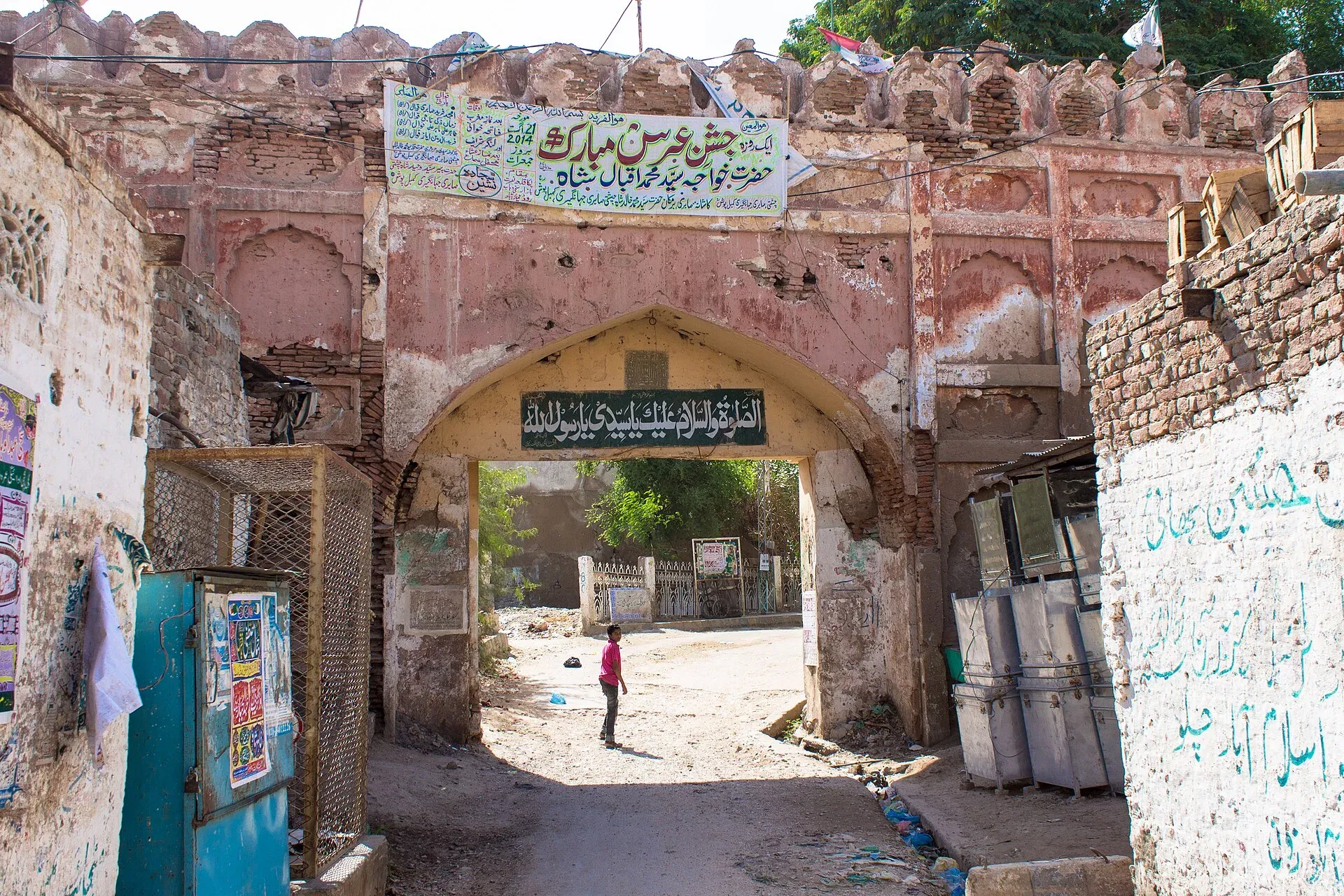
Photo: Soban, with thanks · CC BY-SA 3.0 · via Wikimedia Commons · temporary stand-in photo

Pacco Qillo
The 'Strong Fort' of Hyderabad, built around 1768 on a hill called Ganjo Takkar. Little of the old fort survives, and the site is in need of repair.
Overview
Pacco Qillo (also Pakka Qila, "strong fort"; the Sindhi name means much the same) stands on a hillock in the centre of Hyderabad, Sindh. The Kalhora ruler Mian Ghulam Shah Kalhoro built it around 1768 when he founded the city. Most of its old buildings have gone, but the boundary wall and the main gate can still be seen, and the hill gives a view over the old city.
History
The fort was built of baked brick on a hill known locally as Ganjo Takkar (or Ganji). It served as a military base for the new city.
Mir Fateh Ali Khan Talpur moved his capital from Khudabad to Hyderabad in 1789 and used the fort as his home and court. He added a harem and other buildings for the ruling family, and commissioned mosques so that residents could pray close by. Working families lived in houses around the fort.
The British took the fort after the Battle of Miani in 1843. Later explosions destroyed most of the architecture and nearby buildings, and in 1857 the British cleared the remaining structures to make way for military installations and stores.
The fort's neighbourhood, Pucca Qila, was also the scene of a police operation on 26-27 May 1990 in which about 40 people were killed. The event is still remembered locally, so ask before photographing or raising it.
What to see and do
- The main gate. The best-preserved part and the usual photograph.
- Remains of the fort wall. Sections of the boundary wall still stand around the hill.
- The hill. The fort stands on a rise in the middle of the city, and the lanes and rooftops of the old town spread out around it.
- The old town below. The lanes and shops around the fort give a feel of everyday Hyderabad.
When to visit
November to February is the most comfortable. Summers are hot.
Where to stay and eat
Hyderabad has a range of hotels and restaurants. See the Hyderabad page for food and bazaars.
Getting there
Pacco Qillo is in the middle of Hyderabad and can be reached by rickshaw or taxi from the station or hotels. Hyderabad is about 160 km from Karachi by the M-9 motorway.
Good to know
- This is not a managed visitor attraction. The site is open but in need of repair, and much of the hill is built over.
- Opening hours and any ticket price have not been confirmed by an official source. Ask locally before you go in.
- Take local advice about the area before visiting, especially around political events.
- Sindh is covered by the UK FCDO advice for foreigners, which advises against all but essential travel to areas north of and including Nawabshah. Hyderabad is south of that line. Read the current page before you go.
Highlights
- Fort built around 1768 on Ganjo Takkar hill
- Talpur capital from 1789
- Surviving main gate and wall sections
- Views over the old city
Tips
- Go in the cooler months and in daylight.
- Ask locally about access to the hill before going in.
- Combine with the Talpur tombs and Sindh Museum.
Photos we still need: Hyderabad rooftop view from the hill (section: History). Send us yours
Sources and last checked
Last checked Confidence low3 sources3 still to check
- Last checked
- Method
- Desk research from published sources
- Confidence
- low
- Checked by
- trek.pk research team
Researched from published sources; not yet checked on the ground by our team. Spot something out of date? Report a mistake.
Sources
- Pacco Qillo · Wikipedia · checked
- Hyderabad, Sindh · Wikipedia · checked
- Pakistan travel advice: warnings and insurance (updated 27 October 2026) · UK Foreign, Commonwealth & Development Office · checked
Still to be checked on the ground (3)
- Opening hours and any entry fee
- Current state of the main gate and which areas are open to visitors
- Latest local advice on safety around the fort
Nearby and related

Hyderabad
Sindh's second-largest city, founded in 1768 and famous for its glass bangles, Pacco Qillo fort and Talpur tombs, about 160 km from Karachi.

Sindh
Pakistan's south-east: Karachi's beaches and markets, the Indus Valley city of Moenjodaro, Thatta's Makli tombs, Sufi shrines, the Thar desert and the Indus delta.

Karachi
Pakistan's largest city and main port: colonial buildings, museums, beaches, busy bazaars and some of the country's best food.

Thatta
Sindh's medieval capital, home to the UNESCO-listed Makli Necropolis and the tiled Shah Jahan Mosque, about 100 km from Karachi and Hyderabad.