

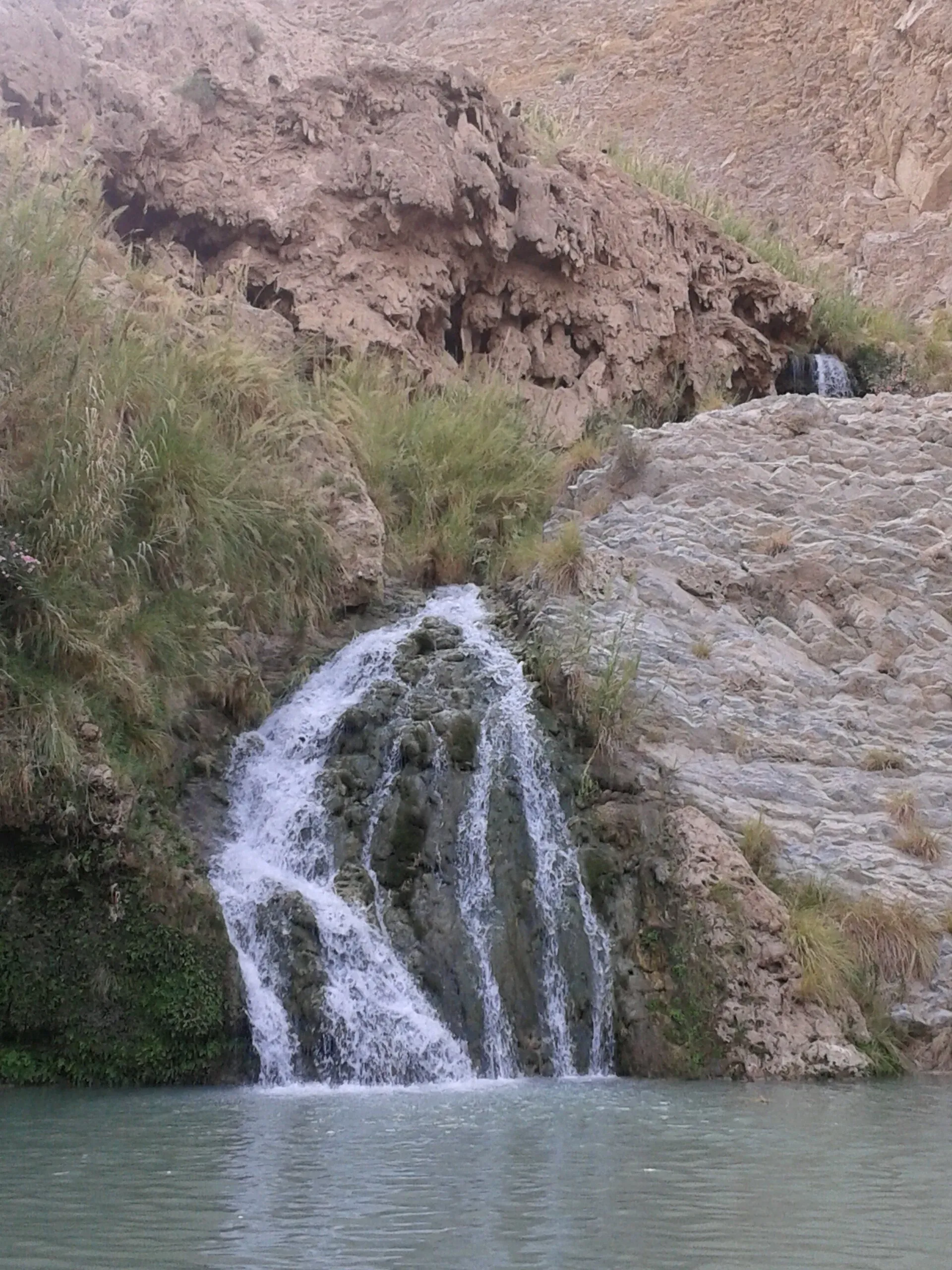
Photo: Najamuddin Shahwani, with thanks · CC BY 3.0 · via Wikimedia Commons · temporary stand-in photo

Pir Ghaib Waterfall
A shrine-side cascade of about 15 m in the Bolan valley of Balochistan, around 70 km from Quetta. Drownings have been reported here. For foreign visitors: the UK FCDO advises against all travel to Balochistan.
Overview
Pir Ghaib Waterfall is a cascade in the Bolan valley of Balochistan, about 70 km south-east of Quetta by the figure given in Wikipedia, Daily Times (28 May 2019) and Quetta Voice (16 May 2021). The fall is about 15 m high and drops in two stages down a rocky mountainside. Water runs through several streams and ponds, with palm trees giving shade. It is a place of belief as well as a picnic spot: local Hindus honour the Pir Ghaib as Mahadev, and Muslim tradition remembers him as a saint.
Plan your visit
- Nearest town
- Quetta
- Getting there
Drive south-east from Quetta into the Bolan valley, about 70 km by Wikipedia and Daily Times; OSRM routes about 88 km in 81 minutes (checked 16 November 2026). More
Best months
Mar – Apr, Oct – Nov
- Pir Ghaib Waterfall
- Related places nearby: Bolan Pass, Quetta
The legend of the Invisible Saint
Accounts vary in detail. In the version recorded on Wikipedia, Pir Ghaib and his sister Bibi Nani came to call local people to Islam in its early days. Fire worshippers sent an army after them. At the Bolan gorge the two parted: Bibi Nani went down the gorge, and a tomb said to be hers lies under a bridge about 15 km downstream. Pir Ghaib fled up the dry valley, was cornered against a rock wall at the head of the gorge, and prayed for rescue. The rock split to receive him, and he became known as Pir Ghaib, "the Invisible Saint". Daily Times tells it with a ruthless king in place of the army, and adds that Pir Ghaib was warned in a dream and fled barefoot. The falls carry his name, and the story says water has flowed here ever since.
The Bolan valley
The fall lies on the old Bolan Pass route. The pass is an 89 km stretch of the Bolan River valley through the Toba Kakar range, running from Rindli (Dhadar) in the south to Darwaza near Kolpur in the north, and it links Sibi and Quetta by road and rail. Armies and traders have used it for centuries: Ahmad Shah Durrani went through in 1748, and a British army under Sir John Keane crossed in 1839. A traveller in 1841 described how rain in the high mountains could send a sudden flood down the valley, sweeping away people and property. Summers are very hot and winters very cold. See the Bolan Pass page for the wider route.
What to see and do
- The falls and pools. Two separate falls pour into a pool of cool water, with streams and palms along the rock face.
- The shrine and the story. Treat the site as holy. Dress modestly, remove shoes where asked, and ask before photographing worshippers.
- A day out from Quetta. Quetta Voice says visitors come from across Balochistan every summer. A sensible plan is an early start from Quetta, time at the falls, and the return drive in daylight.
When to visit
No official season is published. Quetta Voice describes summer as the peak season for visitors, but the valley is hot then. Flow depends on spring water and rain, so it varies.
Where to stay and eat
Quetta has the nearest hotels. No facilities at the fall are described in the sources.
Good to know
- Distance. Wikipedia and Daily Times give about 70 km from Quetta. The OSRM routing service gives about 88 km and 81 minutes to the map position (an estimate, checked 16 November 2026).
- Safety. On 16 May 2021 two young visitors drowned during a picnic at Pir Ghaib, and the same report says the falls have claimed many lives (Quetta Voice). Do not swim, and keep children away from the pools.
- Fees. No official fee information found; current fees will be added soon.
- Etiquette. Keep the water and shrine area free of litter.
- Travel advice. For foreign visitors: the UK FCDO page (updated 27 October 2026, checked 16 November 2026) advises against all travel to Balochistan Province. Read the current page before making any plan.
Highlights
- Cascade of about 15 m in two drops
- Shrine honoured by Muslims and Hindus
- Palm-shaded pools in the Bolan valley
- About 70 km from Quetta
Getting there
Drive south-east from Quetta into the Bolan valley, about 70 km by Wikipedia and Daily Times; OSRM routes about 88 km in 81 minutes (checked 16 November 2026). Sources disagree on the nearest town (Mach or Sibi Road), so ask locally for the turn-off.
Tips
- Do not swim; drownings are reported
- Dress modestly and respect the shrine
- Check FCDO advice and local security news first
- Travel in daylight and use a local driver
Photos we still need: the two falls and pool, and the shrine area (a second, specific photo). Send us yours
Sources and last checked
Last checked Confidence medium6 sources5 still to check
- Last checked
- Method
- Desk research from published sources
- Confidence
- medium
- Checked by
- trek.pk research team
Researched from published sources; not yet checked on the ground by our team. Spot something out of date? Report a mistake.
Sources
- Pir Ghaib Waterfall · Wikipedia · checked
- The panoramic beauty of Baloch waterfalls · Daily Times · checked
- 2 tourists drowned in Pir Ghaib Bolan · Quetta Voice · checked
- OSRM demo routing service (driving routes) · Project OSRM · checked
- Pakistan travel advice: warnings and insurance · UK Foreign, Commonwealth & Development Office · checked
- Bolan Pass · Wikipedia · checked
Still to be checked on the ground (5)
- Distance from Quetta (Wikipedia and Daily Times say 70 km; OSRM to the map point gives about 89 km in 84 minutes, re-run 17 Nov 2026)
- Nearest town and exact turn-off (Wikipedia names none; Mach and Sibi Road both suggested elsewhere)
- Best months (no source gives a season)
- Security and access status (FCDO advises against all travel to Balochistan; nothing site-specific found)
- Which accounts of the legend are locally current (sources differ)
Nearby and related

Bolan Pass
An 89 km gorge route from Sibi to Quetta, with a highway and a railway. A key route since early times, but the FCDO advises against all travel in Balochistan.

Quetta
Balochistan's high-valley capital, the Fruit Garden of Pakistan: bazaars, sajji, orchard valleys and the base for Hanna Lake and Ziarat.