

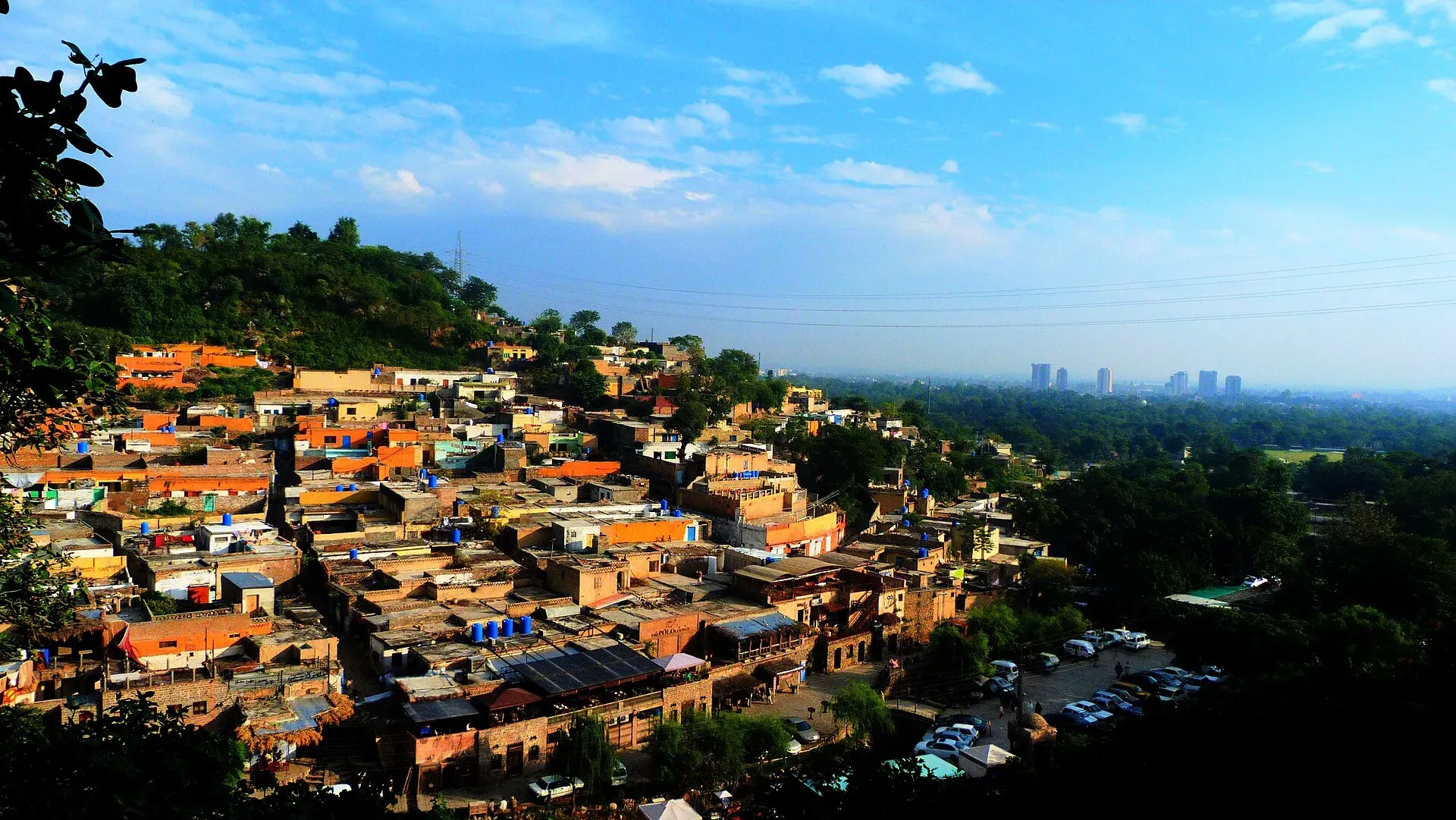
Photo: Naveed Hassan, with thanks · CC BY-SA 3.0 · via Wikimedia Commons · temporary stand-in photo

Saidpur Village
A restored Mughal-era village in a ravine of the Margalla Hills, with an old temple, a gurdwara, craft shops and cafes close to Daman-e-Koh.
Overview
Saidpur is an old village in a ravine of the Margalla Hills, close to the Daman-e-Koh viewpoint, and one of the union councils of Islamabad Capital Territory. It lies at about 620 m. Wikipedia gives a 2015 population estimate of 12,000 to 15,000. It is older than Islamabad by several centuries, and today it is both a place where people live and a visitor stop, with an animal market and sales of local pottery and handicrafts providing income for residents.
Plan your visit
- Nearest town
- Islamabad
- Getting there
From the centre of Islamabad it is about 14 km and 12 minutes by road (OSRM; checked 16 November 2026), longer in evening traffic. Take a taxi or ride-hailing car; More
Best months
Mar – Apr, Oct – Nov
- Saidpur Village
- Related places nearby: Islamabad, Daman-e-Koh, Margalla Hills National Park, Pir Sohawa, Lok Virsa Heritage Museum
History
Wikipedia says the village was founded in 1530 by Mirza Fateh Ali and first called Fatehpur Baoli (a baoli is a step-well). The emperor Akbar later gave it to Said Khan Gakhar as a reward for the Gakhar family's service against Sher Shah Suri, and it took the name Saidpur. Said Khan's daughter married Akbar's son Saleem, later the emperor Jahangir, and Saidpur went to him as a wedding gift. Jahangir's memoir mentions a stay at a village beyond Rawalpindi that is believed to be Saidpur, then a garden resort fed by a natural spring.
In 1580 the commander Raja Man Singh set the village up as a place of Hindu worship. Ponds were built and named after figures in the Ramayana: Rama, Sita, Lakshman and Hanuman. Hindus from Rawalpindi came here to celebrate Baisakhi, the spring festival, and records from 1893 describe an annual fair at the Rama pond.
The temple and gurdwara
The 16th-century Rama temple (Ram Mandir, also called the Ram Kund temple) is dedicated to Rama, and Hindu tradition holds that he lived nearby during his exile. Pilgrims once stayed in an adjoining dharamshala (pilgrims' rest house). The idols have been removed and the temple has not been used for worship since 1947. From 1960 to 2006 it served as a girls' school.
Sikhs built a gurdwara next to the temple in the 20th century, and it also served as a school. Until 1947 Hindu and Sikh worship went on side by side here, with a mosque, a church and the shrine of a saint known as Zinda Pir close by.
Local Hindu residents have asked for the temple to reopen for worship, since the nearest working temple is in Rawalpindi. Some have also said that visitors walk inside in shoes. Treat both buildings as sacred places, not as backdrops.
The 2006 restoration
From 2006 the Capital Development Authority (CDA) remodelled the village as an arts and crafts village, spending about Rs 400 million according to Wikipedia. Historic buildings were refurbished, local mud houses were given a new face, and the stream was cleaned. The CDA kept the old school building, an old Sufi tomb, the temple and the gurdwara. A small museum of old pictures of Islamabad opened in the north-west corner, and an art gallery and restaurants were added.
The restoration has also drawn criticism. Wikipedia reports residents saying that carvings of goddesses were painted over, that restaurants now stand on the sites of former ponds, and that nearby streams carry sewage.
What to see and do
- The lanes. Walk the stepped lanes between refurbished houses and the stream channel.
- The old temple and gurdwara. Visit them as heritage, quietly and with respect.
- Craft shops and galleries. Pottery and handicrafts are sold here, and there is an art gallery and the small museum.
- Cafes and restaurants. Many sit on terraces with views over the ravine.
- Marghzar Cricket Ground. One of Islamabad's older grounds lies in the village and is used mainly for domestic cricket.
- The Margalla trails. Trail routes lead up from the village, but check which are open before you set out.
One simple outline for half a day: walk the lanes and the temple and gurdwara in the late afternoon, look at the craft shops and the museum, then eat on a terrace as the light goes. Daman-e-Koh is a short drive away if you want a view over the city.
When to visit
Spring and autumn are best. Summer afternoons are hot, and the monsoon months can make the stepped lanes slippery. Evenings are the busiest time.
Where to stay and eat
There are restaurants and cafes in the village itself. Hotels are in Islamabad's main sectors, 15 to 25 minutes away.
Good to know
- Redevelopment. In August 2025 CDA cleared illegal construction from the village and announced plans for further development. Expect building work and changes to the layout.
- Entry and hours. No official fee or opening notice is published; ask CDA. Current fees will be added soon if any apply.
- Litter. Keep your rubbish with you.
- Nearby. Daman-e-Koh, Pir Sohawa, the Margalla Hills National Park and Lok Virsa are all within a short drive.
Highlights
- Mughal-era village founded in 1530
- Preserved old temple and gurdwara
- Craft shops, gallery and terrace cafes
- Close to Daman-e-Koh and Margalla trails
Getting there
From the centre of Islamabad it is about 14 km and 12 minutes by road (OSRM; checked 16 November 2026), longer in evening traffic. Take a taxi or ride-hailing car; the village sits in the Margalla Hills below Daman-e-Koh. There is no train service; the nearest railway station is at Rawalpindi.
Tips
- Come in the evening for lamps and cooler air.
- Wear shoes with grip; the lanes are stepped.
- Treat the temple and gurdwara as sacred sites.
- Take rubbish with you.
Photos we still need: the Rama temple and gurdwara; the stepped lanes and a terrace cafe. Send us yours
Sources and last checked
Last checked Confidence medium3 sources3 still to check
- Last checked
- Method
- Desk research from published sources
- Confidence
- medium
- Checked by
- trek.pk research team
Researched from published sources; not yet checked on the ground by our team. Spot something out of date? Report a mistake.
Sources
- Saidpur, Islamabad · Wikipedia · checked
- Islamabad set to get international standard tourist and commercial hub · ProPakistani · checked
- OSRM routing (driving distances) · OSRM project · checked
Still to be checked on the ground (3)
- Current state of redevelopment and what is open (ProPakistani, 20 Aug 2025: plans for a tourist and commercial hub, new restaurants and auctions of vacated properties, no timeline; nothing newer found)
- Opening hours and any entry charge (not in Wikipedia or ProPakistani)
- Condition of trails from the village (no source)
Nearby and related

Islamabad
Pakistan's green, planned capital at the foot of the Margalla Hills: Faisal Mosque, hillside trails, cafes and the gateway to the north.

Daman-e-Koh
A hilltop garden and lookout in the Margalla Hills, about 731 m up and 16 km by road from central Islamabad. It looks over the city's sectors, Faisal Mosque and Rawal Lake.

Margalla Hills National Park
The green hills above Islamabad: hiking trails, viewpoints, leopards and goral, a few minutes from the city centre. Established in 1980 and covering about 174 square kilometres.

Pir Sohawa
A hill-top spot on the Margalla Hills at about 914 m, 22 km by road from central Islamabad. It is a lookout, a trailhead and a cafe stop above the city.

Lok Virsa Heritage Museum
Pakistan's national museum of ethnology on Shakarparian Hill, Islamabad, showing the crafts, costumes and living traditions of the country's peoples.