

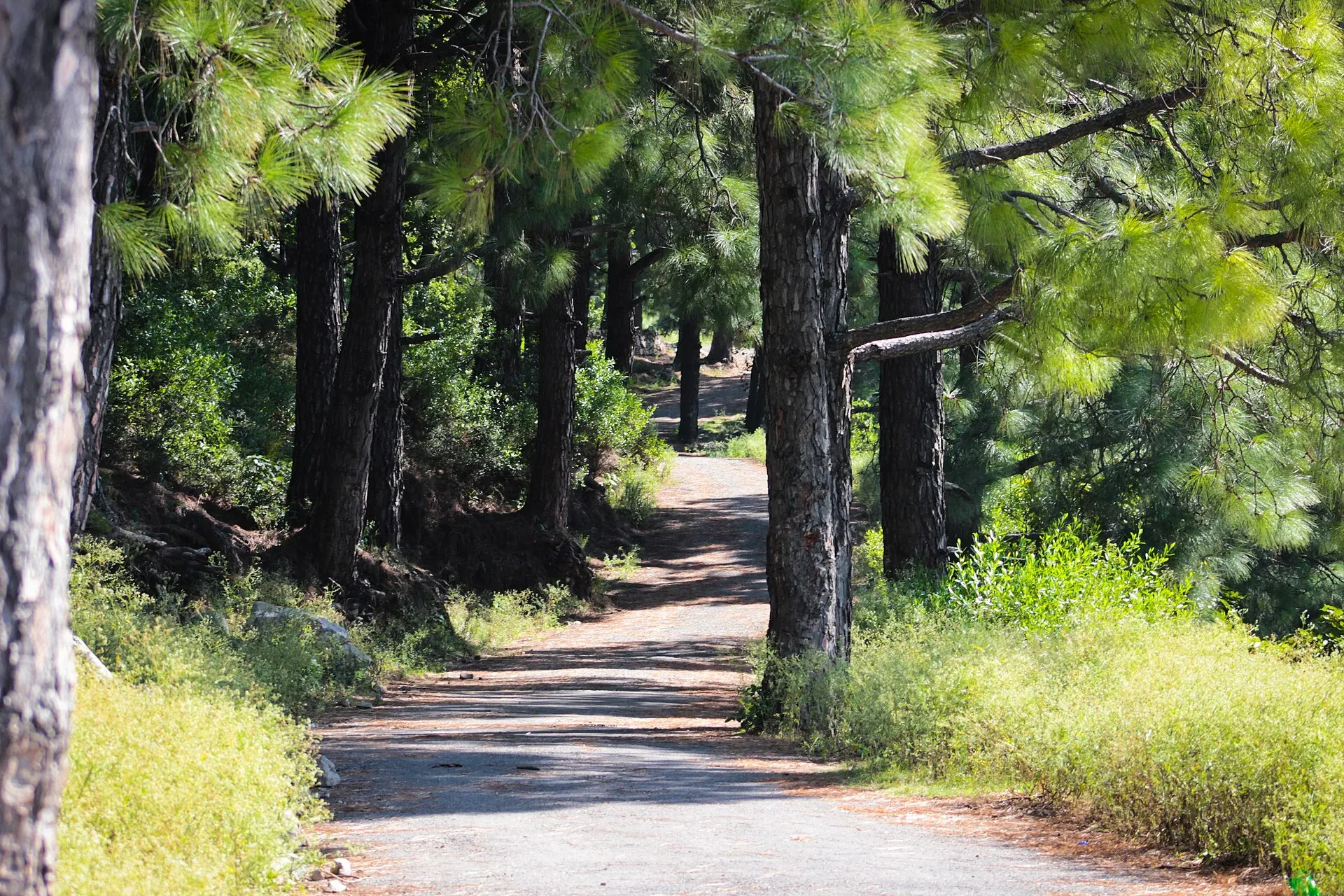
Photo: AhmedKamal92, with thanks · CC BY-SA 3.0 · via Wikimedia Commons · temporary stand-in photo

Margalla Hills National Park
The green hills above Islamabad: hiking trails, viewpoints, leopards and goral, a few minutes from the city centre. Established in 1980 and covering about 174 square kilometres.
Overview
Margalla Hills National Park sits on the northern edge of Islamabad, where the city meets the first foothills of the Himalaya. It was established in 1980 and covers about 17,386 hectares (around 174 square kilometres), which Wikipedia calls the third-largest of Pakistan's national parks that it lists; it also includes Rawal Lake and the Shakarparian area, and is IUCN Category V. Around 600 plant species, 402 bird species and 38 mammal species are reported. The park includes the Margalla Hills themselves, Rawal Lake and the Shakarparian area. The hills rise from about 685 m at the western end to 1,604 m at Tilla Charouni, the highest point.
For most visitors this is the easiest place in Pakistan to walk in real forest. Chir pine, olive and phulai trees cover the slopes, and there are springs and streams that run hard after the monsoon. Wildlife is better than you might expect so close to a capital. Leopards, grey goral, barking deer, wild boar, jackals and rhesus macaques all live here, together with several hundred bird species. Global IUCN Red List status (as given on Wikipedia): leopard Vulnerable, grey goral Near Threatened, and barking deer (red muntjac), wild boar, golden jackal and rhesus macaque all Least Concern. These are worldwide ratings, not local ones.
Plan your visit
- Nearest town
- Islamabad
- Getting there
The park is inside Islamabad. Trail 3 and Trail 5 start from Margalla Road and nearby entrances, a 10 to 20 minute drive from most central sectors. Daman-e-Koh and Pir Sohawa are reached by paved road. More
Best months
Oct – Apr
- Margalla Hills National Park
- Related places nearby: Islamabad, Daman-e-Koh, Pir Sohawa, Saidpur Village, Shah Allah Ditta Caves, Rawal Dam and Rawal Lake, Shakarparian, Faisal Mosque, Lake View Park, Taxila
Landscape and geology
Wikipedia describes the hills as limestone mixed with sandstone and some shale, dating to the Miocene, and says the area was seabed 40 to 50 million years ago, so the rocks contain marine fossils. The range marks the start of the Himalayan foothills. Islamabad's climate is humid subtropical, with about 1,457 mm of rain a year, and snow fell on the hills in 2012 and 2016.
What to see and do
- Hiking. Several marked trails climb from the city side. Trail 3 starts at F-6/3 and climbs steeply. Trail 6 leads towards Monal. Trails and their open status change, so ask at the trailhead or the Islamabad Wildlife Management Board.
- Viewpoints. Daman-e-Koh and Pir Sohawa are reached by road and give wide views over Islamabad and Rawal Lake. Pir Sohawa is the higher of the two. Wikivoyage says the walk from Trail 3 (which starts at F-6/3) takes about two hours uphill, and the drive about 35 to 40 minutes.
- Paragliding. Wikivoyage says paragliding is offered through the Pakistan Adventure Foundation; book ahead.
- Saidpur village. A restored village at the foot of the hills with a small trail start, craft shops and cafes.
- Shah Allah Ditta caves. Wikipedia says the caves are about 2,500 years old and hold Buddhist-era murals, seven lamp alcoves and a painting of Shiva. See Shah Allah Ditta caves.
- Rawal Lake. The reservoir on the park's southern side is good for birdwatching, especially in winter when migratory waterfowl arrive.
- Birds and wildlife. Dawn and late afternoon are best. Himalayan vulture, kalij pheasant, paradise flycatcher and bulbuls are among the birds recorded.
When to visit
October to April is the most comfortable time, with cool, clear weather. May to September can be very hot on the lower trails, so start at first light. During the monsoon (July and August) paths are slippery and there are leeches. Haze and cloud can hide the views.
Where to stay and eat
You do not need to stay inside the park. Islamabad has hotels in every price range, and there are restaurants and cafes at Pir Sohawa, Daman-e-Koh and Saidpur village. The Monal restaurant on the first ridge was demolished in 2024 under a Supreme Court order, so older guides that send visitors there are out of date. Camping on the hills is not generally allowed.
Good to know
- A fee may apply. Current fees will be added soon; check with the park office or the provincial wildlife department before you go.
- Follow the standard park rules: take your litter out with you, do not light fires outside marked sites, do not pick plants or disturb animals, and do not hunt. Hunting and trapping inside a national park are offences. Ask the park office before flying a drone; many parks need written permission and drones are banned near borders and sensitive sites.
- Do not feed the monkeys or leave food out; it makes them bold and aggressive.
- Leopards are present. Walk in a group, stay on marked trails, keep dogs on a lead and be off the hills before dark. If you meet a leopard, do not run; face it, keep calm and back away slowly.
- Wikivoyage advises starting early, before 7:30 am (6:30 am in peak summer), with sturdy shoes and plenty of water, because even the first ridge is a steep climb in heat.
- Carry water and tell someone your route. Mobile signal is patchy on some trails.
- The park has had disputes over development inside it, such as restaurants and new roads. Wikipedia lists quarrying by stone-crushing plants, tree felling and fires, encroachment and poaching among the threats. Details change, so check current news.
Highlights
- Marked hiking trails minutes from Islamabad
- Viewpoints at Daman-e-Koh and Pir Sohawa
- Leopard, grey goral, barking deer and over 400 bird species
- Rawal Lake birdwatching in winter
Getting there
The park is inside Islamabad. Trail 3 and Trail 5 start from Margalla Road and nearby entrances, a 10 to 20 minute drive from most central sectors. Daman-e-Koh and Pir Sohawa are reached by paved road. Taxis and ride-hailing cars work well; public transport to the trailheads is limited.
Tips
- Start early in summer and finish before dark
- Walk in groups and keep to marked trails
- Do not feed monkeys
- Take all litter home
Wildlife
Facilities
- Marked hiking trails
- Roads to Daman-e-Koh and Pir Sohawa
- Restaurants and cafes at viewpoints
- Rawal Lake
Photos we still need: Saidpur village, Rawal Lake birdlife, Shah Allah Ditta caves. Send us yours
Sources and last checked
Last checked Confidence medium10 sources4 still to check
- Last checked
- Method
- Desk research from published sources
- Confidence
- medium
- Checked by
- trek.pk research team
Researched from published sources; not yet checked on the ground by our team. Spot something out of date? Report a mistake.
Sources
- Margalla Hills National Park (Wikipedia) · Wikipedia · checked
- Pakistan Tourism Guide 2021 · TDAP Pakistan · checked
- Leopard · Wikipedia · checked
- Himalayan goral · Wikipedia · checked
- Red muntjac · Wikipedia · checked
- Rhesus macaque · Wikipedia · checked
- Wild boar · Wikipedia · checked
- Golden jackal · Wikipedia · checked
- Islamabad · Wikivoyage · checked
- Margalla Hills · Wikipedia · checked
Still to be checked on the ground (4)
- Entry fees and any ticketing at trailheads and Daman-e-Koh (no official source reachable; iwmb.org.pk did not resolve)
- Which trails are open or restricted today (Wikipedia lists seven trails, Trail 3 and 5 most used; no status)
- Opening and closing times of trails (no source)
- Paragliding operator and current availability (Wikivoyage, undated)
Nearby and related
Margalla Trail 4

Islamabad
Pakistan's green, planned capital at the foot of the Margalla Hills: Faisal Mosque, hillside trails, cafes and the gateway to the north.

Daman-e-Koh
A hilltop garden and lookout in the Margalla Hills, about 731 m up and 16 km by road from central Islamabad. It looks over the city's sectors, Faisal Mosque and Rawal Lake.

Pir Sohawa
A hill-top spot on the Margalla Hills at about 914 m, 22 km by road from central Islamabad. It is a lookout, a trailhead and a cafe stop above the city.

Saidpur Village
A restored Mughal-era village in a ravine of the Margalla Hills, with an old temple, a gurdwara, craft shops and cafes close to Daman-e-Koh.

Shah Allah Ditta Caves
Rock shelters at the foot of the Margalla Hills in Islamabad, linked to Buddhist-era use and later to Hindu and Muslim ascetics. A short stop beside a small shrine and the start of the Margalla Ridge Trail.

Rawal Dam and Rawal Lake
Rawal Dam, opened in 1962, forms Rawal Lake in Islamabad's Margalla foothills. Lake View Park and Dam Park give public viewpoints; the lake is also Islamabad and Rawalpindi's water supply.

Shakarparian
A low hill and park near Zero Point in Islamabad. Its terrace at the Pakistan Monument gives easy views over the city to the Margalla Hills, best near sunset.

Faisal Mosque
Pakistan's national mosque, at the foot of the Margalla Hills in Islamabad. A tent-shaped hall with no dome and four 90 m minarets, open to respectful visitors outside prayer times.

Lake View Park
A CDA-run recreation park on the edge of Rawal Lake in Islamabad, with a large walk-in aviary, picnic lawns, a festival arena and boating on some days.

Taxila
The ruins of several ancient cities and Buddhist monasteries near Islamabad, inscribed by UNESCO in 1980. Taxila was a crossroads of Gandhara, Greek, Persian and Kushan culture, with a fine museum.