

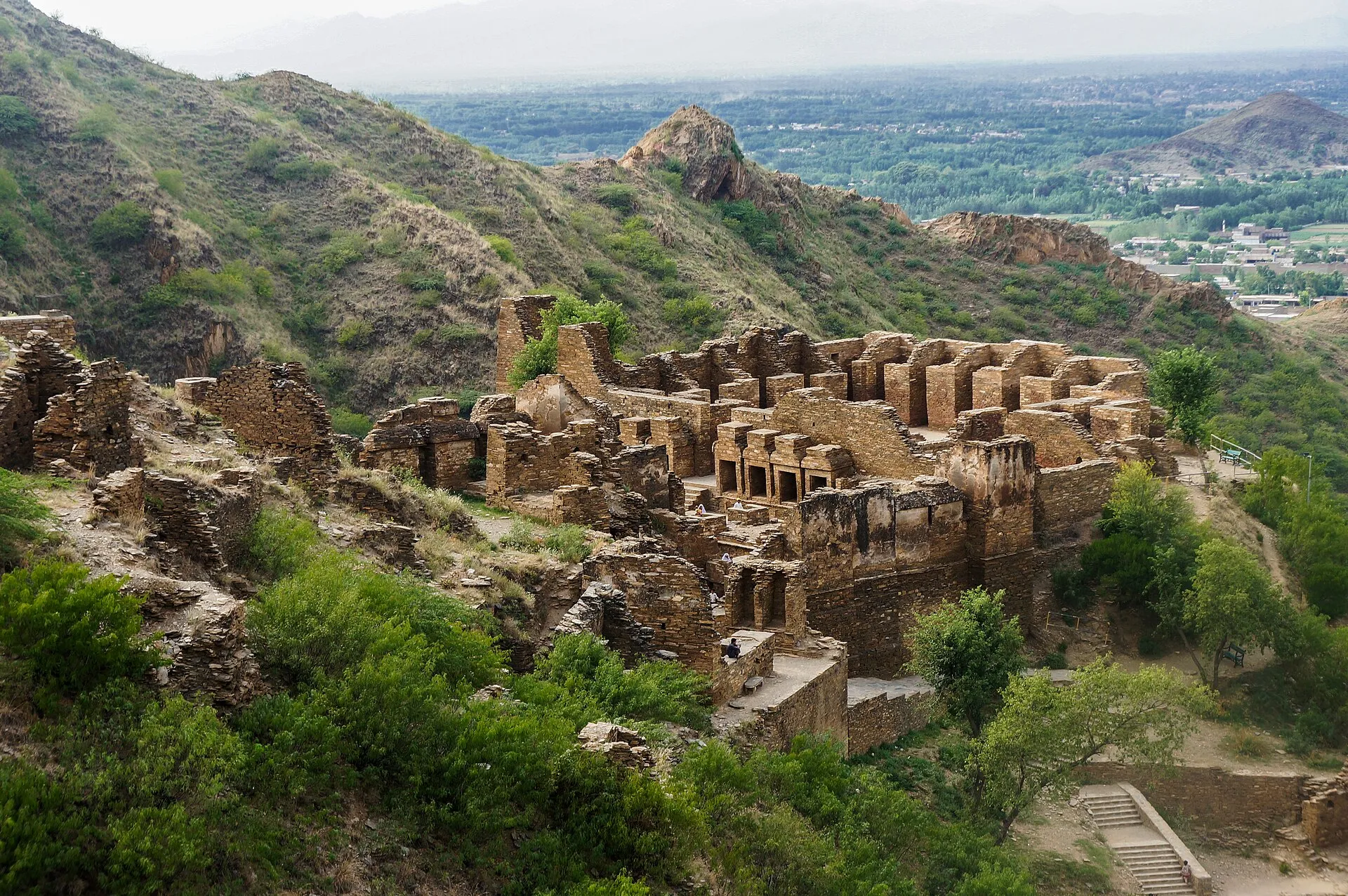
Photo: Asif Nawaz, with thanks · CC BY-SA 3.0 · via Wikimedia Commons · temporary stand-in photo

Takht-i-Bahi and Sahr-i-Bahlol
A hilltop Buddhist monastery near Mardan, founded in the early 1st century CE, with the ruins of a small walled town at Sahr-i-Bahlol. UNESCO World Heritage Site since 1980.
Overview
Takht-i-Bahi is a ruined Buddhist monastery on a rocky hill about 15 km from Mardan, in Khyber Pakhtunkhwa. It is one of the best preserved monasteries of the Gandhara period. Because it sits on top of a hill, it escaped much of the damage that fell on sites in the plains. Sahr-i-Bahlol, the remains of a small walled town nearby, is part of the same World Heritage listing.
UNESCO inscribed "Buddhist Ruins of Takht-i-Bahi and Neighbouring City Remains at Sahr-i-Bahlol" in 1980 (reference 140, criterion iv). UNESCO dates the monastery's foundation to the early 1st century CE.
The name is usually read as "spring on the top". Takht can mean "throne" or "top", and bahi is linked to "spring" or "water", after two springs on the hilltop. Another reading is "throne of origin".
Plan your visit
- Nearest town
- Mardan
- Getting there
Takht-i-Bahi is on the Malakand Road about 15 km from Mardan. From Mardan, take a taxi or local transport towards Takht Bhai. More
Best months
Oct – Mar
- Takht-i-Bahi and Sahr-i-Bahlol
- Related places nearby: Peshawar, Khyber Pakhtunkhwa
History
An inscription naming the Indo-Parthian king Gondophares (reigned about 20 to 46 CE) was found at the site. Later the Kushan kings controlled the area. Archaeologists describe four building phases: the oldest buildings belong to the first centuries BCE and CE, a second phase (3rd to 4th century) added the Stupa Court and an assembly hall, and a later phase is linked to the Kidara Kushans (4th to 5th century). The Huns overran the region in the mid-5th century and damaged the complex, but monks appear to have used it until about the 7th century.
A French officer mentioned Buddhist remains near here in 1836. Exploration and excavation began in 1864, and a major restoration took place in the 1920s. Sculpture from the site is now in museums abroad. Wikipedia lists a stair-riser showing devotees in Greek-style dress in the British Museum, Buddha figures in the Museum für Indische Kunst in Berlin, and a standing Buddha in the Cleveland Museum of Art. For finds kept in Pakistan, see the Peshawar Museum.
What to see and do
The ruins climb the hill in terraces, so expect steps and a fair amount of walking on uneven stone. They sit about 150 m up the hill and roughly 2 km from the village bazaar. A road and car park now lie below the ruins. The buildings are local stone laid with lime and mud mortar, and the layered stonework is one of the first things to notice.
- Stupa Court: a courtyard crowded with small votive stupas and shrines around a main stupa.
- Monastic cells: rows of small rooms around a courtyard, with assembly halls and a dining area.
- Temple complex: a second group of stupas built later than the Stupa Court.
- Dark cells: a block of tiny, low-doored rooms, possibly used for Tantric meditation.
- View: from the top you look over the plain towards Mardan.
Sahr-i-Bahlol is a separate visit. It is a low mound of walls, mostly of interest to people who already enjoy archaeology. Wikipedia says local people explain the name as Hindko for "Sir Bahlol", a local leader, though the village is older than that name.
When to visit
The cooler months, October to March, are the most comfortable for a climb in exposed ruins. Summer afternoons on the bare hill are very hot. Go early to get softer light for photographs.
Where to stay and eat
There are no places to stay at the site. Most visitors come on a day trip from Peshawar or Islamabad and eat in Mardan or Takht Bhai town, which has ordinary roadside restaurants.
Good to know
- Entry and opening hours: a ticket is required. Official fees and hours are not confirmed for this guide, so current fees will be added soon. Check with the Khyber Pakhtunkhwa Directorate of Archaeology and Museums.
- Dress and behaviour: dress modestly, do not climb on walls or stupas, and do not take stones or fragments.
- Photography: for personal photos there is normally no issue, but ask the site staff about rules for tripods and drones.
Travel advice
Ask the district administration or local police about current conditions before you go. For foreign visitors: the UK FCDO advises against all but essential travel to Mardan (advice updated 27 October 2026, checked 17 November 2026). The same advice is against all travel to Peshawar, the usual starting point for a visit. Read the live advice before you plan.
Highlights
- Best preserved Buddhist monastery of the Gandhara period
- Terraced hilltop complex with stupa court and monks' cells
- UNESCO World Heritage Site since 1980
- Sahr-i-Bahlol town ruins about 5 km away
Getting there
Takht-i-Bahi is on the Malakand Road about 15 km from Mardan. From Mardan, take a taxi or local transport towards Takht Bhai. OSRM gives about 68 km and 1 hour 2 minutes from central Peshawar (checked 17 November 2026, optimistic) and about 18 km and 16 minutes from a central Mardan road. Wikipedia says the site is about 15 km from Mardan. Peshawar is on the FCDO advise-against-all-travel list, so read the advice first; ask locally for realistic travel times. Check current road and security conditions before you travel.
Tips
- Wear sturdy shoes, the paths are stone steps and rough ground.
- Bring water and a hat, there is little shade on the hill.
- Combine with a day in Peshawar or Mardan.
- Ask staff before flying a drone.
Photos we still need: Sahr-i-Bahlol ruins. Send us yours
Sources and last checked
Last checked Confidence medium6 sources2 still to check
- Last checked
- Method
- Desk research from published sources
- Confidence
- medium
- Checked by
- trek.pk research team
Researched from published sources; not yet checked on the ground by our team. Spot something out of date? Report a mistake.
Sources
- Buddhist Ruins of Takht-i-Bahi and Neighbouring City Remains at Sahr-i-Bahlol · UNESCO World Heritage Centre · checked
- Takht-i-Bahi (Wikipedia) · Wikipedia · checked
- Pakistan Tourism Guide 2021 · TDAP · checked
- Takht-i-Bahi (OpenStreetMap place data) · OpenStreetMap / Nominatim · checked
- OSRM driving route service (Peshawar to Takht-i-Bahi; Takht-i-Bahi to Mardan), measured 17 November 2026 · OSRM / OpenStreetMap · checked
- Pakistan travel advice: warnings and insurance (updated 27 October 2026) · UK Foreign, Commonwealth & Development Office · checked
Still to be checked on the ground (2)
- Opening hours and ticket price (not in Wikipedia; UNESCO page returns 403; no official page found)
- Current site arrangements: car park, ticketing, guides (Wikipedia gives none)
Nearby and related

Peshawar
Khyber Pakhtunkhwa's capital and one of South Asia's oldest living cities: the Gandhara museum, Qissa Khwani Bazaar, mosques and a strong food culture.

Khyber Pakhtunkhwa
Mountains, Buddhist ruins and old bazaars in north-west Pakistan: Swat, Kaghan, Chitral, the Kalash valleys, the Khyber Pass and Peshawar.

Islamabad
Pakistan's green, planned capital at the foot of the Margalla Hills: Faisal Mosque, hillside trails, cafes and the gateway to the north.