

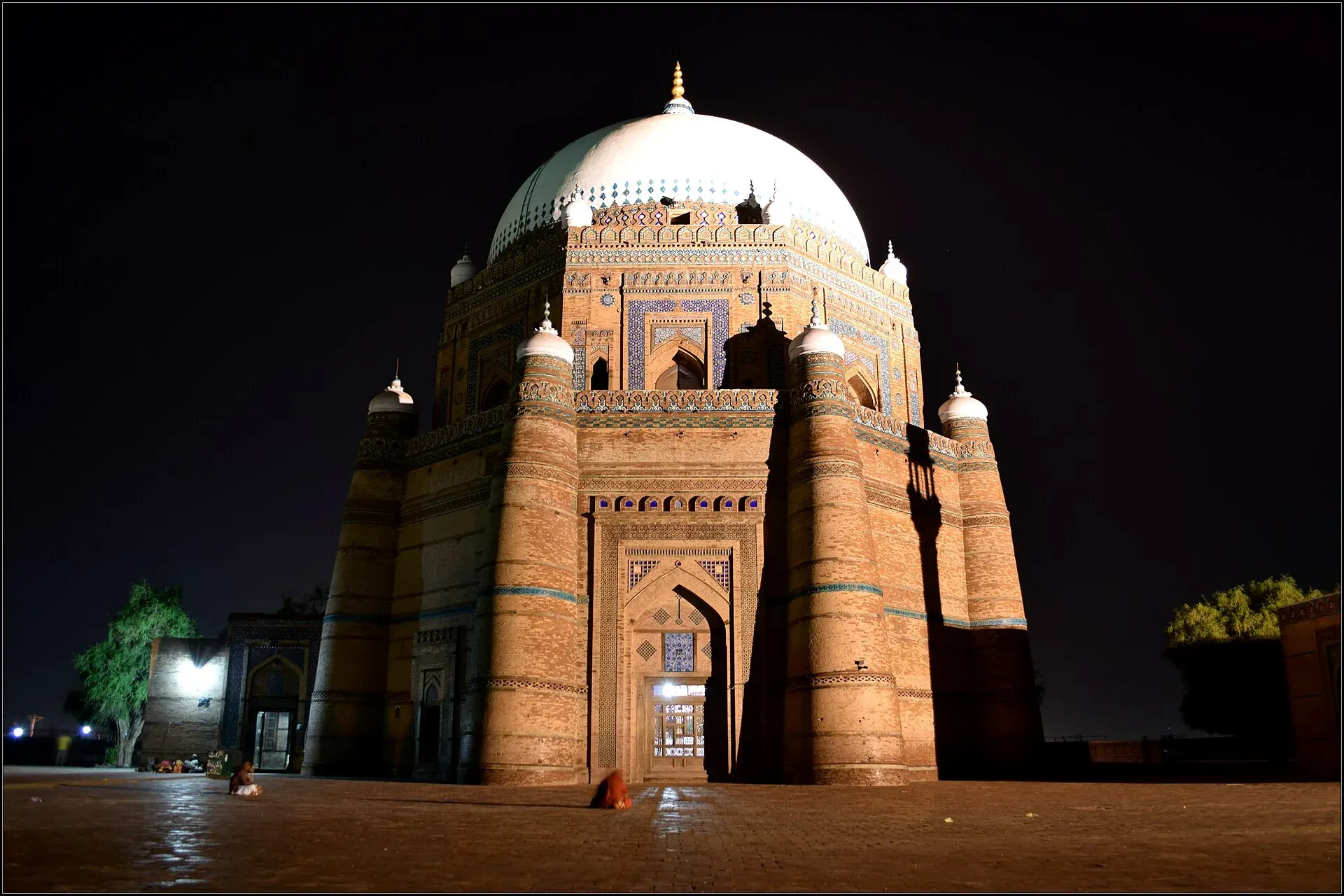
Photo: Junaidali88z, with thanks · CC BY-SA 3.0 · via Wikimedia Commons · temporary stand-in photo
Tomb of Shah Rukn-e-Alam
An octagonal brick tomb from the early 1300s on the edge of Multan Fort, with blue tilework and a dome rising about 35 m. A working shrine and on UNESCO's tentative list.
Overview
The Tomb of Shah Rukn-e-Alam is the most striking building in Multan. It stands on a raised mound at the north-western edge of Multan Fort, behind the old fort ruins, and can be seen from far across the city. It is the burial place of the Sufi saint Shah Rukn-e-Alam, and it is still a place of worship and pilgrimage. Wikipedia calls it the earliest example of Tughluq architecture and one of the most impressive shrines in the subcontinent. The annual urs festival, which marks the saint's death, draws more than 100,000 pilgrims, according to Wikipedia.
History
The tomb was built between about 1320 and 1324 by Ghiyath al-Din Tughluq while he was governor of Dipalpur, apparently as a tomb for himself. He later became sultan of Delhi. The tomb was built before the Tughluq monuments in Delhi. Shah Rukn-e-Alam, a Suhrawardi Sufi and the grandson of Bahauddin Zakariya, lived from about 1251 to 1335. He was first buried in his grandfather's shrine (see Shrine of Bahauddin Zakariya). The present tomb was given by Muhammad bin Tughluq to the saint's descendants, and the remains were moved here in about 1330. The Punjab Auqaf Department carried out major repairs in the 1970s using local tile-makers (kashigars).
The tomb has been on Pakistan's UNESCO tentative list since 1993 (it was listed again in 2004). It is not a World Heritage Site.
What to see and do
- The octagon. The tomb is an eight-sided building about 15 m across at its base, with walls about four feet thick. It rises in three tiers. Small tower-like buttresses at each corner narrow as they rise. A second octagon above carries a small dome at each corner, and a large dome about 15 m across crowns the whole. The total height is about 35 m, with sloping walls. A finial like the amalaka of a Hindu temple caps the dome.
- The materials. Red brick, banded with beams of shisham wood that have turned black over the centuries. Carved wooden panels, carved brick, string-courses and battlements decorate the outside. The battlements and turrets echo Tughluq military building. Glazed tile in dark blue, azure and white forms floral, arabesque and geometric patterns against the deep red brick, and blue tile runs round the foot of the white dome.
- The layout. The plan is typical of Suhrawardi tombs, with three entrances and a west-facing mihrab (the niche that shows the direction of prayer). The original main entrance was on the south axis, with a small vestibule. It has since been moved to the east.
- The interior. A single large chamber with no internal supports, with niches at ground level that widen the space. The walls were once tiled, then plastered over, and are now largely bare. A carved wooden mihrab is among the earliest of its type. The saint's grave sits slightly off-centre. It is surrounded by 72 graves of his relatives, which recall the 72 companions of Imam Hussein who were killed at Karbala in 680 CE.
- The view. The raised ground gives a view across Multan's old city and its domes.
Around the shrine
Wikivoyage (Multan) places the Bahauddin Zakariya shrine just behind the Rukn-e-Alam tomb on the old city mound. The fort itself is mostly ruins, with Fort Qasim Park and the Damdama viewpoint over the city. The old city's bazaars are close. Wikivoyage lists Hussain Agahi as a large, crowded market for textiles, spices, carpets, pottery and handicrafts, Kalay Manddi for cut-piece cloth, Sarafa Bazar for jewellery and Choorian Bazar for bangles. Multan is known for blue pottery and tiles, camel-skin lampshades and the traditional "Multani" shoes sold near the clock tower (Ghanta Ghar). See the Multan page.
When to visit
October to March is the most comfortable period; Multan is among the hottest cities in Pakistan in summer. The shrine is busiest around the saint's annual urs festival and on religious occasions.
Where to stay and eat
Multan has a range of hotels and its own food traditions. Wikivoyage names sohan halwa (a sweet of sugar, ghee and flour topped with nuts, with Qadeerabad suggested for seeing it made), mangoes, and street snacks such as dahi ballay and gol gappay. The areas around Multan Fort and the old city are convenient.
Good to know
- This is an active shrine. Cover your head and shoulders, wear loose clothing and remove shoes at the entrance. Women may be asked to use a separate area.
- Ask before taking photographs inside, and do not photograph people praying.
- Opening hours and any fee were not confirmed by an official source when this page was written. Current fees will be added soon; check with the Auqaf Department, Punjab.
Highlights
- Tughluq-style octagonal tomb, built about 1320-24
- Dome and octagon rise about 35 m
- Blue, azure and white tilework with carved timber
- Working Sufi shrine
- On UNESCO's tentative list
Getting there
The tomb is at the north-western edge of Multan Fort in the old city. From Multan railway station or the city centre, it is a short taxi, ride-hailing or rickshaw ride; many hotels in the old city are within walking distance. Multan is on the Lahore-Karachi railway line and has an international airport.
Tips
- Dress modestly: cover head and shoulders, and remove shoes.
- Go in the cooler months and early in the day.
- Ask before photographing inside the shrine.
- Combine with other Multan shrines and the old city bazaars.
Photos we still need: bazaars around Multan Fort. Send us yours
Sources and last checked
Last checked Confidence medium6 sources3 still to check
- Last checked
- Method
- Desk research from published sources
- Confidence
- medium
- Checked by
- trek.pk research team
Researched from published sources; not yet checked on the ground by our team. Spot something out of date? Report a mistake.
Sources
- Tomb of Shah Rukn-e-Alam · Wikipedia · checked
- Rukn-e-Alam · Wikipedia · checked
- List of World Heritage Sites in Pakistan (Tentative List) · Wikipedia · checked
- Tomb of Shah Rukn-e-Alam (Tentative List 1884) · UNESCO World Heritage Centre record via worldheritagesite.org · checked
- Pakistan Tourism Guide 2021 · Tourism Development Corporation of Pakistan (TDAP) · checked
- Multan (Wikivoyage) · Wikivoyage · checked
Still to be checked on the ground (3)
- Opening hours and any fee (not on Wikipedia; no official page opened)
- Date the remains were moved to the present tomb (Wikipedia says interred in 1330; the Rukn-e-Alam page says the tomb was granted for his burial in 1330 and the coffin moved later)
- Date of the annual urs (no source gives the Islamic date; he died 3 January 1335 per Wikipedia)

