

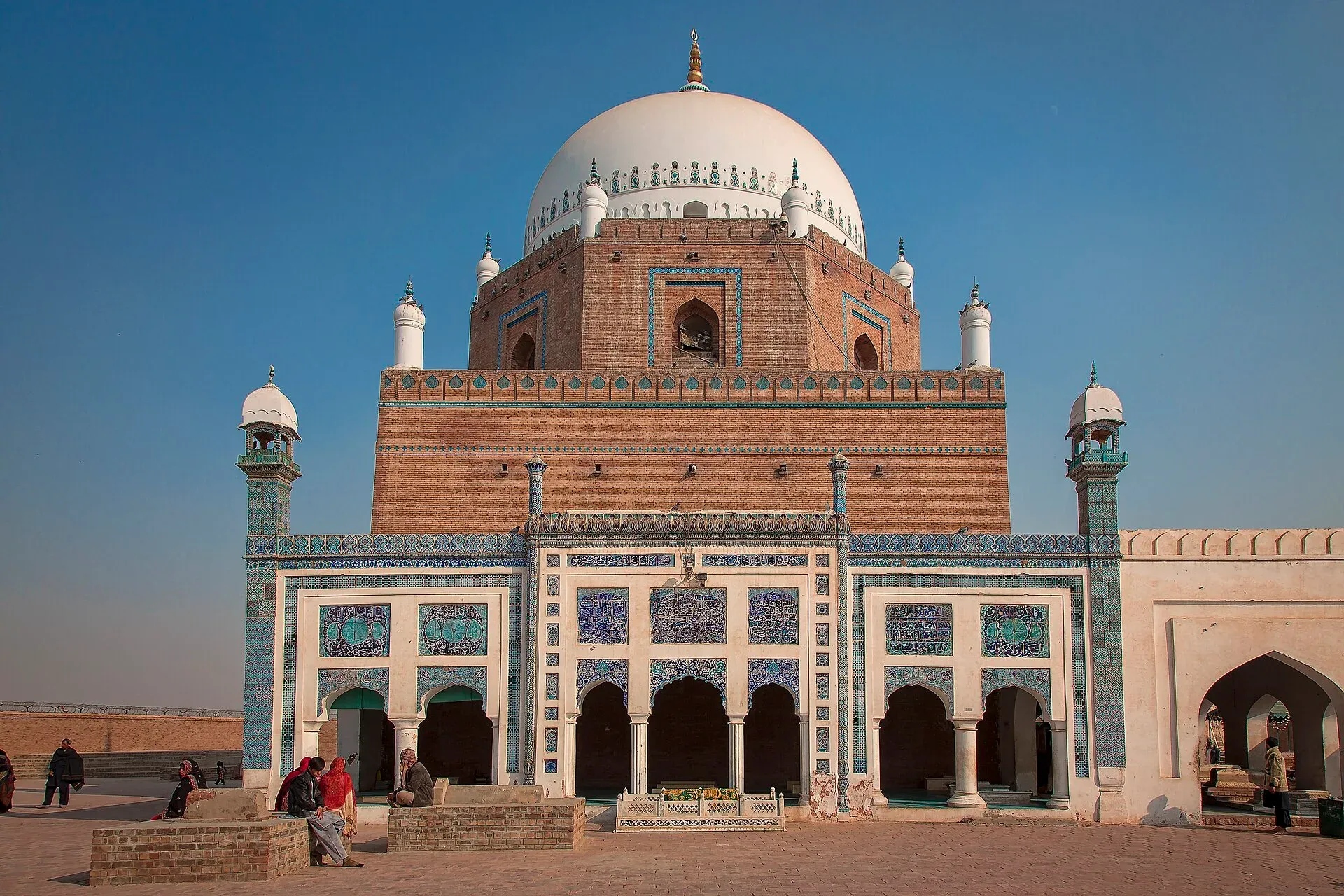
Photo: Tahsin Shah, with thanks · CC BY-SA 4.0 · via Wikimedia Commons · temporary stand-in photo

Shrine of Bahauddin Zakariya
The 13th-century shrine of the Sufi saint Bahauddin Zakariya in Multan, built in 1262 and a model for later Multani tomb architecture. A working shrine with blue tiles and nightly devotional music.
Overview
The Shrine of Bahauddin Zakariya in Multan is one of the most important Muslim shrines in southern Punjab. It honours the Sufi saint Bahauddin Zakariya of the Suhrawardiyya order and is a working shrine: people come to pray, tie threads as a sign of a wish, and listen to qawwali (devotional singing). Wikipedia calls it the prototype for the early shrines of southern Punjab and for Multan's classical style of tomb.
Zakariya's wilayat, or spiritual territory, is described as centred on Multan, with smaller shrines across the region. It borders the territory of the shrine of Baba Farid at Pakpattan. Popular belief holds that the saint protects boatmen on the Indus and Chenab, a link that reflects Multan's long history as a river city.
Plan your visit
- Nearest town
- Multan
- Getting there
The shrine is in central Multan beside Multan Fort and close to the tomb of Shah Rukn-e-Alam. From the railway station or old-city bazaars it is a short rickshaw or taxi ride. Multan has a railway station and an airport. More
Best months
Oct – Mar
- Shrine of Bahauddin Zakariya
- Related places nearby: Multan, Tomb of Shah Rukn-e-Alam
History
The shrine was completed in 1262, before the saint died in 1268. Unusually for a dervish (a Sufi ascetic), it was paid for by Zakariya himself, which Wikipedia reads as a sign of his financial independence.
In 1658 Dara Shikoh gave 25,000 rupees to the shrine after losing the Battle of Samugarh, in an unsuccessful bid to win the loyalty of Multan's citizens. During the British siege of Multan in 1848, the hereditary caretaker (sajjada nashin), Makhdoom Mahmud, aided the British against the Sikhs. British cannon fire nevertheless damaged the cupola and part of the upper tier, and repairs followed soon after. The walls around the courtyard were built in the 18th century by Nawab Ali Mohammad Khan Khakwani, the Durrani governor of Multan. A brick verandah with a painted wooden ceiling was added in 1952.
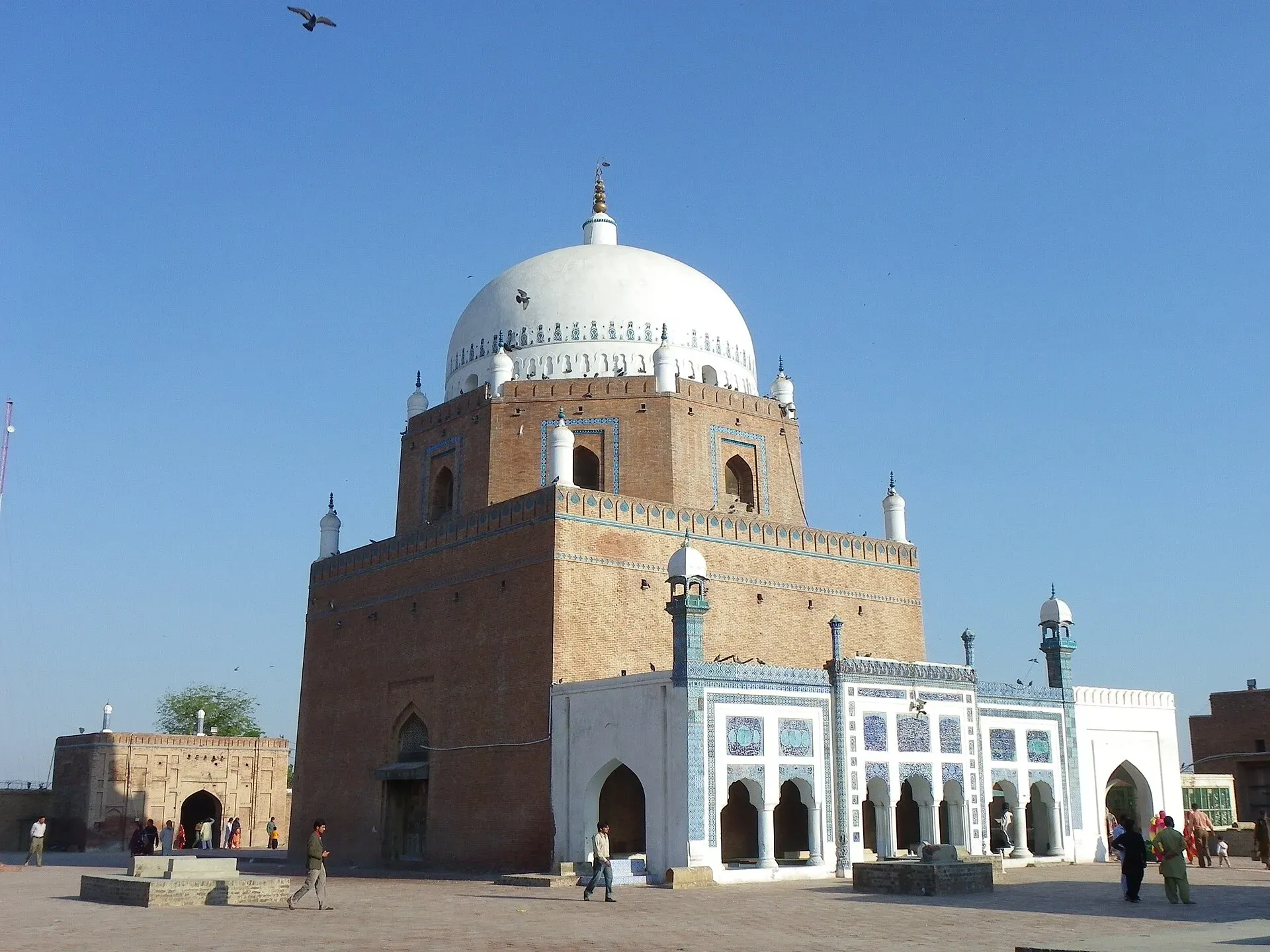
Photo: Masood Ahmad Khan, with thanks · CC BY-SA 3.0 · via Wikimedia Commons · temporary stand-in photo

The shrine is not on Pakistan's UNESCO tentative list, but the nearby tomb of his grandson, Shah Rukn-e-Alam, is.
What to see and do
- The tomb. A two-tier mausoleum of brick. The square base is about 15.8 m on each side. The octagonal upper tier is roughly half the height of the base and carries a white hemispherical dome.
- Glazed blue tile. Wikipedia calls it the earliest building in the area decorated with glazed blue tiles, a style that became typical of Multan and south Punjab. It links the technique to Central Asian builders working in the 13th century.
- The courtyard. A large space of several hundred square metres, ringed by the 18th-century wall and filled with hundreds of graves of descendants and devotees.
- The verandah and doors. The 1952 verandah has a painted wooden ceiling, and large wooden doors lead from it to the inner chamber.
- Threads of prayer. Visitors tie threads around the shrine as symbols of a request (a mannat).
- Devotional music. Qawwali and trance-like dance take place each night after evening prayers, according to Wikipedia.
- Nearby. Shah Rukn-e-Alam's tomb is a short walk away on the mound by Multan Fort.
When to visit
October to March is best. Multan is one of the hottest cities in Pakistan in summer. Visit in the morning or around sunset. Evening prayers are followed by the music, so late afternoon into the evening lets you see both the tilework in daylight and the shrine at its busiest.
Spending a morning in Multan
A suggested outline using the sights on this site. Start at the shrine early, before the heat, then walk to Shah Rukn-e-Alam's tomb on the fort mound. Continue into the old-city bazaars and see the Multan Clock Tower. Return at sunset if you want to hear the qawwali. More in the Multan guide.
Where to stay and eat
Multan has hotels at all levels and is known for sweets such as sohan halwa. The old-city bazaars near the fort are convenient.
Good to know and etiquette
- Dress modestly. Cover your head and shoulders and wear loose clothing. Remove shoes at the entrance. Arrangements for women are not documented here; ask at the entrance.
- Be respectful during prayers and qawwali. Ask before photographing people.
- Do not step on graves.
- The shrine has hereditary caretakers who claim descent from the saint. Ask at the shrine office or the Auqaf department about visiting hours and any charges; no official fees were confirmed. Fees will be added soon.
Highlights
- Built in 1262, before the saint's death in 1268
- Prototype for Multan-style tombs
- Early use of glazed blue tile
- Hundreds of graves in the courtyard
- Evening qawwali
Getting there
The shrine is in central Multan beside Multan Fort and close to the tomb of Shah Rukn-e-Alam. From the railway station or old-city bazaars it is a short rickshaw or taxi ride. Multan has a railway station and an airport.
Tips
- Visit October to March, early or late in the day.
- Cover your head and shoulders; remove shoes.
- Combine with the tomb of Shah Rukn-e-Alam nearby.
- Ask before taking photos.
Photos we still need: Multan old-city bazaars or sweet shops (for the morning outline). Send us yours
Sources and last checked
Last checked Confidence medium3 sources5 still to check
- Last checked
- Method
- Desk research from published sources
- Confidence
- medium
- Checked by
- trek.pk research team
Researched from published sources; not yet checked on the ground by our team. Spot something out of date? Report a mistake.
Sources
- Shrine of Bahauddin Zakariya (Wikipedia) · Wikipedia · checked
- Auqaf and Religious Affairs Department, Government of Punjab · Government of Punjab · checked
- Pakistan Tourism Guide 2021 · TDAP Pakistan (Trade Development Authority of Pakistan) · checked
Still to be checked on the ground (5)
- Visiting hours and arrangements for women
- Who runs visitor access (Wikipedia names hereditary caretakers; the Auqaf site lists the shrine but does not say it manages it)
- Entry charge, if any
- Exact distance to Shah Rukn-e-Alam tomb
- Urs dates (not found in an opened source)
Nearby and related

Multan
The City of Saints in southern Punjab: blue-tiled Sufi shrines, a crowded old city, blue pottery, sohan halwa and mangoes.

Tomb of Shah Rukn-e-Alam
An octagonal brick tomb from the early 1300s on the edge of Multan Fort, with blue tilework and a dome rising about 35 m. A working shrine and on UNESCO's tentative list.

Uch Sharif Monuments
A cluster of tiled Sufi tombs and a mosque in the old town of Uch Sharif near Bahawalpur, dating from the 13th to 15th centuries. The group is on UNESCO's tentative list (2004).