

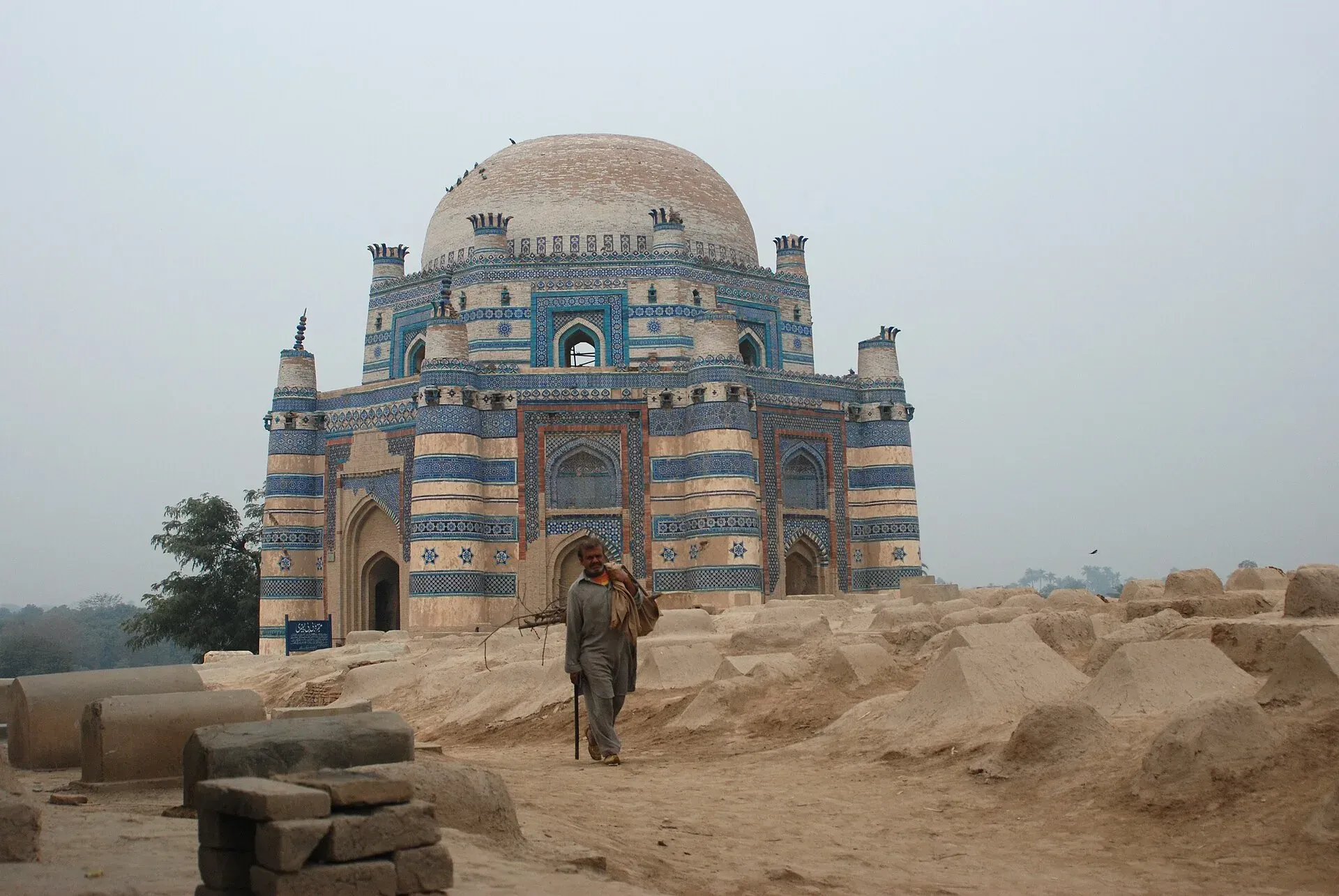
Photo: Batool Nasir, with thanks · CC BY-SA 4.0 · via Wikimedia Commons · temporary stand-in photo

Uch Sharif Monuments
A cluster of tiled Sufi tombs and a mosque in the old town of Uch Sharif near Bahawalpur, dating from the 13th to 15th centuries. The group is on UNESCO's tentative list (2004).
Overview
Uch Sharif is an old town on the plain south of the Chenab river, about 84 km from Bahawalpur. It was a centre of Sufi learning for centuries, and its old core holds one of the finest groups of tiled brick tombs in Pakistan. The best-known are the Tomb of Bibi Jawindi, the Tomb of Baha'al-Halim, the tomb of the architect Ustead, and the shrine and mosque of Jalaluddin Bukhari. The old part of town is also home to many other shrines and about 1,400 graves. Wikipedia gave the town 98,852 residents at the 2023 census. Wikipedia gave the town 98,852 residents at the 2023 census.
Plan your visit
- Nearest town
- Uch Sharif
- Getting there
Uch Sharif is about 84 km from Bahawalpur (Wikipedia), in Bahawalpur district. OSRM gives about 75 km and 66 minutes by road (checked 17 November 2026), so allow 1.5 hours or more. More
Best months
Oct – Mar
- Uch Sharif Monuments
- Related places nearby: Bahawalpur, Tomb of Bibi Jawindi
History
Uch is old. John Cunningham, the 19th-century archaeologist, suggested that it may have been the "Alexandria on the Indus" of about 325 BCE, and the town was earlier called Bhatiah. Muhammad bin Qasim took it in 712 CE, Mahmud of Ghazni took it in 1006 and Muhammad of Ghor captured it in 1176. Under the ruler Qabacha it became a major centre until Iltutmish took it in 1228. Mongol raids continued into the 1300s, and Timur's grandson Pir Muhammad captured it in 1398. A Qadiriyya khanqah (a Sufi lodge) was founded in the mid-1400s, and Uch came under the Mughals from Akbar's reign. The Punjabi Sufi poet Bulleh Shah was born here in 1680. It remained part of Bahawalpur state until 1955.
Local tradition says the saint Jalaluddin Bukhari converted a local princess and named the fort "Uch", meaning "high". The 13th century made the town a stronghold of Sufi orders, and the oldest monuments in the tentative-list group are the 14th-century tomb and mosque of the Central Asian saint Jalaluddin Bukhari. Wikipedia describes the Mosque of Makhdoom Jahaniyan as late 14th century, with blue tilework. The Tomb of Baha'al-Halim was built for a sheikh by his pupil Jahaniyan Jahangasht (1307 to 1383). The Tomb of Bibi Jawindi, built for Jahaniyan's great-granddaughter, is dated to 1493 in one Wikipedia caption and 1494 in its text, which cites UNESCO Bangkok.
Flooding in the early 19th century damaged many tombs. Conservation work has been supported by the World Monuments Fund, which listed the complex on its Watch lists in 1998, 2000 and 2002. Dawn reported in April 2018 a $500 million World Bank loan to the Punjab government to restore several monuments, including the Tomb of Bibi Jawindi. Wikipedia says some monuments are undergoing restoration, so some structures may be fenced off or under repair.
Pakistan submitted the group to UNESCO's tentative list in January 2004: "Tomb of Bibi Jawindi, Baha'al-Halim and Ustead, and the Tomb and Mosque of Jalaluddin Bukhari". It is not a World Heritage Site.
What to look for: the architecture
Wikipedia describes the tombs as domed buildings on octagonal bases, in a regional style of southern Punjab. Much of the glazed tilework was brought from Multan. Tughlaq-style bastions and crenellations (the notched parapet) also appear. The tomb of Bibi Jawindi is the best place to see the blue and white tile, and the shrine of Jalaluddin Bukhari shows how a working shrine looks inside.
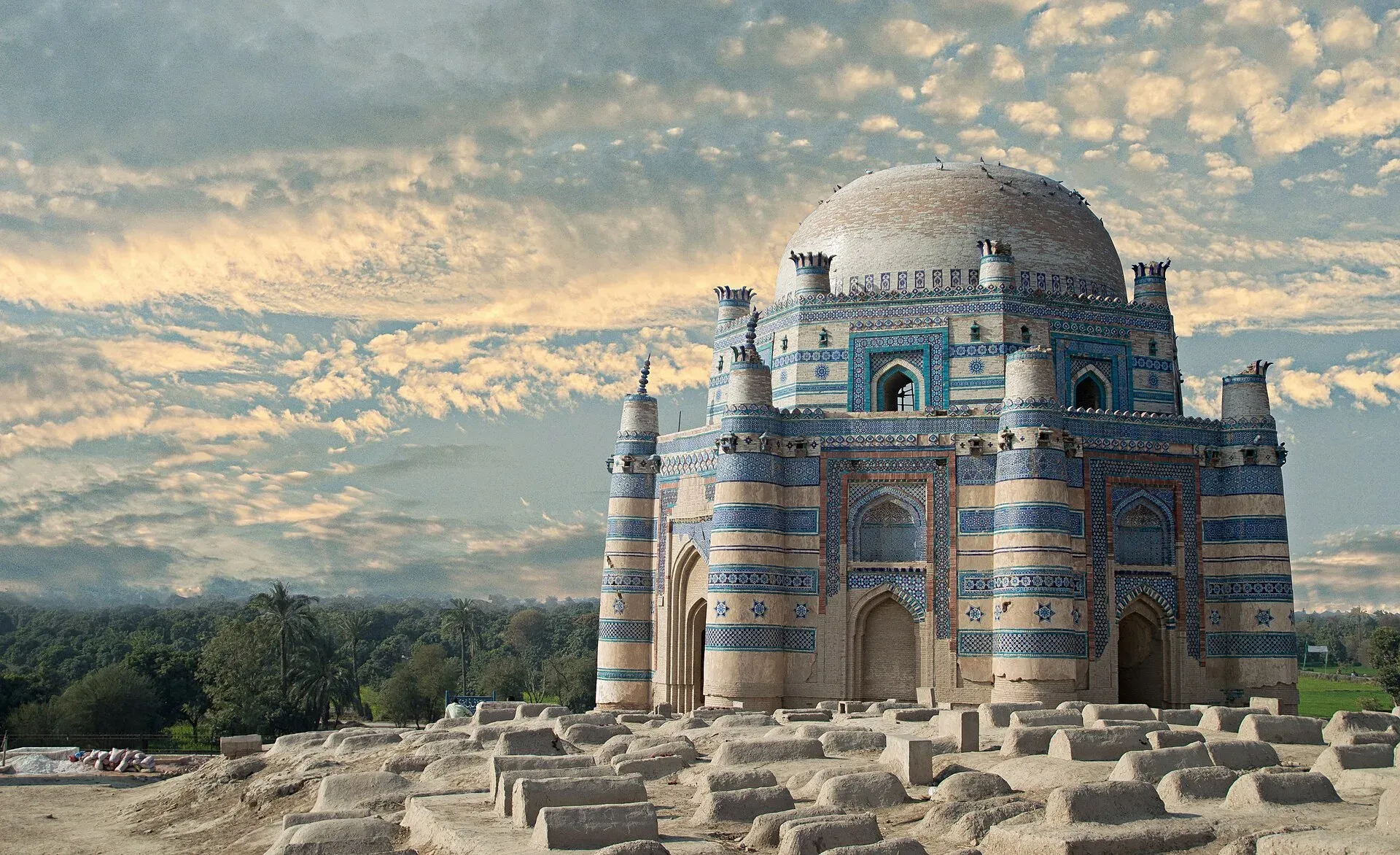
Photo: Usamashahid433, with thanks · CC BY-SA 4.0 · via Wikimedia Commons · temporary stand-in photo

What to see and do
- The Tomb of Bibi Jawindi. A great octagonal-based tomb faced with blue and white tile, dedicated to a descendant of the saint Jahaniyan Jahangasht. It is the most photographed building in Uch.
- The Tomb of Baha'al-Halim. A large tomb with octagonal base and domed roof, which stands close to the Bibi Jawindi tomb.
- The tomb of Ustead. Attributed to the architect of the Bibi Jawindi tomb.
- The shrine and mosque of Jalaluddin Bukhari. Still in use today as a working shrine and mosque.
- The old town. Narrow lanes, shrines and a fair ground used for annual urs celebrations.
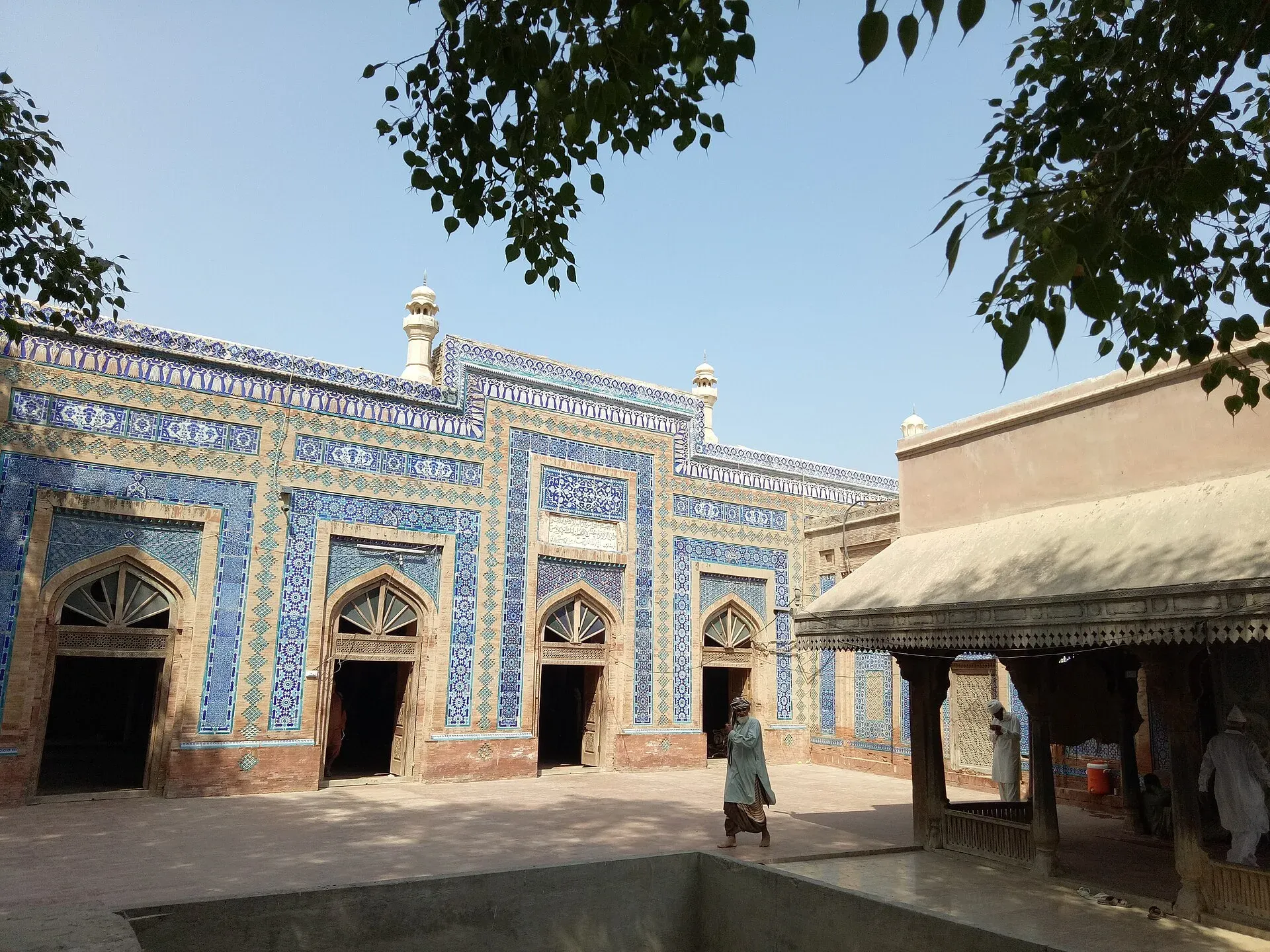
Photo: M.Zafar Shah, with thanks · CC BY-SA 4.0 · via Wikimedia Commons · temporary stand-in photo

Getting there
Uch Sharif is about 84 km from Bahawalpur (Wikipedia), in Bahawalpur district. OSRM gives about 75 km and 66 minutes by road (an estimate, checked 17 November 2026), so allow 1.5 hours or more. The usual way to visit is by road from Bahawalpur, by hired car, taxi or local bus and van. Multan is the nearest big city with an airport and a railway junction. See also Bahawalpur and Multan.
When to visit
October to March is the most comfortable period; summers are very hot. Urs days bring crowds and a lively atmosphere but also limited access.
Where to stay and eat
Most visitors stay in Bahawalpur, which has hotels and restaurants, and visit Uch as a day trip. Uch itself has basic food stalls.
Good to know
- The shrines are active places of worship. Cover your head and shoulders, dress modestly and remove shoes where asked.
- Ask before photographing worshippers, and check whether photography is allowed inside the shrines.
- Some monuments may be closed for conservation, and flood damage in the past is a reason to keep to marked paths. Opening hours and any ticket price were not confirmed by an official source when this page was written. Current fees will be added soon; check with the Punjab Archaeology Department.
Highlights
- Group of 14th-15th century tiled brick tombs
- Tomb of Bibi Jawindi, the best-known monument
- Jalaluddin Bukhari shrine and mosque still in use
- On UNESCO's tentative list since 2004
- About 84 km from Bahawalpur
Tips
- Visit from Bahawalpur as a day trip, and start early.
- Dress modestly and be ready to remove shoes.
- Check locally whether the tombs are open or under repair.
- Go in the cooler months.
Photos we still need: Baha'al-Halim tomb and the Mosque of Makhdoom Jahaniyan. Send us yours
Sources and last checked
Last checked Confidence medium4 sources4 still to check
- Last checked
- Method
- Desk research from published sources
- Confidence
- medium
- Checked by
- trek.pk research team
Researched from published sources; not yet checked on the ground by our team. Spot something out of date? Report a mistake.
Sources
- Uch Sharif monuments (Tentative List 1883) · UNESCO World Heritage Centre · checked
- Uch · Wikipedia · checked
- Tomb of Bibi Jawindi · Wikipedia · checked
- Pakistan Tourism Guide 2021 · Tourism Development Corporation of Pakistan (TDAP) · checked
Still to be checked on the ground (4)
- Which monuments are open or under restoration today (Wikipedia says only that some are being restored)
- Opening hours and any fee (no official page found)
- Exact date of the Baha'al-Halim tomb (Wikipedia vague: 14th century)
- Actual road conditions from Bahawalpur (OSRM 75 km / 66 min; no ground report)
Nearby and related

Bahawalpur
Former capital of a princely state on the edge of the Cholistan Desert: Nawabi palaces, a museum, desert crafts, and a base for Lal Suhanra, Derawar Fort and Uch Sharif.

Multan
The City of Saints in southern Punjab: blue-tiled Sufi shrines, a crowded old city, blue pottery, sohan halwa and mangoes.

Tomb of Bibi Jawindi
The most ornate tomb of Uch Sharif, a 15th-century octagonal tiled monument for a Suhrawardi Sufi woman. Half the tomb was lost in the 1817 flood.

Panjnad River
The short river formed where the Chenab and Sutlej meet, about 16 km north of Uch Sharif, before it joins the Indus at Mithankot. Panjnad Headworks feeds canals for Punjab and Sindh.