

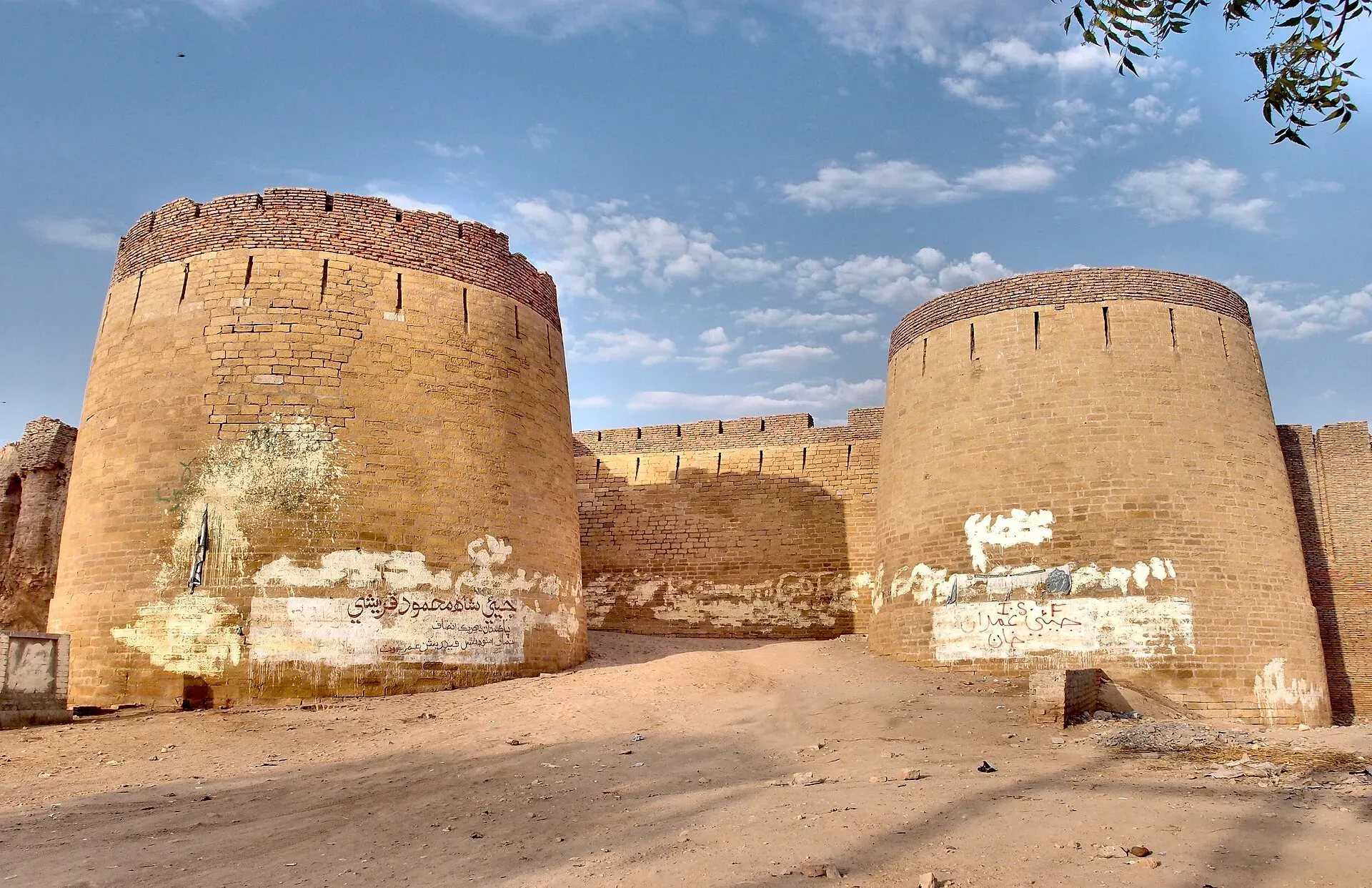
Photo: Saqib Qayyum, with thanks · CC BY-SA 3.0 · via Wikimedia Commons · temporary stand-in photo

Umerkot Fort
A rectangular brick fort in the Thar desert town of Umerkot, linked to the birth of the Mughal emperor Akbar in 1542. Listed on Pakistan's UNESCO tentative list (2026, per Wikipedia).
Overview
Umerkot Fort stands in the middle of Umerkot, a town in eastern Sindh at the edge of the Thar desert. The fort is best known as the place where the future Mughal emperor Akbar was born in 1542. Wikipedia describes it as built in the Rajput style.
Plan your visit
- Nearest town
- Umerkot
- Getting there
Umerkot Fort is in the town centre. By road it is about 78 km (about 1 hour) from Mirpur Khas and about 150 km (about 2 hours) from Hyderabad (OSRM, checked 16 November 2026). More
Best months
Nov – Feb
- Umerkot Fort
- Related places nearby: Mithi, Mirpur Khas
The structure
According to the Sindh Department of Antiquities, the plan is roughly rectangular and the walls taper on both faces. The facades were first lined with burnt-brick tiles laid in mud mortar, around a core of mud. The walls were once about 6 m wide and rose to about 15 m. Semi-circular bastions support all four corners, and an arched gateway on the east side is flanked by more of them. A watch tower stands in the centre, with staircases that visitors can climb for a view over the town.
History
Origins are unclear. The Sindh Department of Antiquities credits the first fort to Umer, an early Soomro ruler, and dates it to roughly 1050 to 1350. Wikipedia names the Rajput ruler Rana Amar Singh in the 11th century, so treat early dates as uncertain.
The better-documented story starts in the first half of the 13th century, when the Sodha Rajputs held the fort. Rana Prasad (Parshad) gave shelter to the Mughal emperor Humayun after his defeat by Sher Shah Suri, and Akbar was born here on 15 October 1542 (date from Wikipedia). The Kalhoras took the fort later, and one Kalhora ruler sold it to the Raja of Jodhpur. The Talpurs recovered it in 1813 and held it until the British took Sindh. Wikipedia adds that in 1746 the Kalhora ruler Noor Mohammad built a fort at the site of Akbar's birthplace. After 1947 the fort passed to Pakistan, and the Rana family still holds an estate about 16 km away.
Umar and Marvi
The fort is the setting of the folk tale of Umar and Marvi, told in Shah Abdul Latif Bhittai's Shah Jo Risalo. Marvi, a village girl from Thar, is held in the fort for years after she turns down the ruler's proposal. She is remembered locally for her courage.
UNESCO status
Wikipedia's list shows Umerkot Fort added to Pakistan's UNESCO tentative list in 2026. It is not an inscribed World Heritage Site (checked 16 November 2026).
What to see and do
- The walls and gate. Walk the outside first to see the taper and the corner bastions, then the arched east gate.
- The watch tower. Climb for a view over the town and the desert edge.
- Akbar's birthplace. Wikipedia says the marked spot is open land near the fort.
- The museum. The TDAP guide lists an Archaeological Museum in Umerkot. Check that it is open.
When to visit
November to February. Summer is very hot, and the Thar rains of July and August can make side roads muddy.
Where to stay and eat
Umerkot has simple hotels and eateries. Sindhi and Thari food is easy to find.
Good to know
- Umerkot is not covered by the FCDO "against all travel" or "all but essential" lists (checked 16 November 2026); read the live page before you go.
- No official opening hours or fee were published on the sources checked. Current fees will be added soon; check with the Directorate General of Antiquities and Archaeology, Government of Sindh.
- Parts of the fort are in poor repair. Watch your footing near the walls.
Highlights
- Rajput-era brick fort in the middle of Umerkot
- Birthplace of the Mughal emperor Akbar, 1542
- Setting of the Umar and Marvi folk tale
- On Pakistan's UNESCO tentative list (2026, per Wikipedia)
Getting there
Umerkot Fort is in the town centre. By road it is about 78 km (about 1 hour) from Mirpur Khas and about 150 km (about 2 hours) from Hyderabad (OSRM, checked 16 November 2026). Buses and vans run from Hyderabad and Mirpur Khas to Umerkot.
Tips
- Climb the watch tower for the best view.
- Ask locally about opening times; no official hours are published online.
- Combine with Mithi and Nagarparkar on a Thar trip.
- Travel in winter; summer heat is severe.
Photos we still need: the east gate of Umerkot Fort; view from the watch tower. Send us yours
Sources and last checked
Last checked Confidence medium7 sources4 still to check
- Last checked
- Method
- Desk research from published sources
- Confidence
- medium
- Checked by
- trek.pk research team
Researched from published sources; not yet checked on the ground by our team. Spot something out of date? Report a mistake.
Sources
- Umerkot Fort, Umerkot · Directorate General of Antiquities & Archaeology, Government of Sindh · checked
- Umarkot Fort · Wikipedia · checked
- Umerkot · Wikipedia · checked
- List of World Heritage Sites in Pakistan (tentative list table) · Wikipedia (UNESCO site whc.unesco.org returned HTTP 403) · checked
- Pakistan Tourism Guide 2021 · TDAP (Trade Development Authority of Pakistan) · checked
- OSRM driving route calculation · OSRM (OpenStreetMap routing) · checked
- Pakistan travel advice (warnings and insurance), updated 27 October 2026 · UK Foreign, Commonwealth & Development Office · checked
Still to be checked on the ground (4)
- Fort's earliest date and founder (conflict stands: Sindh Antiquities says Umer of the Soomro dynasty, about 1050 to 1350; Wikipedia says Rana Amar Singh, 11th century)
- Opening hours and entry fee (Sindh Antiquities page gives none)
- Whether the Umerkot museum is open (not on the Sindh Antiquities page; only the TDAP guide lists it)
- Date and extent of the Kalhora-era rebuilding (Wikipedia says 1746 and a fort at a nearby location, not clearly this fort; not in the Sindh Antiquities page)
Nearby and related

Mithi
The district headquarters of Tharparkar in Sindh, a Hindu-majority town in the Thar Desert and the practical base for Islamkot, Nagarparkar and the green desert after the monsoon.

Mirpur Khas
Sindh's City of Mangoes, founded by the Talpurs in 1806, with the Chitorri tombs and Buddhist-era remains, about 70 km east of Hyderabad.

Hyderabad
Sindh's second-largest city, founded in 1768 and famous for its glass bangles, Pacco Qillo fort and Talpur tombs, about 160 km from Karachi.