

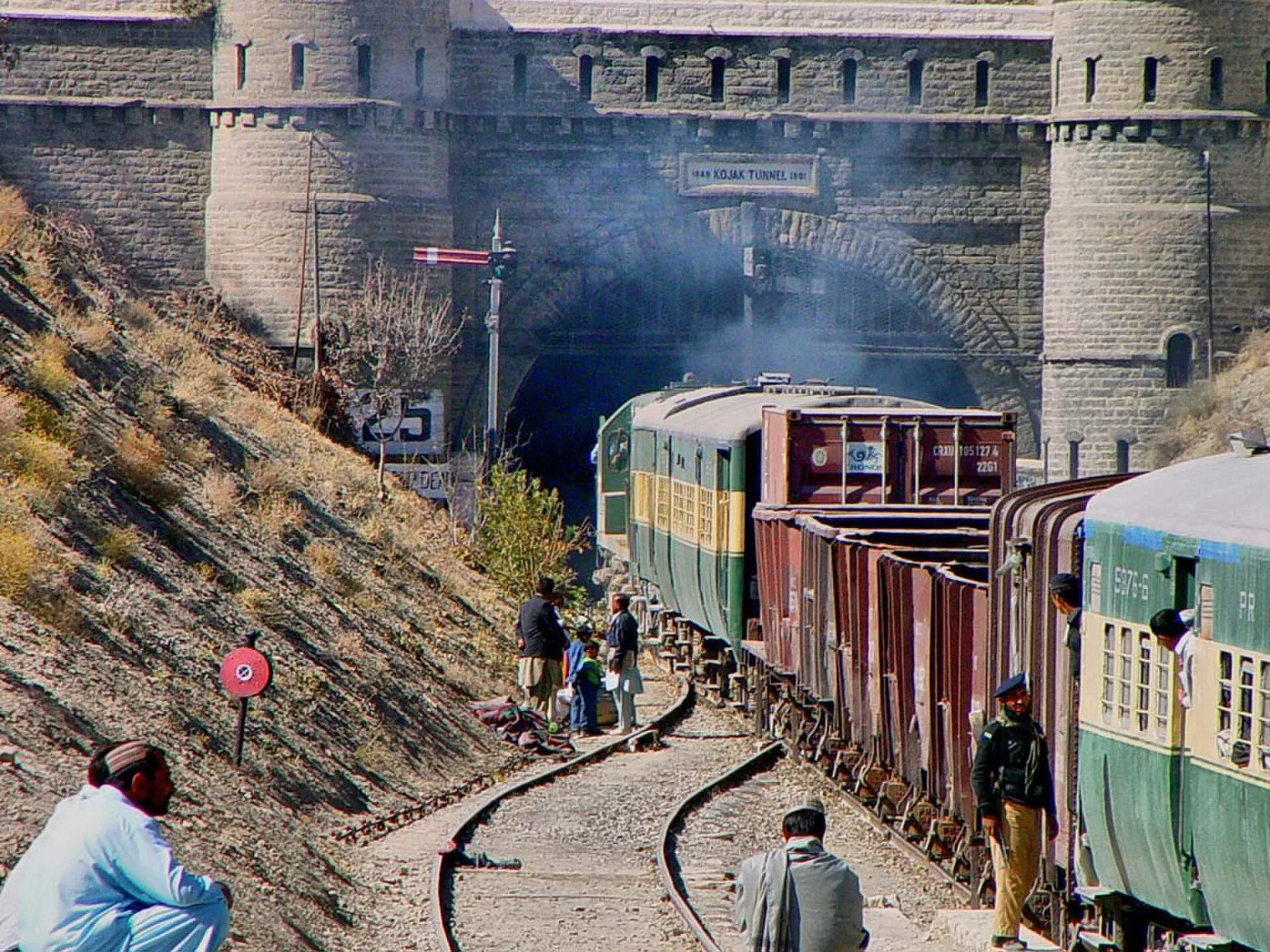
Photo: Amanullahkhan007, with thanks · CC BY-SA 3.0 · via Wikimedia Commons · temporary stand-in photo

Khojak Tunnel Railway (Quetta-Chaman)
The Quetta to Chaman line crosses the Khwaja Amran range through the 3.91 km Khojak Tunnel, opened in 1891. Services have been suspended or irregular in 2026, and the UK advises against travel to Balochistan.
What it is
The Quetta to Chaman line is the western end of the Rohri to Chaman railway (ML-3). It climbs from Quetta over the Khwaja Amran range and runs through the Khojak Tunnel to Chaman, beside the Afghan border. Wikipedia gives the Quetta to Chaman length as about 142 km, with Chaman at km 526 and Quetta at km 384 on the line's chainage.
Does it run now?
Unclear, and this is a background page. The train on this line is the Chaman Passenger. Express Tribune (8 February 2026) reported it running to its normal timetable. But Dawn (27 March 2026) said the Quetta to Chaman passenger train "has not been running" for reasons authorities did not disclose, and Dawn (10 May 2026) listed Quetta to Chaman services among those suspended. There is no known later official notice. Also, on 24 May 2026 a suicide bomb struck a shuttle train in Quetta (Wikipedia). Ask the district administration or local police about current conditions before you go. For foreign visitors: the UK FCDO (updated 27 October 2026, checked 16 November 2026) advises against all travel to Balochistan, including Quetta. Do not plan a trip here.
Route and stops
- Quetta: km 384
- Bostan: junction where the Chaman line leaves the main line (Dawn)
- Yaru, Saranan: small stations on the climb; Dawn (2020) says Saranan was long abandoned and is now lived in by a local family, in a mud-brick and timber building that may not last many more years
- Shelabagh: km 496, at the eastern portal of the tunnel
- Khojak Tunnel: 3.91 km long
- Sanzala: beyond the western portal; Dawn (2020) says it has a prominent turret and looks more like a fortification than a station
- Chaman: km 526, the terminus
What you see
The line crosses high, dry hills. Dawn's Salman Rashid describes the Khwaja Amran range as a water-bearing rock mass rising to about 2,000 m. The railway has to climb from about 1,400 m to cross it, and that is why the tunnel exists.
Going west from Quetta, the track first runs past crowded housing and farmyards. Bostan is a sleepy station with a large yard of mixed gauge lines, built to be the junction for the Chaman branch. Beyond it the line winds through dry clay hills. Yaru is an unremarkable station. Saranan was abandoned and was occupied by a local family when Dawn visited in 2020.
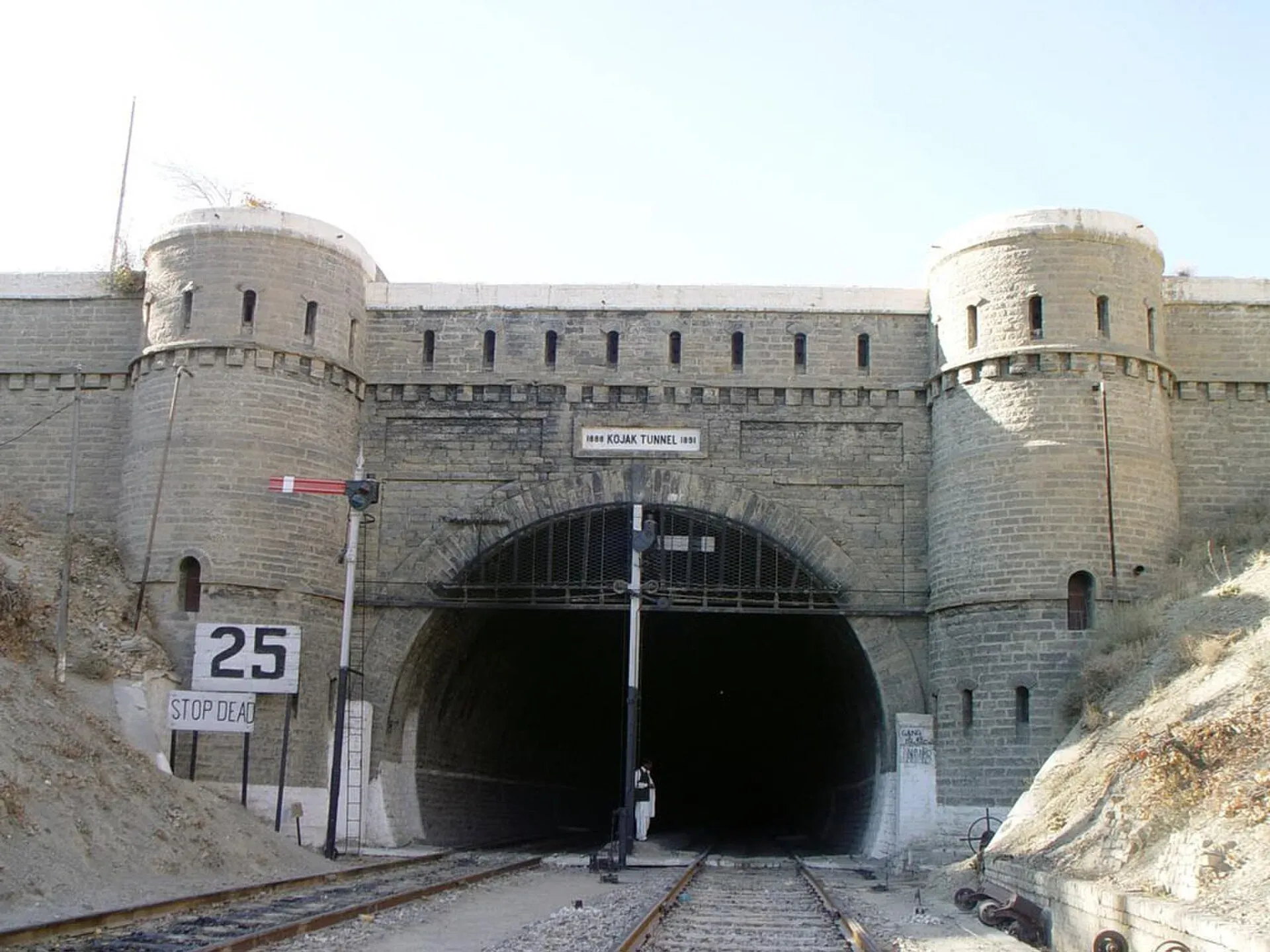
Photo: Amanullahkhan007, with thanks · CC BY-SA 3.0 · via Wikimedia Commons · temporary stand-in photo

Shelabagh sits at the eastern portal. The writer notes that shela is Pashto for a small stream, and brooks near the station water orchards and gardens. The tunnel itself is straight, with only a vertical curve that gains height near its middle. Wikipedia says a mirror's reflected light at one end is visible at the other, and it sits at 1,945 m. Water seeps through the rock, and the lining uses 19,764,426 bricks (Dawn). When it opened it was the longest railway tunnel in the subcontinent (Dawn), and until the 8.75 km Lowari Tunnel opened in 2018 it was the longest in Pakistan (Wikipedia). It appeared on a Pakistani five-rupee banknote after independence. Beyond the western portal, Sanzala has a heavy turret that makes it look like a fortification. Chaman is the terminus beside the border, in country Dawn describes as barren, with hot summers and freezing winters. In 2020 the station saw one train a day in each direction.
History
The line was planned after the Second Afghan War as part of a military railway toward Kandahar. Dawn's Salman Rashid wrote that work on the tunnel began in mid-April 1888, with about 4,000 workers including 65 Welsh miners. In winter 1889 workers hit an underground reservoir and flooded a shaft; no lives were lost. The tunnel was ready for inspection in early September 1891 and the first train ran through later that month. The tunnel is lined with nearly 20 million bricks. The railway reached Chaman in January 1892.
The railway was built by the British administration. Wikipedia names the track-laying and labour contractor as Waja Durra Khan Gorgigh Baloch of Karachi, whose family had come from Bahu Kalat (now in Iran) in the early 1800s. Rashid records that the first Quetta line was begun in 1879 as the Kandahar State Railway and later renamed, and that the line reached Quetta in March 1887. A 1966 plan to extend it to Spin Boldak in Afghanistan was never carried out.
How to book (if services resume)
Only via Pakistan Railways: the e-ticket portal linked from pakrail.gov.pk, a booking office, or the helpline +92-51-9272117 (checked 16 November 2026). Current fares will be added soon.
Safety
Chaman is next to a sensitive border crossing and the line runs through an area the FCDO tells people to avoid completely. Do not travel here unless official advice changes.
Highlights
- 3.91 km Khojak Tunnel, opened in 1891
- Line reached Chaman in January 1892
- Built with about 4,000 workers, including 65 Welsh miners
- Services suspended or irregular in 2026
Stops
- Quetta
- BostanJunction where the Chaman line leaves the main line
- ShelabaghEast portal of the Khojak Tunnel
- Khojak Tunnel3.91 km; about 1,945 m above sea level
- Chaman
km: distance from the start along the route.
Numbers follow the stops in order. The map shows the 3 stops that have a trek.pk page, not the road itself.
Road conditions
Rail line. Not applicable.
Fuel and services
Not applicable.
More safety notes
For foreign visitors: the UK FCDO advises against all travel to Balochistan including Quetta (updated 27 October 2026). A Quetta shuttle train was bombed on 24 May 2026.
Tips
- Do not plan travel here while FCDO advice stands.
- Read the Khojak Pass and Chaman pages for the road side of the story.
- Only trust Pakistan Railways for status.
Photos we still need: Sanzala and Chaman stations; the Quetta to Chaman line between Bostan and Shelabagh. Send us yours
Sources and last checked
Last checked Confidence medium8 sources3 still to check
- Last checked
- Method
- Desk research from published sources
- Confidence
- medium
- Checked by
- trek.pk research team
Researched from published sources; not yet checked on the ground by our team. Spot something out of date? Report a mistake.
Sources
- Khojak Tunnel · Wikipedia · checked
- Heritage: imperial grit, spies and locomotives (12 Jan 2020) · Dawn · checked
- Rohri-Chaman Railway Line · Wikipedia · checked
- No Jaffar Express service from Quetta today (27 March 2026) · Dawn · checked
- Train services from Quetta suspended (10 May 2026) · Dawn · checked
- Train services partially restored in Quetta (Feb 2026) · The Express Tribune · checked
- Pakistan Railways official website (home page, helpline and e-ticket links) · Pakistan Railways · checked
- Pakistan travel advice (updated 27 October 2026) · UK Foreign, Commonwealth & Development Office · checked
Still to be checked on the ground (3)
- Whether the Chaman Passenger runs now (reports show repeated suspensions in 2026; no notice found after 31 May 2026)
- Chainage kilometres: Wikipedia gives Quetta 384, Shelabagh 496, Chaman 526 (Quetta-based table gives Shelabagh 112 km and Chaman 142 km, which agree); no official timetable chainage found
- Present condition of Sanzala and Shelabagh stations (Dawn gave no condition for Shelabagh; 2020 article only)
Nearby and related

Khojak Pass
A 2,290 m pass in the Toba Achakzai range between Qila Abdullah and Chaman, with the N-25 road and a 3.9 km British-built rail tunnel. Chaman border closed since October 2025; FCDO advises against Balochistan.

Chaman
Border trading city and headquarters of Chaman District, at the end of the Quetta road and railway on the Afghan frontier. 130,139 residents in the 2023 census. For foreign visitors: the UK FCDO advises against all travel to Balochistan.

Quetta
Balochistan's high-valley capital, the Fruit Garden of Pakistan: bazaars, sajji, orchard valleys and the base for Hanna Lake and Ziarat.

Bolan Pass Railway (Sibi-Quetta)
The Sibi to Quetta line climbs through the Bolan Pass on the Rohri-Chaman route (ML-3). Services have been repeatedly suspended in 2026, and the UK advises against all travel to Balochistan, so this page is background, not a trip plan.

Heritage Railway Stations
Pakistan's oldest railway stations, from Lahore Junction (1860, fort-style) to Karachi City (1864) and Peshawar Cantonment (1898), plus Golra Sharif and Attock Khurd, worth seeing even if you do not ride.