

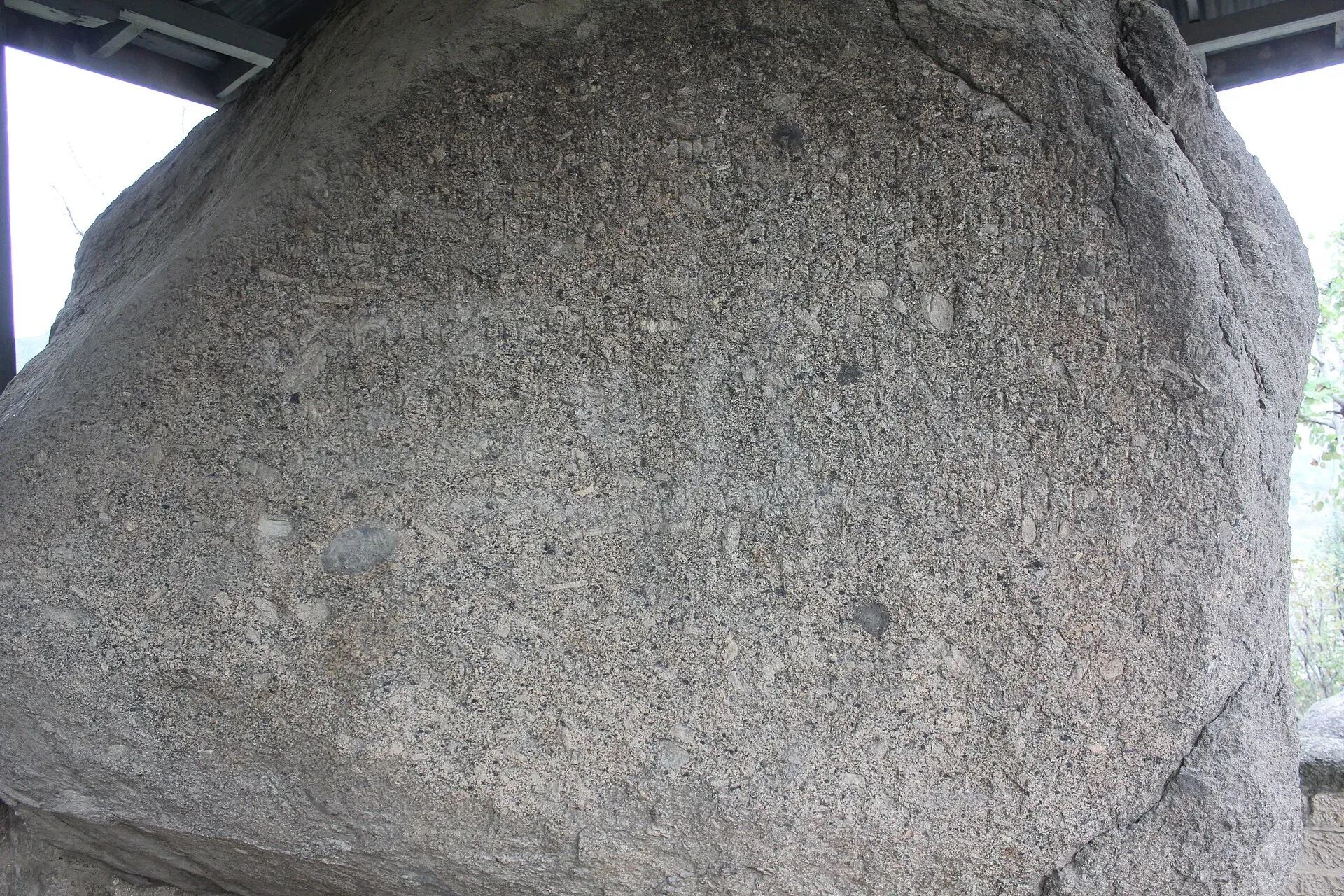
Photo: Muhammad Zahir, with thanks · CC BY-SA 3.0 · via Wikimedia Commons · temporary stand-in photo

Ashoka Rock Edicts (Mansehra)
Fourteen edicts of the Mauryan emperor Ashoka cut into three boulders outside Mansehra, written in Kharosthi in the 3rd century BCE. On Pakistan's UNESCO tentative list since 2004.
Overview
The Mansehra Rock Edicts are fourteen edicts of the Mauryan emperor Ashoka, carved on three large boulders on a small rocky hill outside Mansehra town in Hazara, Khyber Pakhtunkhwa. They date from the 3rd century BCE and are written in Kharosthi, the script used in ancient Gandhara. The site is near the Karakoram Highway, on the old Silk Route; Taxila lies to the south and Abbottabad close to the east. Pakistan nominated it for UNESCO World Heritage status in 2004 and it is on the tentative list.
Plan your visit
- Nearest town
- Mansehra
- Getting there
The edicts are on the outskirts of Mansehra, close to the Karakoram Highway. Mansehra is about 131 km by road from Islamabad (about 1 hour 40 minutes, OSRM) and close to Abbottabad. More
Best months
Mar – May, Sep – Nov
- Ashoka Rock Edicts (Mansehra)
- Related place nearby: Abbottabad
History
Ashoka ruled much of the subcontinent. Buddhist tradition says that after the destruction of the Kalinga war he turned to Buddhism and began to publish a moral law, called dharma, on rocks and pillars across his empire. Mansehra is one of about 33 inscriptions of this kind. Another set in Kharosthi, the Shahbazgarhi edicts, is near Mardan (see Shahbazgarhi Rock Edicts). James Prinsep deciphered Kharosthi, which allowed the texts to be read.
What the edicts say
The Major Rock Edicts, of which Mansehra holds the set of fourteen, deal with dharma: proper conduct, order and non-violence. They do not mention the Buddha or set out Buddhist teaching. They also give practical orders for running the empire and refer to relations with Hellenistic rulers on the frontier.
- Edict 1 says no living being is to be killed for sacrifice. It records that the royal kitchen once killed animals daily and that this had been cut to three (two peacocks and one deer), with even those to stop.
- Edict 2 describes two kinds of medical care, for people and for cattle, set up across the realm and among neighbouring rulers, with herbs, roots and fruit planted and wells dug.
The full Mansehra text is published at Gandhari.org. Kharosthi is read from right to left and is related to the Aramaic script, which is why the north-western edicts look different from those in Brahmi further east.
What to see and do
- Three inscribed boulders, now partly sheltered by canopies put up by the Department of Archaeology and Museums.
- The carved text. Weathering is wearing the letters away, so many are hard to read.
- A short walk around the rocky outcrop.
It is a small site: 30 to 45 minutes is enough. Side light in the morning or evening makes the letters easier to see.
When to visit
Spring and autumn are comfortable for a visit.
Where to stay and eat
Mansehra and Abbottabad have hotels and restaurants.
Good to know
- Travel advice. For foreign visitors: the UK FCDO (updated 27 October 2026, checked 16 November 2026) advises against all travel on the Karakoram Highway between Mansehra and Chilas via Battagram. The site is on the Mansehra side. Read the current advice and plan routes accordingly. Ask the district administration or local police about current conditions before you go.
- Hours and fees. Current opening hours and fees will be added soon. It is an open-air archaeological site; the Khyber Pakhtunkhwa archaeology department is the contact.
- Etiquette. Do not touch, rub or trace the inscriptions; the stone is fragile.
- Nearby. Abbottabad is close by; Takht-i-Bahi is the other major Gandharan site in the province.
Highlights
- Fourteen edicts of Ashoka in Kharosthi
- Three inscribed boulders, 3rd century BCE
- On UNESCO tentative list since 2004
- Beside the Karakoram Highway on the old Silk Route
Getting there
The edicts are on the outskirts of Mansehra, close to the Karakoram Highway. Mansehra is about 131 km by road from Islamabad (about 1 hour 40 minutes, OSRM) and close to Abbottabad. The coordinates here are a rounded Wikipedia value; the site is a few kilometres from Mansehra centre. Taxis and rickshaws from Mansehra can take you.
Tips
- Ask locally for the exact turn-off; signs are limited.
- Visit in morning or evening light to see the carving.
- Do not touch the inscriptions.
- Check FCDO advice on the Karakoram Highway before planning.
Photos we still need: the canopied boulders and the site setting. Send us yours
Sources and last checked
Last checked Confidence medium4 sources4 still to check
- Last checked
- Method
- Desk research from published sources
- Confidence
- medium
- Checked by
- trek.pk research team
Researched from published sources; not yet checked on the ground by our team. Spot something out of date? Report a mistake.
Sources
- Mansehra Rock Edicts (Wikipedia) · Wikipedia · checked
- List of World Heritage Sites in Pakistan · Wikipedia · checked
- Pakistan travel advice: warnings and insurance (updated 27 October 2026) · UK Foreign, Commonwealth & Development Office · checked
- Edicts of Ashoka (Wikipedia) · checked
Still to be checked on the ground (4)
- Exact coordinates (Wikipedia gives a rounded point, 34.3333 N 73.1667 E; no OpenStreetMap entry found)
- Opening arrangements and any entry fee
- Present condition of the canopies (Wikipedia says only that the Department of Archaeology and Museums provided them, and that the script is fading)
- Current road safety on the Karakoram Highway north of Mansehra: the FCDO advice is official, but conditions on the ground are not
Nearby and related

Abbottabad
A cool, green cantonment city at about 1,256 m in Hazara, the military academy town and the main gateway to Nathia Gali, Thandiani, Ayubia National Park and the Kaghan Valley.

Takht-i-Bahi and Sahr-i-Bahlol
A hilltop Buddhist monastery near Mardan, founded in the early 1st century CE, with the ruins of a small walled town at Sahr-i-Bahlol. UNESCO World Heritage Site since 1980.

Khyber Pakhtunkhwa
Mountains, Buddhist ruins and old bazaars in north-west Pakistan: Swat, Kaghan, Chitral, the Kalash valleys, the Khyber Pass and Peshawar.
Shahbazgarhi Rock Edicts, Mardan
Edicts of the Mauryan emperor Ashoka cut in Kharosthi on two large boulders at Shahbaz Garhi, near Mardan, in the 3rd century BCE. On Pakistan's UNESCO tentative list since 2004.