

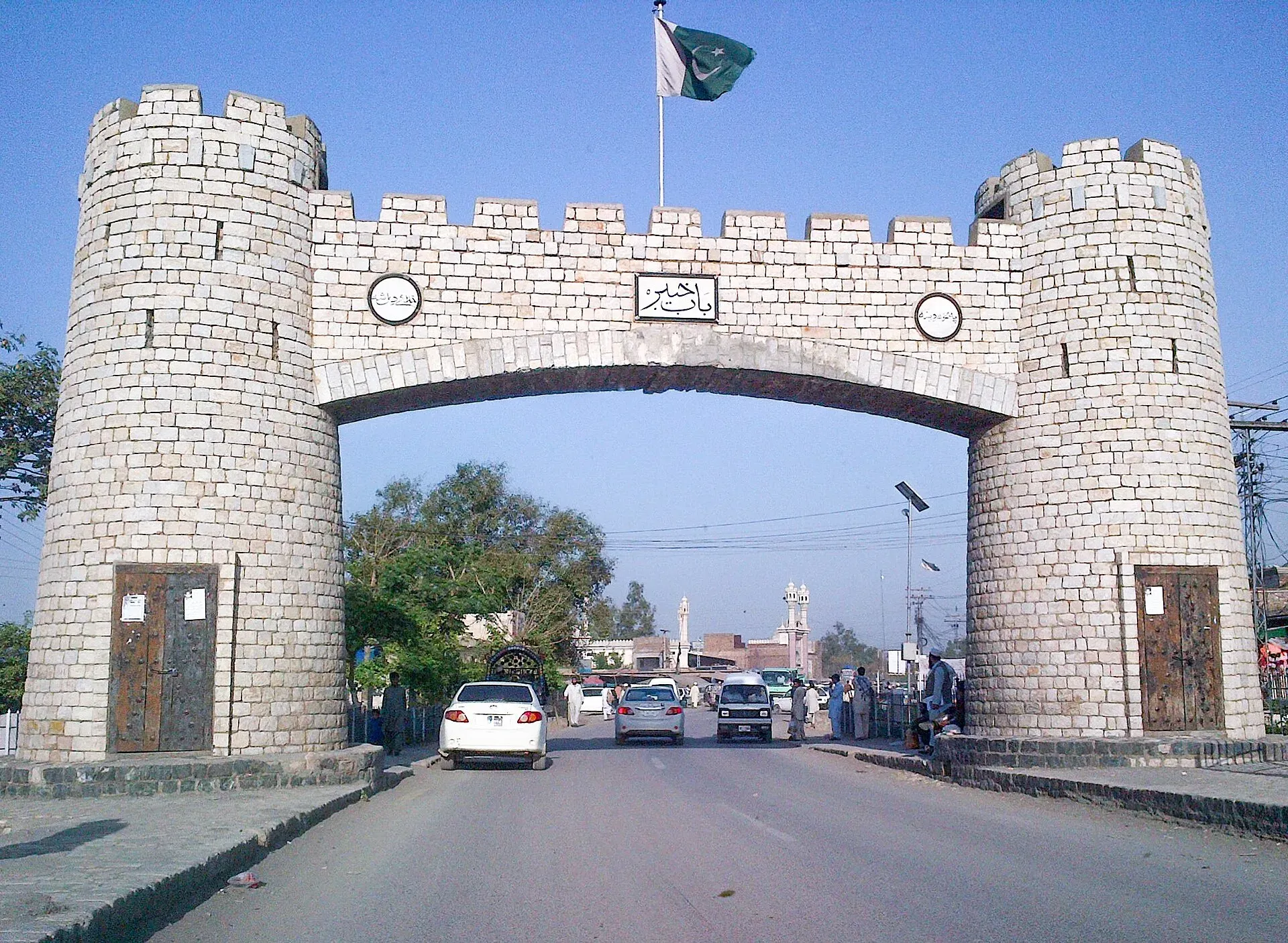
Photo: Muhammad Imran Saeed, with thanks · CC BY 2.5 · via Wikimedia Commons · temporary stand-in photo

Bab-e-Khyber
The Khyber Gate, a monumental arch at Jamrud marking the entrance to the Khyber Pass, opened in 1963. Access to the pass is restricted and FCDO advises against travel to Khyber.
Overview
Bab-e-Khyber, or Khyber Gate, is a gateway monument at the eastern entrance of the Khyber Pass, immediately west of Peshawar in Khyber district. It was built by the Government of Pakistan and opened by Field Marshal Ayub Khan on 11 June 1963. It is described as the best-known post-independence structure of the Khyber region, and a vignette of the Khyber Pass with the monument's name has appeared on the Pakistani 10-rupee note.
Plan your visit
- Nearest town
- Jamrud
- Getting there
Bab-e-Khyber is about 15.6 km by road from central Peshawar (OSRM, about 24 minutes without traffic), on the Peshawar to Torkham road at Jamrud. No public transport details were confirmed. More
Best months
Oct – Apr
- Bab-e-Khyber
- Related places nearby: Khyber Pass, Landi Kotal, Peshawar, Peshawar Walled City, Jamrud Fort (Fatehgarh), Khyber
Why visit
For many Pakistanis it is the symbolic doorway to the pass that links Peshawar and Afghanistan. The arch stands beside the historic Jamrud Fort and at the start of the old route that runs up to Landi Kotal.
History
The gate was completed in 1963. Some mirror sites give 1964 or 1965 for the plaque, but the 1963 inauguration date is the one supported by Wikipedia and should be treated as the working date. The designer and exact dimensions were not found in a reliable source. For the longer story of the pass itself, see the Khyber Pass page.
Jamrud Fort
The fort next to the gate is older than the monument by well over a century. The Sikh Empire occupied Jamrud in October 1836, and General Hari Singh Nalwa laid the foundation of the fort on 18 December 1836. Construction is reported to have taken 54 days. It was first called Fatehgarh, after a Sikh victory over disunited tribes. In April 1837 Afghan forces under Mohammad Akbar Khan attacked the lightly held fort. Nalwa was killed, but the Sikhs held the fort and the Afghans withdrew towards Kabul. Control passed to the British in 1849 and to the Pakistan Army in 1947.
The fort is built of stone and brick, with walls about 3 m (10 feet) thick. It is a garrison of the Frontier Corps and is not open to the public. See the Jamrud Fort page.
What to see and do
- Look at the arch from a safe roadside position.
- See the outer walls of Jamrud Fort next to it.
- Learn about the pass on the Khyber Pass page.
When to visit
October to April is more comfortable; summers are hot.
Good to know
- Ask the district administration or local police about current conditions before you go. Travel advice. For foreign visitors: the UK FCDO (updated 27 October 2026, checked 16 November 2026) advises against all travel to Khyber. Read the current page before making any plans.
- Access. Entry beyond Jamrud has long needed official permission and security arrangements. Border crossings with Afghanistan have also been affected by closures. Check with the local administration and current news.
- Etiquette. Do not photograph military or security posts.
- Nearby. Jamrud Fort, Khyber Pass, Landi Kotal and Peshawar.
Highlights
- Opened 11 June 1963
- Gateway to the Khyber Pass
- Next to Jamrud Fort
- Featured on the 10-rupee note
Getting there
Bab-e-Khyber is about 15.6 km by road from central Peshawar (OSRM, about 24 minutes without traffic), on the Peshawar to Torkham road at Jamrud. No public transport details were confirmed. Access beyond the gate is restricted; check locally.
Tips
- Check FCDO and local advice before going.
- Do not photograph security posts.
- Go with a local host who knows the access rules.
- Keep to the roadside; avoid stopping on the main road.
Sources and last checked
Last checked Confidence medium5 sources3 still to check
- Last checked
- Method
- Desk research from published sources
- Confidence
- medium
- Checked by
- trek.pk research team
Researched from published sources; not yet checked on the ground by our team. Spot something out of date? Report a mistake.
Sources
- Bab-e-Khyber · Wikipedia · checked
- Khyber Pass · Wikipedia · checked
- Pakistan travel advice: warnings and insurance (updated 27 October 2026) · UK FCDO · checked
- OSRM driving route service: distances and times measured 16 November 2026 (times are optimistic, without stops) · OSRM · checked
- Jamrud Fort · Wikipedia · checked
Still to be checked on the ground (3)
- Whether visitors may stop at the gate and any permit needed (Wikipedia is silent)
- Designer and dimensions (not named in Wikipedia)
- Current security and border situation
Nearby and related

Khyber Pass
The historic 40 km pass from Jamrud to Landi Kotal and the Afghan border, used by invaders and traders for thousands of years. Today the area is under an FCDO all-travel warning and Torkham is closed.

Landi Kotal
Hill town at the western end of the Khyber Pass, 1,072 m above sea level and about 5 km from the Afghan border. For foreign visitors: the UK FCDO advises against all travel to Khyber.

Peshawar
Khyber Pakhtunkhwa's capital and one of South Asia's oldest living cities: the Gandhara museum, Qissa Khwani Bazaar, mosques and a strong food culture.

Peshawar Walled City
The old core of Peshawar: Qissa Khwani Bazaar, the carved wooden Sethi havelis and the Gor Khatri complex. Parts are being restored, and the Sethi House and Gor Khatri are on UNESCO's tentative list.
Jamrud Fort (Fatehgarh), Khyber
A Sikh-era frontier fort of 1836 to 1837 at the eastern end of the Khyber Pass, beside Bab-e-Khyber. Hari Singh Nalwa died here in 1837. It is a military site, not open to the public. FCDO advises against all travel to Khyber.