

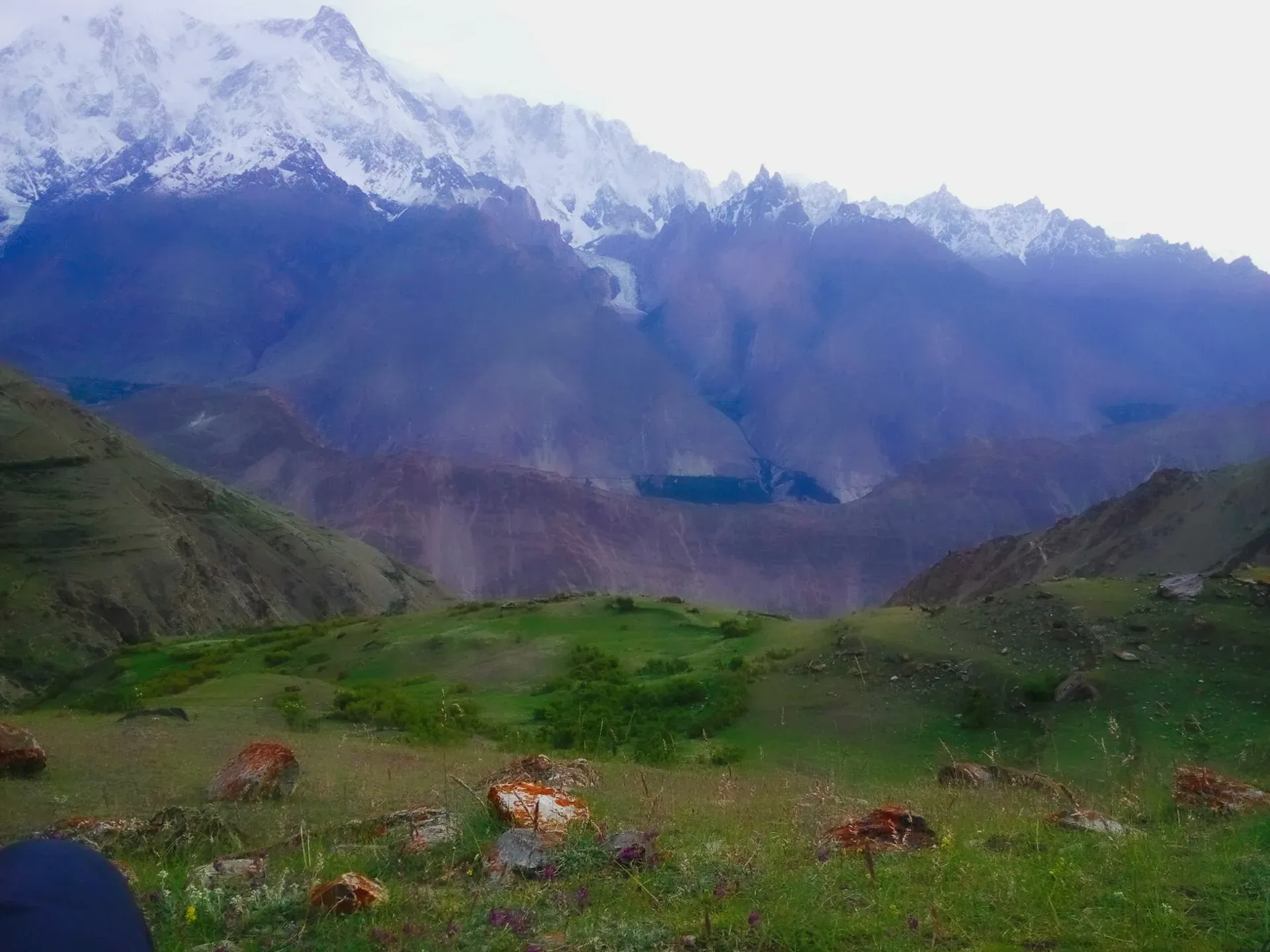
Photo: Aqibnagri, with thanks · CC BY-SA 4.0 · via Wikimedia Commons · temporary stand-in photo

Bar Valley Conservancy
A 906 square kilometre community-managed conservation area in Nagar, Gilgit-Baltistan, run since about 1990 with WWF-Pakistan. Home to Himalayan ibex and snow leopard, with community income from regulated trophy permits.
Overview
Bar Valley is a side valley of Nagar in Gilgit-Baltistan, about 49 km from Gilgit according to a 2004 Ismaili Heritage report (another source gives about 35 km). It is not a government park. It is a community conservation area, listed by the Gilgit-Baltistan Forest, Wildlife & Environment Department as "Bar (Nagar)", 906 square kilometres, with snow leopard and ibex. The department calls such areas Community Managed Conservation Areas; they used to be called Community Controlled Hunting Areas (CCHAs). This page uses the name Bar Valley Conservancy for ease. The department's own list gives only "Bar (Nagar)", so that is the formal name to look for.
The programme grew from a local proposal in 1989. WWF-Pakistan began a sustainable wildlife-use project in the valley in 1990 with local communities, and the community-based trophy-hunting programme was running by 1991. A 1995 amendment raised the community's share of income to 80 per cent. The idea is simple: villagers earn from a small, regulated number of trophy permits, so they protect the ibex and other wildlife year round.
Plan your visit
- Nearest town
- Gilgit
- Getting there
Bar Valley is reached from the Karakoram Highway near Nagar, north of Gilgit. Distance from Gilgit is given as 49 km (Ismaili Heritage, 2004) or about 35 km in another study. More
Best months
Jun – Sep
How the programme works
Trophy hunting here is regulated. According to a 2004 Ismaili Heritage report, hunting began regularly in July 1990 under rules drawn up after a meeting of WWF, IUCN and the Forest Department, and the first two licences were issued in 1995. Only mature male ibex qualify, with a minimum horn length, and females are protected. The Express Tribune reports that the community's share of permit income was set at 80 per cent in 1995, up from 75 per cent in a 1992 proposal. For markhor permits across Pakistan from 1995 to 2020 it gives about USD 4.86 million in income, of which about USD 4.3 million went to community development, with roughly 30 per cent of income spent on conservation and 70 per cent on social and economic projects. Bar is one of more than 50 community conservation areas that together cover over 30 per cent of Gilgit-Baltistan. Until 1995, WWF and the Aga Khan Rural Support Programme were the only development organisations working in the valley.
What to see and do
- Himalayan ibex. A study from the winter and spring of 2010 to 2011 found ibex at a density of about 0.22 per square kilometre in Bar Valley, which is lower than an earlier estimate of 0.68. The IUCN rates the ibex Near Threatened (2020), and the authors list poaching, competition with livestock and weak watch and ward as threats.
- Markhor, bears, blue sheep and snow leopard. Ismaili Heritage mentions markhor (about 600 to 3,000 m in the region), brown bear, blue sheep and snow leopard in the valley, which it describes as surrounded by snow-capped mountains and glaciers. It gives the local name for the ibex as kil. The snow leopard is Vulnerable on the IUCN Red List. These animals are shy and rarely seen.
- Alpine scenery. The valley is steep and dry, with juniper, birch and sub-alpine slopes. Ibex favour precipitous ground between about 2,500 and 3,500 m.
- Village life. Nagar villages nearby offer a look at community-based conservation. A local guide can explain how the programme works.
When to visit
Summer, from June to September, is easiest for access and walking. Winter and spring surveys find ibex on lower slopes, but the valley can be snowbound. No official source gives the best season for seeing wildlife, so ask a local guide.
Where to stay and eat
Stay in Nagar or Gilgit, which have hotels and guesthouses. No visitor facilities inside the conservancy are confirmed.
Good to know
- The conservancy is managed by local community institutions with the Gilgit-Baltistan Forest, Wildlife & Environment Department. Ask the department or a local guide before you walk in; some areas are used for livestock grazing and hunting seasons.
- Regulated trophy hunting happens in the valley under permits. Ordinary visitors must not hunt, trap or disturb animals. A fee may apply for guides or entry: current fees will be added soon.
- Ask before flying a drone, and keep your distance from wildlife.
- Safety. For foreign visitors: the UK FCDO page (updated 27 October 2026, checked 16 November 2026) does not advise against Gilgit-Baltistan generally. It does advise against all travel on the Karakoram Highway between Mansehra and Chilas, so fly to Gilgit rather than driving that section. Check the current page before you go.
- Mountain tracks can be blocked by rockfall or snow.
Highlights
- Community-managed since about 1990
- Listed at 906 square kilometres
- Himalayan ibex and snow leopard habitat
- Community receives 80 per cent of programme income
- Side valley of Nagar
Getting there
Bar Valley is reached from the Karakoram Highway near Nagar, north of Gilgit. Distance from Gilgit is given as 49 km (Ismaili Heritage, 2004) or about 35 km in another study. No exact OSRM route is given because we have not confirmed the access point. Gilgit has flights from Islamabad when weather allows. Ask locally for the jeep track and any permission needed.
Tips
- Hire a local guide
- Visit June to September
- Ask the GB Wildlife Department before you walk in
- Do not hunt, trap or disturb animals
- Fly to Gilgit rather than driving the Mansehra to Chilas KKH
Wildlife
Facilities
- Hotels and guesthouses in Nagar and Gilgit
Photos we still need: the Bar valley slopes with ibex habitat, and the access track. Send us yours
Sources and last checked
Last checked Confidence medium7 sources5 still to check
- Last checked
- Method
- Desk research from published sources
- Confidence
- medium
- Checked by
- trek.pk research team
Researched from published sources; not yet checked on the ground by our team. Spot something out of date? Report a mistake.
Sources
- Community Managed Conservation Areas (CMCAs) · Forest, Wildlife & Environment Department, Gilgit-Baltistan · checked
- Hunting sustaining communities in Northern Areas (19 March 2004) · Ismaili Heritage · checked
- The story behind why Gilgit-Baltistan allows trophy hunting (25 March 2021) · The Express Tribune · checked
- Population density and habitat use of Himalayan ibex in Nagar Valley, Gilgit-Baltistan (Ali, Anwar and Nawaz, 2015) · International Journal of Conservation Science · checked
- Snow leopard · Wikipedia (cites IUCN Red List assessment, McCarthy et al. 2017) · checked
- Pakistan travel advice · UK Foreign, Commonwealth & Development Office (FCDO) · checked
- Capra sibirica (Siberian or Himalayan ibex) (IUCN Red List category) · GBIF, IUCN Red List checklist · checked
Still to be checked on the ground (5)
- Distance from Gilgit (49 km per Ismaili Heritage 2004; another source says 35 km; no official figure found)
- Exact access point and whether any permission is needed
- Current ibex and markhor numbers (no counts in the department list, Tribune or Ismaili Heritage)
- Fees for guides or entry (the only fees found are for trophy hunting, not visitors)
- Hunting-permit income figures are for markhor permits across Pakistan, not Bar alone
Nearby and related

Nagar Valley
The quieter bank of the Hunza River, facing Karimabad: Minapin, Hoper and Hispar villages, Rakaposhi viewpoints and easy treks below Rakaposhi, Diran and Spantik.

Gilgit
Gateway to Gilgit-Baltistan on the Karakoram Highway: a busy mountain town with the Kargah Buddha and the base for Hunza, Naltar and Skardu.

Gilgit-Baltistan
Pakistan's far north: three great ranges meet here, with K2, Nanga Parbat, giant glaciers, the Karakoram Highway and the valleys of Hunza, Skardu and Gilgit.

Astore Wildlife Sanctuary
A mountain wildlife sanctuary in Astore District, Gilgit-Baltistan, listed by Wikipedia as designated in 1975 and covering about 415 square kilometres. It protects habitat of the Astor markhor and snow leopard. Boundaries and access need local confirmation.