

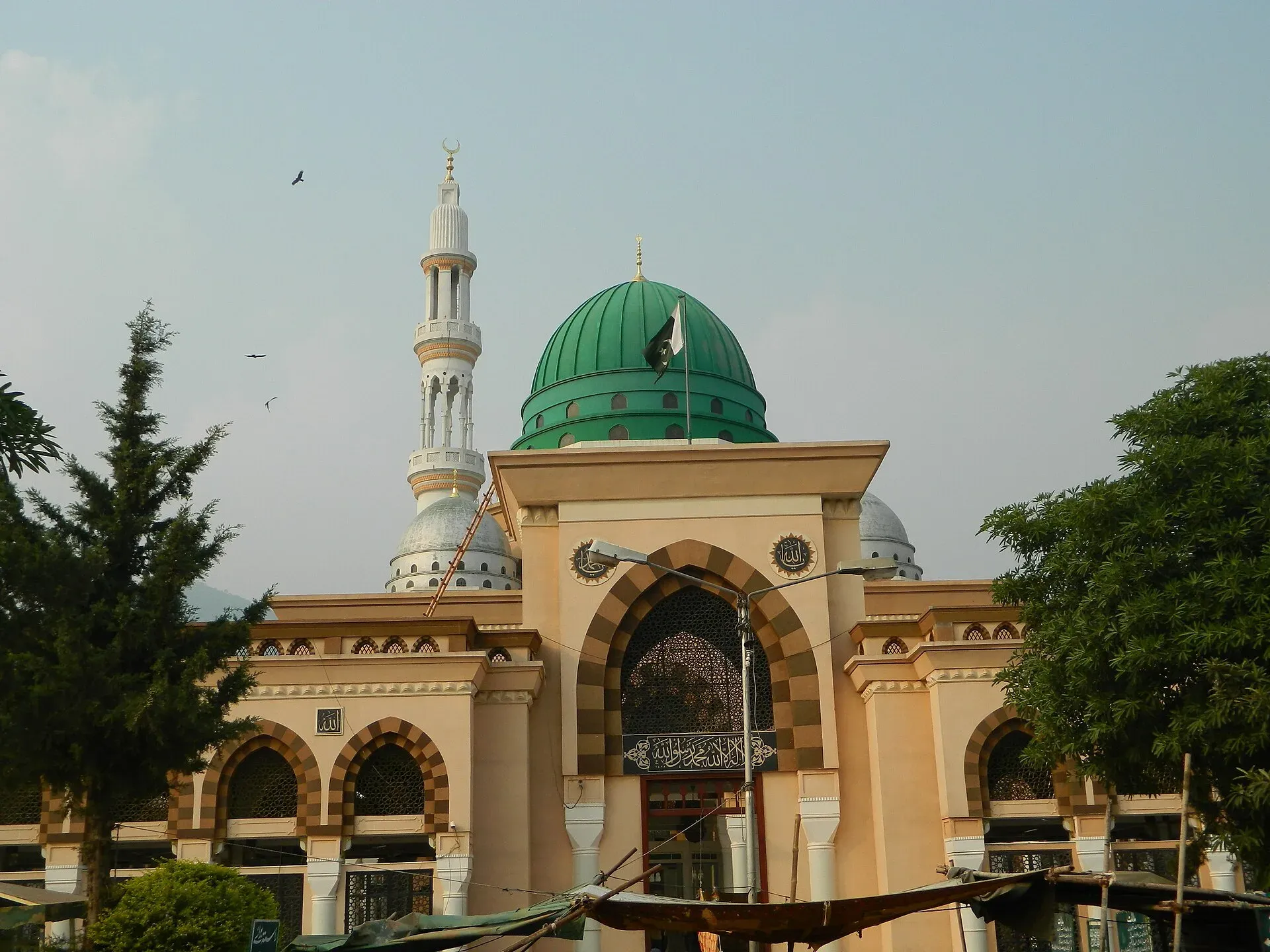
Photo: Ibnazhar, with thanks · CC BY-SA 4.0 · via Wikimedia Commons · temporary stand-in photo

Bari Imam Shrine
The shrine of Bari Imam, the Sufi saint and patron of Islamabad, at Noorpur Shahan beneath the Margalla Hills. An active place of worship that welcomes respectful visitors of all faiths.
Overview
The shrine of Bari Imam, in the old village of Noorpur Shahan on the edge of Islamabad, is the burial place of Shah Abdul Latif Kazmi (1617 to 1705), known as Bari Imam or Bari Sarkar. He is revered as the patron saint of Islamabad and the Pothohar region (the plateau around Islamabad and Rawalpindi) and belonged to the Qadiri Sufi order. Hundreds of people come each day, according to Dawn (2015), and the shrine draws devotees from across Pakistan. It lies a few kilometres from Parliament House and the Diplomatic Enclave.
Plan your visit
- Nearest town
- Islamabad
- Getting there
The shrine is in Noorpur Shahan, about 16 km by road from central Islamabad (roughly 15 minutes, OSRM), near the Diplomatic Enclave. Ride-hailing cars, taxis and local transport all go there. More
Best months
Oct – Mar
- Bari Imam Shrine
- Related places nearby: Islamabad, Rawalpindi, Margalla Hills National Park, Islamabad Capital Territory
Who was Bari Imam
Sources differ on his birthplace: Wikipedia names Karsal in Chakwal district, while Dawn says Jhelum. His father, Syed Mehmood Shah, was a farmer, and the family moved to Baghan village, now Aabpara in Islamabad, when he was about eight. At about 12 he went to Ghorghushti (now Attock) for two years of study in fiqh (Islamic law), hadith (the sayings of the Prophet) and logic. Later he travelled to Central Asia, Mecca and Madinah and made the hajj.
He settled at Noorpur Shahan. Local people say the village was once called Chorpur, "place of thieves", because bandits preyed on trade caravans, and that his teaching of peace and harmony changed both the place and its name to Noorpur, "place of light". Popular lore also credits him with miracles, such as making water flow from rock.
The shrine and its history
Wikipedia says the shrine was first built in the 17th century under the Mughal emperor Aurangzeb, who revered him. It has been renovated many times and is now run by the government. Dawn reported in 2015 that the first phase of a new renovation was nearly complete, adding an outer arcade, corridors and a minaret, and that the tomb chamber was then covered with a canopy, so devotees prayed from the corridors. The shrine is described as silver-mirrored, with glasswork on the walls of the tomb chamber.
What visitors do here
Dawn describes the practices at the shrine: devotees light oil and earthen lamps, lay chaddars (cloths) and wreaths on the grave, and eat free food from the langar (communal kitchen). Some perform dhamal, a devotional dance. Come to watch and listen, not as a sightseer. A visit takes an hour or so.
The urs
The urs (death anniversary) used to be one of the region's largest gatherings. Wikipedia reports that it drew very large crowds until the 1960s, up to 1.2 million in one especially busy year. A suicide attack at the shrine on 27 May 2005 killed 20 people and injured almost 70, and the urs was discontinued. Dawn reported in May 2015 that it had not been held since 2008; the Islamabad administration announced a revival from 28 May 2015, then reversed the decision for security reasons. The Express Tribune (2013) described a five-year gap. No current date is confirmed, so check local news before planning around it.
Security and access
Dawn (2015) reported private guards inside the complex, police at the main entrance and separate security gates for men and women. Expect bag checks. The shrine's closeness to the Diplomatic Enclave and other sensitive buildings was given as a reason for caution.
When to visit
October to March is pleasant. If an urs is held, it draws very large crowds, and no fixed month is reported.
Where to stay and eat
The shrine is a short drive from central Islamabad, so stay there; see the Islamabad page. Ask locally for places to eat.
Good to know
- Etiquette. This is a living place of worship, open to people of all faiths. Dress modestly: long sleeves and trousers or a long skirt; women should cover their hair. Remove shoes before entering. Be quiet, do not point your feet at the grave, and ask before taking photographs of worshippers. Follow the staff and signs about men's and women's areas.
- Hours. No official hours found. Shrines are usually open from early morning to night; check locally.
- Nearby. Margalla Hills National Park and Islamabad's main sights.
Highlights
- Shrine of the patron saint of Islamabad
- Qadiri Sufi saint who lived 1617 to 1705
- Mirrored shrine first built under Aurangzeb
- Open to visitors of all faiths who show respect
Getting there
The shrine is in Noorpur Shahan, about 16 km by road from central Islamabad (roughly 15 minutes, OSRM), near the Diplomatic Enclave. Ride-hailing cars, taxis and local transport all go there.
Tips
- Dress modestly and cover your head if you are a woman.
- Take your shoes off at the entrance.
- Ask before photographing people.
- Visit outside the urs to avoid the crowds.
Photos we still need: the shrine courtyard and arcade (exterior, without identifiable worshippers). Send us yours
Sources and last checked
Last checked Confidence medium3 sources6 still to check
- Last checked
- Method
- Desk research from published sources
- Confidence
- medium
- Checked by
- trek.pk research team
Researched from published sources; not yet checked on the ground by our team. Spot something out of date? Report a mistake.
Sources
- Bari Imam (Wikipedia) · Wikipedia · checked
- Urs of Potohar's patron saint yet to be celebrated · Dawn · checked
- Security concerns: Bari Imam's urs · The Express Tribune · checked
Still to be checked on the ground (6)
- Opening hours and any dress-code details posted at the gate
- Timetable of qawwali (Sufi devotional singing) and whether non-Muslims are asked to follow extra rules
- Dates of the next urs (reports from 2013 and 2015 say it was halted for security reasons; no current date found)
- Current state of the renovation described in 2015 and whether the tomb chamber is open to visitors
- Birthplace: Wikipedia says Karsal, Chakwal; Dawn says Jhelum
- Coordinates are from OpenStreetMap, not the shrine itself
Nearby and related

Islamabad
Pakistan's green, planned capital at the foot of the Margalla Hills: Faisal Mosque, hillside trails, cafes and the gateway to the north.

Rawalpindi
Islamabad's older twin city: a busy bazaar and cantonment, the north's main rail and bus hub, and an easy base for Taxila and Murree.

Margalla Hills National Park
The green hills above Islamabad: hiking trails, viewpoints, leopards and goral, a few minutes from the city centre. Established in 1980 and covering about 174 square kilometres.
Islamabad Capital Territory
Pakistan's planned capital at the foot of the Margalla Hills: Faisal Mosque, Daman-e-Koh, hiking trails, museums and the gateway to the north.