

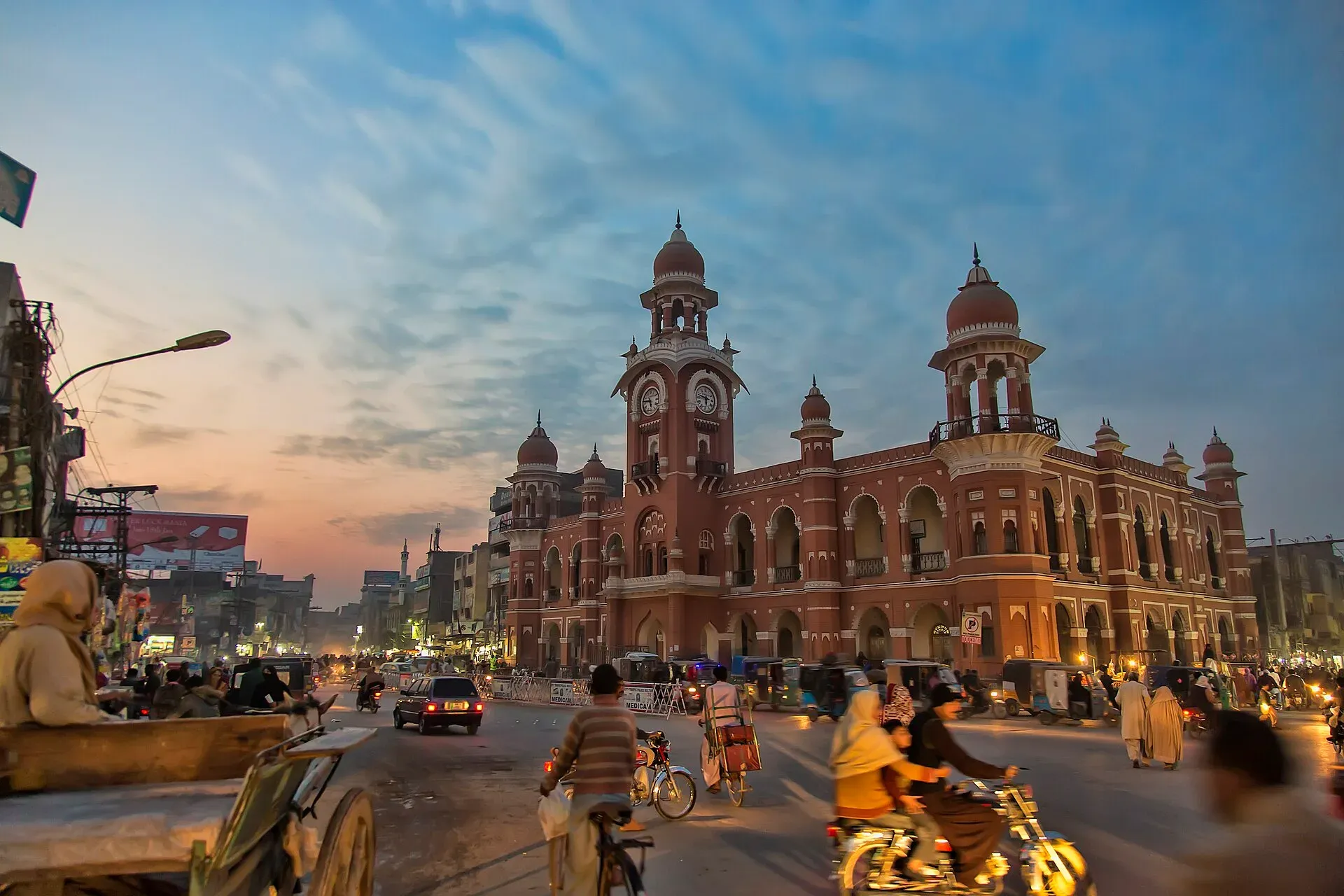
Photo: Tahsin Shah, with thanks · CC BY-SA 4.0 · via Wikimedia Commons · temporary stand-in photo

Hussain Agahi Bazaar (Multan)
A busy market in old Multan, near the fort mound and the great shrines, known for blue pottery, embroidered cloth and khussa shoes.
Overview
Hussain Agahi Bazaar is one of the main shopping streets of old Multan. It lies to the south-west of the old fort (Qila Kohna Qasim Bagh), near the hill that holds the shrines of Shah Rukn-e-Alam and Bahauddin Zakariya. Wikivoyage calls it a huge but congested market that sells almost anything, from textiles, electronics and spices to carpets, handicrafts, pottery and halwa. Multan is a major handicraft centre, and the city's merchants traded across Central Asia in the Mughal era.
Plan your visit
- Nearest town
- Multan
- Getting there
The bazaar is about 8 km from the centre of Multan by road, roughly 10 minutes without traffic (OSRM routing). Rickshaws, taxis and ride-hailing cars can drop you near the fort; finish the last stretch on foot. More
Best months
Oct – Mar
- Hussain Agahi Bazaar (Multan)
- Related places nearby: Multan, Shrine of Bahauddin Zakariya, Tomb of Shah Rukn-e-Alam
What to see and do
- Sweets. A sweet shop at the entrance is recommended for sampling Multani sohan halwa, the city's best-known dessert, made with sugar, ghee, flour and nuts.
- Oils and spices. The first street on the left sells plant and animal oils, and vendors will mix a blend for a stated purpose. A spice bazaar lies further along.
- Kalay Manddi. Past the spice bazaar, known for cut-piece cloth and fabric shops.
- Blue pottery and tiles. Multan's glazed blue pottery, especially vases, and its blue tiles are well-known local crafts. The tomb of Shah Gardez in the city, from the 1150s, is covered in the blue enamelled tiles typical of Multan.
- Embroidery and khussa. Embroidered fabric is on sale. Multani khussa shoes, traditionally worn at weddings and festivals, are sold in this part of the old city, and Wikivoyage points to the area near Ghanta Ghar (the clock tower).
- Handicrafts. Camel-skin lamp shades are among the crafts listed for the bazaar, and a first-floor handicraft shop is worth a look.
- Bangles and jewellery. Choorian Bazar (bangles) and Sarafa Bazar (jewellers) are nearby.
- Street food. Food stalls are close by. Dahi ballay and gol gappay are common snacks, and rus milaee (milk sweets) and a sweet condensed-milk drink called rubri are sold around Ghanta Ghar and Hussain Agahi. Both are very sweet.
The old city around it
Multan was a walled city. The walls date from 1627 and were rebuilt in 1756, and the royal citadel was largely destroyed by the British in 1848. Several of the old gates still give their names to districts, among them Pak Gate, Haram Gate, Delhi Gate and Lohari Gate, named for the ironsmiths who work outside it. Bohar Gate faced the River Ravi when Multan was a river port. The Damdama, a mound in the fort grounds, offers a view over the city.
History
The market takes its name from a local figure, Syed Hussain Shah Bukhari, called Hussain Agahi. No reliable written history of the bazaar itself is available, so no dates are given.
A day in old Multan
An honest outline from the sights above: shop here in the early morning, walk up to the shrine hill and fort mound while it is cool, and return towards Ghanta Ghar for sweets and chaat in the evening. Take shoes off at the shrines.
When to visit
October to March is best. Multan has a hot desert climate with very hot summers (the record is 50 degrees C in May 2010) and mild winters, and about 200 mm of rain a year, mostly in the monsoon. Shop in the early morning or evening in summer. Wikivoyage lists February and March as the main sale season.
Where to stay and eat
Hotels are mostly outside the old city. Food is easy to find near the bazaar.
Good to know
- The lanes are narrow and crowded. Avoid driving in; rickshaws are the usual way to get around, and apps such as Careem work in the city.
- Expect to haggle; many sellers offer the same goods, so compare prices.
- Dress modestly, particularly near the shrines.
- Many shops close for Friday prayers.
Highlights
- Old Multan shopping street near the fort mound
- Blue pottery, embroidery and khussa
- Close to the shrines of Shah Rukn-e-Alam and Bahauddin Zakariya
Getting there
The bazaar is about 8 km from the centre of Multan by road, roughly 10 minutes without traffic (OSRM routing). Rickshaws, taxis and ride-hailing cars can drop you near the fort; finish the last stretch on foot.
Tips
- Visit early or in the evening in hot months.
- Pair with the shrines on foot.
- Compare prices before buying.
- Wear modest clothes.
Photos we still need: Hussain Agahi Bazaar street scene, blue pottery or khussa stalls. Send us yours
Sources and last checked
Last checked Confidence low5 sources3 still to check
- Last checked
- Method
- Desk research from published sources
- Confidence
- low
- Checked by
- trek.pk research team
Researched from published sources; not yet checked on the ground by our team. Spot something out of date? Report a mistake.
Sources
- A brief guide to Hussain Agahi Market, Multan · Graana.com · checked
- Multan city page (old trek.pk page, facts only) · trek.pk legacy · checked
- OSRM road routing (driving distance and time from the city centre) · OpenStreetMap / OSRM · checked
- Multan · Wikivoyage · checked
- Multan (Wikipedia) · en.wikipedia.org · checked
Still to be checked on the ground (3)
- Exact map pin (Wikivoyage gives no address or coordinates)
- Origin and history of the bazaar name (only a blog, which could not be re-opened, gives it)
- Opening hours and weekly closing day (none found)
Nearby and related

Multan
The City of Saints in southern Punjab: blue-tiled Sufi shrines, a crowded old city, blue pottery, sohan halwa and mangoes.

Shrine of Bahauddin Zakariya
The 13th-century shrine of the Sufi saint Bahauddin Zakariya in Multan, built in 1262 and a model for later Multani tomb architecture. A working shrine with blue tiles and nightly devotional music.

Tomb of Shah Rukn-e-Alam
An octagonal brick tomb from the early 1300s on the edge of Multan Fort, with blue tilework and a dome rising about 35 m. A working shrine and on UNESCO's tentative list.

Multan Museum
Multan's first public museum, built near the Qasim Bagh fort mound at Damdama and planned with four galleries on the city's history and culture. Opening status is unconfirmed, so check before you go.