

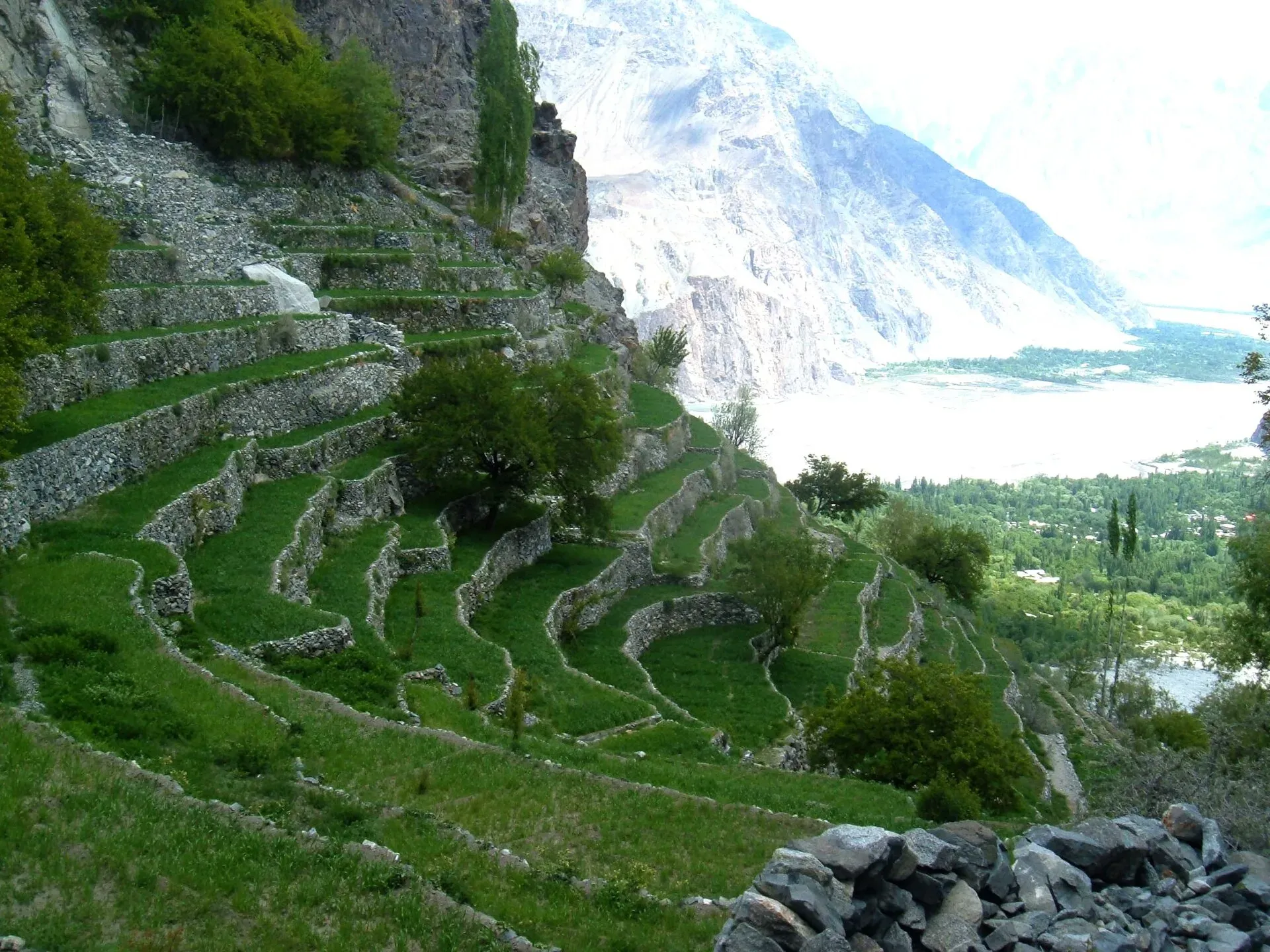
Photo: Balti sahib, with thanks · CC BY-SA 4.0 · via Wikimedia Commons · temporary stand-in photo

Khaplu Bazaar
The small market of Khaplu, capital of Ghanche District, with a road up to the fort and the base for Hushe. Few facts are confirmed, so check locally before you rely on shops.
Overview
Khaplu (also spelt Khapalu) is the administrative capital of Ghanche District, on the Shyok River at about 2,600 m, at the foot of the Karakoram. Its 2023 population was about 83,000 for the wider area. The bazaar is a small market where locals shop and where trekkers heading to Hushe and Masherbrum stock up. A Dawn travel report notes that a road leads from the bazaar up to the old Khaplu Fort. No detailed description of the bazaar's lanes, trades or hours has been published.
Plan your visit
- Nearest town
- Khaplu
- Getting there
Khaplu is about 93 km by road from Skardu (OSRM, about 87 minutes without stops); Wikipedia and Dawn quote 103 km. Vans and jeeps run from Skardu. The map point is the OSM point for Khaplu, not a verified bazaar centre. More
Best months
May – Oct
- Khaplu Bazaar
- Related places nearby: Khaplu and Hushe, Khaplu Palace (Yabgo Khar), Skardu, Shigar Valley, Khaplu
Why visit
It is a quiet town compared with Hunza or Skardu, and the bazaar gives a view of everyday Balti life. It is a place to buy fruit, bread, basic supplies and fuel before the road towards Hushe.
History
Khaplu became an independent kingdom after the Tibetan Empire broke up in the 10th century. Its rulers combined the Tibetan title Cho, "master", with the Turkish title Yabghu, and the Yabgo dynasty held the second-largest kingdom in Baltistan and guarded the trade route to Ladakh along the Shyok. Tradition holds that Ali Hamdani arrived in the late 14th century and converted the people to Islam. In the 17th and 18th centuries the royal house had close political and family ties with Ladakh.
What to see and do
- The bazaar. Walk it for fruit, bread and basic supplies.
- Khaplu Palace (Yabgo Khar). Built in the mid-19th century as a summer residence, replacing an older fort, and restored by the Aga Khan Trust for Culture between 2005 and 2011. It now operates as a hotel with a museum on Baltistan's history and culture. See Khaplu Palace.
- The old fort. Only a few remains survive. The road from the bazaar leads up to it.
- Chaqchan Mosque (Khanqah-i-Chaqchan). A wooden mosque reported as about 700 years old, restored by the Aga Khan Historic Cities Programme. Its style mixes Persian, Kashmiri and Tibetan architecture, and locals say it began as a Buddhist gompa. Visitors may pray in any mosque or khanqah regardless of sect. Ask permission before entering and respect worshippers.
- Jeeps to Hushe or Saling. Khaplu is the gateway to Hushe and the routes towards Masherbrum, Laila Peak, Gondogoro and K7. See Khaplu and Hushe.
People
The population includes Noorbakhshi (Sufi-order) Muslims, Sunnis, Shias and Aga Khanis.
When to visit
May to October. Winters are cold and the road from Skardu can be affected by snow.
Getting there
Khaplu is about 103 km east of Skardu by the figure given in a Dawn report, taking about three hours; OSRM estimates 93 km and 87 minutes without stops. Vans and jeeps run from Skardu. The map point is the OSM point for Khaplu, not a verified bazaar centre.
Good to know
- Ask the district administration or local police about current conditions before you go. Travel advice. For foreign visitors: the UK FCDO (updated 27 October 2026, checked 16 November 2026) does not advise against Gilgit-Baltistan generally, but it does advise against all travel on the Karakoram Highway between Mansehra and Chilas, which many road routes from Islamabad use. Read the current page before making any plans.
- Opening hours. No official hours found. Ask locally.
- Etiquette. Conservative area. Dress modestly and ask before photographing people.
Highlights
- Market of Ghanche District's capital
- Road up to old Khaplu Fort
- Near Khaplu Palace and Chaqchan Mosque
- Base for Hushe and Masherbrum
Tips
- Buy fruit and supplies here before Hushe.
- Ask permission before entering a mosque.
- Dress modestly.
- Check winter road status from Skardu.
Photos we still need: Khaplu bazaar; Chaqchan Mosque. Send us yours
Sources and last checked
Last checked Confidence low4 sources3 still to check
- Last checked
- Method
- Desk research from published sources
- Confidence
- low
- Checked by
- trek.pk research team
Researched from published sources; not yet checked on the ground by our team. Spot something out of date? Report a mistake.
Sources
- Khaplu · Wikipedia · checked
- Khaplu: off the beaten path · Dawn · checked
- Pakistan travel advice: warnings and insurance (updated 27 October 2026) · UK FCDO · checked
- OSRM driving route service: distances and times measured 16 November 2026 (times are optimistic, without stops) · OSRM · checked
Still to be checked on the ground (3)
- Bazaar layout, shop hours and services (no reliable source found)
- Chaqchan Mosque visitor rules (age: Dawn 2014 'about 700 years old', Wikipedia 14th century; visitor rules not published)
- Road conditions from Skardu (Dawn 2014: about three hours, 103 km; no current report)
Nearby and related

Khaplu and Hushe
Khaplu, the old Yabgo capital on the Shyok River with its restored palace and mosque, and the Hushe valley beyond, the road end for Masherbrum, K6, K7 and the Gondogoro La.

Khaplu Palace (Yabgo Khar)
The 1840 palace of the Yabgo rajas of Khaplu, restored by the Aga Khan Trust for Culture (2005-2011) and now a museum and heritage hotel facing the Karakoram.

Skardu
The main town of Baltistan, where the Indus meets the Shigar river. Skardu is the base for the Deosai Plains, the Kachura and Satpara lakes, Shigar, and the K2 and Baltoro treks.

Shigar Valley
A green valley north-east of Skardu with Shigar Fort, old wooden mosques and orchards, leading to Askole and the trailheads for the Baltoro, Biafo and Hispar treks.

Khaplu
Administrative centre of Ghanche District in the Shyok valley at about 2,600 m, with a Tibetan-style palace, old mosques and the Hushe valley road for Masherbrum and Gondogoro La.