

Photo: Moskenes, with thanks · CC BY 4.0 · via Wikimedia Commons · temporary stand-in photo

Khaplu and Hushe
Khaplu, the old Yabgo capital on the Shyok River with its restored palace and mosque, and the Hushe valley beyond, the road end for Masherbrum, K6, K7 and the Gondogoro La.
Overview
Khaplu is the main town of Ghanche District, in the Shyok River valley east of Skardu. For centuries it was the capital of a small kingdom ruled by the Yabgo dynasty, and it kept strong links with neighbouring Ladakh. Today it is known for its restored palace, its old mosque and its apricot orchards.
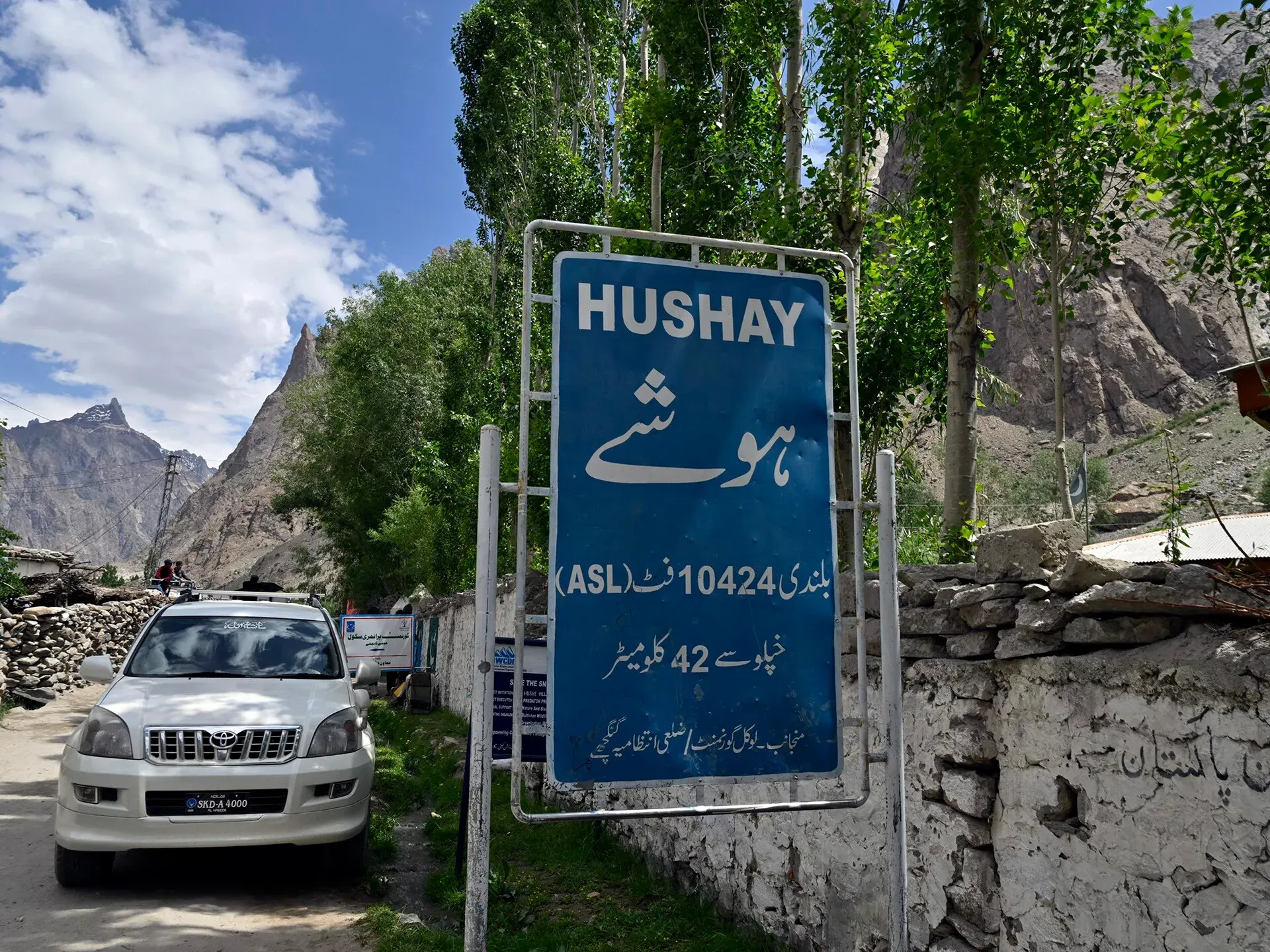
Across the river, the Hushe valley runs north from the Shyok to the foot of Masherbrum (7,821 m). Hushe village is the last settlement on the road, and the jumping-off point for Masherbrum, K6, K7, Laila Peak and the Gondogoro La. The two places are best visited together, with Khaplu as a base and Hushe as the mountain end of the trip.
Plan your visit
- Nearest town
- Khaplu
- Getting there
Khaplu is about 93 km from Skardu (OSRM models 1 h 25; Wikipedia says 103 km). Hushe is about 36 km beyond across the Shyok by a rough jeep road, 2 to 4 hours. More
Best months
May – Oct
- Khaplu and Hushe
- Related places nearby: Shigar Valley, Satpara Lake, Khaplu, Thalay Valley, Chorbat Valley, Aling Glacier (Hushe), Laila Peak (Hushe), K6 (Baltistan Peak), K7 (Gomgma Gangri)
Getting there
Wikivoyage describes Khaplu as the starting point for most trekking and climbing expeditions in the area, with Masherbrum, Saltoro, Sia Kangri, K6 and K7 nearby. Khaplu is about 93 km from Skardu by OSRM (modelled at about 1 hour 25), though Wikipedia gives 103 km, and real driving times are longer on the narrow road along the Shyok. From Khaplu, Hushe is about 36 km by OSRM; reports describe a rough jeep road of two to four hours. The CKNP (Central Karakoram National Park) page for the valley gives 5 to 6 hours by jeep from Skardu to Hushe. Minivans do not go all the way; use a 4x4. Skardu itself is about 212 km from Gilgit and about 646 km from Islamabad by OSRM, with flights from Islamabad in good weather.
Sights in Khaplu
- Khaplu Palace (Yabgo Khar). Built in 1840 by the Yabgo raja and restored between 2005 and 2011 by the Aga Khan Trust for Culture. It now holds a hotel run by Serena and a museum of Balti culture. The restoration won a UNESCO Asia-Pacific Heritage Award of Distinction in 2013.
- Chaqchan Mosque. One of the oldest mosques in Baltistan. Wikipedia's Chaqchan Mosque article gives 1370 but notes that the date and the founder are disputed, and its Khaplu article says 14th century. Wikivoyage's Skardu guide gives 1504 and attributes the mosque to Syed Ali Hamdani, so the date is not settled. It is an active place of worship, so ask before entering.
- Old town and orchards. Walk the lanes of the old quarters, the fields and the Shyok riverbank.
- Nearby villages. Thoqsikhar, Hanjor and Kaldaq are listed by Wikipedia as local sights.
Hushe valley and treks
Hushe village stands at about 3,200 m (CKNP and several sources agree) and is a Balti village of stone and timber houses and terraced barley and apricot fields. A juniper grove grows on the slope above the village. Homestays are available, with less English spoken than in Hunza. Mobile signal is patchy in Hushe village and absent beyond Saicho (CKNP). From here:
- Saicho meadow: about an hour above Hushe village, an easy overnight walk (CKNP).
- Masherbrum Base Camp (about 4,300 m): about two days' walk, rated moderate.
- Charakusa Glacier: about two days' walk to the base camp area; CKNP rates the trek moderate to demanding and gives four nights.
- K6 base camp: a demanding trek of about four nights. K7 stands at 6,934 m.
- Gondogoro La (about 5,545 m per CKNP; Wikipedia gives 5,585 m from satellite data and 5,618 m by GPS on the climbing route): a technical crossing to the Baltoro side, normally done from Concordia and needing an Alpine Club of Pakistan certified guide.
For more, see the pages on Gondogoro Valley and La, Masherbrum Base Camp and K7 Base Camp, and the Other treks in Baltistan roundup.
Wildlife
The CKNP describes the Hushe drainage as a high-priority area for monitoring snow leopard and brown bear, with camera-trap records of snow leopard. Ibex are common on high south-facing slopes, and markhor appear on lower forested edges. Treat sightings as rare and keep to marked routes.
A day or two in Khaplu and Hushe
An outline built from the sights above. A first day in Khaplu can cover the palace, the Chaqchan Mosque and a walk through the old lanes and orchards to the Shyok riverbank. A second day goes by jeep to Hushe, with an easy walk towards Saicho meadow if the weather is clear. Skardu to Saicho and back can be done in three days with one night in the meadow (CKNP).
When to go
Khaplu is pleasant from April to October. For Hushe treks the CKNP gives June to September, with July and August best. Winters are cold and the Hushe road may be closed by snow.
Where to stay and eat
Khaplu has the palace hotel and several guest houses. In Hushe, expect simple homestays and basic food. Balti dishes include noodle soups, barley bread, dried apricots and dairy. Bring cash.
Culture and languages
The people are Balti, and Balti, a language related to Tibetan, is spoken in both valleys. Urdu is widely understood and English is spoken in tourist places. Dress modestly, ask before photographing women and holy places, and respect local customs during Muharram.
Safety and practical points
- The Hushe road is rough and exposed to rockfall. Hire an experienced driver.
- A CKNP trekking permit is required for multi-day treks above Hushe village. Permits are issued at the park's Skardu office. Some routes also lie in restricted zones that need a GB permit. Fees change, so ask your operator.
- Porter rates are set by the porters' association and the load limit is 25 kg.
- Foreign visitors have not needed an NOC for Gilgit-Baltistan generally since March 2019, but border strips are restricted.
Highlights
- Khaplu Palace, restored by the Aga Khan Trust for Culture
- Chaqchan Mosque, one of Baltistan's oldest
- Hushe village at about 3,200 m beneath Masherbrum (7,821 m)
- Starting point for Masherbrum, K6, K7 and Gondogoro La treks
- Balti homestays and apricot orchards
Tips
- Use a 4x4 and experienced driver on the Hushe road.
- Get your CKNP permit at the Skardu office before multi-day treks above Hushe.
- Allow two to four hours for the Khaplu to Hushe jeep road.
- Bring cash; there are few cash machines.
- Treks June to September; July and August are best.
Photos we still need: Hushe village houses and terraced fields (Where to stay and eat). Send us yours
Sources and last checked
Last checked Confidence medium10 sources4 still to check
- Last checked
- Method
- Desk research from published sources
- Confidence
- medium
- Checked by
- trek.pk research team
Researched from published sources; not yet checked on the ground by our team. Spot something out of date? Report a mistake.
Sources
- Khaplu (Wikipedia) · Wikipedia · checked
- Khaplu Palace (Wikipedia) · Wikipedia · checked
- Hushe Valley (Wikipedia) · Wikipedia · checked
- Hushe Valley: Masherbrum and Charakusa · Central Karakoram National Park (CKNP) · checked
- Skardu (travel guide) · Wikivoyage · checked
- OSRM driving routes (distances and modelled times between towns) · OSRM / OpenStreetMap · checked
- NOC requirements for foreigners visiting Pakistan abolished (26 March 2019) · Dawn · checked
- GB winter adventure tourism hit by soaring permit fee, visa delays (1 Feb 2026) · Dawn · checked
- Chaqchan Mosque · Wikipedia · checked
- Gondogoro Pass · Wikipedia · checked
Still to be checked on the ground (4)
- Real drive times Skardu to Khaplu and Khaplu to Hushe (CKNP gives 5 to 6 hours Skardu to Hushe; no separate figures from an official source)
- Gondogoro La height: 5,545 m (CKNP), 5,585 m (SRTM) or 5,618 m (GPS) in Wikipedia; still a range
- Current CKNP and GB permit rules and fees (CKNP page: permit from the Skardu office, no prices; Dawn, 1 Feb 2026, reports sharp increases in GB trekking and mountaineering permit fees but gives no amounts)
- Chaqchan Mosque date: Wikivoyage (Skardu) says 1504; Wikipedia says 1370 and notes it is disputed
Nearby and related

Gondogoro Valley
Gondogoro La

Masherbrum Base Camp

K7 Base Camp

Other treks in Baltistan

Central Karakoram National Park
Pakistan's largest protected area, covering about 10,500 square kilometres of the highest mountains on earth: K2, Gasherbrum I and II, Broad Peak and the Baltoro, Biafo and Hispar glaciers.

Shigar Valley
A green valley north-east of Skardu with Shigar Fort, old wooden mosques and orchards, leading to Askole and the trailheads for the Baltoro, Biafo and Hispar treks.

Deosai National Park
A vast high plateau at about 4,100 m above Skardu and Astore, covered in wildflowers in summer. Created in 1993 to protect the Himalayan brown bear. Open only in summer.

Satpara Lake
A large lake at about 2,600 m, a short drive south of Skardu. It supplies Skardu's water and fed the Satpara Dam. Trout, a small island and the road to Deosai make it an easy half-day outing.

Khaplu
Administrative centre of Ghanche District in the Shyok valley at about 2,600 m, with a Tibetan-style palace, old mosques and the Hushe valley road for Masherbrum and Gondogoro La.
Thalay Valley
A side valley of the Khaplu area in Ghanche, rising from about 2,500 m to the Thalay La pass. Farming villages, pasture and ibex country, with few visitor services.
Chorbat Valley
A stretch of the Shyok valley in Ghanche District, close to the Line of Control. Farming villages with very few visitor services; access needs checking first.
Aling Glacier (Hushe)
The westernmost large glacier in the Hushe valley, reached from Hushe by a long trail to K6 base camp. Few go beyond the seventh stage.
Laila Peak (Hushe)
Laila Peak (Hushe) is a needle-shaped Karakoram summit above the Gondogoro Glacier, about 6,096 m by one map. Heights differ between sources. Trekkers see it from the Gondogoro valley.
K6 (Baltistan Peak)
K6, also called Baltistan Peak, is a 7,282 m peak in the Masherbrum Mountains above the Charakusa and Hushe valleys. It was first climbed in 1970 by an Austrian expedition. It is seen on the K7 Base Camp trek.
K7 (Gomgma Gangri)
K7 (6,934 m) is a granite peak at the head of the Charakusa valley, with one of the largest granite walls in the Karakoram. The K7 Base Camp trek from Hushe reaches its foot.
Skardu, Shigar and Deosai
A 7-day road trip from Islamabad to Skardu, the Shigar valley and the high Deosai Plains, with day-by-day distances, road conditions and the summer-only Deosai season.