

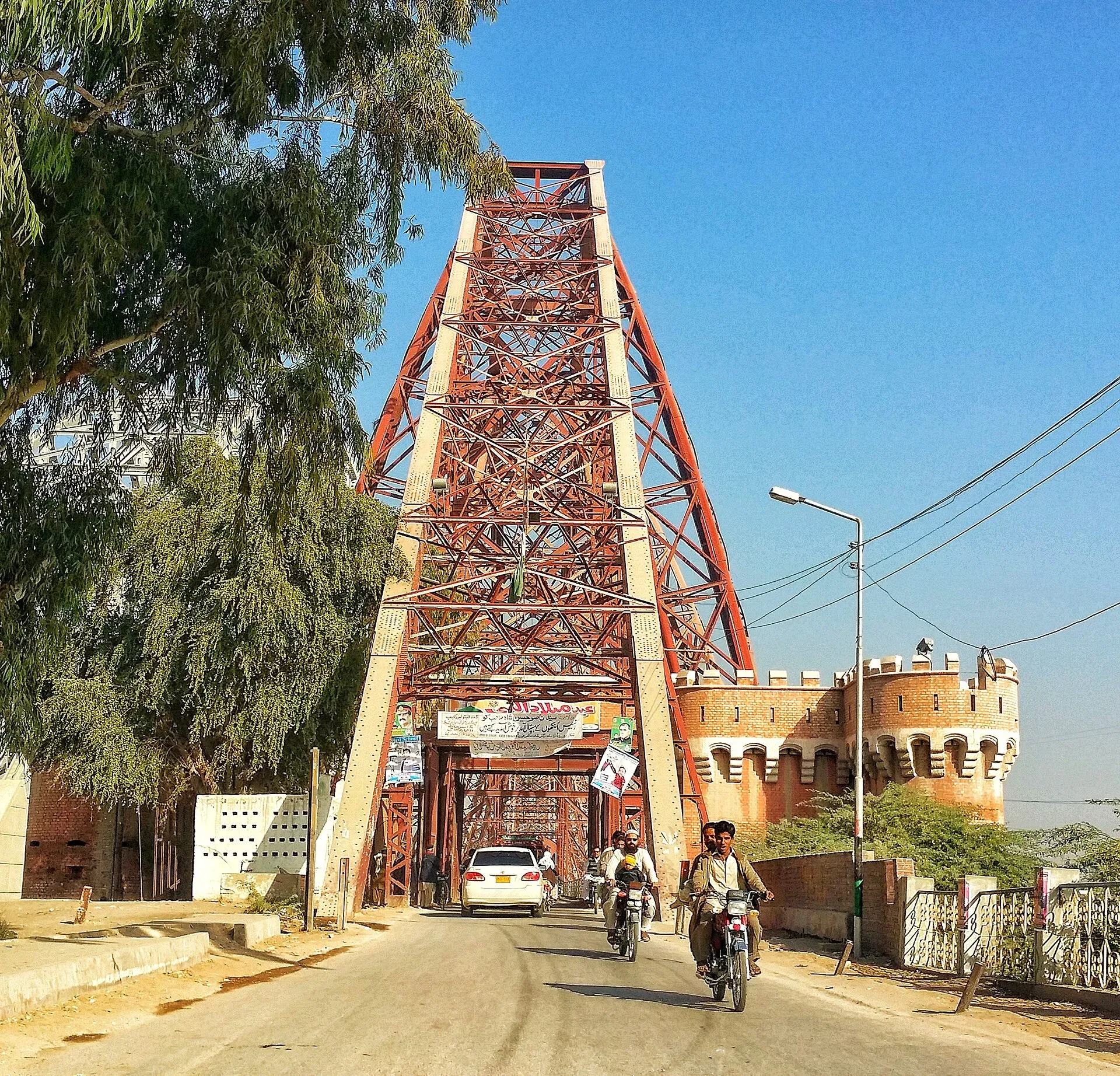
Photo: Fassifarooq, with thanks · CC BY-SA 4.0 · via Wikimedia Commons · temporary stand-in photo
Lansdowne Bridge (Sukkur)
An iron cantilever bridge over the Indus between Sukkur and Rohri, opened in 1889. Trains stopped using it in 1962, when the Ayub Bridge beside it took the railway. It has since carried road traffic and pedestrians.
Overview
The Lansdowne Bridge crosses the Indus between Sukkur on the west bank and Rohri on the east bank, in Sindh. It is a cantilever truss bridge of iron and steel, designed by the English engineer Sir Alexander Meadows Rendel and opened in 1889. It is also called the Lloyd Bridge in some accounts. It remained a rail crossing until 1962, and it is one of the best-known pieces of British-era engineering in Sindh.
Plan your visit
- Nearest town
- Sukkur
- Getting there
From Sukkur city centre it is about 6 km by road (OSRM, around 7 minutes without traffic). Rickshaws and taxis are the usual way; Sukkur has bus and rail links to other Sindh cities. More
Best months
Nov – Mar
- Lansdowne Bridge (Sukkur)
- Related place nearby: Sukkur
Why it was built
The Indus was bridged at Attock in 1887, which linked the railways running from the Khyber Pass to Calcutta. Rail traffic to Karachi was still broken at Rohri and Sukkur, where trains had to be ferried across the river. A steam ferry carried eight wagons at a time until the bridge made it redundant. The bridge connected Lahore, in the grain-growing heartland of British India, with the port of Karachi.
The site was chosen for a reason. At Sukkur the Indus divides around Bukkur Island, which made the Bukkur to Rohri line the best place to cross. The riverbed is silt rather than rock, which made piers hard to build. Five bridge proposals were made between 1872 and 1882, and none was judged fully workable until Rendel's design.
Design and construction
The bridge has two anchored cantilevers of 94.4 m (310 ft), which carry a suspended centre span of 60.9 m (200 ft). When assembled, the cantilevers stood about 51.8 m (170 ft) high. The girder work, about 3,300 tons, was made in London by Westwood, Baillie & Co. and shipped out. The Express Tribune gives the bridge's total length as 908 ft (about 277 m).
Erection was difficult. Giant derricks of 240 tons had to be set up over the water and leaned inward. The centre span was meant to be assembled on boats and lifted, but seasonal floods made that impractical, so the engineers built a temporary staging of about 56 tons instead. The permanent centre girders were then put up and riveted in four and a half days, without pneumatic tools or electric drives. Six workers died during construction. The total cost was Rs 2,696,000.
One account gives the opening as 25 March 1889, by Lord Reay, Governor of Bombay, standing in for the viceroy, Lord Lansdowne, after whom the bridge is named. The Express Tribune gives 27 March, so the sources differ by two days. A decorative padlock designed by John Lockwood Kipling, the father of Rudyard Kipling, secured the iron gates at the ceremony.
The Ayub Bridge beside it
The steel arch Ayub Bridge was built about 100 ft away between 1960 and 1962, to separate road and rail traffic. Its foundation stone was laid on 9 December 1960 and President Ayub Khan opened it on 6 May 1962. Trains moved to it, and the older bridge was left for motorists and pedestrians. The consulting engineer was David B. Steinman of New York. Most photographs of the Lansdowne Bridge show the Ayub Bridge behind it.
What to see and do
Look at the riveted ironwork from the river banks and from the Ayub Bridge side, and read the plaque at the site. A 2013 Express Tribune report said the bridge was open to motorists and pedestrians, with wooden walkways on both sides. Railways once charged a toll to cross, until a Sindh High Court order ended it.
A Sindhi folk song, "Ho Jamalo", is linked by popular legend to the bridge: a condemned prisoner is said to have driven a test train across it and won a pardon. This is a story, not a documented event.
For other sights in the area, see Sukkur, Bukkur Island and Sukkur Barrage.
Condition and use
The 2013 report described a two-way road with craters at several points that had not been resurfaced for a long time. It said no authority maintained the bridge. Railway officials and the district administration each pointed to the other as responsible. Heavy vehicles are meant to be barred since the Sukkur bypass bridge opened, but the report found loaded tractor trolleys still crossing. That report is more than a decade old, so check the current condition and rules locally.
When to visit
October to March is cooler. Summer heat at Sukkur is severe.
Photography and safety
The Ayub Bridge is an active railway, and both bridges are strategic crossings. Do not walk on the railway bridge. Photograph only from open ground, avoid security posts and respect any police instruction. Take care if you walk across the old bridge, because of the road surface and the traffic.
Good to know
- Ask the district administration or local police about current conditions before you go.
- Travel advice. For foreign visitors: the UK FCDO (updated 27 October 2026, checked 17 November 2026) advises against all but essential travel to Sindh north of and including Nawabshah, which includes Sukkur. Read the live page.
- Fees. None confirmed.
- Nearby. Sukkur and Rohri.
Highlights
- Opened in 1889; trains stopped in 1962
- Two 94.4 m cantilevers carry a 60.9 m centre span
- Ayub Bridge built alongside 1960 to 1962
- Steel erected over the Indus in about two years
Getting there
From Sukkur city centre it is about 6 km by road (OSRM, around 7 minutes without traffic). Rickshaws and taxis are the usual way; Sukkur has bus and rail links to other Sindh cities.
Tips
- Go in the cooler months.
- View from open ground; do not walk on the railway bridge.
- Do not photograph security posts.
- Ask locally about the current condition of the road.
Photos we still need: the Ayub Bridge beside the Lansdowne Bridge; close view of the riveted ironwork. Send us yours
Sources and last checked
Last checked Confidence medium4 sources3 still to check
- Last checked
- Method
- Desk research from published sources
- Confidence
- medium
- Checked by
- trek.pk research team
Researched from published sources; not yet checked on the ground by our team. Spot something out of date? Report a mistake.
Sources
- Lansdowne Bridge (Pakistan) · Wikipedia · checked
- An abandoned landmark: with no takers, Lansdowne Bridge stands on its own · The Express Tribune (2013) · checked
- Foreign travel advice: Pakistan · UK FCDO · checked
- Sukkur · Wikivoyage · checked
Still to be checked on the ground (3)
- Current traffic rules and state of the road surface (the only source is the Express Tribune report of 19 October 2013)
- Safe public vantage points (no source names any)
- Opening date: 25 March 1889 (Wikipedia) or 27 March (Express Tribune)

