

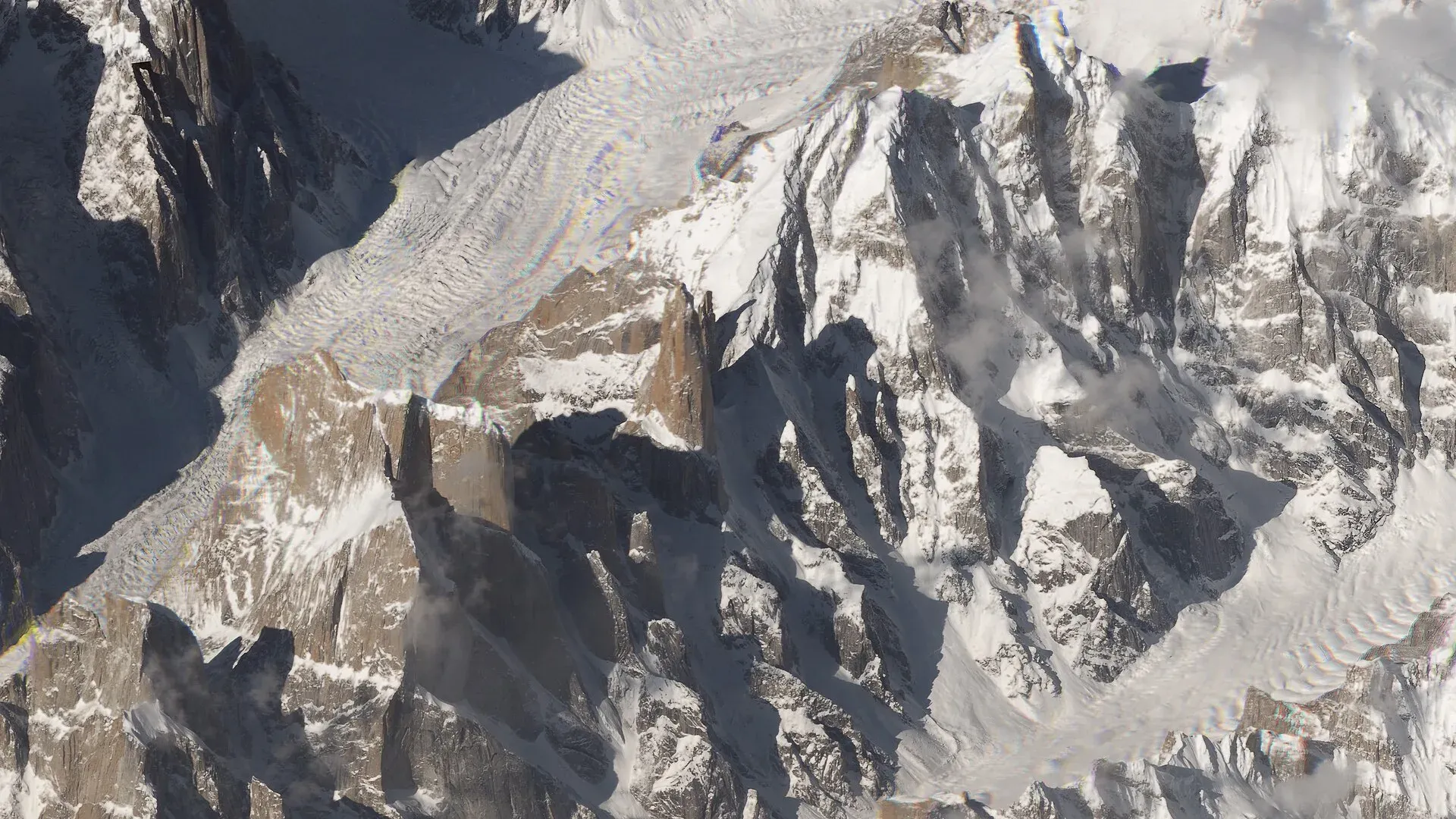
Photo: Planet Labs, with thanks · CC BY 4.0 · via Wikimedia Commons · temporary stand-in photo

Trango Towers
A cluster of granite spires north of the Baltoro Glacier, with some of the world's biggest rock walls. Great Trango is 6,286 m. It is a big-wall climbing destination and a sight for Baltoro trekkers.
Overview
The Trango Towers are a family of rock towers on a ridge north of the Baltoro Glacier, in the Baltoro Muztagh of the Karakoram, Gilgit-Baltistan. They carry some of the largest cliffs in the world, and climbers come for big-wall routes. The Trango Glacier lies to the west of the ridge and the Dunge Glacier to the east.
Plan your visit
- Nearest town
- Skardu
- Getting there
Fly or drive to Skardu, drive to Askole, then walk up the Baltoro Glacier. See the Baltoro Glacier trek page. More
Best months
Jun – Aug
- Trango Towers
- Related places nearby: Baltoro Glacier, Central Karakoram National Park, Skardu, Uli Biaho Tower, Paiju Peak, Hainablak Glacier
What to see and do
The group. Great Trango is a massif with three summits: Main (6,286 m), East (6,231 m) and West (6,223 m). Its east face is described as the world's greatest nearly vertical drop. Just north-west is Trango Tower, often called the Nameless Tower, 6,239 m and about 1,000 m of bare spire. Next come Trango Monk, Trango II (6,237 m) and Trango Ri (6,363 m), the highest point on the ridge. To the south are Trango Pulpit (6,050 m) and Trango Castle (5,753 m), the last large peak on the ridge before the Baltoro Glacier.
Where to see them. The towers are seen on the Baltoro Glacier trek, as you walk towards Concordia. Our Baltoro trek page describes first views of Paiju Peak and the Cathedral Towers on the approach to Paiju, and calls Urdukas a good place for a last look at the Trango Towers in the afternoon. Only trekkers with a permit can go there.
Climbing history
Overall, the Trango Towers have seen some of the most difficult big-wall climbs ever done, because of the altitude, the height of the routes and the steepness of the rock. All routes are highly technical.
Nameless Tower. It was first climbed in 1976 by the British climbers Joe Brown, Mo Anthoine, Martin Boysen and Malcolm Howells. There are at least eight routes to the summit today. In 1987 Slovenian climbers made the second ascent on what became known as the Yugoslav Route, and a Swiss and French team climbed the Great Overhanging Dihedral on the western pillar. The German team of Kurt Albert, Wolfgang Güllich and Hartmut Münchenbach freed the Yugoslav Route in 1988, and Albert, Güllich and two others climbed Eternal Flame on the south-east face in 1989. Catherine Destivelle made the first female ascent in 1990. Alexander and Thomas Huber made the first fully free ascent of Eternal Flame in 2009.
Great Trango. It was first climbed in 1977 by Galen Rowell, John Roskelley, Kim Schmitz, Jim Morrissey and Dennis Hennek, from the Trango Glacier side. Andy Selters and Scott Woolums climbed the north-west face in 1984. In 1984 two Norwegians, Hans Christian Doseth and Finn Dæhli, climbed the east face to the East Summit and died on the descent. The east-south-east headwall was completed in 1992 by Xaver Bongard and John Middendorf over 18 days, in the only route ever completed on that 1,340 m wall. Those two climbs have been called perhaps the hardest big-wall climbs in the world. The Norwegian route was repeated in 2008 by four Norwegians who spent 27 days on the wall.
Other firsts. In 1999 American and Russian teams made nearly simultaneous first ascents of the West Summit of Great Trango and of Trango Pulpit, and both climbs were nominated for the Piolet d'Or. In August 1992 two Australians climbed Great Trango and BASE jumped from 5,955 m, the highest starting point for a BASE jump on record. In May 2024 three skiers made the first ski descent of Great Trango, by the west face.
When to visit
Big-wall seasons and Baltoro treks run in summer, about June to August.
Where to stay and eat
Trekkers camp along the Baltoro; climbers set up base camps on the Trango Glacier. Skardu has the hotels and supplies.
Good to know
- Permits. Expeditions need a climbing permit through a licensed operator and national park fees. Trekkers on the Baltoro need a restricted-zone permit. Current fees will be added soon; ask a licensed operator or Gilgit-Baltistan Tourism.
- Heights. Sources vary by a few metres between towers; the figures above follow Wikipedia, which gives no survey source for them. Wikipedia itself rounds the Nameless Tower to about 6,200 m in one place, and notes Trango Ri is not usually counted as part of the group.
- Safety. Rockfall, storms and altitude are real hazards; rescue is slow.
- Travel advice. For foreign visitors: the UK FCDO does not advise against Gilgit-Baltistan as a whole (page updated 27 October 2026, checked 16 November 2026). Read the live page.
Highlights
- Some of the world's biggest rock walls
- Great Trango Main 6,286 m; Nameless Tower 6,239 m
- Nameless Tower first climbed in 1976
- Visible on the Baltoro trek
- A big-wall climbing destination
Getting there
Fly or drive to Skardu, drive to Askole, then walk up the Baltoro Glacier. See the Baltoro Glacier trek page.
Tips
- Photograph from the Baltoro trail in the morning light.
- Expect to need a licensed operator for any visit.
- Take climbing grades with caution; these are among the hardest big walls.
Photos we still need: Trango Glacier base camp, if an openly licensed photo exists. Send us yours
Sources and last checked
Last checked Confidence medium8 sources3 still to check
- Last checked
- Method
- Desk research from published sources
- Confidence
- medium
- Checked by
- trek.pk research team
Researched from published sources; not yet checked on the ground by our team. Spot something out of date? Report a mistake.
Sources
- Trango Towers · Wikipedia · checked
- Pakistan travel advice: warnings and insurance · UK Foreign, Commonwealth & Development Office (FCDO) · checked
- Fees and Paperwork for a Karakorum Trek (peaks above 6,500 m need a climbing permit; Alpine Club of Pakistan quoted) · ExplorersWeb · checked
- Trekking in the Karakoram and Hindukush (peak table; facts only) · Lonely Planet · checked
- Great Trango Tower · Wikipedia · checked
- Trango Tower · Wikipedia · checked
- Baltoro Glacier trek (trek.pk) · trek.pk · checked
- Baltoro Glacier (Wikipedia) · Wikipedia · checked
Still to be checked on the ground (3)
- Exact heights of individual towers (Wikipedia gives 6,286 m for Great Trango Main and 6,239 m for Trango Tower but cites no survey; Nameless Tower also appears as about 6,200 m)
- Fees for climbing and trekking permits (no official page reachable)
- Which camps give the best Trango views (no source names camps)
Nearby and related

Baltoro Glacier and K2 Base Camp

Baltoro Glacier
About 62 km long, the Baltoro is the glacier you walk up to reach K2 Base Camp and Concordia. A restricted-zone trek of about two weeks from Askole, inside Central Karakoram National Park.

Central Karakoram National Park
Pakistan's largest protected area, covering about 10,500 square kilometres of the highest mountains on earth: K2, Gasherbrum I and II, Broad Peak and the Baltoro, Biafo and Hispar glaciers.

Skardu
The main town of Baltistan, where the Indus meets the Shigar river. Skardu is the base for the Deosai Plains, the Kachura and Satpara lakes, Shigar, and the K2 and Baltoro treks.
Uli Biaho Tower
Uli Biaho Tower (about 6,100 m) is a granite tower near the Trango Towers above the Baltoro Glacier. An American team climbed its east face in 1979.
Paiju Peak
Paiju Peak (6,610 m) is a granite peak near the end of the Baltoro Glacier. It was first climbed in 1976 by an Alpine Club of Pakistan team.
Hainablak Glacier
A glacier in the Baltoro Muztagh near Trango Tower. Sources are thin.