

Read this first
Several famous Pakistan treks, including Baltoro, Biafo, Hispar and Batura, cross or follow glaciers. Walking on a glacier is not like hill walking. Hidden crevasses, thin snow bridges, loose moraine, meltwater streams and falling stones are hazards that you cannot judge from a guidebook.
This page explains what you will meet and what to ask of your guide. It does not teach crevasse rescue. Cicerone and other mountaineering publishers say rescue skills must be learned and practised on a course or with an experienced mountaineer, and write-ups of unroped crevasse falls repeat the same advice: use a guide.
What a glacier looks like
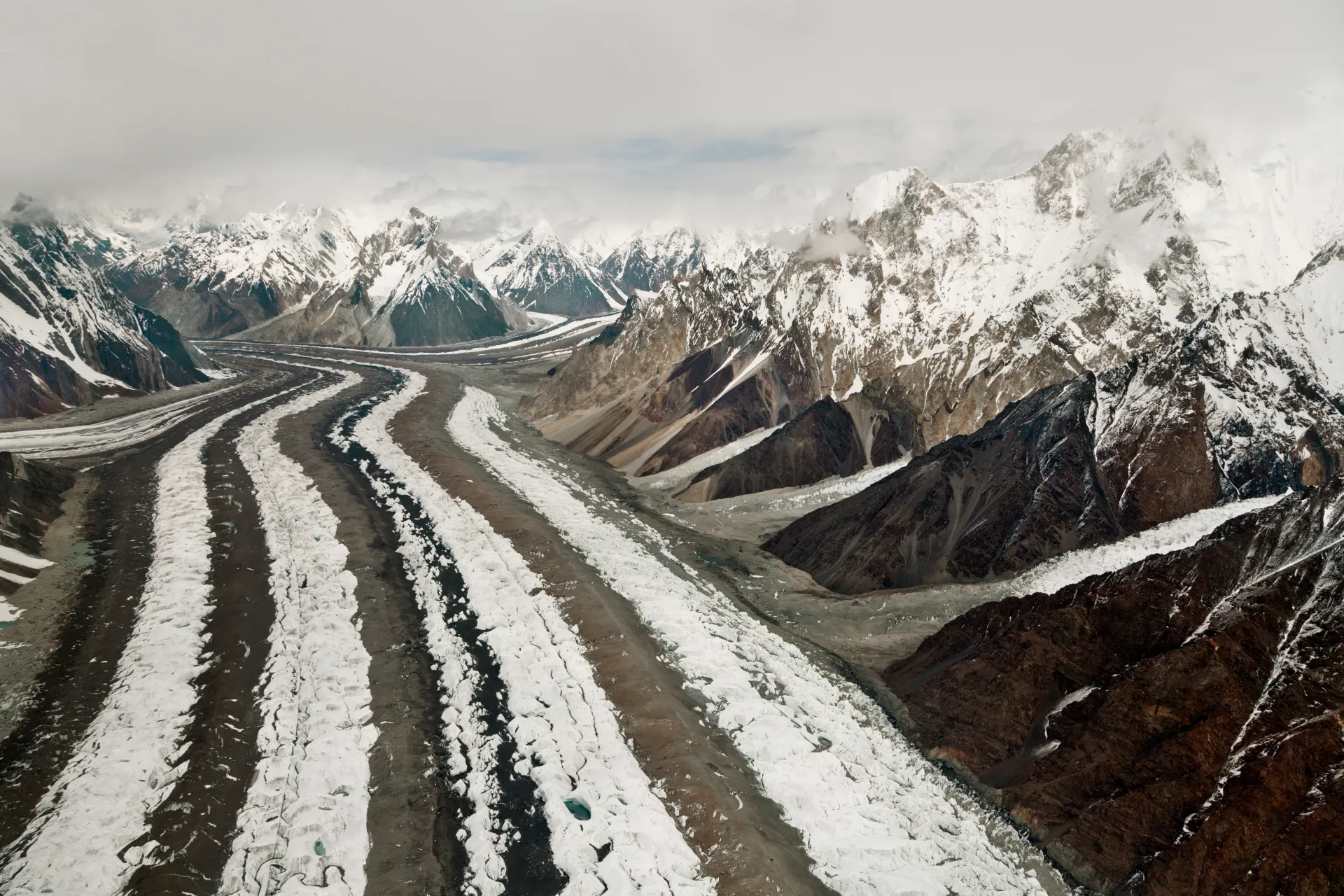
An older Lonely Planet trekking guide to the region describes the parts of a glacier. These matter on the ground:
- Moraine. Rubble of gravel and boulders. Below about 1,000 m the surface can be mostly covered by it, and where it lies densely, walking is slow and tedious. Medial moraine, running down the middle of the glacier, usually offers the easiest walking as you gain height. Lateral moraine along the sides is typically dense and jumbled.
- Bare ice. Below about 5,000 m the ice is often exposed, with permanent snow above that height.
- Crevasses. Deep cracks in the ice. They form where glaciers flow over rock or bend, and are especially likely where the glacier slows. Marginal crevasses are almost always present. They are most dangerous when bridged and hidden by snow.
- Icefalls and seracs. Where a glacier tumbles over a cliff it breaks into blocks and pinnacles of ice. Do not camp or rest beneath them.
- Meltwater streams and ponds. Common on the lower glacier, with unstable edges and ice caves.
- Cornices and avalanche slopes on passes. Steep snow slopes release avalanches, and cornices overhang ridges.
Who needs a rope and a guide
- Many trekking routes touch a glacier for less than a day. The same guide notes that on most treks you are on glacier terrain for no more than a day, and that for many glacier traverses prior experience with glacier travel, rope technique and crevasse rescue is essential, but you do not have to be a climber if you hire a qualified guide who can teach and supervise.
- Unroped travel is only sometimes acceptable. Sources agree it is risky. Where the surface is flat ice with few crevasses, risk is lower; where snow can hide crevasses, it is not. Judging conditions is difficult, and should be done by guides or experienced glacier travellers.
- Technical grade. On trek.pk, "technical" means glacier travel, ropes or crampons, and an experienced guide required. Gondogoro La is graded technical, and Hispar La is also technical.
- Passes with fixed ropes. CKNP says technical passes such as Gondogoro La require an Alpine Club of Pakistan-certified guide. Its operator directory asks whether the lead guide is qualified for fixed-rope work above 5,500 m on that route.
Registered operators, permits and guides are discussed in the hiring guide. Rules are being reviewed, so confirm with the Tourism Department.
Safe habits on a glacier
These are general points for a guided group.
- Follow the guide's line. Step where they step. Do not take shortcuts.
- Keep the group close. A person who falls into a hidden crevasse needs help immediately.
- Start when your guide says. Glacier streams grow through the afternoon, so an early start also helps with stream crossings.
- Watch the surface, and follow your guide's reading of it. Cicerone notes that crevasses are obvious on dry glaciers but hidden on wet, snow-covered ones.
- Rope up when the guide says so. If the route is roped, make sure the harness fits and knots are checked, and that you know your role. Cicerone describes roped walkers about 10 m apart with the rope kept reasonably tight; follow your guide's system.
- Do not step on snow-covered patches unless the guide has checked.
- Stay out of the runout of seracs and slopes. Cross avalanche-prone ground quickly and one at a time.
- Choose rest stops carefully. Do not rest on thin ice, on snow-covered patches or beneath cliffs.
Equipment
Equipment depends on the route. Possible items are crampons, ice axe, helmet, harness, rope, prusik cords, helmets, glacier glasses and gaiters. Bring them only if your guide asks, and only if you know how to use them. See the gear lists.
Water and weather
Glacial streams grow through the afternoon, so see the river crossing guide. Glacier streams should be filtered or boiled before drinking, as CKNP advises. Weather can close high routes with little warning, and CKNP says first snow at Concordia usually falls between 10 and 25 September in its description of the season.
Cold, sun and altitude
Glacier routes are high and cold. Snow reflects strong sunlight, so protect eyes and skin. Treat altitude carefully. See the altitude sickness guide.
If someone falls in a crevasse
Teams with the right skills may rescue them. If you do not have the skills, your most useful actions are to stay calm, keep everyone away from the edge, and shout to the guide and use any communication device. Do not walk to the edge to look.
Your insurance must cover rescue at altitude in Pakistan. Helicopter rescue is paid for in advance (see the hiring guide). Many glacier treks are days from a road.
Questions for your operator
- How many days are on glacier, and what is the technical level?
- Who leads, and what is their glacier and rescue qualification?
- What does the team carry: ropes, harnesses, radio or satellite device?
- What happens if the weather turns or a pass is not safe?
- Can we skip the glacier section if conditions are poor?


