

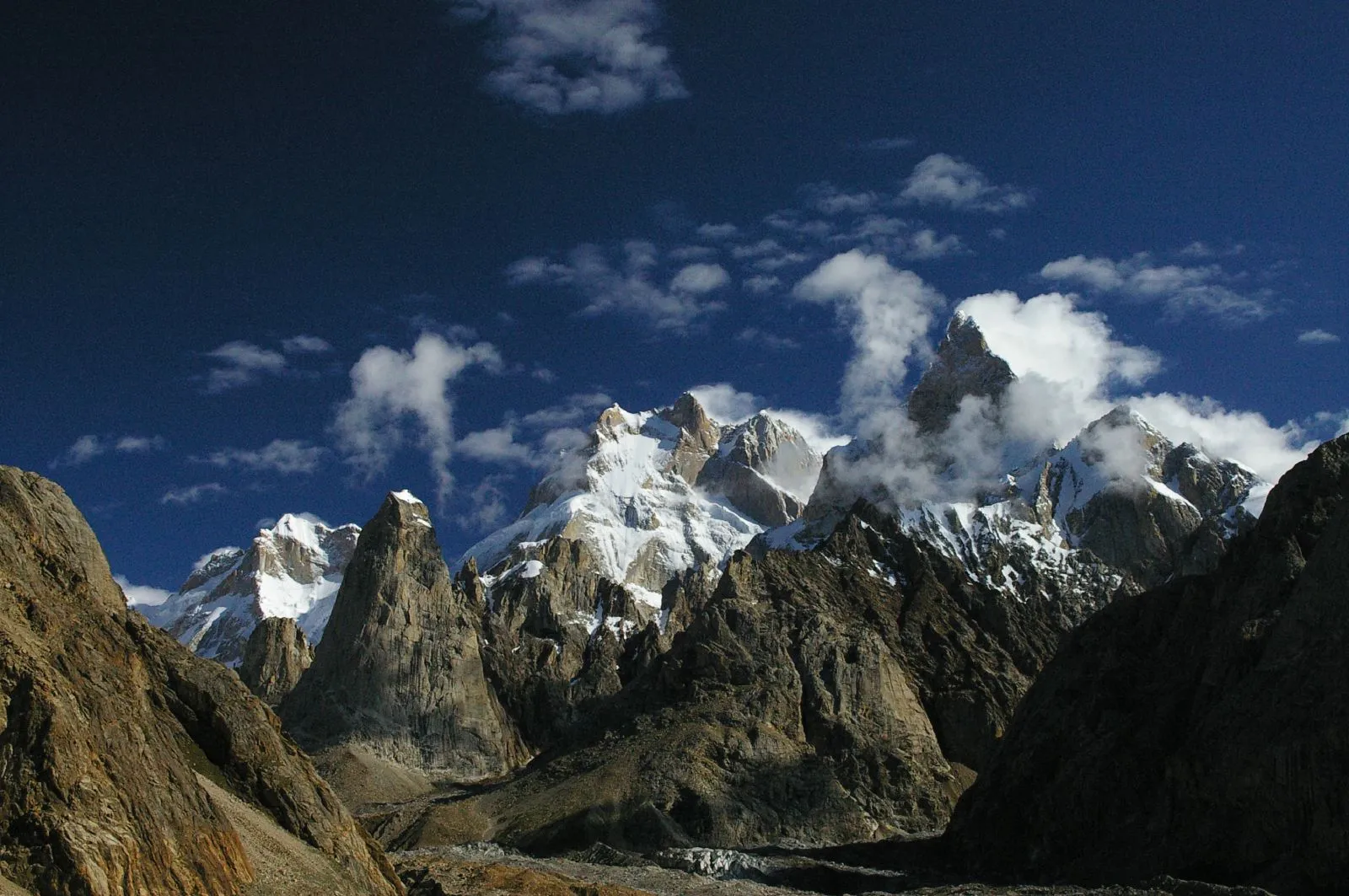
Photo: Ben Tubby, with thanks · CC BY 2.0 · via Wikimedia Commons · temporary stand-in photo

Baintha Brakk (The Ogre)
Baintha Brakk, also called The Ogre (7,285 m), is a granite peak in the Panmah Muztagh above the Biafo Glacier. Its first ascent in 1977 became one of the best-known stories in mountaineering.
Overview
Baintha Brakk, also called The Ogre, is 7,285 m (23,901 ft) high, ranked 86th in the world, with a prominence of 1,891 m. Its lower west summit is about 7,150 m. It is in the Panmah Muztagh, a sub-range of the Karakoram in Gilgit-Baltistan, and rises on the north side of the Biafo Glacier, about 30 km north of the Askole roadhead and about 75 km from Skardu. It is a granite tower, and its south face rises more than 3,000 m above the Uzun Brakk Glacier within about 2 km horizontally. The Latok peaks nearby are similarly steep and rocky.
Plan your visit
- Nearest town
- Skardu
- Getting there
From Skardu, drive through Shigar to Askole (the Braldu valley road), then follow the Biafo Glacier north-west. More
Best months
Jun – Sep
- Baintha Brakk (The Ogre)
- Related places nearby: Biafo Glacier, Hispar Glacier, Skardu, Central Karakoram National Park
First ascent, 1977
Attempts in 1971 and 1976 failed. A British expedition made the first ascent on 13 July 1977. Doug Scott and Chris Bonington reached the main summit by the south-west spur and west ridge; Mo Anthoine, Clive Rowland and Nick Estcourt reached the west summit. Tut Braithwaite was hurt early on by rockfall. The summit block needed hard rock climbing.
The descent turned the climb into a survival story. On the first abseil Scott broke both legs. Bonington broke two ribs and developed pneumonia. A big storm hit during the week-long descent, but the whole party reached base camp.
Later ascents
The second ascent came on 21 July 2001, by Urs Stöcker, Iwan Wolf and Thomas Huber by the south pillar, after they had made the first ascent of Ogre III (about 6,800 m). Sources disagree on how many expeditions failed in between: one account says more than 20, while the Himalayan Index lists ten. Kyle Dempster and Hayden Kennedy made the third ascent on 21 August 2012, on a new line on the south face. Josh Wharton turned back at about 6,800 m with altitude sickness. The same group had earlier made a first ascent of a new line on the east face of K7 (6,934 m).
What to see and do
- Biafo-Hispar traverse (Hispar La trek): the route up the Biafo Glacier passes close below the granite spires of Baintha Brakk and Lukpe Lawo Brak.
- Biafo Glacier: about 67 km long. The route from the last village, Askole, passes camps at Mango, Namla and Baintha. Baintha has a green meadow and streams and is often used as a rest day. The first three camps have running water. Trekkers can expect several days of boulder-hopping, and ibex and markhor are present.
When to visit
The Biafo-Hispar glacier route is usually walked from about June to September.
Where to stay and eat
Askole has basic guesthouses and camping; on the glacier you camp. Skardu has hotels.
Good to know
Climbing context. Baintha Brakk is a technical expedition peak for experienced, well-equipped mountaineers only. It is not a trekking peak and this page does not describe a climbing route. Climbing needs an expedition permit from the Gilgit-Baltistan authorities, arranged through a licensed Pakistani operator. No permit fees are quoted here; ask the operator for the current rules. Its history includes serious injury and rockfall.
Getting there safely. For foreign visitors: the UK FCDO (updated 27 October 2026) advises against travel on the Karakoram Highway between Mansehra and Chilas but does not name Gilgit-Baltistan as a whole. Ask your operator which route they use.
Highlights
- 7,285 m granite peak above the Biafo Glacier
- First climbed in 1977 by Doug Scott and Chris Bonington, after Scott broke both legs on the descent
- Second ascent 24 years later, in 2001
- Seen from the Biafo-Hispar trek
Getting there
From Skardu, drive through Shigar to Askole (the Braldu valley road), then follow the Biafo Glacier north-west.
Tips
- Glacier travel needs a guide and proper equipment.
- Allow plenty of spare days on the Biafo-Hispar route.
Photos we still need: Baintha camp meadow on the Biafo Glacier; Askole village and the roadhead. Send us yours
Sources and last checked
Last checked Confidence low4 sources3 still to check
- Last checked
- Method
- Desk research from published sources
- Confidence
- low
- Checked by
- trek.pk research team
Researched from published sources; not yet checked on the ground by our team. Spot something out of date? Report a mistake.
Sources
- Baintha Brakk (Wikipedia) · Wikipedia · checked
- Latok I (Wikipedia) · Wikipedia · checked
- Pakistan travel advice: warnings and insurance (updated 27 October 2026) · UK FCDO · checked
- Biafo Glacier · Wikipedia · checked
Still to be checked on the ground (3)
- Photo caption location (Biafo Glacier) is assumed from the peak's position; confirm the viewpoint
- Current royalty and permit rules (not confirmed from an official source)
- Exact trailhead and approach times from Askole
Nearby and related

Hispar La (Biafo–Hispar traverse)

Biafo Glacier
A glacier of about 63 km that runs from Snow Lake down to Askole. With the Hispar Glacier it forms one of the longest glacier routes outside the polar regions, a serious roped trek over the Hispar La.

Hispar Glacier
A 49 km glacier flowing west from the Hispar La into Nagar, below Distaghil Sar and Kunyang Chhish. Its lower stretch is summer pasture; the whole length is walked on the Biafo-Hispar traverse.

Skardu
The main town of Baltistan, where the Indus meets the Shigar river. Skardu is the base for the Deosai Plains, the Kachura and Satpara lakes, Shigar, and the K2 and Baltoro treks.

Central Karakoram National Park
Pakistan's largest protected area, covering about 10,500 square kilometres of the highest mountains on earth: K2, Gasherbrum I and II, Broad Peak and the Baltoro, Biafo and Hispar glaciers.