

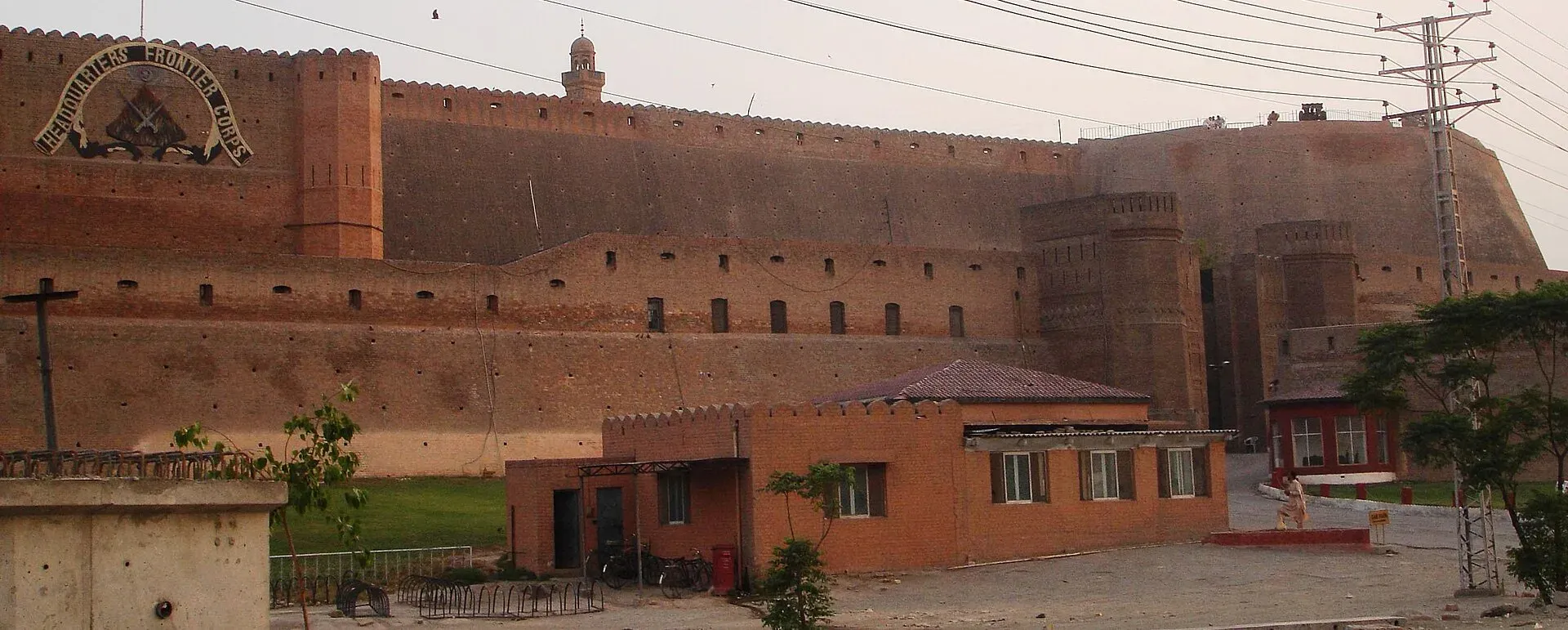
Photo: Marwatt at en.wikipedia, with thanks · Public domain (CC0) · via Wikimedia Commons · temporary stand-in photo

Bala Hisar Fort (Peshawar)
A high old citadel on the edge of Peshawar's walled city, rebuilt by the Sikhs and British and now a Frontier Corps headquarters. Public access is limited and should be checked first.
Overview
Bala Hisar, meaning "high fortress", is the old citadel of Peshawar, on a rise in the north-west of the walled city. The present fort has been rebuilt many times. Wikipedia says it is the headquarters of the Frontier Corps (a paramilitary force), so it has been a working military site and not a normal tourist monument. A 2018 Dawn report says the force had largely moved to a new camp at Hayatabad.
Plan your visit
- Nearest town
- Peshawar
- Opening hours
- No confirmed official hours. Wikipedia says the fort was opened to visitors on Sundays (families only on Saturdays) but was closed during COVID-19, and does not say it has reopened. Check with Khyber Pakhtunkhwa Tourism or the Frontier Corps.
- Getting there
Bala Hisar is in the north-west of Peshawar, about 6 km by road from the centre (about 11 minutes, OSRM). Use a taxi or ride-hailing car. Peshawar is about 182 km (roughly 2 hours) from Islamabad by motorway. More
Best months
Nov – Mar
- Bala Hisar Fort (Peshawar)
- Related places nearby: Peshawar, Khyber Pakhtunkhwa, Mahabat Khan Mosque, Peshawar Walled City, Pushkalavati Museum
Names and history
During the Mughal and Sur periods the fort was known as Bagram Fort, after an older name for Peshawar. After the Sikhs captured it in 1834 they called it Samir Garh, but the name did not stick.
- 630 CE: the Chinese monk Xuanzang found a royal residence at Peshawar. The historian Ahmad Hasan Dani links this to a walled citadel with a moat.
- Mughal period: the fort was still standing in Babur's time.
- 1747 onwards: Ahmad Shah Durrani conquered Peshawar in December 1747. Timur Shah (1773 to 1793) used the fort as his winter capital.
- 1758 and 1759: the Marathas took the fort after the Battle of Peshawar on 8 May 1758; Ahmad Shah Abdali recaptured it in 1759.
- 1823: the Sikhs defeated the Durranis at Nowshera, destroyed the Afghan court and fort, and began rebuilding under Hari Singh Nalwa. They took it again in 1834.
- 1849: after the First Anglo-Sikh War the British East India Company rebuilt the outer walls, which stand today.
What to look for
The outer walls rebuilt in 1849 are the main surviving feature. Wikipedia describes a Frontier Corps museum inside with uniforms and weapons from different units, and a martyrs' memorial stands on the premises. No source describes the interior buildings in detail, so do not expect a restored palace.
Access
Wikipedia says that when the fort was open, entry was free: Saturdays were for families and Sundays for everyone, with a CNIC (national ID card) required, or a passport for international visitors. That information is out of date, as the page says the fort was closed during COVID-19.
In December 2018 Dawn reported a Khyber Pakhtunkhwa plan to turn the fort into a military museum with Sunday guided tours. The Frontier Corps had agreed to vacate the fort and the province had allotted land in Hayatabad, but the report gives no opening date, and the idea of making the fort a tourist site dates back to the mid-1990s. Whether the plan went ahead is not confirmed, so treat the fort as closed unless an official notice says otherwise.
When to visit
Peshawar is hot from May to September. November to March is more comfortable.
Where to stay and eat
Stay in Peshawar's cantonment or university area. See the Peshawar page for general guidance.
Good to know
- Ask the district administration or local police about current conditions before you go. Travel advice. For foreign visitors: the UK FCDO (updated 27 October 2026, checked 16 November 2026) advises against all travel to Peshawar, including the city. Read the current page before making any plans.
- Access. We have not confirmed any official visiting hours or whether the museum is open to the public. Ask Khyber Pakhtunkhwa Tourism or the Frontier Corps before you go. Do not photograph military areas.
- Etiquette. Follow the guards' instructions at all times.
- Nearby. Peshawar Walled City, Mahabat Khan Mosque and the Peshawar Museum.
Highlights
- Peshawar's old citadel, rebuilt in the Sikh and British periods
- Used by the Durrani rulers as a winter capital
- Now a Frontier Corps headquarters
- Small museum reported inside
Getting there
Bala Hisar is in the north-west of Peshawar, about 6 km by road from the centre (about 11 minutes, OSRM). Use a taxi or ride-hailing car. Peshawar is about 182 km (roughly 2 hours) from Islamabad by motorway.
Tips
- Do not turn up unannounced: ask the Frontier Corps or KP Tourism about access.
- Carry your CNIC or passport.
- Do not photograph military installations.
- Check FCDO advice for Peshawar.
Photos we still need: the main gate and the Frontier Corps museum. Send us yours
Sources and last checked
Last checked Confidence low4 sources5 still to check
- Last checked
- Method
- Desk research from published sources
- Confidence
- low
- Checked by
- trek.pk research team
Researched from published sources; not yet checked on the ground by our team. Spot something out of date? Report a mistake.
Sources
- Bala Hissar, Peshawar (Wikipedia) · Wikipedia · checked
- Military museum in Balahisar Fort planned · Dawn · checked
- Pakistan Tourism Guide 2021 · Tourism Development Corporation of Pakistan (TDAP) · checked
- Pakistan travel advice: warnings and insurance (updated 27 October 2026) · UK Foreign, Commonwealth & Development Office · checked
Still to be checked on the ground (5)
- Whether the public can enter now, and the hours (Wikipedia says closed since COVID-19, with a note that the line needs updating; no official source)
- Whether the Frontier Corps museum is open and who may visit (Dawn, 16 Dec 2018, reported only a plan to turn the fort into a military museum with Sunday tours)
- Fee (Wikipedia says entry was free; no official page)
- Whether the Frontier Corps has fully moved to Hayatabad (Dawn, December 2018, says largely moved; Wikipedia still names it the headquarters)
- Architecture and the interior buildings (no source describes them)
Nearby and related

Peshawar
Khyber Pakhtunkhwa's capital and one of South Asia's oldest living cities: the Gandhara museum, Qissa Khwani Bazaar, mosques and a strong food culture.

Khyber Pakhtunkhwa
Mountains, Buddhist ruins and old bazaars in north-west Pakistan: Swat, Kaghan, Chitral, the Kalash valleys, the Khyber Pass and Peshawar.

Mahabat Khan Mosque
A 17th-century Mughal mosque in Peshawar's old city with a white marble facade, two tall minarets and a large courtyard. It is an active mosque, so visit outside prayer times.

Peshawar Walled City
The old core of Peshawar: Qissa Khwani Bazaar, the carved wooden Sethi havelis and the Gor Khatri complex. Parts are being restored, and the Sethi House and Gor Khatri are on UNESCO's tentative list.
Pushkalavati Museum
A district museum of archaeology and ethnology at Ghani Dheri near Charsadda, also called Charsadda Museum, close to the ruins of ancient Pushkalavati.