

Photo: Faysalelahi, with thanks · CC BY-SA 4.0 · via Wikimedia Commons · temporary stand-in photo

Mahabat Khan Mosque
A 17th-century Mughal mosque in Peshawar's old city with a white marble facade, two tall minarets and a large courtyard. It is an active mosque, so visit outside prayer times.
Overview
The Mahabat Khan Mosque, sometimes spelt Mohabbat Khan, is a Mughal-era mosque in the old city of Peshawar. It stands on what was the highest point of the old city (Wikipedia, citing Dawn) and is one of Peshawar's best-known landmarks. It is named after a Mughal governor of Peshawar. The Jewellers' Bazaar runs beside it.
Plan your visit
- Nearest town
- Peshawar
- Getting there
The mosque is in the old city, about 6 km by road from central Peshawar (roughly 11 minutes, OSRM). Take a taxi or ride-hailing car to the bazaar edge, then walk the narrow lanes. More
Best months
Nov – Mar
- Mahabat Khan Mosque
- Related places nearby: Peshawar, Peshawar Walled City, Bala Hisar Fort (Peshawar), Khyber Pakhtunkhwa, Sethi House and Sethi Mohallah, Peshawar
History
Sources disagree on the date. Wikipedia's Peshawar article says 1630; the mosque article's history section says 1660 to 1670 (citing a Dawn article of 5 December 2008 and a 1996 journal) and its headline figure says 1670. No Mughal record mentions its construction; local tradition links it to a governor named Mahabat Khan. Scholars have suggested he was Mahabat Khan Luhrasp, a noble of Shah Jahan and Aurangzeb. After the Soviet invasion of Afghanistan in 1979, Afghan refugee tribal elders met here to build unity.
Architecture
The complex covers about 30,155 square feet. The prayer hall is on the west side of an open courtyard, with a pool in the middle for washing before prayer and a single row of rooms along the outer walls.
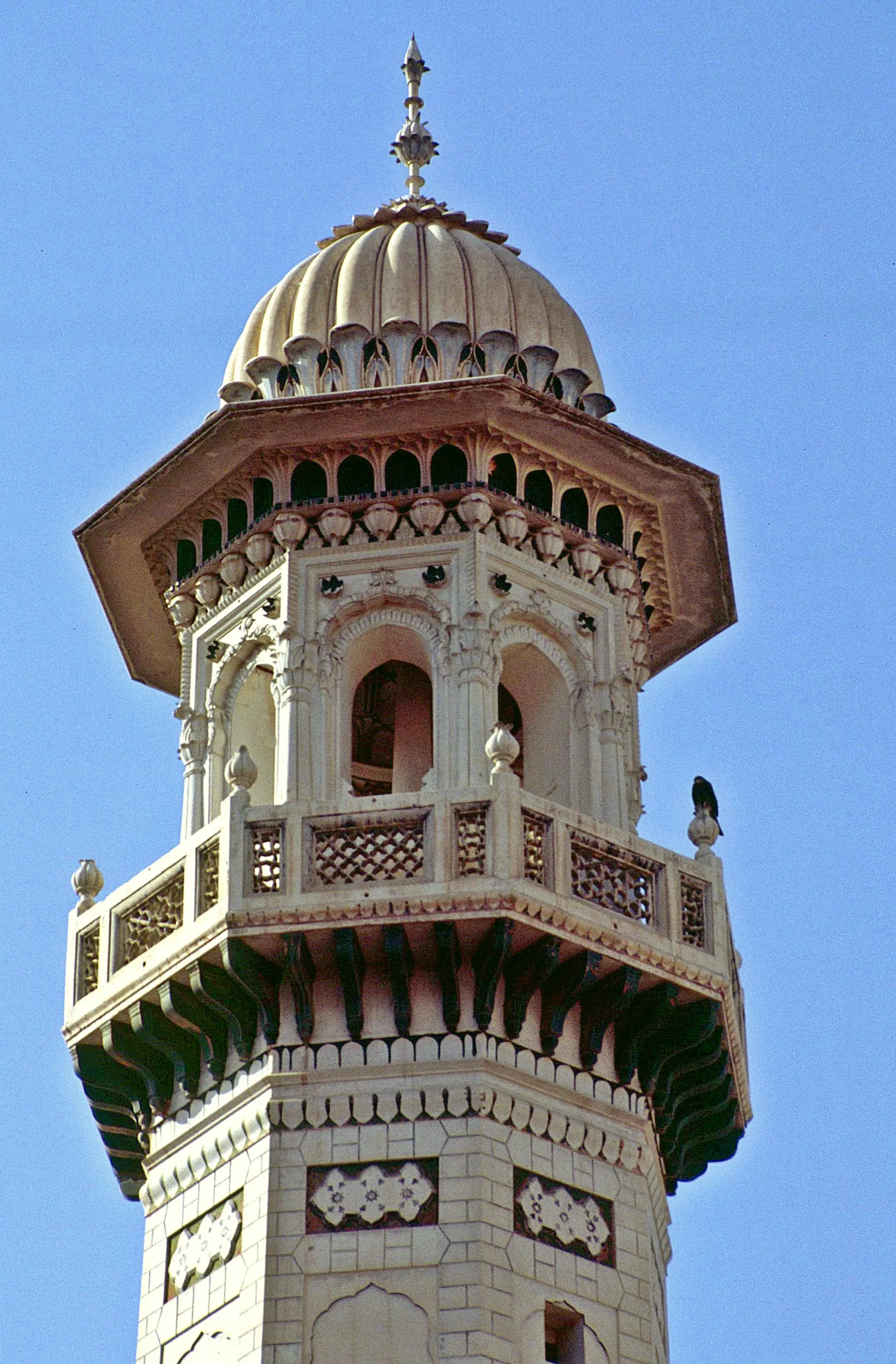
Photo: Ziegler175, with thanks · CC BY-SA 3.0 · via Wikimedia Commons · temporary stand-in photo

The facade is white marble with five arched entrances. The central arch is the tallest and has the cusped (scalloped) profile typical of Mughal work. The two arches beside it are plainer, in a Persian and Central Asian style. Above each arch tip is a row of seven small arched openings. The three central ones have muqarnas (stalactite-like vaulting), and the outermost have stucco ribbing. Three fluted domes cap the hall. Two tall minarets, each in three sections, flank it, and eight small decorative minarets line the roof, six beside the entrances and two at the ends. The roofline steps up towards the centre in four small stages and is edged with merlons.
What to see and do
- The marble facade, domes and minarets from the courtyard.
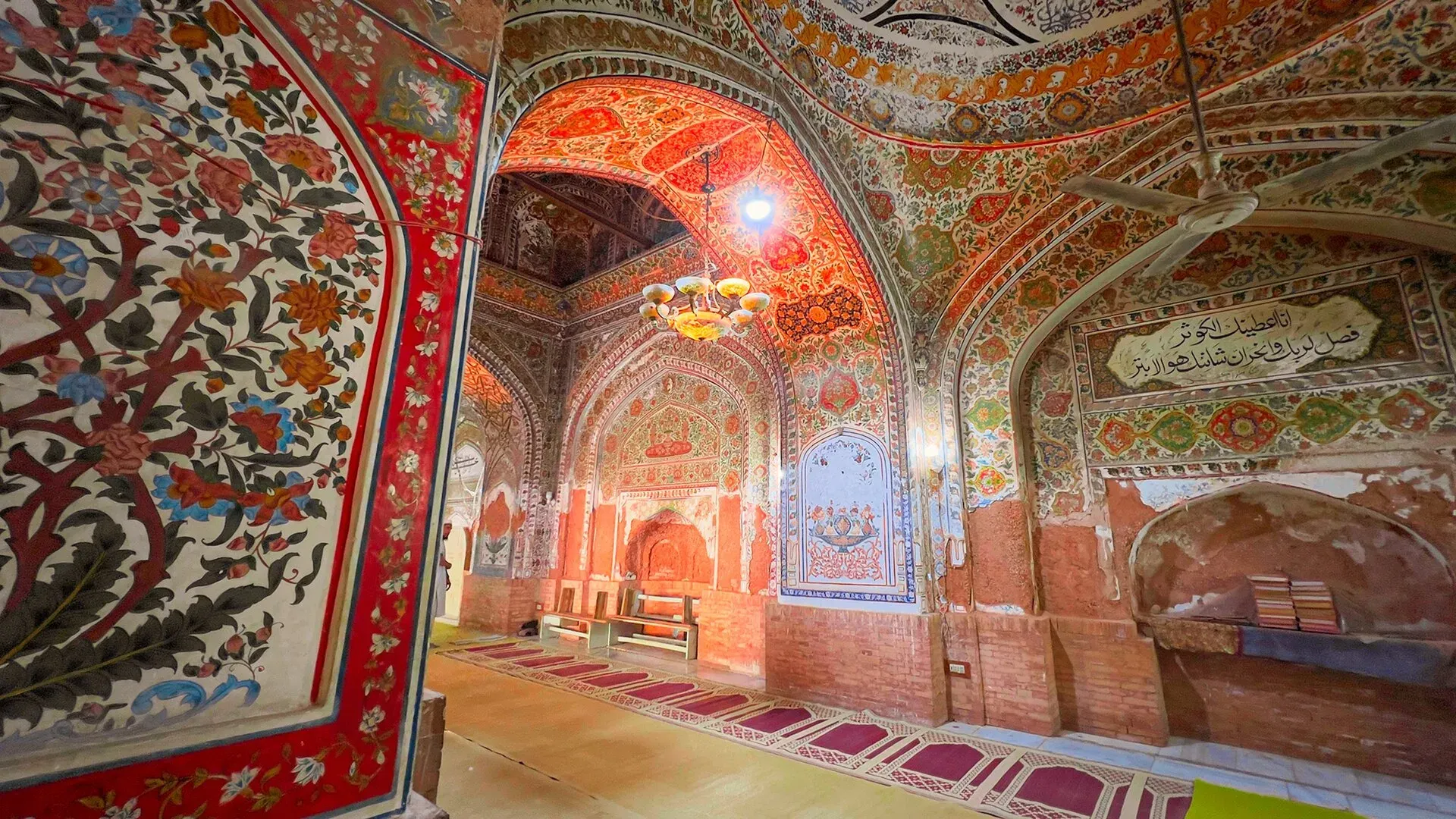
- Painted floral and geometric designs and Quranic calligraphy inside. The plant motifs are multi-coloured, unlike the green motifs at Lahore's Badshahi Mosque.
- The surrounding bazaars, including the Jewellers' Bazaar, on foot. See Peshawar Walled City.
A visit takes 30 to 45 minutes.
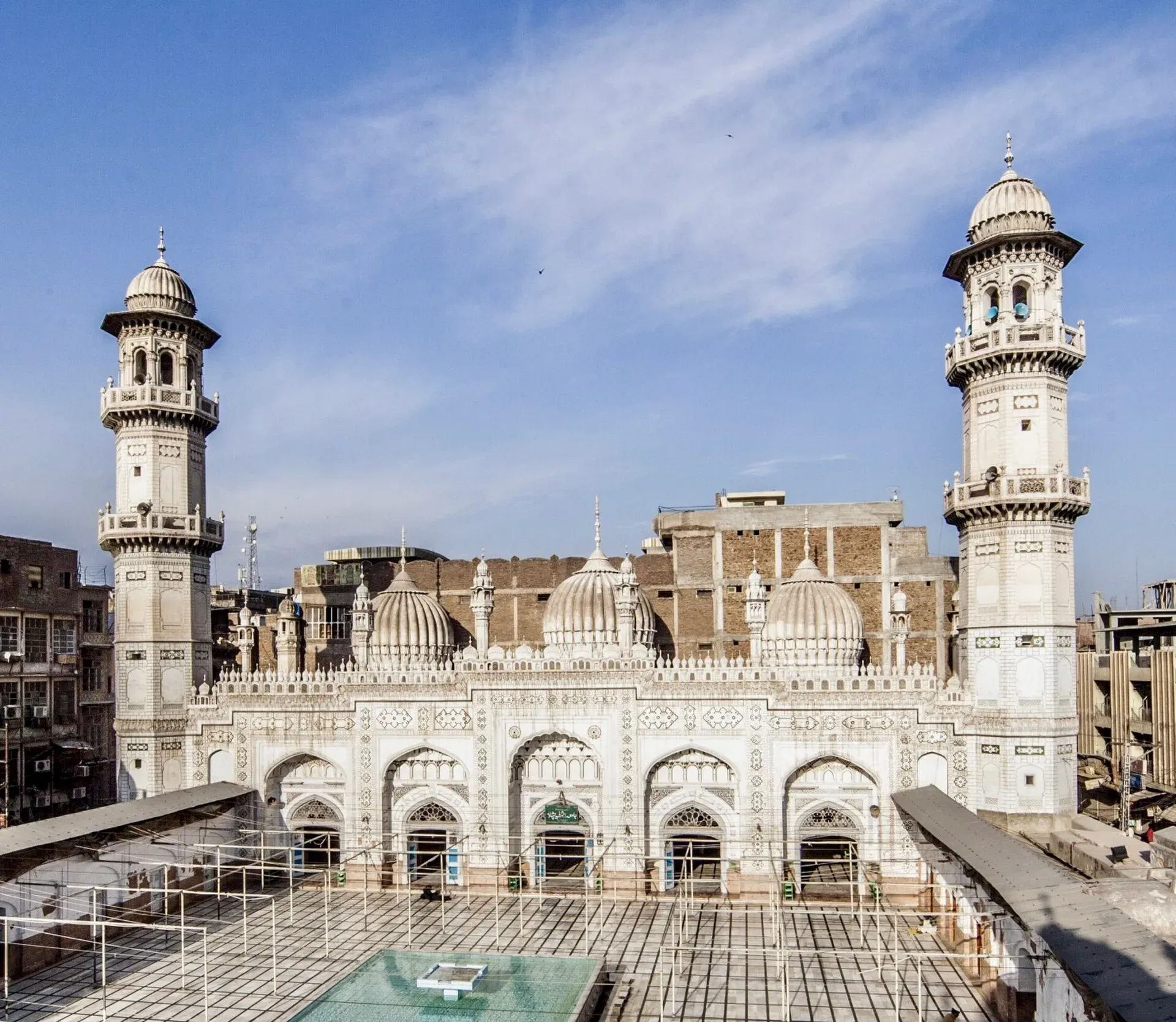
Photo: US Embassy Pakistan, with thanks · Public domain (CC0) · via Wikimedia Commons · temporary stand-in photo

When to visit
Go between November and March when it is cool. Avoid the hour around the five daily prayers and Friday midday prayer.
Where to stay and eat
The old city has traditional food and tea; stay elsewhere in Peshawar.
Good to know
- Ask the district administration or local police about current conditions before you go. Travel advice. For foreign visitors: the UK FCDO (updated 27 October 2026, checked 17 November 2026) advises against all travel to Peshawar, including the city. Read the current page before making any plans.
- Etiquette. The mosque is in daily use. Dress modestly with arms and legs covered; women should cover their hair. Take off your shoes, speak quietly and do not enter the prayer hall during prayers unless invited. Ask before photographing worshippers.
- Hours. No official hours found. Ask locally.
- Nearby. Peshawar Walled City, including Qissa Khwani Bazaar and Sethi Mohallah; Bala Hisar Fort.
Highlights
- White marble facade with two minarets
- Three fluted domes
- Courtyard with ablution pool
- On the highest point of the old city
Getting there
The mosque is in the old city, about 6 km by road from central Peshawar (roughly 11 minutes, OSRM). Take a taxi or ride-hailing car to the bazaar edge, then walk the narrow lanes. Peshawar is about 182 km from Islamabad by motorway.
Tips
- Visit outside prayer times.
- Dress modestly and remove shoes.
- Ask before photographing worshippers.
- Check FCDO advice for Peshawar before any trip.
Photos we still need: the courtyard pool and the Jewellers' Bazaar beside the mosque. Send us yours
Sources and last checked
Last checked Confidence medium4 sources4 still to check
- Last checked
- Method
- Desk research from published sources
- Confidence
- medium
- Checked by
- trek.pk research team
Researched from published sources; not yet checked on the ground by our team. Spot something out of date? Report a mistake.
Sources
- Mahabat Khan Mosque (Wikipedia) · Wikipedia · checked
- Pakistan Tourism Guide 2021 · Tourism Development Corporation of Pakistan (TDAP) · checked
- Pakistan travel advice: warnings and insurance (updated 27 October 2026) · UK Foreign, Commonwealth & Development Office · checked
- Peshawar · Wikipedia · checked
Still to be checked on the ground (4)
- Construction date: 1630 versus 1660-1670 (still disputed; no Mughal record)
- Visiting rules for non-Muslims and for women (not covered by Wikipedia)
- Hours and prayer-time closures
- Current state of repairs
Nearby and related

Peshawar
Khyber Pakhtunkhwa's capital and one of South Asia's oldest living cities: the Gandhara museum, Qissa Khwani Bazaar, mosques and a strong food culture.

Peshawar Walled City
The old core of Peshawar: Qissa Khwani Bazaar, the carved wooden Sethi havelis and the Gor Khatri complex. Parts are being restored, and the Sethi House and Gor Khatri are on UNESCO's tentative list.

Bala Hisar Fort (Peshawar)
A high old citadel on the edge of Peshawar's walled city, rebuilt by the Sikhs and British and now a Frontier Corps headquarters. Public access is limited and should be checked first.

Khyber Pakhtunkhwa
Mountains, Buddhist ruins and old bazaars in north-west Pakistan: Swat, Kaghan, Chitral, the Kalash valleys, the Khyber Pass and Peshawar.

Sethi House and Sethi Mohallah, Peshawar
A lane of merchant havelis in Peshawar's old city, built from about 1800 to 1910 by the Sethi family in a Central Asian style, with carved wood, painted ceilings and courtyards. On Pakistan's UNESCO tentative list since 2026.