

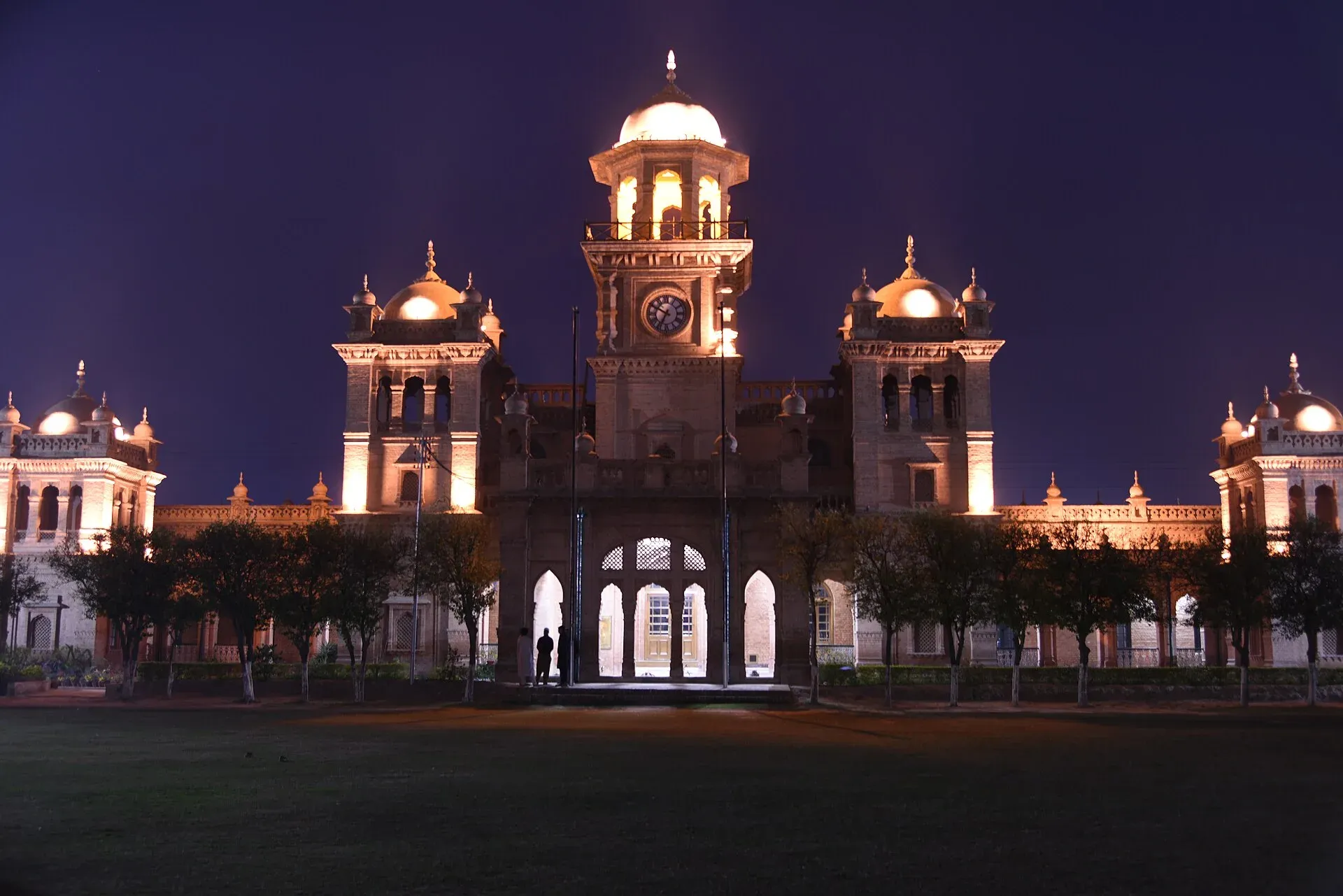
Photo: Mhtoori, with thanks · CC BY-SA 4.0 · via Wikimedia Commons · temporary stand-in photo

Islamia College Peshawar
A century-old college campus in Peshawar, founded in 1913, with a large grounds, mosque and library. It is a university today and is linked with Jinnah's will. Visit only by arrangement.
Overview
Islamia College Peshawar was founded in 1913 by Sahibzada Abdul Qayyum and Sir George Roos-Keppel. It received university status from the Government of Pakistan in 2008, and its full name is now Islamia College University; the word "college" was kept to preserve its heritage. The campus covers about 300 acres on the western side of Peshawar and includes a central library, a mosque, gardens and a fountain, and the Tribal Hostel (founded 1956).
Plan your visit
- Nearest town
- Peshawar
- Getting there
The campus is about 6.6 km by road from central Peshawar (OSRM, about 15 minutes). Use a taxi or ride-hailing car. Peshawar is about 182 km from Islamabad by road (OSRM). More
Best months
Oct – Apr
- Islamia College Peshawar
- Related places nearby: Peshawar, Peshawar Museum, Bala Hisar Fort (Peshawar), Bab-e-Khyber
Why visit
It is one of the most recognisable historic institutions in the province. The main building, with its central clock tower, is a British colonial structure that Dawn (2007) calls a red-brick Victorian-style building. It is a quiet change from the bazaars of the old city, and the grounds are green and open.
How the college began
When the North-West Frontier Province was formed in 1901, Edwardes College was the only college in the province. A meeting held in Peshawar on 12 April 1911 began collecting donations. Wikipedia names the Khan of Sherpao as the largest contributor; about Rs 150,000 came from the Hashtnagar area (now Charsadda district), the Nizam of Hyderabad gave Rs 150,000 and the Nawab of Amb gave Rs 100,000 towards construction. Haji Sahib of Turangzai laid the foundation stone.
The University of Peshawar began in 1950 as an offshoot of the college. Dawn reported in October 2007 that the main building had been declared dangerous in 2004 after a structural survey, and that repair work had started; there is no known later report, so check for current news before you go.
Jinnah and the college
Muhammad Ali Jinnah visited in 1936, 1945 and 1948, and became a lifelong honorary member of the Khyber Union in 1936. His will, dated 1939 by Wikipedia, left one-third of his residuary estate to the college, with the rest going to Aligarh University and the Sindh Madrassa in Karachi. In an address to students on 12 April 1948, he said that nothing was nearer to his heart than to have a great centre of culture and learning in a place like Peshawar.
The campus today
Wikipedia gives more than 5,000 students and about 500 academic staff, with teaching in Urdu and English across arts and humanities, business and social sciences, languages and culture, engineering, and science and technology. The college trust also owns farmland in Charsadda district and shops and flats in Khyber Bazaar. Public figures linked with the college include Khan Abdul Ghaffar Khan, the statesman Abdur Rab Nishtar and the Pashto poets Hamza Shinwari and Ajmal Khattak.
What to see
- The main historic block and clock tower, seen from the grounds.
- The central library and campus mosque.
- The gardens and fountain.
- The Tribal Hostel, in the middle of the campus.
With other sights in Peshawar
If a campus visit is approved, other city sights are separate trips: Peshawar Museum, Bala Hisar Fort and the old walled city. Bab-e-Khyber lies further west.
When to visit
October to April is pleasant. Summer is very hot. The campus is a working university, so term time and exam periods are busy.
Good to know
- Access. This is an active campus, not a ticketed attraction. Ask the university administration for permission before you enter or photograph buildings; no official visiting hours were found.
- Ask the district administration or local police about current conditions before you go. Travel advice. For foreign visitors: the UK FCDO (updated 27 October 2026, checked 16 November 2026) advises against all travel to Peshawar, including the city. Read the current page before any plan.
- Etiquette. Dress modestly and be considerate of students.
Highlights
- Founded 1913; university status 2008
- About 300 acres of campus
- Historic main block with central clock tower
- Linked to Jinnah's will
Getting there
The campus is about 6.6 km by road from central Peshawar (OSRM, about 15 minutes). Use a taxi or ride-hailing car. Peshawar is about 182 km from Islamabad by road (OSRM).
Tips
- Ask the administration for permission before visiting or taking photographs.
- Avoid exam weeks and public holidays.
- Dress modestly.
- Check FCDO advice for Peshawar first.
Photos we still need: the clock-tower front of the main historic block in its current state. Send us yours
Sources and last checked
Last checked Confidence medium4 sources4 still to check
- Last checked
- Method
- Desk research from published sources
- Confidence
- medium
- Checked by
- trek.pk research team
Researched from published sources; not yet checked on the ground by our team. Spot something out of date? Report a mistake.
Sources
- Islamia College University · Wikipedia · checked
- Peshawar: restoration work on Islamia College building starts · Dawn · checked
- Pakistan travel advice: warnings and insurance (updated 27 October 2026) · UK FCDO · checked
- OSRM driving route service: distances and times measured 16 November 2026 (times are optimistic, without stops) · OSRM · checked
Still to be checked on the ground (4)
- Visitor access rules (no official notice found)
- Current state of the historic building and restoration (Dawn, Oct 2007: declared dangerous in 2004, repairs began Oct 2007; no later report found)
- Architect not confirmed (Dawn calls the building red-brick Victorian-style; no architect named in Wikipedia or Dawn)
- Founding donors and Jinnah's will are from Wikipedia only; Wikipedia's account of how the campus land was bought is inconsistent
Nearby and related

Peshawar
Khyber Pakhtunkhwa's capital and one of South Asia's oldest living cities: the Gandhara museum, Qissa Khwani Bazaar, mosques and a strong food culture.
Peshawar Museum
Founded in 1907 in the Victoria Hall, the Peshawar Museum holds one of the world's great collections of Gandharan Buddhist sculpture, plus coins, Islamic art and Kalash material.

Bala Hisar Fort (Peshawar)
A high old citadel on the edge of Peshawar's walled city, rebuilt by the Sikhs and British and now a Frontier Corps headquarters. Public access is limited and should be checked first.

Bab-e-Khyber
The Khyber Gate, a monumental arch at Jamrud marking the entrance to the Khyber Pass, opened in 1963. Access to the pass is restricted and FCDO advises against travel to Khyber.