

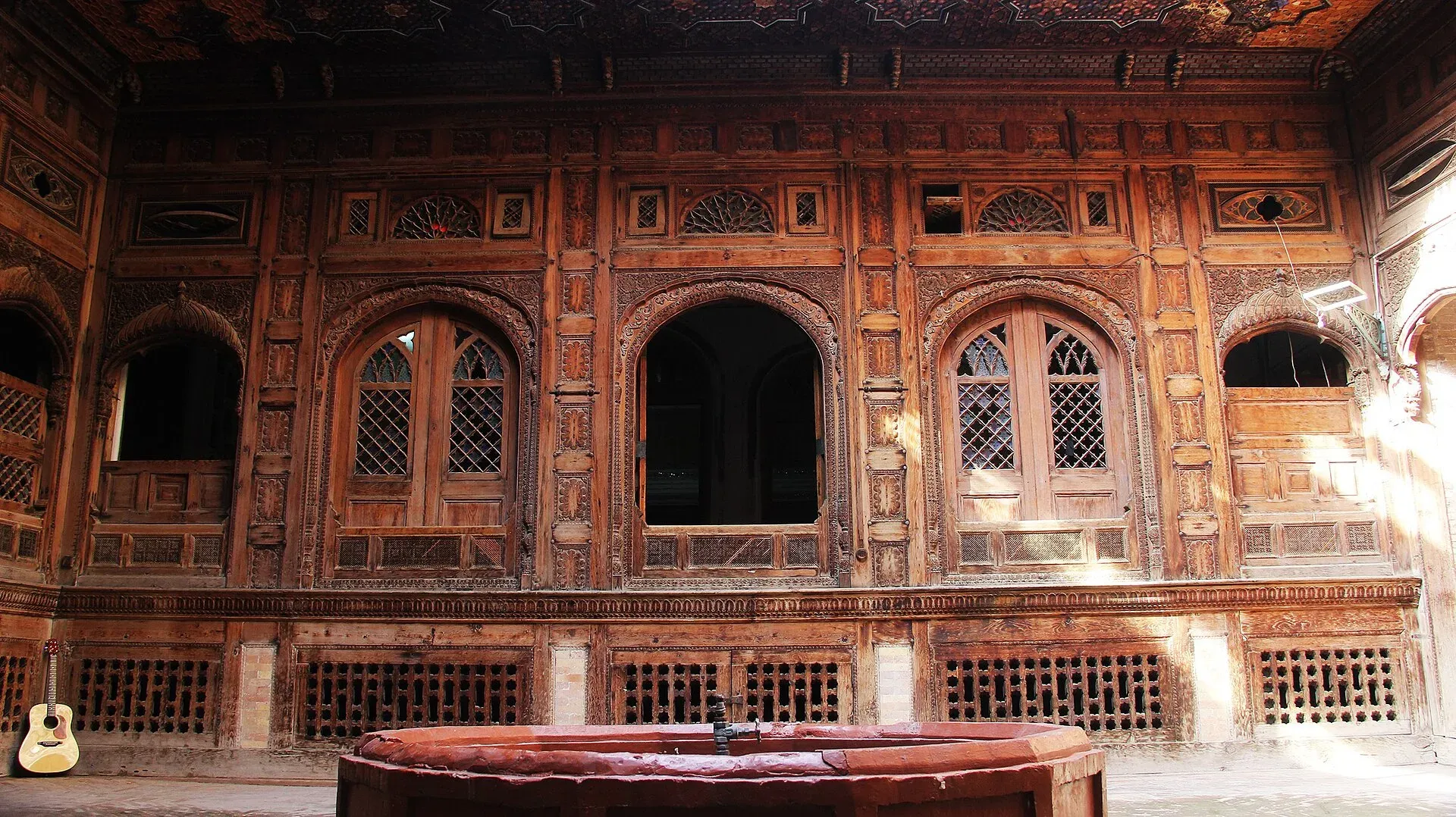
Photo: Ibrahim Zauq, with thanks · CC BY-SA 4.0 · via Wikimedia Commons · temporary stand-in photo

Sethi House and Sethi Mohallah, Peshawar
A lane of merchant havelis in Peshawar's old city, built from about 1800 to 1910 by the Sethi family in a Central Asian style, with carved wood, painted ceilings and courtyards. On Pakistan's UNESCO tentative list since 2026.
Overview
Sethi Mohallah (also Kucha Sethian) is a historic quarter in Peshawar's walled city, close to the Ghanta Ghar (clock tower), Bazaar Kalan and Gor Khatri. It is known for a group of grand merchant houses, called havelis, built by the Sethi family. Peshawar's Sethi House is on Pakistan's UNESCO Tentative List.
Plan your visit
- Nearest town
- Peshawar
- Getting there
Sethi Mohallah is in the walled city of Peshawar, near the clock tower, Bazaar Kalan and Gor Khatri. The lanes are narrow, so visitors usually walk in from the clock tower. Taxis and rickshaws reach the old city gates. More
Best months
Oct – Mar
- Sethi House and Sethi Mohallah, Peshawar
- Related places nearby: Peshawar, Peshawar Walled City, Gor Khatri and City Museum Gor Khatri, Peshawar, Qissa Khwani Bazaar, Mahabat Khan Mosque, Cunningham Clock Tower, Khyber Pakhtunkhwa
History
The Sethis were a Punjabi Muslim merchant family from Bhera who traded with Central Asia, first in indigo and later in goods such as wood, fur, cotton cloth, copperware, salt, spices, porcelain, carpets and gold thread. Wikipedia says the family moved to Peshawar in 1730 and to Mohalla Sethian in the early 19th century, and built a series of houses from about 1800 to 1910. Their business suffered after the 1917 Russian Revolution closed Central Asian markets. The family funded wells for the poor and contributed to the Lady Reading Hospital and the Islamia College mosque.
The havelis
The family built twelve havelis, and seven survive in part. Several others were demolished, including some in the 1950s, 1970s and 1980s. The earliest surviving one, the Karam Buksh Sethi haveli, dates to about 1808 to 1814. Others named on Wikipedia include the Fateh Gul Sethi haveli (1810 to 1818), Abdul Rahim Sethi (1890 to 1896) and Abdul Jalil Sethi (1904 to 1910). One house was bought by the provincial government and has separate men's and women's sections.
UNESCO status
Sethi House is on the 2026 additions to Pakistan's UNESCO Tentative List. A tentative listing is a first step only: it is not World Heritage status.
What to see and do
The houses took their design from the vernacular architecture of Bukhara. Wikipedia describes a typical layout: two tehkhanas (basement rooms, cool in summer), a balakhana (upper storey), dalaans (large halls), chinikhanas (rooms for displaying decorative pieces) and fountains.
- Carved wooden doors, balconies and windows, set into brick walls.
- Painted ceilings and mirror work in the main halls, with painted and mirrored atriums that bring light and air indoors.
- One example house has 12 rooms, four basements and a fountain, with coloured glass ceilings in geometric designs, engraved woodwork and a wooden sun platform called Takht-e-Sulaimani for winter use.
- The surrounding old city: Gor Khatri, Qissa Khwani Bazaar and Mahabat Khan Mosque are all within walking distance. Cunningham Clock Tower is a landmark for finding the lane.
A half-day on foot could take in the Sethi houses and these neighbours, if access and conditions allow.
When to visit
October to March is the most comfortable. Summers are very hot.
Where to stay and eat
Peshawar has hotels in Saddar and the Cantonment, and the old city has many places to eat. No businesses are listed here.
Good to know
- Travel advice. For foreign visitors: the UK FCDO (updated 27 October 2026, checked 17 November 2026) advises against all travel to Peshawar, including the city of Peshawar. Read the current advice before planning a visit.
- Access. Some houses are open to visitors according to Wikivoyage. Many are family homes or in poor repair. Hours and any fees were not found; ask locally or at the provincial tourism office.
- Etiquette. These are lived-in neighbourhoods. Ask before entering, dress modestly and do not touch the woodwork or painted ceilings.
Highlights
- Merchant havelis built from about 1800 to 1910
- Carved wood, painted ceilings and courtyards
- Central Asian (Bukhara-style) architecture
- On UNESCO tentative list since 2026
- FCDO advises against all travel to Peshawar
Getting there
Sethi Mohallah is in the walled city of Peshawar, near the clock tower, Bazaar Kalan and Gor Khatri. The lanes are narrow, so visitors usually walk in from the clock tower. Taxis and rickshaws reach the old city gates.
Tips
- Check FCDO advice for Peshawar first.
- Ask before entering any house; many are private.
- Combine with Gor Khatri and Qissa Khwani Bazaar.
- Do not touch the woodwork.
Photos we still need: carved wooden facade or balcony of a Sethi house; a painted or mirrored ceiling. Send us yours
Sources and last checked
Last checked Confidence medium5 sources5 still to check
- Last checked
- Method
- Desk research from published sources
- Confidence
- medium
- Checked by
- trek.pk research team
Researched from published sources; not yet checked on the ground by our team. Spot something out of date? Report a mistake.
Sources
- Sethi Mohallah (Wikipedia) · Wikipedia · checked
- Peshawar (Wikivoyage) · Wikivoyage · checked
- UNESCO widens Pak heritage map · The Express Tribune · checked
- List of World Heritage Sites in Pakistan (tentative list table) · Wikipedia · checked
- Pakistan travel advice: warnings and insurance (updated 27 October 2026) · UK Foreign, Commonwealth & Development Office · checked
Still to be checked on the ground (5)
- Which houses are open, hours and any fee
- Which house the tentative-list entry refers to (it is named Sethi House, not the whole lane)
- Present condition of the havelis
- Coordinates are from Wikivoyage for the lane
- Wikipedia lists more than seven surviving havelis while giving seven as the count
Nearby and related

Peshawar
Khyber Pakhtunkhwa's capital and one of South Asia's oldest living cities: the Gandhara museum, Qissa Khwani Bazaar, mosques and a strong food culture.

Peshawar Walled City
The old core of Peshawar: Qissa Khwani Bazaar, the carved wooden Sethi havelis and the Gor Khatri complex. Parts are being restored, and the Sethi House and Gor Khatri are on UNESCO's tentative list.

Gor Khatri and City Museum Gor Khatri, Peshawar
An archaeological complex in old Peshawar: a Mughal caravanserai built over much older layers, later a Sikh-era residence and a police station, now a park with the City Museum Gor Khatri. On Pakistan's UNESCO tentative list since 2026.
Qissa Khwani Bazaar
Peshawar's old 'street of storytellers': a lively bazaar of tea houses, qehwa shops and traders in the walled city, with a long history as a caravan meeting place. Check FCDO advice before any visit.

Mahabat Khan Mosque
A 17th-century Mughal mosque in Peshawar's old city with a white marble facade, two tall minarets and a large courtyard. It is an active mosque, so visit outside prayer times.

Cunningham Clock Tower
A tall brick clock tower in Peshawar's old city, completed in 1900 to mark Queen Victoria's Diamond Jubilee. Locals call it Ghanta Ghar; it is a handy landmark at the edge of the old bazaars.

Khyber Pakhtunkhwa
Mountains, Buddhist ruins and old bazaars in north-west Pakistan: Swat, Kaghan, Chitral, the Kalash valleys, the Khyber Pass and Peshawar.