

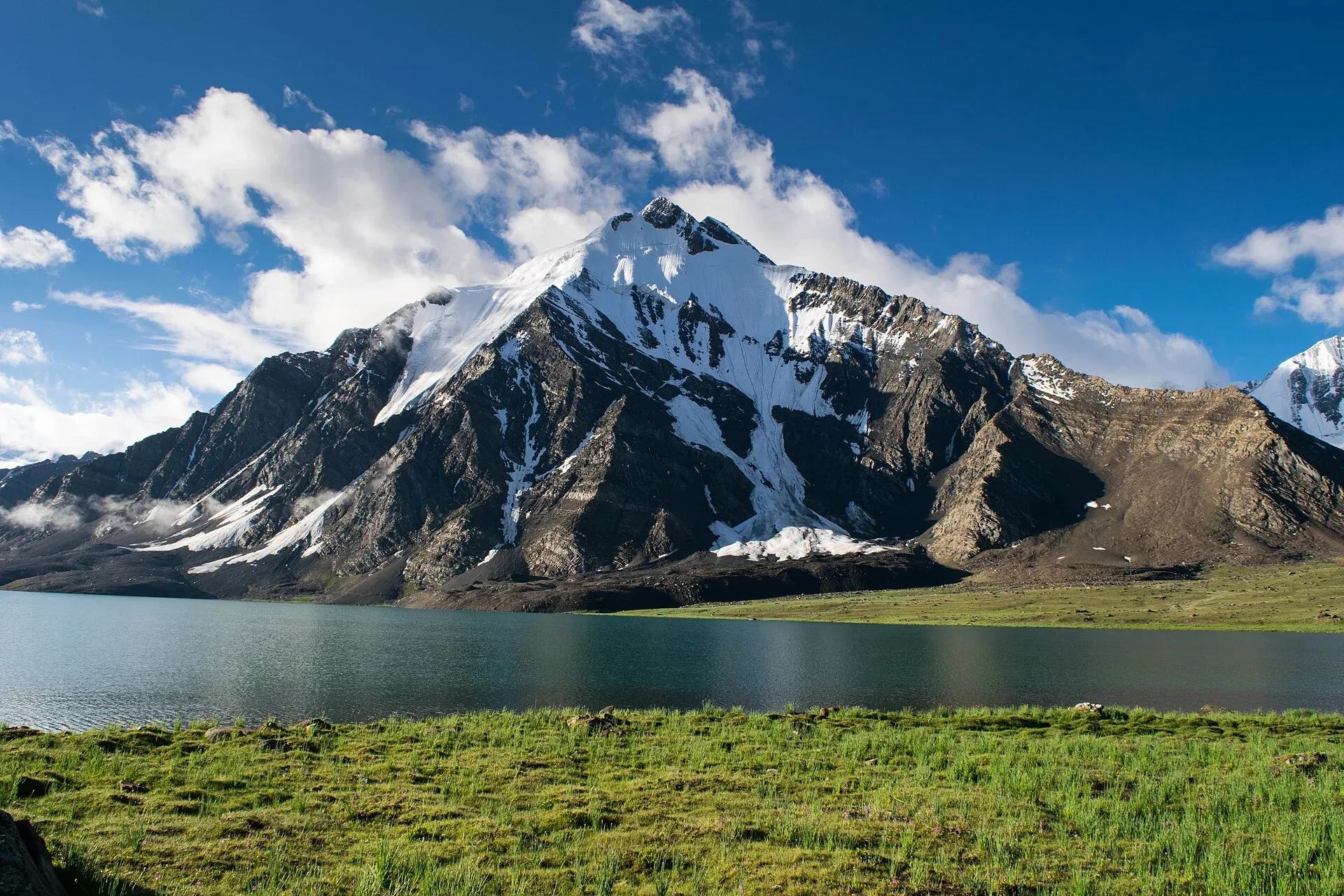
Photo: Talha Mahin Mir, with thanks · CC BY-SA 4.0 · via Wikimedia Commons · temporary stand-in photo
Qurumber National Park
A remote high park in Ghizer District, Gilgit-Baltistan, notified in 2011 and covering about 738 square kilometres. It protects Karambar Lake and the surrounding mountains.
Overview
Qurumber National Park (also spelled Qurumbar) is in Ghizer District, in the far north-west of Gilgit-Baltistan. It was established in 2011 and covers about 73,800 hectares (738 square kilometres). Broghil Valley National Park in Chitral District, Khyber Pakhtunkhwa, lies next to it, and the park meets the Hindu Kush range.
The park covers the Qurumbar valley. Its landmarks include Karambar Lake, Qurumbar Glacier and the Broghil and Chillinji passes. The terrain is alpine steppe and alpine meadow, with glaciers and high pastures that herders use in summer.
Plan your visit
- Nearest town
- Gupis
- Getting there
From Gilgit, drive west on the Gilgit-Chitral road to Gahkuch, then north up the Ishkoman Valley; the road to the upper valleys is rough and the last stretch to Karambar Lake is by 4x4 and on foot. More
Best months
Jun – Sep
- Qurumber National Park
- Related place nearby: Karambar Lake
Karambar Lake
Karambar Lake (also Qurumbar or Kar Ambar Lake) lies in the Ishkoman Valley at about 4,272 m. It is a glacier-fed alpine lake about 3.9 km long and up to 2 km wide, with a surface area of about 2.6 square kilometres. It is described as the second-largest lake in northern Pakistan after Attabad Lake and the 33rd highest in the world. Published depth figures disagree (an average of 52 m in one place, a maximum of 55 m and a mean of about 17 m in another), so no depth is given here. A measurement of water clarity reported for the lake is the highest recorded in Pakistani lake studies. See also the lake's own page, Karambar Lake.
Plants and wildlife
Plants listed for the park include blue pine, birch, willow, wild rose and ephedra. Mammals recorded include Himalayan ibex, Himalayan wolf, Himalayan lynx, Himalayan brown bear, snow leopard (Vulnerable), Pallas's cat and Marco Polo sheep (Near Threatened). Birds include golden eagle, bearded vulture, Himalayan griffon vulture and chukar partridge. The IUCN categories shown are for each species as a whole, not counts in this park. Sightings are uncommon; a local guide helps.
People of the valleys
The Ishkoman Valley below the park lies between about 2,100 and 3,700 m. Its people speak Shina, Khowar, Burushaski and Wakhi, and herding families use the high pastures in summer.
What to see and do
- Karambar Lake. A long, high lake reached by jeep and on foot through the Ishkoman Valley, with glaciers and peaks around it.
- Treks and passes. The park is a gateway to routes over the Karambar An and other passes into Chitral and Broghil.
- Wildlife watching. Sightings are uncommon; go with a local guide.
When to visit
June to September. The high ground is snowed in for the rest of the year.
Where to stay and eat
Services are limited to simple guest houses in Gupis and Ishkoman and the valleys, and camping on the high ground. Bring supplies.
Good to know
- Check permit rules and security advice for the Ghizer and Broghil border area with Gilgit-Baltistan tourism before you go. A fee may apply. Current fees will be added soon; check with the park office or the provincial wildlife department before you go.
- Roads are rough and may be closed by landslides.
- Follow the standard park rules: take your litter out with you, do not light fires outside marked sites, do not pick plants or disturb animals, and do not hunt. Hunting and trapping inside a national park are offences. Ask the park office before flying a drone; many parks need written permission and drones are banned near borders and sensitive sites.
- Treat the area with care: people depend on these pastures and water for their animals.
Highlights
- Karambar Lake at over 4,000 m
- Neighbour of Broghil Valley National Park
- Wildlife including snow leopard and Marco Polo sheep
- Gateway to Karambar An trek
Getting there
From Gilgit, drive west on the Gilgit-Chitral road to Gahkuch, then north up the Ishkoman Valley; the road to the upper valleys is rough and the last stretch to Karambar Lake is by 4x4 and on foot. Check the current route, time and road status in Gahkuch or Gupis; there is no regular public transport to the park.
Tips
- Check permits and road conditions locally
- Hire a local guide
- Take all supplies with you
- Pack out litter
Wildlife
Facilities
- None inside the park
- Guest houses in Gupis and Phander
Photos we still need: Qurumbar Glacier and the high pastures. Send us yours
Sources and last checked
Last checked Confidence medium4 sources5 still to check
- Last checked
- Method
- Desk research from published sources
- Confidence
- medium
- Checked by
- trek.pk research team
Researched from published sources; not yet checked on the ground by our team. Spot something out of date? Report a mistake.
Sources
- Qurumbar National Park (Wikipedia) · Wikipedia · checked
- Pakistan Tourism Guide 2021 · TDAP Pakistan · checked
- Karambar Lake (Wikipedia) · Wikipedia · checked
- Ishkoman Valley · Wikipedia · checked
Still to be checked on the ground (5)
- Exact access route and times via Ishkoman (no source gives a route or time)
- Permit rules and fees (no official source found)
- Nearest town for visitors (Gahkuch and Ishkoman are working assumptions)
- Coordinates: two sets are published for the park
- Lake depth (published figures disagree)


