

Photo: Aun Muhammad, with thanks · CC BY-SA 4.0 · via Wikimedia Commons · temporary stand-in photo

Shalimar Gardens
A Mughal terraced garden in Lahore built for Shah Jahan in 1641-42, with 414 fountains on three levels. UNESCO inscribed it in 1981 with Lahore Fort; its walls and waterworks need repair.
Overview
The Shalimar Gardens (also spelt Shalamar) are a Mughal garden in the east of Lahore, beside the Grand Trunk Road and about 5 km east of Delhi Gate. They are laid out as a charbagh, a formal garden divided into four, and arranged on three terraces that step down towards the entrance. UNESCO inscribed them in 1981 together with Lahore Fort.
The garden is a rectangle about 658 metres long and 258 metres wide on a north-south axis, roughly 16 hectares, inside a high brick wall with fretwork. A Dawn report (March 2025) quotes the Walled City of Lahore Authority (WCLA) as giving the area as about 80 acres, so the figures disagree. Each terrace is 4 to 5 metres higher than the one below. Dense trees and water make it noticeably cooler than the streets outside.
Plan your visit
- Nearest town
- Lahore
- Opening hours
- Daytime hours not confirmed from an official source. The WCLA announced night opening from 7 pm to 11 pm (Express Tribune, 16 October 2026). Check with the WCLA.
- Getting there
The gardens are on the Grand Trunk Road in Baghbanpura, about 12 km by road from Lahore Fort (roughly 17 minutes without traffic, OSRM). Ride-hailing cars, taxis and rickshaws are the easiest options. More
Best months
Oct – Mar
- Shalimar Gardens
- Related places nearby: Lahore Fort, Lahore, Walled City of Lahore, Badshahi Mosque
History
Construction began on 6 June 1641 under Shah Jahan and took 17 months and 14 days. It was modelled on the older Shalimar Garden in Kashmir. The land belonged to the Arain Mian family of Baghbanpura, who gave it to Shah Jahan in exchange for custodianship of the gardens, which the family kept for over 350 years. Ali Mardan Khan oversaw a canal of about 100 miles that brought water from the foothills.
The gardens were first called Farah Bakhsh, "delightful". Under Sikh rule much of the marble was taken to Amritsar and the agate gate was stripped and sold, though Ranjit Singh ordered repairs in 1806. The Mela Chiraghan festival was held here until President Ayub Khan banned it in 1958, and he took the gardens into government hands in 1962.
The three terraces
The upper terrace, Farah Bakhsh, was reserved for the emperor's family. The middle terrace, Faiz Bakhsh, was the emperor's garden and has the richest waterworks. The lowest terrace was the entrance level and was open to nobles and sometimes the public. Some guides treat Faiz Bakhsh as covering both the middle and lower terraces, so labels vary.
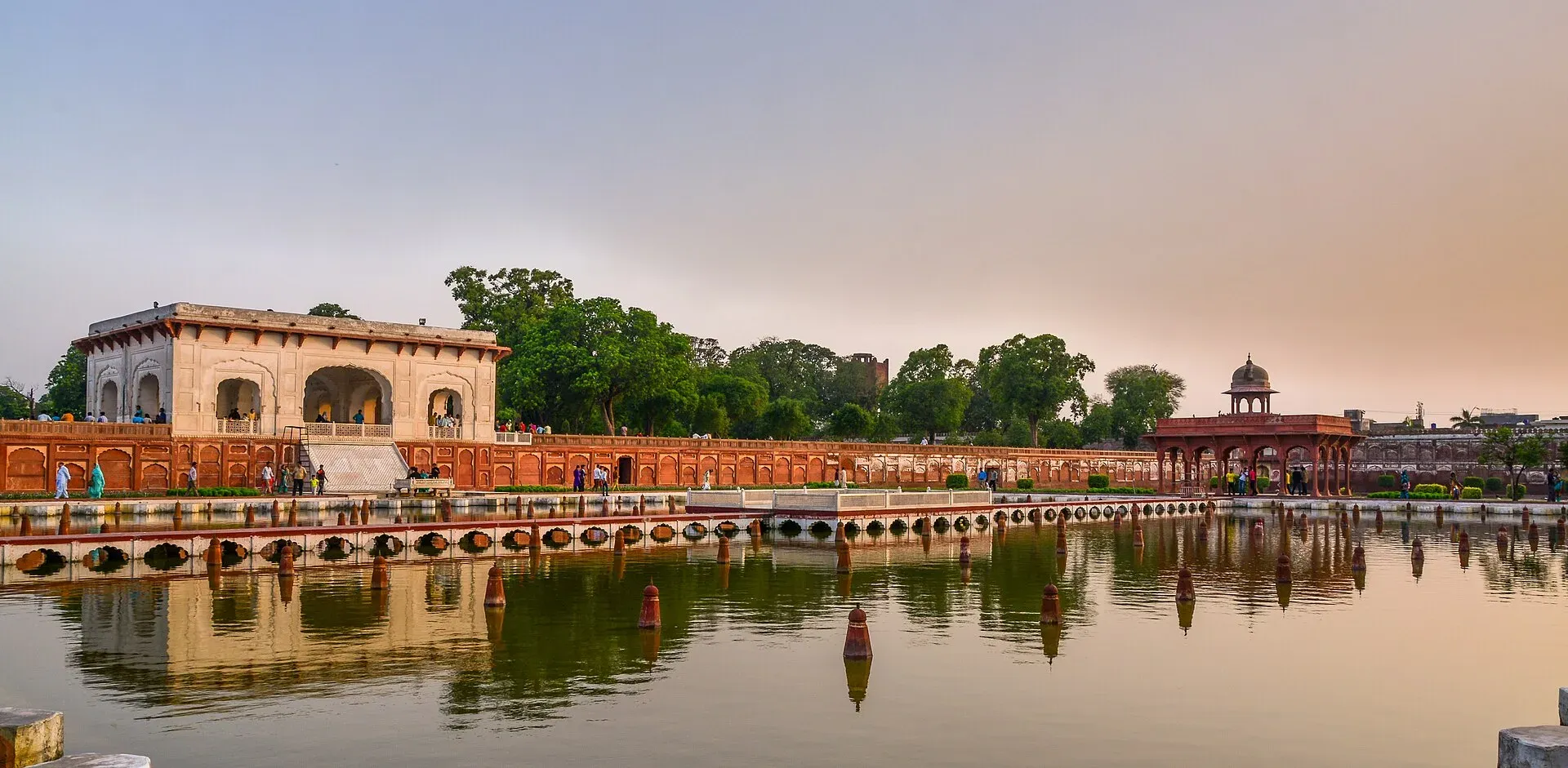
Photo: Muhammad Ashar, with thanks · CC BY-SA 3.0 · via Wikimedia Commons · temporary stand-in photo

Water
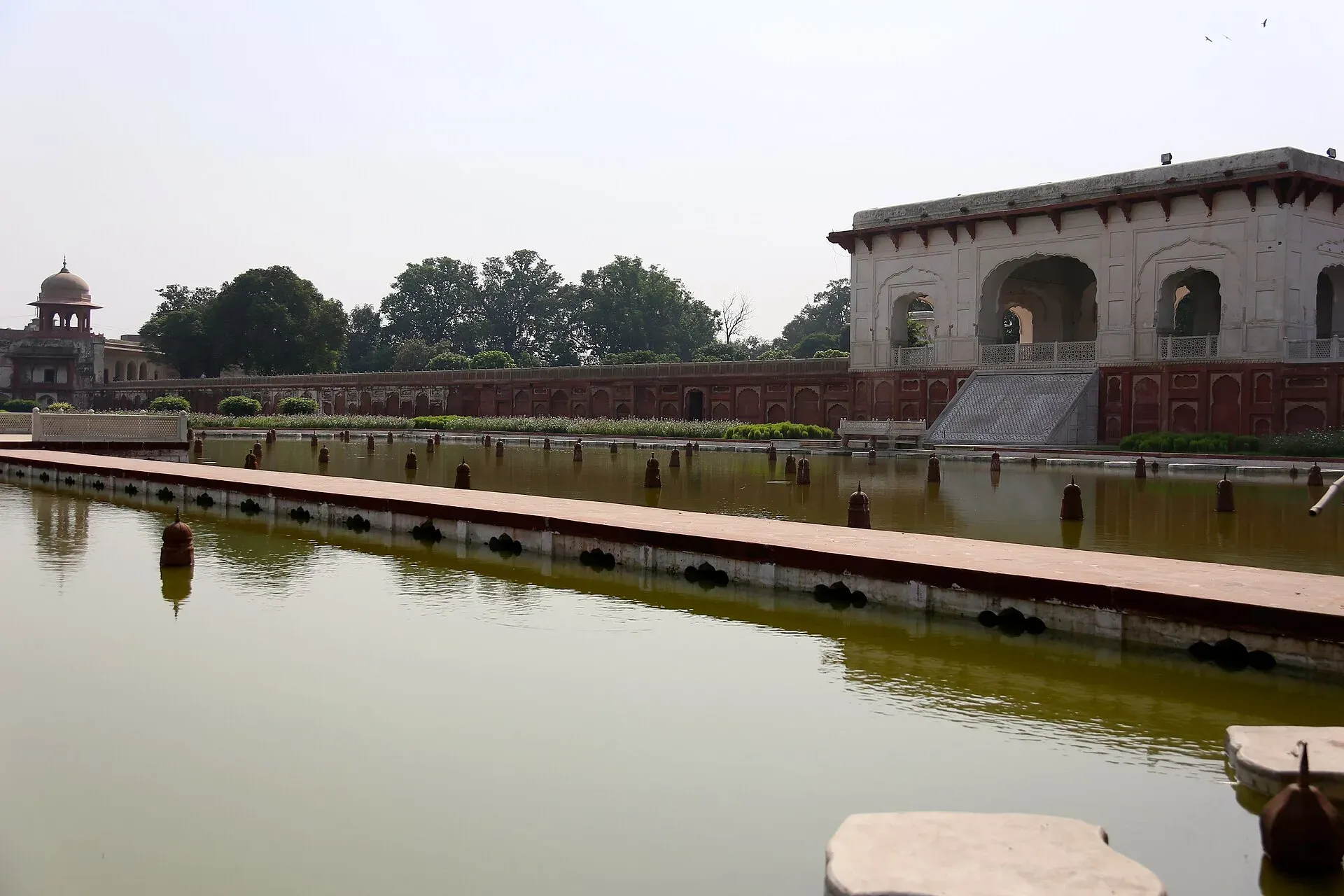
Water is the main feature. Guides give 414 fountains, but the breakdown of 105 on the upper, 152 on the middle and 153 on the lower level adds up to 410, so treat the count as approximate. Water spills over carved marble slopes called chadors into large pools, and there are five cascades, including the great marble cascade and the Sawan Bhadon. Unlike the Kashmir gardens on natural slopes, Lahore's needed artificial cascades and terraces.
What to see and do
- Upper terrace (Farah Bakhsh). The highest level, with the Khwabgah (sleeping chambers) and the Aiwan, a grand hall.
- Middle terrace (Faiz Bakhsh). The great marble cascade, the Sawan Bhadon pavilions and the Naqar Khana.
- Lower terrace. The old entrance level.
- Chini khanas. Niches behind the water chutes that held lamps at night.
- Hammam. The royal bath.
- Baradaris. Summer pavilions with open arches.
Walk the central axis from top to bottom, then look back up. Two hours is plenty.
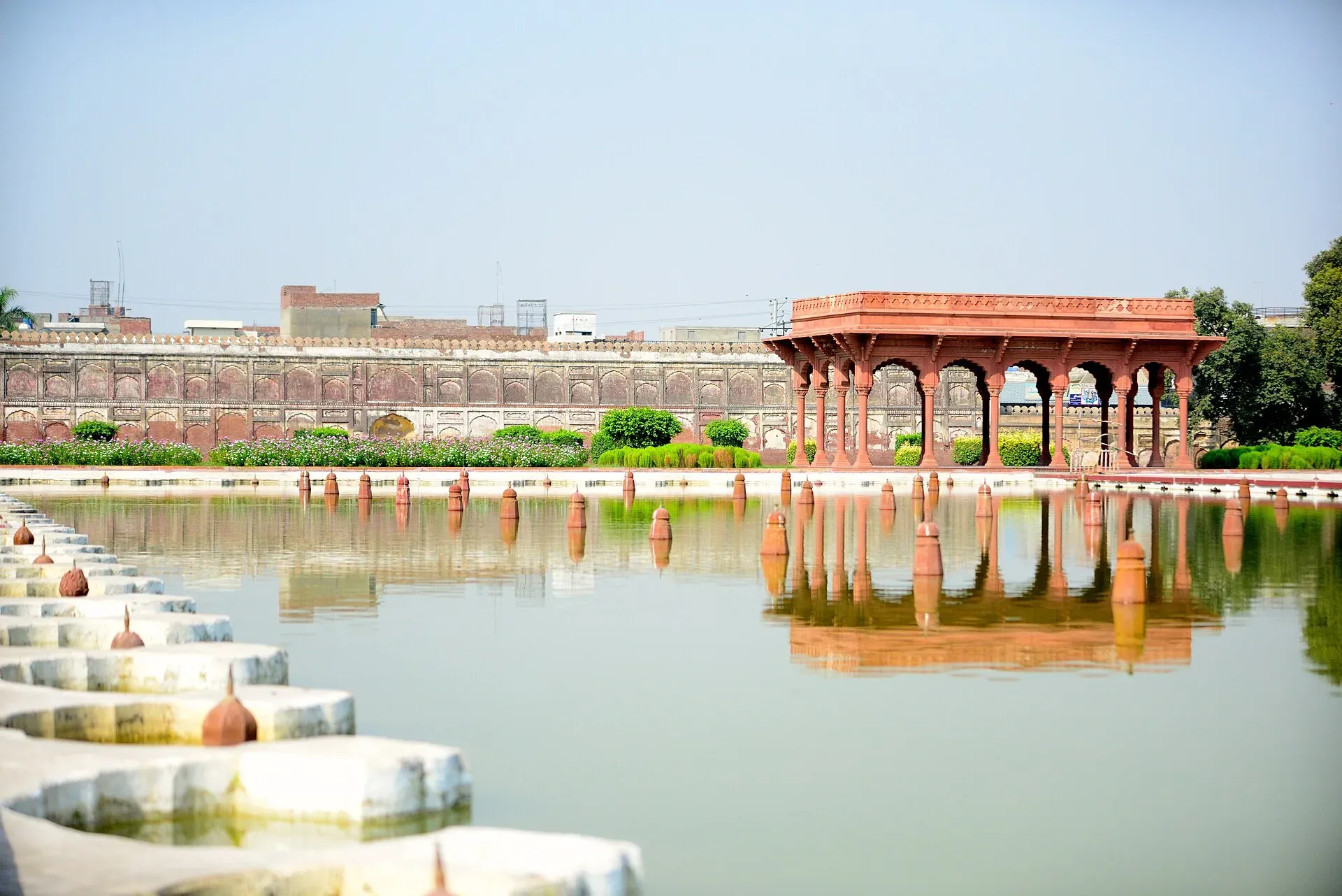
Photo: Aun Muhammad, with thanks · CC BY-SA 4.0 · via Wikimedia Commons · temporary stand-in photo

When to visit
Go from late autumn to early spring. The fountains run only when the water system is working, and summer heat is very high. Evening visits (see hours) can be pleasant.
Where to stay and eat
The gardens are east of the centre, so most people stay in central Lahore. There are food stalls outside; ask your hotel for current places.
Good to know
- Condition. Dawn reported in March 2025 that the boundary wall, gates and waterworks were in poor repair, that part of the wall had collapsed before, that monsoon rain mixed with sewage collects in the gardens, and that the WCLA had about Rs100 million for conservation of the pavilions, the royal bath and the plant nursery. Expect scaffolding or closed areas.
- Hours. Official daytime hours not confirmed. The WCLA announced night opening from 7 pm to 11 pm for the gardens and Lahore Fort (Express Tribune, 16 October 2026). Current ticket prices will be added soon.
- Etiquette. Do not climb on the marble or step into the pools. Keep to the paths and take rubbish with you.
- Nearby. Lahore Fort, the Walled City and the Badshahi Mosque.
Highlights
- UNESCO World Heritage Site since 1981 (with Lahore Fort)
- Three terraces, about 410 fountains and five cascades
- Built 1641-42 for Shah Jahan
- Cooler than the surrounding streets
- Conservation work under way
Getting there
The gardens are on the Grand Trunk Road in Baghbanpura, about 12 km by road from Lahore Fort (roughly 17 minutes without traffic, OSRM). Ride-hailing cars, taxis and rickshaws are the easiest options.
Tips
- Walk the axis from the top terrace downwards.
- Come in cooler months; check the fountains are running.
- Combine with Lahore Fort in a single day.
- Check current day and night hours with the WCLA.
Sources and last checked
Last checked Confidence medium5 sources5 still to check
- Last checked
- Method
- Desk research from published sources
- Confidence
- medium
- Checked by
- trek.pk research team
Researched from published sources; not yet checked on the ground by our team. Spot something out of date? Report a mistake.
Sources
- Shalamar Gardens, Lahore (Wikipedia) · Wikipedia · checked
- Shalimar Gardens crumble as authorities look away · Dawn (19 March 2025) · checked
- Lahore Fort, Shalimar Gardens to stay open late · The Express Tribune (16 October 2026) · checked
- List of World Heritage Sites in Pakistan · Wikipedia · checked
- Pakistan travel advice: warnings and insurance (updated 27 October 2026) · UK Foreign, Commonwealth & Development Office · checked
Still to be checked on the ground (5)
- Daytime hours and ticket prices (Tribune 16 Oct 2026 gives night hours 7 pm to 11 pm only, and night ticket prices for Lahore Fort only)
- Current state of conservation work and any closed terraces (latest report Dawn, March 2025)
- Exact fountain count (Wikipedia: 414 stated, breakdown sums to 410; no official figure)
- UNESCO website returned 403; inscription year 1981 confirmed only from Wikipedia's list
- Area: about 16 hectares (658 m by 258 m) in one source, about 80 acres per the WCLA via Dawn, March 2025
Nearby and related

Lahore Fort
The Mughal citadel at the north end of Lahore's Walled City, with palaces, a marble mosque and a long tiled Picture Wall. Inscribed by UNESCO in 1981 together with the Shalimar Gardens.

Lahore
Punjab's capital and Pakistan's cultural city: Mughal forts, mosques and gardens, a lively Walled City, and some of the best food in the country.

Walled City of Lahore
Lahore's old core: lanes, gates and Mughal and Sikh-era monuments around the Royal Road, including Wazir Khan Mosque, Delhi Gate and the Shahi Hammam. Its lanes are best explored on foot.

Badshahi Mosque
Lahore's great Mughal mosque, built for Emperor Aurangzeb in 1671-73 from red sandstone and marble. It faces Lahore Fort and has been on UNESCO's tentative list since 1993.

Punjab
Pakistan's most populous province: Mughal Lahore, ancient Taxila and Harappa, Sufi shrines, the Salt Range, the Cholistan desert and the hills of Murree.