

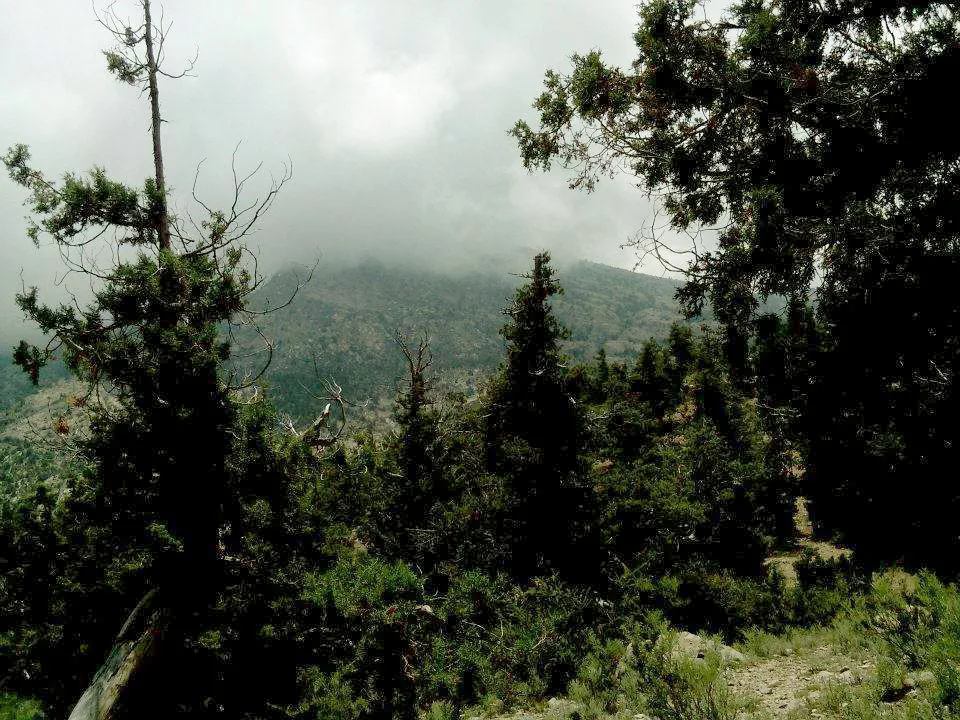
Photo: Akashahmed007, with thanks · CC BY-SA 3.0 · via Wikimedia Commons · temporary stand-in photo

Ziarat Juniper Forest
Pakistan's largest juniper forest, around 110,000 ha in the hills of Ziarat, with trees thought to be thousands of years old. A biosphere reserve since 2013 and a tentative World Heritage site.
Overview
The Ziarat Juniper Forest covers hills in Ziarat District, around Mount Zarghoon in northern Balochistan. It is Pakistan's largest juniper forest. Wikipedia gives its area as about 110,000 ha, and the official designation figures add up to 111,852 ha. The surrounding mountains rise from about 1,181 m to 3,488 m, and the junipers grow between roughly 2,000 and 3,000 m, on ridgetops and moderate to steep slopes.
Plan your visit
- Nearest town
- Ziarat
- Getting there
Ziarat is about 126 km from Quetta by road (OSRM, modelled 1.8 h). For foreign visitors: the UK FCDO advises against all travel to Balochistan; follow local official guidance. More
Best months
May – Sep
- Ziarat Juniper Forest
- Related places nearby: Ziarat Valley, Ziarat, Quetta, Ziarat National Park
Landscape and trees
The characteristic tree is the Pashtun juniper, Juniperus seravschanica. Some sources call the forest Juniperus excelsa; the naming differs between references. The trees stand in open, mostly pure stands and are slow-growing, twisted and widely spaced. The oldest are reported to be 5,000 to 7,000 years old, which is why they are called living fossils, though another figure given is 3,000 years, so treat the age as an estimate.
About 54 plant species are recorded in the forest. Companion trees and shrubs include Afghan ash, wild pistachio, wild almond and several barberries. About half the native plant species are used as medicine by local people, and juniper oils have long been used medicinally. The climate is temperate and semi-arid, with rain peaking in July (about 269 mm a year at Ziarat) and snow from November to April.
Wildlife
The wildlife list includes the Sulaiman markhor, urial, Asian black bear, wolf, golden jackal and Afghan pika. The IUCN lists the markhor as Near Threatened (2015 assessment), and the Asian black bear as Vulnerable. Birds include chukar partridge, mistle thrush, black-throated thrush, streaked laughingthrush, rufous-naped tit and bar-tailed treecreeper.
Protection and threats
A 372 km2 part of the area became a wildlife sanctuary in 1971. In 2013 it was declared a biosphere reserve, with a core area of 11,243 ha, a buffer zone of 60,519 ha and a transition area of 40,090 ha. Pakistan nominated it for World Heritage status in 2016 and it is on the tentative list. It is managed by the Balochistan Forest and Wildlife Department. In 2010 the provincial government gave the Juniper Defender Award to Hayatullah Khan Durrani for his work protecting the forests since 1984.
Threats include overgrazing, illegal logging, firewood and seed collection, drought, mistletoe and fungal parasites, and climate change. Harmful activity, once mostly at lower elevations, has spread higher in recent decades. After the magnitude 6.4 earthquake of 29 October 2008, villagers began using juniper as firewood. On 29 July 2026 Dawn reported that the Balochistan Forest and Wildlife Department was investigating damage to protected juniper trees during construction of security check-posts.
What to see and do
Visitors usually walk and drive in the forest around Ziarat town, take in the views, and visit the Quaid-e-Azam Residency, which is covered on the Ziarat Valley page.
When to visit
Summer, May to September, is the main season, because Ziarat is cold. Wikipedia notes winter temperatures in northern highland Balochistan can fall to about -20 C.
Where to stay and eat
Ziarat has hotels and rest houses. Check availability and current conditions locally.
Good to know
- Ask the district administration or local police about current conditions before you go. Travel advice: For foreign visitors: the UK FCDO (updated 27 October 2026) advises against all travel to Balochistan, including Quetta and Ziarat. Read the live page first.
- Quetta to Ziarat is about 126 km (modelled 1.8 h, OSRM).
- Do not cut or break juniper wood or collect cones.
- Juniper grows very slowly, so damage done now will take centuries to recover.
Highlights
- About 111,852 ha, Pakistan's largest juniper forest
- Trees reported to be thousands of years old
- Biosphere reserve since 2013
- Markhor, urial and black bear
Getting there
Ziarat is about 126 km from Quetta by road (OSRM, modelled 1.8 h). For foreign visitors: the UK FCDO advises against all travel to Balochistan; follow local official guidance.
Tips
- Check the FCDO advice before planning
- Never cut or collect juniper wood
- Dress for cold, even in summer evenings
Wildlife
Photos we still need: wildlife (markhor) and the forest in winter (for the 'Wildlife' and 'Protection and threats' sections). Send us yours
Sources and last checked
Last checked Confidence medium6 sources4 still to check
- Last checked
- Method
- Desk research from published sources
- Confidence
- medium
- Checked by
- trek.pk research team
Researched from published sources; not yet checked on the ground by our team. Spot something out of date? Report a mistake.
Sources
- Ziarat Juniper Forest (Wikipedia) · Wikipedia · checked
- Probe into damage to Ziarat juniper trees (29 July 2026) · Dawn · checked
- Markhor (Wikipedia) · Wikipedia · checked
- Asian black bear (Wikipedia) · Wikipedia · checked
- Pakistan travel advice (updated 27 October 2026) · UK Foreign, Commonwealth & Development Office · checked
- OSRM driving routes (modelled distance and time) · OSRM project · checked
Still to be checked on the ground (4)
- Species name: Wikipedia names Juniperus seravschanica and uses J. excelsa only in a reference title; no taxonomic authority checked
- Current security and access (Dawn 29 Jul 2026 mentions check-posts being built in the forest; FCDO advises against all travel to Balochistan)
- Area: about 110,000 ha vs 111,852 ha; no official figure found
- Tree age: 3,000 vs 5,000 to 7,000 years in Wikipedia; Dawn (29 Jul 2026) says only 'centuries-old'
Nearby and related

Ziarat Valley
A cool mountain valley and hill station at about 2,400 m in northern Balochistan, known for ancient juniper forest, orchards and the Quaid-e-Azam Residency. Check security advice before travel.

Ziarat
A cool hill town at about 2,500 m in northern Balochistan, famous for the Quaid-e-Azam Residency and nearby juniper forest. UK advice is against all travel to Balochistan, including Ziarat (checked 16 November 2026).

Quetta
Balochistan's high-valley capital, the Fruit Garden of Pakistan: bazaars, sajji, orchard valleys and the base for Hanna Lake and Ziarat.

Balochistan Plateau
The dry upland plateau that fills most of Balochistan, in the south-east of the Iranian plateau, with ranges, cold winters and the cool hill areas around Quetta and Ziarat.
Ziarat National Park
A protected area around Ziarat in Balochistan, listed as a national park in 2021 and about 214 square kilometres. It covers part of the juniper-forest hills near Ziarat town. Visitor facilities inside the park are not confirmed.
Sherani Chilgoza Forests
High forests of chilgoza (pine-nut) pine on the Sulaiman range in Sherani district, Balochistan, around the Takht-i-Sulaiman ridge. Not set up for tourism; the UK FCDO advises against all travel to Balochistan.