

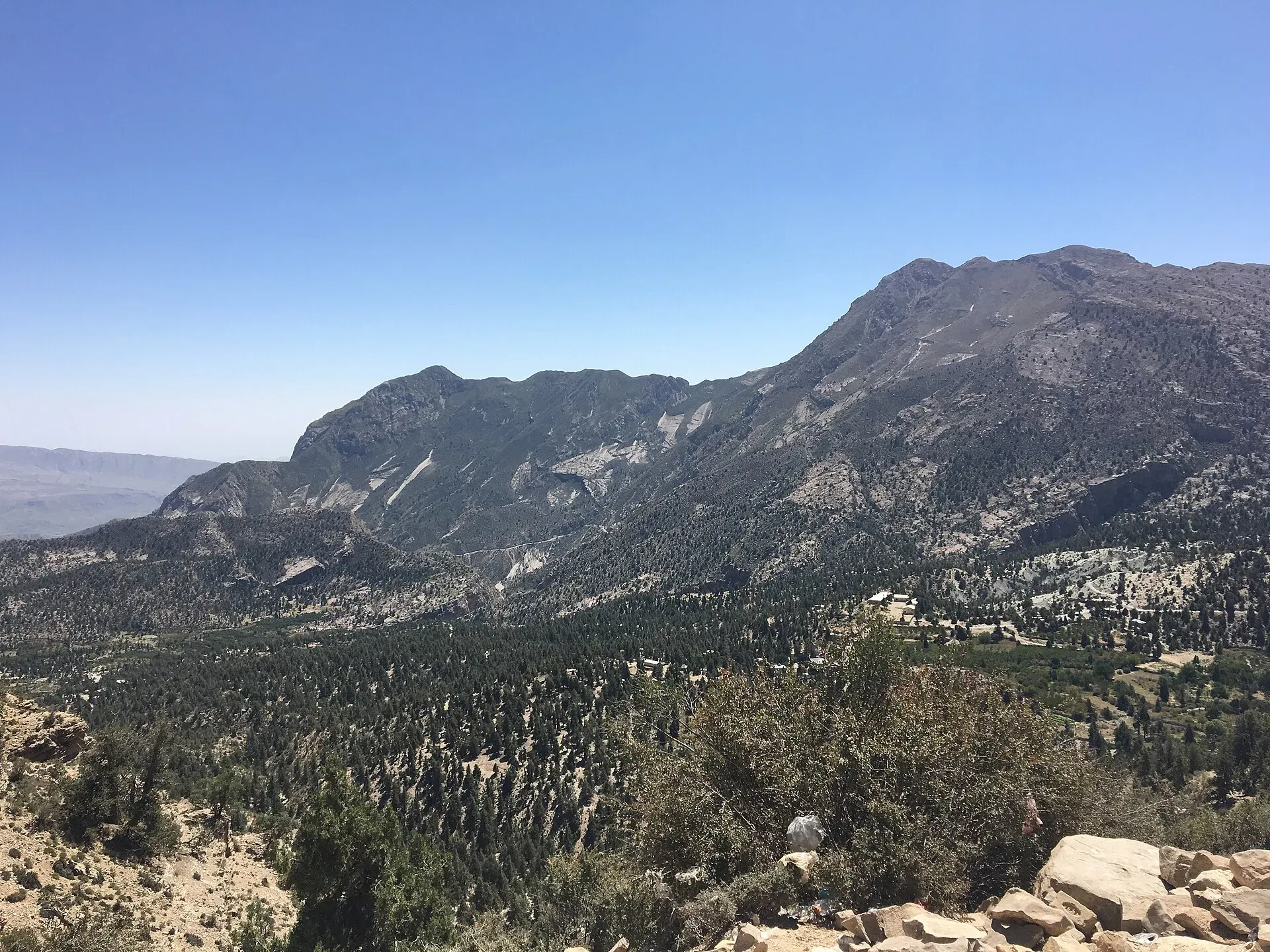
Photo: Faiqah Abdul Jabbar, with thanks · CC BY-SA 4.0 · via Wikimedia Commons · temporary stand-in photo

Ziarat National Park
A protected area around Ziarat in Balochistan, listed as a national park in 2021 and about 214 square kilometres. It covers part of the juniper-forest hills near Ziarat town. Visitor facilities inside the park are not confirmed.
Overview
Ziarat National Park is a protected area in Ziarat District, Balochistan, listed with a 2021 establishment date and an area of about 21,450 hectares (214.5 square kilometres). It lies in the hill country around Ziarat town, which is known for one of the largest juniper forests in the world. The Balochistan Forest and Wildlife Department manages the wider Ziarat Juniper Forest. The exact boundary of the national park compared with the older sanctuary and the UNESCO biosphere reserve is not confirmed here.
The wider juniper forest was made a wildlife sanctuary in 1971 and a UNESCO biosphere reserve in 2013. Its slow-growing Pashtun juniper trees are very old. Mountains in the area run from about 1,181 m to 3,488 m, and most junipers grow between 2,000 and 3,000 m.
Plan your visit
- Nearest town
- Ziarat
- Getting there
Ziarat is the nearest town and the usual base. We have no confirmed road directions to the park boundary or entry points. See the Ziarat page for the road from Quetta. More
Best months
May – Oct
- Ziarat National Park
- Related places nearby: Ziarat, Ziarat Valley, Ziarat Juniper Forest, Quetta
The forest and its trees
The characteristic tree is the Pashtun juniper (Juniperus seravschanica). Juniper grows mainly between 2,000 and 3,000 m, on ridge tops and on slopes of about 18 to 30 degrees. The oldest trees are estimated at 5,000 to 7,000 years, which is why they are called living fossils. The wider forest has about 54 plant species, including Afghan ash, wild pistachio, wild almond and several barberries. About half of the native plants are used medicinally by local people.
What to see and do
- Juniper forest. The main sight is the juniper woodland on the slopes above Ziarat. See the Ziarat juniper forest page for walking and viewing notes.
- Wildlife. Sulaiman markhor, urial, Asian black bear, wolf and golden jackal are listed for the juniper forest. Afghan pika is also recorded. Birds include chukar, mistle thrush and bar-tailed treecreeper. Sightings are rare; do not expect to see large animals.
- Ziarat town. Most visitors use the town as a base. See Ziarat and Ziarat valley.
Conservation
About 372 square kilometres of the juniper forest became a wildlife sanctuary in 1971. In 2013 it was declared a biosphere reserve, with a core area of 11,243 hectares, a buffer zone of 60,519 hectares and a transition area of 40,090 hectares. Pakistan nominated the forest for the World Heritage tentative list in 2016. It is managed by the Balochistan Forest and Wildlife Department. Besides grazing and logging, the forest is attacked by fungi and by a parasitic mistletoe on weakened trees, and droughts add to the strain. After the 2008 earthquake (magnitude 6.4), villagers burned more juniper for fuel, which put further pressure on the trees.
When to visit
Summer (May to October) is mild. Winters are cold: snow falls from November to April, deepest in February, and roads can close. Average annual rain at Ziarat is about 269 mm. July is the warmest month (around 27 C) and January the coldest (around 8 C on average).
Where to stay and eat
There are no confirmed visitor facilities inside the national park. Stay and eat in Ziarat town.
Good to know
- Current fees will be added soon; none are confirmed.
- Overgrazing, illegal logging and firewood cutting are named threats to the forest. Stay on existing tracks and never cut or collect wood.
- Follow the standard park rules: take your litter out with you, do not light fires outside marked sites, do not pick plants or disturb animals, and do not hunt. Ask the park office before flying a drone.
Travel advice
For foreign visitors: the UK FCDO advises against all travel to Balochistan Province (checked 17 November 2026, page updated 27 October 2026). Ziarat is within Balochistan. Check the live advice before you plan a visit.
Highlights
- Part of the Ziarat juniper forest hills
- Listed as a national park in 2021
- Juniper forest also a UNESCO biosphere reserve
- Based from Ziarat town
Getting there
Ziarat is the nearest town and the usual base. We have no confirmed road directions to the park boundary or entry points. See the Ziarat page for the road from Quetta. Check locally, as the situation in Balochistan can change.
Tips
- Check the live FCDO advice, which advises against all travel to Balochistan
- Go between May and October; snow closes roads in winter
- Ask the Forest and Wildlife Department about access first
- Do not cut or collect juniper wood
Wildlife
Photos we still need: old juniper trees in the forest; the park's walking tracks or viewpoints. Send us yours
Sources and last checked
Last checked Confidence low5 sources6 still to check
- Last checked
- Method
- Desk research from published sources
- Confidence
- low
- Checked by
- trek.pk research team
Researched from published sources; not yet checked on the ground by our team. Spot something out of date? Report a mistake.
Sources
- Ziarat Juniper Forest · Wikipedia · checked
- List of national parks of Pakistan · Wikipedia · checked
- Ziarat · Protected Planet · checked
- Pakistan travel advice (updated 27 October 2026) · UK FCDO · checked
- Ziarat Juniper Forest: flora, fauna, climate, conservation (text read again) · Wikipedia · checked
Still to be checked on the ground (6)
- Park boundary and how it relates to the juniper forest sanctuary and biosphere reserve (the list gives 214.5 km2; Protected Planet gives 372.47 km2 for Ziarat)
- Date and notification of the national park listing (2021)
- Entry points, access and permissions
- Fees
- Coordinates are from Wikipedia's list, not an official source
- The first photo is a general valley view reused on several pages; replace with a park or juniper-forest photo
Nearby and related

Ziarat
A cool hill town at about 2,500 m in northern Balochistan, famous for the Quaid-e-Azam Residency and nearby juniper forest. UK advice is against all travel to Balochistan, including Ziarat (checked 16 November 2026).

Ziarat Valley
A cool mountain valley and hill station at about 2,400 m in northern Balochistan, known for ancient juniper forest, orchards and the Quaid-e-Azam Residency. Check security advice before travel.

Ziarat Juniper Forest
Pakistan's largest juniper forest, around 110,000 ha in the hills of Ziarat, with trees thought to be thousands of years old. A biosphere reserve since 2013 and a tentative World Heritage site.

Quetta
Balochistan's high-valley capital, the Fruit Garden of Pakistan: bazaars, sajji, orchard valleys and the base for Hanna Lake and Ziarat.

Hazarganji-Chiltan National Park
A mountain park about 20 km south-west of Quetta, established in 1980 to protect the Chiltan ibex and Sulaiman markhor. Juniper and dry mountain scrub.