

Photo: Saqib Qayyum, with thanks · CC BY-SA 3.0 · via Wikimedia Commons · temporary stand-in photo

Indus Civilisation
Visit the great cities of the Indus Valley Civilisation: Harappa in Punjab, then Kot Diji and Mohenjo-daro in Sindh. Story, timeline, day plan, and current safety limits for northern Sindh.
Customise this route Change the dates, stops and how you travel in the Road Trip Planner.
The story
The Indus Valley Civilisation, also called the Harappan civilisation, is one of the world's earliest city cultures, and most of it lies in Pakistan. It lasted from about 3300 to 1300 BCE, with the Mature Harappan period running from about 2600 to 1900 BCE. Over 1,000 Mature Harappan sites have been reported across the Indus plain and its tributaries, in Pakistan, north-west India and north-east Afghanistan. As of 2008, about 406 of the reported sites were in Pakistan and 616 in India. Mohenjo-daro and Harappa are the two great cities of the Pakistani side, and each probably had 30,000 to 60,000 people.
The cities were planned. They had baked-brick houses, drains and a shared system of weights and seals. No conclusive evidence of palaces or temples has been found. The Indus script has still not been deciphered, so much of what we know comes from bricks, pots, seals and burials. A gradual drying of the region in the 3rd millennium BCE reduced the water supply and probably contributed to the end of the cities.
The civilisation was only recognised in the 1920s. The bricks of Harappa were reused as railway ballast on the Lahore to Multan line in the late 1850s, which did great damage. Daya Ram Sahni began the first large excavation there in 1921. R. D. Banerji, visiting Mohenjo-daro in 1919 to 1920, found a flint scraper that suggested it was very old. Large-scale digging followed under Kashinath Dikshit (1924 to 1925) and John Marshall (1925 to 1926).
Timeline
- c. 3300 BCE: Harappa begins to be settled.
- c. 3300 to 2600 BCE: Early Harappan Kot Diji phase, named for the site in Sindh. Sources give the end as 2800 or 2600 BCE; Dawn (25 March 2026) gives 3300 to 2600 BCE, and about 2800 to 2600 BCE for Harappa's Kot Dijian wall.
- c. 2600 to 1900 BCE: Mature Harappan period; Harappa at its largest, about 150 hectares.
- c. 2500 BCE: Mohenjo-daro at its height (abandoned about 1700 BCE). New radiocarbon work reported by Dawn (25 March 2026) finds Early Harappan occupation at the site from about 3300 BCE, with the first city wall about 2700 to 2600 BCE.
- 1826: Charles Masson is the first European to report on the Harappa ruins.
- Late 1850s: Harappa bricks used as railway ballast.
- 1921: Large excavation at Harappa begins.
- 1980: UNESCO lists Mohenjo-daro, the first World Heritage Site in South Asia.
- 1986 to 2010: The Harappa Project, led by University of California, Berkeley, with Pakistan's Department of Archaeology.
Harappa (Punjab)
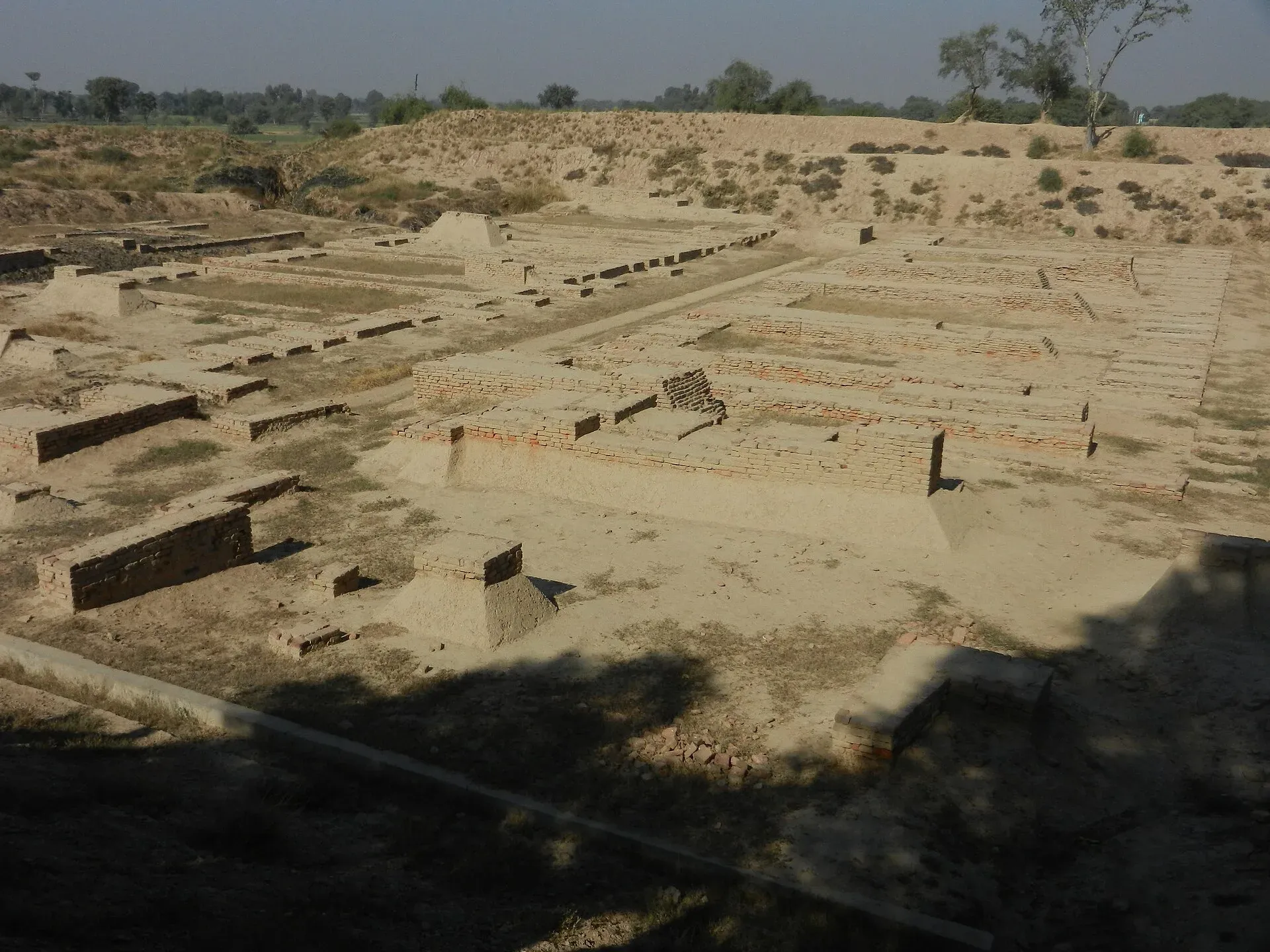
Photo: Muhammad Bin Naveed, with thanks · CC BY-SA 3.0 · via Wikimedia Commons · temporary stand-in photo

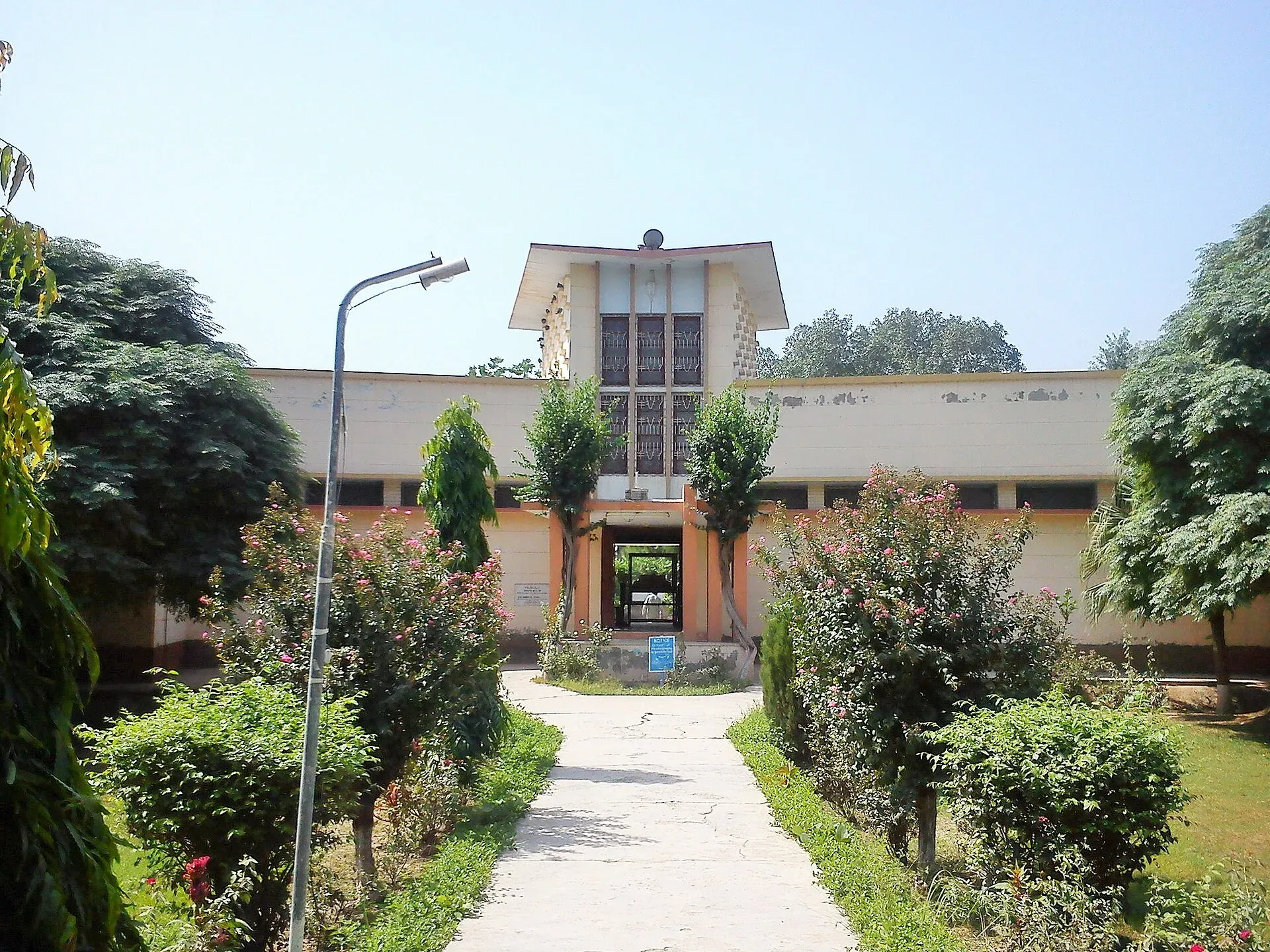
Photo: Shamshad Hussain, with thanks · CC BY-SA 3.0 · via Wikimedia Commons · temporary stand-in photo

Harappa is about 24 km west of Sahiwal, and the modern village of about 15,000 people is less than 1 km from the ruins. The site covers about 150 hectares and is managed by the Government of Punjab. The ruins are low brick mounds. On Mound F, a building with parallel walls is identified as a storehouse and is often called the granary; John Marshall compared it to palace storerooms on Crete. Daya Ram Sahni cut a 500-foot trench across Mound F in 1921. Mound AB lies over early deposits, and Cemetery R-37, with about fifty Harappan burials, was dug in 1937 to 1938. The Harappa Project, led by the University of California, Berkeley with Pakistan's Department of Archaeology, worked here from 1986 to 2010. The site museum shows pottery, seals and figurines. Harappa is on UNESCO's tentative list (2004).
Mohenjo-daro (Sindh)
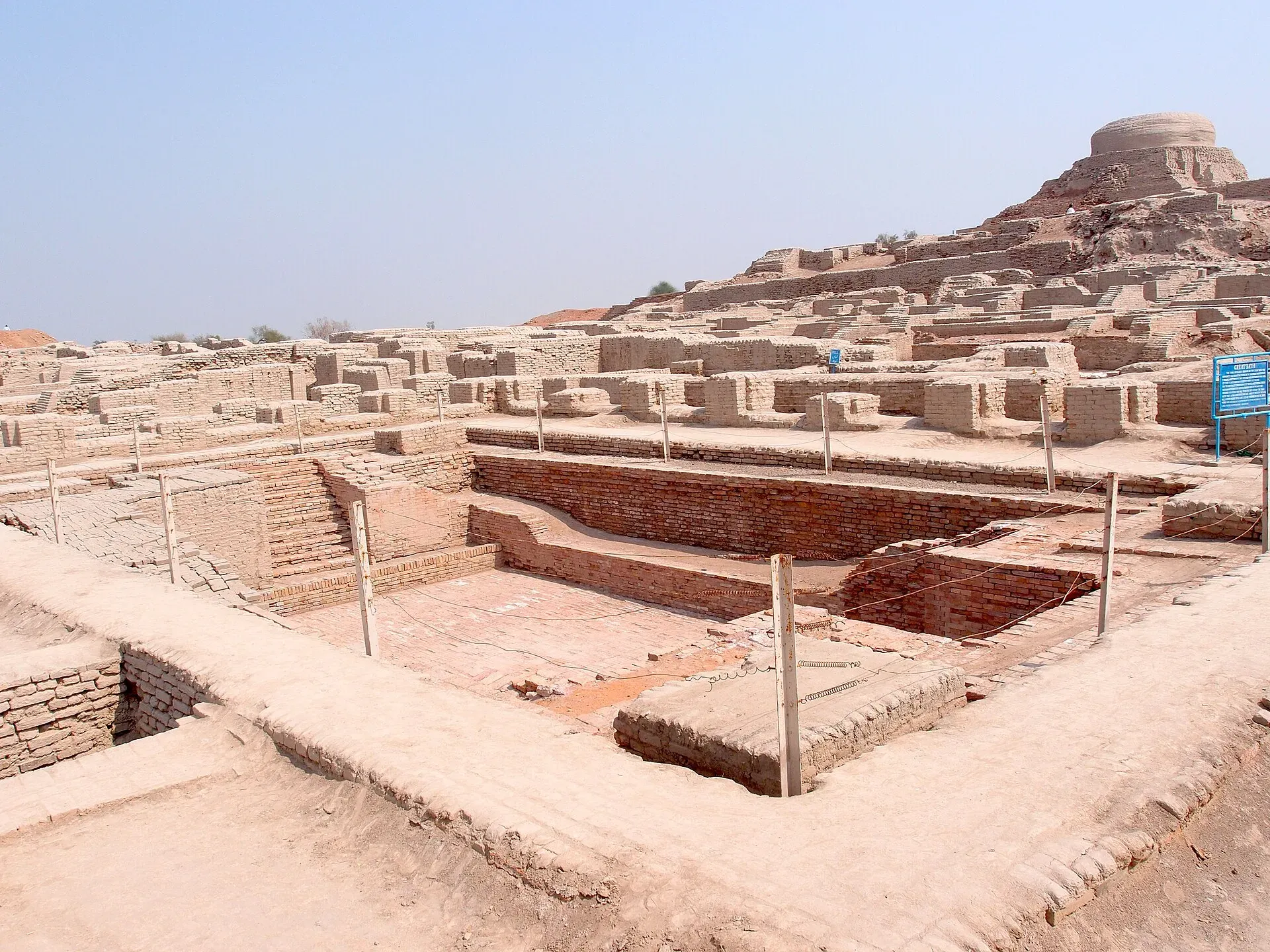
Mohenjo-daro is about 28 km from Larkana, on the west bank of the Indus on a ridge in the flood plain. The raised citadel of mud brick is about 12 m high. It holds the Great Bath, a bitumen-lined brick pool about 12 m long, 7 m wide and 2.4 m deep, reached by steps from a colonnaded courtyard. Mortimer Wheeler named the nearby "Great Granary", but Jonathan Kenoyer found no grain evidence there and suggested "Great Hall". The Lower City has streets and houses laid out in a grid. More than 700 wells have been found, about one for every three houses, and covered drains ran along the main streets. Some finds are in a museum on site. The soapstone Priest-King and a Mother Goddess figure are in the National Museum of Pakistan in Karachi. The bronze Dancing Girl went to India and is in the National Museum, New Delhi. Excavation has been banned since 1965 because digging speeds up weathering, so only salvage work, surveys and conservation are allowed. The Sindh government took over care of the site in 2011.
Kot Diji (Sindh)
Kot Diji is on the east bank, across the river from Mohenjo-daro. It gave its name to the Early Harappan culture, with a citadel on high ground, a defensive wall with regular bastions, and wheel-made red pottery with geometric patterns. F. A. Khan excavated it in 1954 to 1955. The Talpur fort of Kot Diji, built about 1790 by Mir Suhrab at the foot of the Rohri Hills, is also here and is well preserved.
Journey stages
Distances and times are OSRM estimates for a car without stops.
- Lahore to Harappa: about 196 km, around 2 hours 40 minutes.
- Harappa to Multan: about 157 km, around 2 hours. Multan is the overnight stop.
- Multan to Sukkur: about 423 km, around 4 hours 40 minutes, the longest day.
- Sukkur to Kot Diji: about 48 km, about 45 minutes.
- Sukkur to Mohenjo-daro: about 114 km, about 1 hour 35 minutes. From Larkana the site is about 31 km, about 35 minutes.
Larkana is the nearer base for Mohenjo-daro. The sites in Sindh lie in the area where the FCDO advises against all but essential travel, as noted in the stops.
Etiquette and care
Do not walk on the walls or remove bricks. Salt and groundwater are slowly eating the bricks at Mohenjo-daro. Dawn (27 June 2025) reported that repairs after the 2022 floods, which brought down over a dozen walls, were still unfinished and a further conservation proposal had been approved. In 2012 Pakistani archaeologists warned that the site could disappear by 2030. Keep to paths, take your rubbish with you and do not use drones without permission.
Pilgrim and visitor information
This is an archaeology journey and there is no pilgrimage route or registration scheme. Entry fees apply at the sites; current fees will be added soon. Check Pakistan's visa rules for your nationality.
When to go
November to February is the comfortable season. Sindh is very hot from April to September, and the sites have little shade.
Events
The 2014 Sindh Festival was opened at Mohenjo-daro despite protests and a court case about the harm to the site. Ask local authorities whether any event is planned during your dates.
Highlights
- Harappa, the type site of the civilisation
- Mohenjo-daro: the Great Bath and planned streets
- Kot Diji: Early Harappan citadel and Talpur fort
- UNESCO listing for Mohenjo-daro (1980)
Stops
- LahoreStart
- HarappaDistance from Lahore; site and museum
- MultanOvernight stop; 157 km from Harappa
- SukkurOvernight stop; 423 km from Multan; FCDO: all but essential travel
- Kot Diji48 km from Sukkur; FCDO: all but essential travel
- Mohenjo-daro73 km from Kot Diji; 113 km from Sukkur; FCDO: all but essential travel
km: distance from the start along the route.
Numbers follow the stops in order. The map shows the stops, not the road itself.
Day by day
Day 1 · Lahore to Harappa and Multan
Drive 196 km (2.6 hours) to Harappa. Visit the mounds and museum, then go on 157 km (2 hours) to Multan for the night. Multan's blue-tiled shrines make a fitting evening walk.
Day 2 · Multan to Sukkur
A long road day south. Consider the train or a domestic flight if you want to save time. Overnight at Sukkur.
Day 3 · Sukkur, Kot Diji and Mohenjo-daro
Drive 48 km to Kot Diji for the fort and the early settlement. Continue 73 km to Mohenjo-daro and spend the afternoon there. Return to Sukkur, 113 km from the site. Larkana is a closer overnight stop.
Day 4 · Spare day or return
Use this for a second look at Mohenjo-daro, to see the National Museum in Karachi or to travel home. Karachi is 446 km from Mohenjo-daro by road (5.8 hours by OSRM).
Road conditions
- Lahore to Multan and on to Sukkur: paved highways with heavy truck traffic.
- Sukkur to Mohenjo-daro: paved roads; ask locally about the latest conditions.
- Times: OSRM drive times are optimistic and exclude stops, traffic and checkpoints.
Fuel and services
Fill up in Multan and Sukkur. Basic hotels and restaurants are available at Sukkur, Larkana and Harappa town. Services at the sites are limited; carry water.
Where to stay, eat and fuel up
Places to stay
- Avari Towers KarachiCall Avari Towers KarachiMap of Avari Towers Karachi in Google Maps
- Pearl Continental Hotel, LahoreCall Pearl Continental Hotel, LahoreMap of Pearl Continental Hotel, Lahore in Google Maps
- Avari Hotel LahoreCall Avari Hotel LahoreMap of Avari Hotel Lahore in Google Maps
- Serena HotelCall Serena HotelMap of Serena Hotel in Google Maps
- Islamabad Marriott HotelCall Islamabad Marriott HotelMap of Islamabad Marriott Hotel in Google Maps
- Mövenpick KarachiCall Mövenpick KarachiMap of Mövenpick Karachi in Google Maps
Places to eat
- The Monal IslamabadCall The Monal IslamabadMap of The Monal Islamabad in Google Maps
- Tehzeeb Bakers Blue AreaCall Tehzeeb Bakers Blue AreaMap of Tehzeeb Bakers Blue Area in Google Maps
- TKR 3Call TKR 3Map of TKR 3 in Google Maps
- Port Grand - KarachiCall Port Grand - KarachiMap of Port Grand - Karachi in Google Maps
- Kolachi RestaurantCall Kolachi RestaurantMap of Kolachi Restaurant in Google Maps
- Savour FoodsCall Savour FoodsMap of Savour Foods in Google Maps
Essential services fuel stations, mechanics, banks, pharmacies and hospitals and clinics
Fuel
- PSO Petrol Pump (Stadium Service Station)Call PSO Petrol Pump (Stadium Service Station)Map of PSO Petrol Pump (Stadium Service Station) in Google Maps
- Attock Petrol PumpMap of Attock Petrol Pump in Google Maps
- PSO Petrol PumpMap of PSO Petrol Pump in Google Maps
- PSO Petrol PumpMap of PSO Petrol Pump in Google Maps
- Total Parco LA TownCall Total Parco LA TownMap of Total Parco LA Town in Google Maps
- PSO-Al-Rafay Filling Station - Petrol Pump Thokar Niaz BaigCall PSO-Al-Rafay Filling Station - Petrol Pump Thokar Niaz BaigMap of PSO-Al-Rafay Filling Station - Petrol Pump Thokar Niaz Baig in Google Maps
Mechanics and tyre shops
- Mohammed Bilal tyre centreMap of Mohammed Bilal tyre centre in Google Maps
- Changan City SalesCall Changan City SalesMap of Changan City Sales in Google Maps
- Toyota Airport MotorsCall Toyota Airport MotorsMap of Toyota Airport Motors in Google Maps
- Honda GatewayCall Honda GatewayMap of Honda Gateway in Google Maps
- Saif Traders - Best Tyre Shop in LahoreCall Saif Traders - Best Tyre Shop in LahoreMap of Saif Traders - Best Tyre Shop in Lahore in Google Maps
- Mini MotorsCall Mini MotorsMap of Mini Motors in Google Maps
Banks and money exchange
- State Bank of PakistanCall State Bank of PakistanMap of State Bank of Pakistan in Google Maps
Pharmacies
- Imtiaz Mega - Misaq-ul-Mall - FaisalabadCall Imtiaz Mega - Misaq-ul-Mall - FaisalabadMap of Imtiaz Mega - Misaq-ul-Mall - Faisalabad in Google Maps
- Al Jadeed Super MarketCall Al Jadeed Super MarketMap of Al Jadeed Super Market in Google Maps
- Imtiaz Mega - Ramzan Mall - islamabadCall Imtiaz Mega - Ramzan Mall - islamabadMap of Imtiaz Mega - Ramzan Mall - islamabad in Google Maps
- Imtiaz Supermarket - Awami Markaz - KHICall Imtiaz Supermarket - Awami Markaz - KHIMap of Imtiaz Supermarket - Awami Markaz - KHI in Google Maps
- Imtiaz Mega - Kings Mall - GujranwalaCall Imtiaz Mega - Kings Mall - GujranwalaMap of Imtiaz Mega - Kings Mall - Gujranwala in Google Maps
- Hydri Super MarketCall Hydri Super MarketMap of Hydri Super Market in Google Maps
Hospitals and clinics
- Hashmanis Hospital NumaishCall Hashmanis Hospital NumaishMap of Hashmanis Hospital Numaish in Google Maps
- Holistic CareCall Holistic CareMap of Holistic Care in Google Maps
- Lahore Care HospitalCall Lahore Care HospitalMap of Lahore Care Hospital in Google Maps
- Shifa International Hospitals LimitedCall Shifa International Hospitals LimitedMap of Shifa International Hospitals Limited in Google Maps
- Amanat Eye Hospital RawalpindiCall Amanat Eye Hospital RawalpindiMap of Amanat Eye Hospital Rawalpindi in Google Maps
- Maryam Memorial Hospital (MMH)Call Maryam Memorial Hospital (MMH)Map of Maryam Memorial Hospital (MMH) in Google Maps
Listings come from Google Maps data and are unverified: phone numbers, opening months and prices may have changed. Report a problem · Own one of these? Claim it
Safety
- Government advice (UK FCDO, updated 27 October 2026, checked 16 November 2026): the FCDO advises against all but essential travel to all areas of Sindh north of and including Nawabshah. Sukkur, Kot Diji (Khairpur) and Mohenjo-daro (Larkana) are all in this area. Harappa (Sahiwal) and Multan in Punjab are not named. This is the plain reading of the advice, not an assessment of any one town.
- Insurance: For foreign visitors: the UK FCDO notes that travel insurance can be invalid if you travel against its advice.
- What this means for planning: treat the Sindh part of the journey as a trip only for essential travel unless the advice changes. Check with the Sindh Culture department and your embassy, and use a trusted local operator.
- Heat: summer temperatures are very high.
Tips
- Go between November and February; summer heat is severe.
- Take water, a hat and sun protection; there is little shade.
- Stay on paths and do not walk on brick walls.
- Sindh stops are in an area where the UK FCDO advises against all but essential travel.
Sources and last checked
Last checked Confidence medium9 sources4 still to check
- Last checked
- Method
- Desk research from published sources
- Confidence
- medium
- Checked by
- trek.pk research team
Researched from published sources; not yet checked on the ground by our team. Spot something out of date? Report a mistake.
Sources
- Pakistan travel advice: Warnings and insurance (updated 27 October 2026) · UK Foreign, Commonwealth & Development Office (FCDO) · checked
- OSRM driving route service: distances and times measured 16 November 2026 (drive times are optimistic and exclude stops) · OSRM / OpenStreetMap contributors · checked
- Indus Valley Civilisation (Wikipedia) · Wikipedia · checked
- Mohenjo-daro (Wikipedia) · Wikipedia · checked
- Kot Diji (Wikipedia) · Wikipedia · checked
- Harappa (Wikipedia) · Wikipedia · checked
- Fresh studies trace Mohenjo Daro's urban roots to 3300 BC (25 Mar 2026) · Dawn · checked
- Monsoon haunts damaged Mohenjo Daro again (27 Jun 2025) · Dawn · checked
- Train operations on Dadu line suspended (7 Aug 2026) · Dawn · checked
Still to be checked on the ground (4)
- Current opening hours and fees at Harappa, Mohenjo-daro and Kot Diji (no official source found)
- Current train and flight schedules to Sukkur (only aggregator pages; check PIA and Pakistan Railways)
- Whether the post-2022 repairs at Mohenjo-daro are finished (last report June 2025)
- Security situation in northern Sindh: FCDO advice as already cited; check for changes
Nearby and related

Harappa
The type site of the Indus Valley Civilisation, near Sahiwal in Punjab. Settlement here began about 3300 BCE and the city flourished about 2600-1900 BCE. On UNESCO's tentative list since 2004.

Multan
The City of Saints in southern Punjab: blue-tiled Sufi shrines, a crowded old city, blue pottery, sohan halwa and mangoes.

Sukkur
Sindh's third-largest city on the Indus, with the 1932 Sukkur Barrage, the 1889 Lansdowne Bridge, Masum Shah's Minaret and the river islands of Rohri.

Lahore
Punjab's capital and Pakistan's cultural city: Mughal forts, mosques and gardens, a lively Walled City, and some of the best food in the country.

Larkana
A rice-growing city in northern Sindh and the base for Mohenjo-daro, the UNESCO-listed Indus Valley city about 30 km away, with the Bhutto family mausoleum nearby.

Sahiwal
A canal-colony city between Lahore and Multan, once called Montgomery, famous for the Sahiwal breed of cattle and a short drive from the Bronze Age ruins of Harappa.

Nawabshah (Shaheed Benazirabad)
A hot agricultural and university city in the middle of Sindh, headquarters of Shaheed Benazirabad District, on the main road and rail line between Hyderabad and Sukkur.