

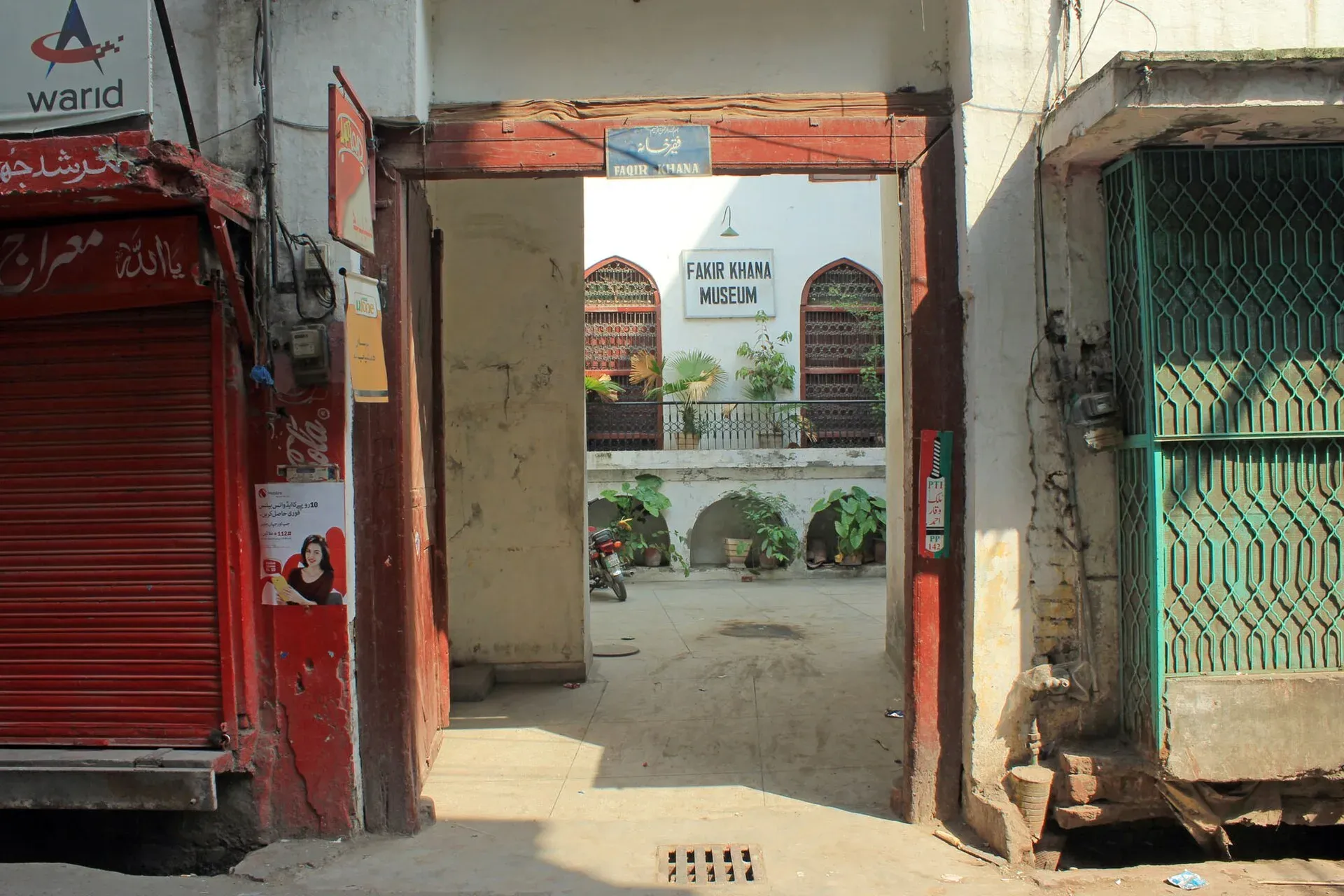
Photo: Meemjee, with thanks · CC BY-SA 3.0 · via Wikimedia Commons · temporary stand-in photo

Faqir Khana Museum
A family-run private museum in a haveli near Bhati Gate in Lahore's Walled City, holding Sikh-era gifts, miniatures, manuscripts and Gandharan pieces. Visits are by appointment.
Overview
Faqir Khana is a private museum inside the home of the Fakir family, on Hakimaan Bazaar near Bhati Gate in Lahore's Walled City. It is run by the family, not by the government, though it is reported to receive some state funds for upkeep. Press reports describe it as one of the largest privately owned museums in South Asia.
Plan your visit
- Nearest town
- Lahore
- Getting there
The museum is on Hakimaan Bazaar near Bhati Gate in the Walled City of Lahore. Take a taxi or ride-hailing car to Bhati Gate and walk the last part through the bazaar. More
Best months
Oct – Mar
- Faqir Khana Museum
- Related places nearby: Lahore, Walled City of Lahore, Badshahi Mosque, Wazir Khan Mosque, Lahore Fort, Lahore Museum
History of the family and the house
According to Dawn, the Fakir family were hakims (traditional physicians) who moved to Lahore from Chunian in the 1730s and settled in a haveli said to have belonged to Raja Todar Mal. The family ran a pharmacy, a hospital, a school and a publishing house. In the Sikh period, Fakir Syed Azizuddin served Maharaja Ranjit Singh as his chief secretary and foreign minister. Many objects in the collection were gifts to the family from the Maharaja and from the East India Company.
The museum's own website and Google Arts & Culture say it has welcomed the public since 1901. Dawn (2021) gives 1905, and a 1937 date also appears in print, so 1901 is the most likely. The collection was once lent to the Lahore Museum (in 1864 according to Dawn) and later returned to the family.
What to see and do
The museum's own site does not give a count. Google Arts & Culture says more than 20,000 objects (Wikipedia gives about 21,000, including about 10,000 manuscripts and 180 displayed miniatures), while Dawn (2021) says about 30,000 and some older reports say 13,000, so treat any single figure with care. Most objects date from the 18th to 20th centuries. Dawn calls the miniature hall the heart of the museum. Items mentioned in published accounts include:
- Miniature paintings. A tiny portrait of Nawab Mumtaz Ali of Dajuna by Ghulam Ali, said to have taken 15 years and a single squirrel hair as a brush, and an ivory painting of Mariam Zamani, one of Akbar's wives.
- Sikh-era gifts and textiles connected with the court of Ranjit Singh.
- Manuscripts and calligraphy, including handwritten copies of the Quran.
- Gandharan sculpture showing the life of the Buddha, and terracotta dolls from the prehistoric site of Mehrgarh, dated by Dawn to around 7000 BC.
- Porcelain and curios, such as eggshell china and Chinese plates said to change colour when poisoned food was served on them.
- Islamic relics. Dawn describes the Islamic collection as the richest section. It includes 47 items said to belong to the Prophet Muhammad, his family, companions and descendants, which are shown once a year during Muharram and otherwise kept in the family's Darbar-i-Hussaini shrine. Dawn also lists handwritten copies of the Quran, calligraphy by master calligraphers, and an overcoat said to have been given by Ibn Arabi to Ertugrul, founder of the Ottoman line.
- Other curios. A ring said to have belonged to King Porus and an ancient water filter are also mentioned.
The family today
The museum is managed by the seventh generation of the family, with Fakir Syed Saifuddin as custodian according to Dawn. Dawn reports about 13,000 to 15,000 visitors a year, among them diplomats, students, tourists and artists, and says the space is also rented for private events such as weddings and fashion shoots. It describes the museum as apparently the only private museum in the country to be recognised and given modest government funding.
When to visit
Winter and spring are more comfortable for walking in the old city. For the Muharram display, ask the family about dates, which move each year.
Where to stay and eat
Stay in or near the Walled City or in central Lahore. The old city has many traditional food streets within walking distance.
Good to know
- Visits by appointment. The museum's own website lists visits as by prior appointment, and Dawn (2021) says the same since the pandemic, because the building is also the family's residence. No official hours or ticket price are published, so none are given here. Ask through a local guide or the Walled City of Lahore Authority.
- Photography: not stated in the sources. Ask the family.
- Access: the building is a traditional haveli with steps, so it may be hard for wheelchair users. This is not confirmed.
- Respect: you are a guest in a family home, and some objects are religious relics. Dress modestly and ask before photographing.
- Getting around: Bhati Gate is on the western side of the Walled City. Narrow lanes and traffic make walking from the gate the easiest approach.
Highlights
- Private family museum in a Walled City haveli
- Gifts linked to Maharaja Ranjit Singh's court
- Miniatures, manuscripts and Gandharan pieces
- Islamic relics shown once a year in Muharram (as reported)
- Visits by appointment
Getting there
The museum is on Hakimaan Bazaar near Bhati Gate in the Walled City of Lahore. Take a taxi or ride-hailing car to Bhati Gate and walk the last part through the bazaar. Confirm the exact entrance when you make your appointment.
Tips
- Book ahead: reports say walk-in visits stopped after the pandemic.
- Treat object counts as approximate; reports vary from 13,000 to 30,000.
- Dress modestly and ask before taking photos.
Photos we still need: the haveli entrance on Hakimaan Bazaar and the miniature hall (only if a licensed photo exists). Send us yours
Sources and last checked
Last checked Confidence medium6 sources3 still to check
- Last checked
- Method
- Desk research from published sources
- Confidence
- medium
- Checked by
- trek.pk research team
Researched from published sources; not yet checked on the ground by our team. Spot something out of date? Report a mistake.
Sources
- Fakir Khana · Wikipedia · checked
- Faqir Khana Museum: family and collection (Dawn) · Dawn · checked
- Fakir Khana (search summary of Gulf News and Academy of the Punjab in North America pages) · Gulf News / APNA · checked
- Pakistan Tourism Guide 2021 (museums list) · Trade Development Authority of Pakistan (TDAP) · checked
- Fakir Khana Museum · Fakir Khana Museum (official site) · checked
- Fakir Khana Museum · Google Arts & Culture · checked
Still to be checked on the ground (3)
- Opening hours and the booking contact (the museum site says by prior appointment; no hours or contact opened)
- Muharram display dates (Dawn: relics shown once a year in Muharram; dates not published)
- Photography rules, any ticket price, accessibility (not stated on the museum site)
Nearby and related

Lahore
Punjab's capital and Pakistan's cultural city: Mughal forts, mosques and gardens, a lively Walled City, and some of the best food in the country.

Walled City of Lahore
Lahore's old core: lanes, gates and Mughal and Sikh-era monuments around the Royal Road, including Wazir Khan Mosque, Delhi Gate and the Shahi Hammam. Its lanes are best explored on foot.

Badshahi Mosque
Lahore's great Mughal mosque, built for Emperor Aurangzeb in 1671-73 from red sandstone and marble. It faces Lahore Fort and has been on UNESCO's tentative list since 1993.

Wazir Khan Mosque
A Mughal mosque in Lahore's Walled City, built 1634 to 1641, famous for its tilework and painted interior. On Pakistan's UNESCO tentative list since 1993, and still an active place of worship.

Lahore Fort
The Mughal citadel at the north end of Lahore's Walled City, with palaces, a marble mosque and a long tiled Picture Wall. Inscribed by UNESCO in 1981 together with the Shalimar Gardens.

Lahore Museum
Pakistan's oldest and largest museum, in an 1894 Indo-Saracenic building on The Mall. Home of the Fasting Buddha from Gandhara and galleries from the Indus Valley to the Pakistan Movement.