

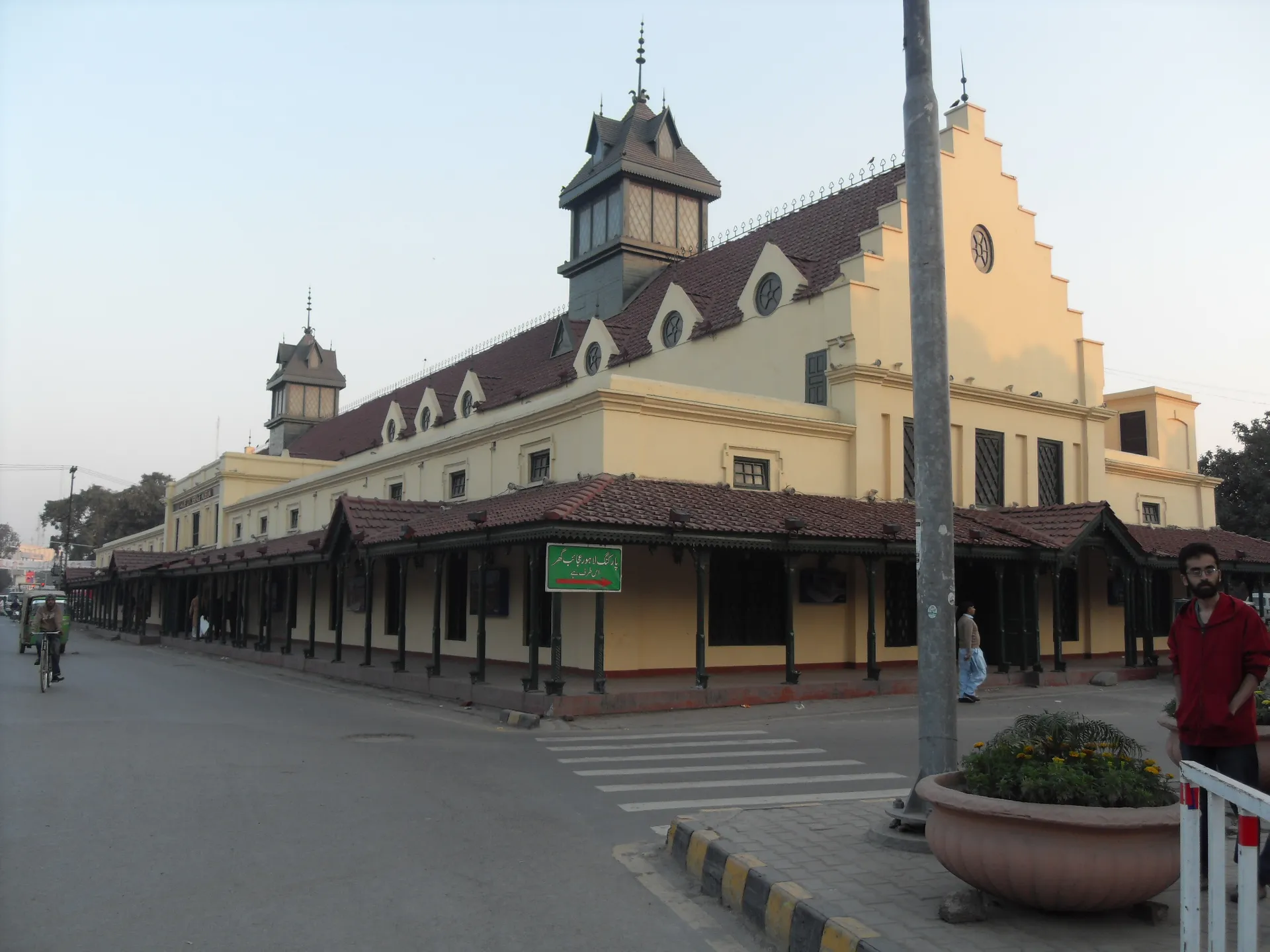
Photo: G mustafa, with thanks · CC BY-SA 3.0 · via Wikimedia Commons · temporary stand-in photo

Lahore Museum
Pakistan's oldest and largest museum, in an 1894 Indo-Saracenic building on The Mall. Home of the Fasting Buddha from Gandhara and galleries from the Indus Valley to the Pakistan Movement.
Overview
The Lahore Museum is on The Mall (Shahrah-e-Quaid-e-Azam), in Lahore's colonial-era centre. The museum's own website calls it the oldest and largest museum in Pakistan and says it holds about 60,000 objects in its permanent collection, plus more than 30,000 in reserve collections. Wikipedia's text says over 58,000 are reported, with only about 14,000 on display at any one time. Whichever figure is right, only a part of the collection is on show.
Wikipedia reports more than 250,000 visitors in 2005, falling to 236,536 in 2016, 214,697 in 2017 and rising to 227,994 in 2018. It was the most visited museum in Pakistan among foreign visitors in 2016 and 2017 (about 2,950 each year), and second to Taxila Museum in 2018 (3,659).
Plan your visit
- Nearest town
- Lahore
- Opening hours
- Official site (checked 16 Nov 2026): Saturday to Thursday, 9 am to 4 pm (header); footer: winter 9 am to 4 pm, summer 9 am to 5 pm; closed Fridays and the first Monday of each month. Confirm before you go.
- Entry fee
- Rs 20 (students and children), Rs 50 (adults), Rs 1,000 (foreigners). Source: Lahore Museum website, checked 17 November 2026.
- Getting there
The museum is on The Mall (Shahrah-e-Quaid-e-Azam), Lahore 54000. Taxis, ride-hailing cars and rickshaws serve the area. Lahore has an international airport and a main railway station; More
Best months
Oct – Mar
- Lahore Museum
- Related places nearby: Lahore, Walled City of Lahore, Badshahi Mosque, Wazir Khan Mosque, Tomb of Anarkali
The building
The red-brick building is in the Indo-Saracenic style. It was designed by Bhai Ram Singh and John Lockwood Kipling, built under the supervision of Ganga Ram, and paid for by a public fund raised for Queen Victoria's Golden Jubilee. The cornerstone inscription calls it the Jubilee Museum and Technical Institute. Kipling's son Rudyard opened his novel Kim in front of the museum, beside the Zamzama gun that used to stand outside; the elder Kipling was one of the museum's earliest curators.
History
The museum began in 1865-66 in a hall built for the 1864 Punjab Exhibition (now Tollinton Market, which has since passed to the National College of Arts). The foundation stone of the present building was laid on 3 February 1890 by Prince Albert Victor, Duke of Clarence, Queen Victoria's grandson. The collection moved to the new building in 1894 under the name Jubilee Museum. At the 1947 partition about 60% of the collection stayed in Lahore. The rest went to India, where it forms the core of the museum in Chandigarh. Wikipedia describes 1970 to 1990, when the archaeologist Dr Saif-ur-Rehman Dar was director, as the museum's golden years.
Gandhara and the Fasting Buddha
The emaciated seated Buddha from Gandhara is the museum's best-known object. It shows the Buddha during his years of severe fasting before enlightenment, with the ribs, veins and sunken eyes carved in dark stone. Gandhara was an ancient kingdom of the north-west whose Greco-Buddhist sculpture the museum collects. The Gandhara gallery also holds stupa models. For more of that story, see the Gandhara trail.
What to see and do
The museum's website lists 13 galleries: Gandhara; Hindu, Buddhist and Jain; Pre-historic and Indus; Islamic; Sikh; Miniature Paintings; Contemporary Paintings; Manuscripts; Coins; Ethnological; Postage and Stamps; Pakistan Movement; and a general gallery.
- Gandhara and Indus collections. Greco-Buddhist sculpture, stupa models and Indus Valley figurines show how old the region's cities are. The museum displays material from the Bronze Age to the Hindu Shahi and Mughal periods.
- Coins. The museum has a large collection of Indo-Greek and Mughal coins.
- Paintings and crafts. Mughal and Pahari miniatures, Mughal and Sikh carved woodwork, textiles, jewellery, musical instruments and arms, plus some Tibetan and Nepalese work.
- Sadequain's mural. The Evolution of Mankind is a 48-panel ceiling mural in the entrance hall, painted in 1973 according to Wikipedia (the museum's site says 1974). Weather and termites damaged it. It was taken down in 2010 and restoration began in 2012, with 16 panels restored by 2018. Ask whether it is on view.
Around the museum
The museum is on The Mall, with the National College of Arts also on the road. Anarkali Bazaar runs north from The Mall; see Anarkali Bazaar and the nearby Tomb of Anarkali. Wikivoyage lists Anarkali Food Street and Gawalmandi Food Street for street food, though it does not say how far they are from the museum. Wikivoyage's contributors also describe the museum's presentation as old-fashioned and basic, and say captions are sometimes in Urdu only. The Walled City, Badshahi Mosque and Wazir Khan Mosque are across the city; allow time for traffic.
When to visit
Galleries are most comfortable from October to March. Weekday mornings are quietest.
Where to stay and eat
The museum is on The Mall, with a range of hotels and restaurants in central Lahore. See the Lahore page for areas to stay.
Good to know
- Opening hours (official site, checked 17 November 2026): the header gives Saturday to Thursday, 9 am to 4 pm. The footer gives winter 9 am to 4 pm and summer 9 am to 5 pm, with Friday as the weekly holiday and closure for maintenance on the first Monday of each month. The two do not match exactly, so confirm before you go.
- Tickets (official site, checked 17 November 2026): Rs 20 for students and children, Rs 50 for adults and Rs 1,000 for foreigners. The site also has an online ticket page.
- Contact: +92-42-99211819, lahore.museum@punjab.gov.pk.
- Photography: the museum's site does not state rules. Ask at the ticket desk.
- Access: the website does not describe wheelchair access. Ask the museum before you go.
Highlights
- Pakistan's oldest and largest museum (opened 1894 on The Mall)
- Fasting Buddha from Gandhara
- 13 galleries from the Indus Valley to the Pakistan Movement
- Sadequain's Evolution of Mankind mural (under restoration)
- Setting of the opening of Kipling's Kim
Getting there
The museum is on The Mall (Shahrah-e-Quaid-e-Azam), Lahore 54000. Taxis, ride-hailing cars and rickshaws serve the area. Lahore has an international airport and a main railway station; the museum is in the central part of the city.
Tips
- Check the hours first: the official site's header and footer differ.
- Allow two to three hours for a proper visit.
- Foreign visitors pay a higher ticket price than residents.
- Ask at the desk whether the Sadequain mural and any closed galleries are on view.
Photos we still need: the Sadequain mural, if it is on view again. Send us yours
Sources and last checked
Last checked Confidence medium4 sources4 still to check
- Last checked
- Method
- Desk research from published sources
- Confidence
- medium
- Checked by
- trek.pk research team
Researched from published sources; not yet checked on the ground by our team. Spot something out of date? Report a mistake.
Sources
- Lahore Museum (official website) · Lahore Museum, Government of the Punjab · checked
- Lahore Museum · Wikipedia · checked
- Pakistan Tourism Guide 2021 (museums list) · Trade Development Authority of Pakistan (TDAP) · checked
- Lahore (Wikivoyage), Lahore Museum entry and nearby sights · Wikivoyage · checked
Still to be checked on the ground (4)
- Opening hours: header says Saturday to Thursday 9 am to 4 pm; footer says winter 9 am to 4 pm, summer 9 am to 5 pm (still conflicting on 17 Nov 2026)
- Whether the Sadequain mural is on display (official site and Wikipedia describe it, but not whether it is on view; Wikipedia: removed in 2010, restoration from 2012, 16 panels restored by 2018)
- Photography rules and accessibility (not stated on the official site)
- Coordinates taken from Wikivoyage (31.568213, 74.308392); confirm on the ground
Nearby and related

Lahore
Punjab's capital and Pakistan's cultural city: Mughal forts, mosques and gardens, a lively Walled City, and some of the best food in the country.

Walled City of Lahore
Lahore's old core: lanes, gates and Mughal and Sikh-era monuments around the Royal Road, including Wazir Khan Mosque, Delhi Gate and the Shahi Hammam. Its lanes are best explored on foot.

Badshahi Mosque
Lahore's great Mughal mosque, built for Emperor Aurangzeb in 1671-73 from red sandstone and marble. It faces Lahore Fort and has been on UNESCO's tentative list since 1993.

Wazir Khan Mosque
A Mughal mosque in Lahore's Walled City, built 1634 to 1641, famous for its tilework and painted interior. On Pakistan's UNESCO tentative list since 1993, and still an active place of worship.

Tomb of Anarkali
An octagonal Mughal tomb in the Punjab Civil Secretariat grounds in Lahore. It has housed the Punjab Archives since 1891, so public access is limited.