

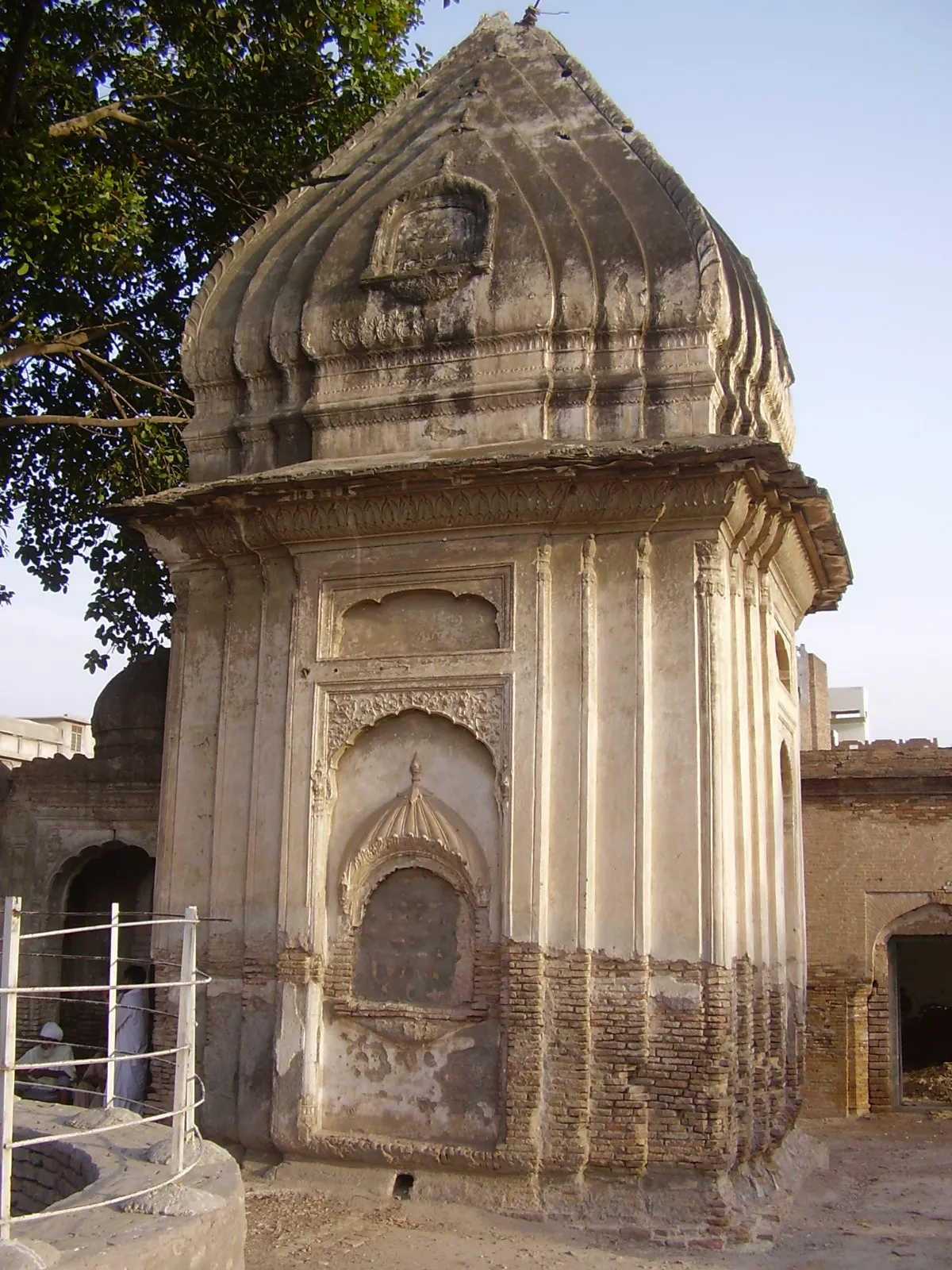
Photo: Khalid Mahmood, with thanks · CC BY-SA 3.0 · via Wikimedia Commons · temporary stand-in photo

Gor Khatri and City Museum Gor Khatri, Peshawar
An archaeological complex in old Peshawar: a Mughal caravanserai built over much older layers, later a Sikh-era residence and a police station, now a park with the City Museum Gor Khatri. On Pakistan's UNESCO tentative list since 2026.
Overview
Gor Khatri (also Gor Khuttree) is a walled compound of about 160 by 160 m in the south-east of Peshawar's old city. The name is usually translated as "Grave of the Kshatriya". It has been a Buddhist site, a Mughal caravanserai, a Sikh-era residence and a police headquarters, and today is an archaeological park with a museum. It is on Pakistan's UNESCO Tentative List.
Plan your visit
- Nearest town
- Peshawar
- Getting there
Gor Khatri is in the south-east of Peshawar's walled city, near the Ghanta Ghar (clock tower) and Sethi Mohallah. Taxis and rickshaws reach the old city; the last stretch is on foot through the bazaars. More
Best months
Oct – Mar
- Gor Khatri and City Museum Gor Khatri, Peshawar
- Related places nearby: Peshawar, Peshawar Walled City, Sethi House and Sethi Mohallah, Peshawar, Qissa Khwani Bazaar, Cunningham Clock Tower, Peshawar Museum, Khyber Pakhtunkhwa
The compound
The site is a square of about 160 by 160 m. Two prominent gateways give access. The Gorakhnath temple stands at the centre, and a network of cells and rooms runs along the southern and western sides. Under the Mughals the compound served as a caravanserai, a walled inn for travellers and their animals. It was equipped with a mosque, a bath and two wells.
History
Alexander Cunningham linked the place with the original site of the Kanishka stupa, and the archaeologist Ahmad Hasan Dani linked it with a tower that held the Buddha's bowl. Many historians connect it with a site described by the 7th-century Chinese pilgrim Xuanzang. Babur mentions a visit in his memoirs. In 1641 Jahanara Begum, daughter of Shah Jahan, turned it into a caravanserai called Sarai Jahanabad, with a mosque, a bath and two wells. Under the Sikhs (1838 to 1842) it was the home and headquarters of Paolo Avitabile, governor of Peshawar, and a Shiva temple was built inside. From 1917 to 2002 it was a police headquarters and fire station.
Excavations began in 1992 to 1993 under Dr Farzand Ali Durrani, whose vertical trenches confirmed settlement at least from the 3rd century BC. Work stopped for lack of funds and later resumed in the north-eastern part of the compound, running to 2007. The results pushed back the accepted age of Peshawar by a couple of centuries, and support its claim to be one of the oldest living cities in South Asia.
UNESCO status
The Gor Khatri archaeological complex is on the 2026 additions to Pakistan's UNESCO Tentative List. A tentative listing is a first step only: it is not World Heritage status.
What to see and do
- Two gateways and the compound walls.
- Gorakhnath Temple in the middle of the compound. In the Sikh period a Shiva temple here was a Hindu pilgrimage site where a head-shaving rite, the Sardukahr, was performed, according to the historian S. M. Jaffar.
- Old cells and rooms around the south and west sides.
- Excavation areas in the north-east.
- City Museum Gor Khatri: a museum inside the complex showing the archaeological and ethnological history of Peshawar, according to Wikivoyage. Check what is on display when you visit.
Around the old city
Gor Khatri sits near the Ghanta Ghar (clock tower) and Sethi Mohallah, and other old-city sights are covered on these pages: Peshawar walled city, Sethi House, Qissa Khwani Bazaar and Cunningham Clock Tower. If travel to Peshawar is possible when you read this, a morning at Gor Khatri and the museum, followed by a walk through the nearby lanes, is a workable half day. The current UK advice below should be read first.
When to visit
October to March is the most comfortable. Summers are very hot.
Where to stay and eat
Peshawar has hotels and many places to eat. We do not list businesses.
Good to know
- Travel advice. For foreign visitors: the UK FCDO (updated 27 October 2026, checked 17 November 2026) advises against all travel to Peshawar, including the city of Peshawar. Read the current advice before planning a visit.
- Hours and fees. No official hours or fees were found, for the compound or the museum.
- Etiquette. The temple is a place of worship for some visitors. Ask before photographing people.
Highlights
- Mughal caravanserai built over much older layers
- Excavated settlement at least from the 3rd century BC
- Gorakhnath Temple inside the compound
- City Museum Gor Khatri on site
- On UNESCO tentative list since 2026
Getting there
Gor Khatri is in the south-east of Peshawar's walled city, near the Ghanta Ghar (clock tower) and Sethi Mohallah. Taxis and rickshaws reach the old city; the last stretch is on foot through the bazaars.
Tips
- Check FCDO advice for Peshawar first.
- Combine with Sethi House and Qissa Khwani Bazaar on foot.
- Ask at the gate about museum hours.
- Go in the morning in warm months.
Photos we still need: excavated areas and the City Museum interior. Send us yours
Sources and last checked
Last checked Confidence medium6 sources5 still to check
- Last checked
- Method
- Desk research from published sources
- Confidence
- medium
- Checked by
- trek.pk research team
Researched from published sources; not yet checked on the ground by our team. Spot something out of date? Report a mistake.
Sources
- Gor Khatri (Wikipedia) · Wikipedia · checked
- Gor Khuttree (Wikipedia) · Wikipedia · checked
- Peshawar (Wikivoyage) · Wikivoyage · checked
- UNESCO widens Pak heritage map · The Express Tribune · checked
- List of World Heritage Sites in Pakistan (tentative list table) · Wikipedia · checked
- Pakistan travel advice: warnings and insurance (updated 27 October 2026) · UK Foreign, Commonwealth & Development Office · checked
Still to be checked on the ground (5)
- Opening hours and fees for the compound and the City Museum
- What the City Museum displays and when it opened (only Wikivoyage's one-line description found)
- Date of the Mughal caravanserai (sources agree on 1641)
- Date of the tentative-list submission
- Whether the Mughal-era dating in the sources ('early 16th century' appears in one account) is a slip for 1641
Nearby and related

Peshawar
Khyber Pakhtunkhwa's capital and one of South Asia's oldest living cities: the Gandhara museum, Qissa Khwani Bazaar, mosques and a strong food culture.

Peshawar Walled City
The old core of Peshawar: Qissa Khwani Bazaar, the carved wooden Sethi havelis and the Gor Khatri complex. Parts are being restored, and the Sethi House and Gor Khatri are on UNESCO's tentative list.

Sethi House and Sethi Mohallah, Peshawar
A lane of merchant havelis in Peshawar's old city, built from about 1800 to 1910 by the Sethi family in a Central Asian style, with carved wood, painted ceilings and courtyards. On Pakistan's UNESCO tentative list since 2026.
Qissa Khwani Bazaar
Peshawar's old 'street of storytellers': a lively bazaar of tea houses, qehwa shops and traders in the walled city, with a long history as a caravan meeting place. Check FCDO advice before any visit.

Cunningham Clock Tower
A tall brick clock tower in Peshawar's old city, completed in 1900 to mark Queen Victoria's Diamond Jubilee. Locals call it Ghanta Ghar; it is a handy landmark at the edge of the old bazaars.
Peshawar Museum
Founded in 1907 in the Victoria Hall, the Peshawar Museum holds one of the world's great collections of Gandharan Buddhist sculpture, plus coins, Islamic art and Kalash material.

Khyber Pakhtunkhwa
Mountains, Buddhist ruins and old bazaars in north-west Pakistan: Swat, Kaghan, Chitral, the Kalash valleys, the Khyber Pass and Peshawar.