

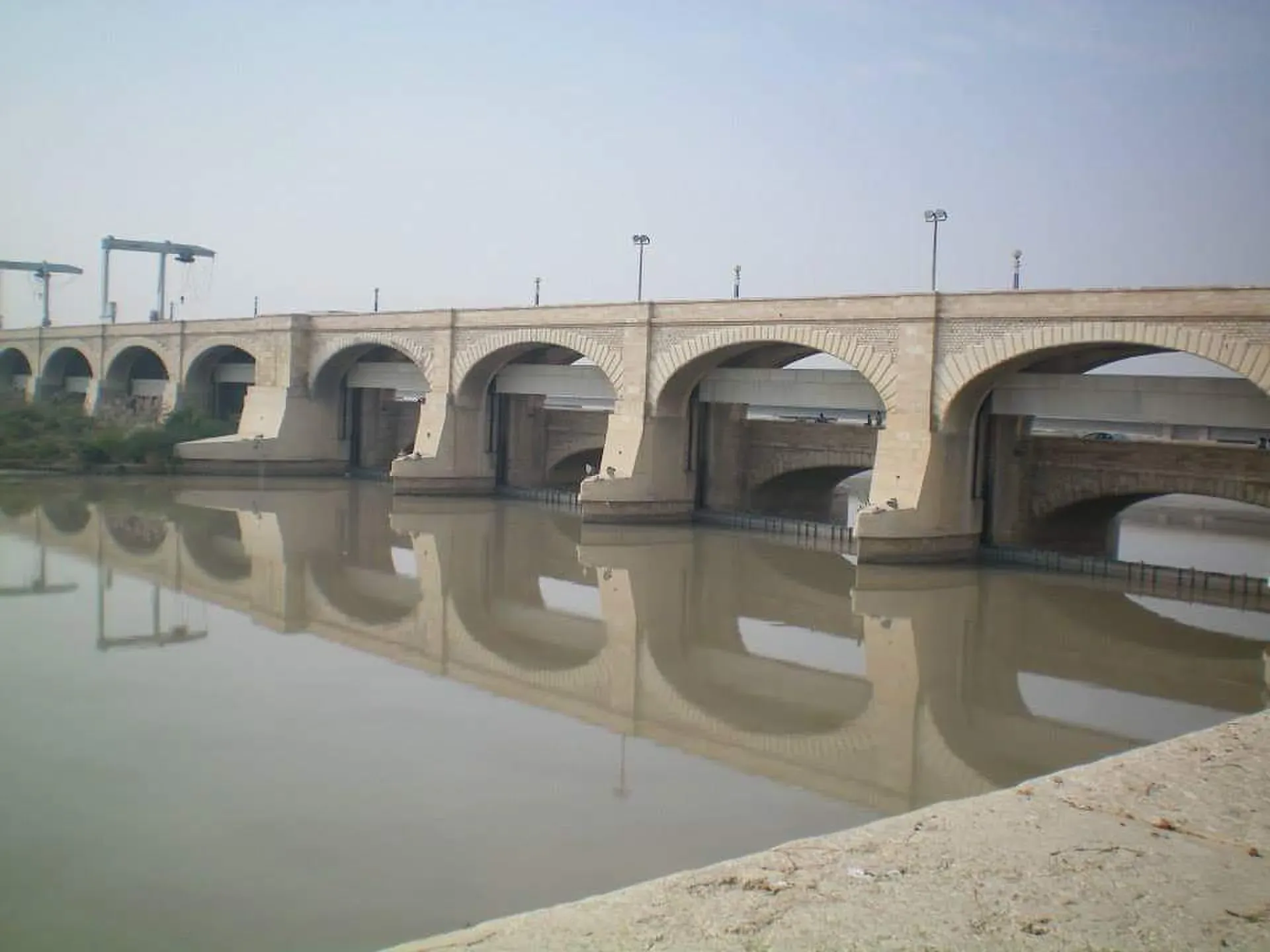
Photo: Ashahid83, with thanks · CC BY-SA 4.0 · via Wikimedia Commons · temporary stand-in photo

Indus Dolphin Reserve (Sukkur-Guddu)
A river reserve on the Indus in northern Sindh between Guddu and Sukkur barrages, declared in 1974 and Ramsar site no. 1065 since 2001. Home to the largest group of the Endangered Indus river dolphin. Security advice applies.
Overview
The Indus Dolphin Reserve protects a stretch of the River Indus in northern Sindh between Guddu Barrage and Sukkur Barrage. It holds the largest surviving group of the Indus river dolphin, a freshwater dolphin found only in the Indus system. The reserve was set up in 1974 and listed as a Wetland of International Importance on 10 May 2001 (Ramsar site no. 1065, 125,000 hectares). The river is managed by the Sindh Irrigation Department, and the Sindh Wildlife Department leads protection of the dolphins and the riverine forests.
Sources disagree on the length. The Ramsar sheet gives about 170 km, the 2019 survey covered about 194 km of river from Guddu to Sukkur barrage, and Arab News calls the reserve roughly 200 km.
Plan your visit
- Nearest town
- Sukkur
- Getting there
Sukkur is the main base and has a motorway, rail and air links. Guddu Barrage is upstream near the Punjab border; More
Best months
Nov – Mar
- Indus Dolphin Reserve (Sukkur-Guddu)
- Related places nearby: Sukkur, Sukkur Barrage (Lloyd Barrage)
The Indus river dolphin
The dolphin is easy to tell from sea dolphins. It has a long, thin snout with teeth that show even when the mouth is closed, a brownish, stocky body, and only a small triangular lump where a dorsal fin would be. Males reach about 2 to 2.2 m and females about 2.4 to 2.6 m. It has no crystalline eye lens, so it is effectively blind and finds its way and its prey by echolocation, using sound. It was the first side-swimming dolphin to be described; it is thought to swim on its side to move through shallow water in the dry season.
The IUCN Red List classes it as Endangered, and it is on CITES Appendix I. Its range once covered about 3,400 km of the Indus and its tributaries. It now occupies about 690 km of the main river, and in Pakistan irrigation barrages split the population into five small groups. The Sukkur and Guddu barrages mark the ends of the largest one.
The Sindh stretch has recovered since the 1970s. A 1974 to 1975 survey found about 150, the Ramsar sheet gives 600 to 650, and the Sindh Wildlife Department counted 1,419 dolphins in 34 groups in a four-day survey on 8 to 11 April 2019, up from 918 in a 2012 survey (Arab News). A figure of about 2,100 for 2021 is quoted for the Sindh Wildlife Department, but it is not traced to a primary report. Survey methods differ, so treat these numbers as trends, not exact counts. A 2022 survey was cut short over fears of attacks from the riverbanks (KPBS, January 2024).
What to see and do
- Dolphins. Dolphins surface briefly for breath in the muddy water, usually near deeper channels. Sightings need patience and quiet, and are never guaranteed. Wikipedia notes that they are usually seen upstream of Sukkur Barrage.
- Waterbirds. Pond areas near the barrages hold migratory waterbirds. The Ramsar sheet records 4,000 to 5,000 in midwinter counts from 1996 to 1999.
- Riverine forest and marsh. Tamarisk scrub, reed beds and old riverine forest line the banks.
- Sukkur Barrage. Built between 1923 and 1932 and opened in 1932, it was first called the Lloyd Barrage. It once fed seven canals with a combined length of about 10,417 km, and the system irrigates more than 7.6 million acres. See the Sukkur Barrage page.
- Sadhu Bela. The Ramsar sheet notes that the reserve near the barrage is surrounded by the centuries-old Hindu shrine of Sadhu Bela; treat it with respect.
- No official dolphin-viewing programme is described in published sources. Ask the Sindh Wildlife Department about any arrangements.
Threats and protection
Hunting dolphins is illegal. Their main threats are entanglement in fishing nets, loss of habitat and pollution. Falling water levels from irrigation and the barrages themselves, which cut the population into separate groups, add to the pressure. An NPR report in 2024 described fisherfolk on the Indus helping to protect the dolphins. Satellite tagging of the species began in 2022.
When to visit
The cooler months from November to March are more comfortable. Summers are fierce and the river floods from the monsoon. No official source gives the best season for seeing dolphins, so ask the department.
Where to stay and eat
Sukkur is the base, with hotels and restaurants. There is no accommodation inside the reserve.
Good to know
- Do not buy or accept dolphin products, and do not feed or chase animals.
- Boat activity should be slow and quiet. Ask the Sindh Wildlife Department about what is allowed, and ask before flying a drone near the barrage.
- A fee may apply for any boat or entry: current fees will be added soon.
- Ask the district administration or local police about current conditions before you go.
Safety
For foreign visitors: the UK FCDO page (updated 27 October 2026, checked 16 November 2026) advises against all but essential travel to Sindh north of and including Nawabshah. Sukkur and Guddu are inside that area. A KPBS report in 2024 noted that a 2022 Indus dolphin survey was curtailed over fears of attacks by outlaws who live by the riverbank. Casual travel along this stretch is not advised; read the current FCDO advice and speak to the department and local police first.
Highlights
- Ramsar site no. 1065, designated 10 May 2001
- Largest remaining group of Indus river dolphins
- About 125,000 hectares of river and floodplain
- Between Guddu and Sukkur barrages
- Set up in 1974
Getting there
Sukkur is the main base and has a motorway, rail and air links. Guddu Barrage is upstream near the Punjab border; OSRM models roughly 150 km and 1.7 hours by road between Sukkur and the Guddu area (approximate coordinates). There is no regular public access programme to the river; any visit must be arranged with the Sindh Wildlife Department.
Tips
- Ask the Sindh Wildlife Department before you plan any visit
- Read the FCDO advice for northern Sindh first
- Keep boats slow and quiet
- Never buy or use dolphin products
- Do not fly a drone near the barrages
Wildlife
Facilities
- Sukkur Barrage
- Hotels in Sukkur
Photos we still need: Indus river dolphins surfacing in the reserve, or the Guddu end of the river. Send us yours
Sources and last checked
Last checked Confidence medium9 sources6 still to check
- Last checked
- Method
- Desk research from published sources
- Confidence
- medium
- Checked by
- trek.pk research team
Researched from published sources; not yet checked on the ground by our team. Spot something out of date? Report a mistake.
Sources
- Ramsar Sites Information Service: Indus Dolphin Reserve (site 1065) · Ramsar Convention Secretariat · checked
- Ramsar Information Sheet: Indus Dolphin Reserve · Ramsar Convention Secretariat / IUCN-Pakistan · checked
- Indus Dolphin Reserve · Wikipedia · checked
- Indus river dolphin · Wikipedia (cites IUCN Red List assessment, Braulik et al. 2023) · checked
- Pakistan wildlife survey shows 'Indus Queen' dolphins flourishing · Arab News · checked
- An endangered river dolphin finds an unlikely savior: fisherfolk · KPBS / NPR · checked
- Pakistan travel advice · UK Foreign, Commonwealth & Development Office (FCDO) · checked
- OSRM routing (driving distance and time estimates) · OpenStreetMap / Project OSRM · checked
- Sukkur Barrage · Wikipedia · checked
Still to be checked on the ground (6)
- Latest dolphin counts and whether the 1,419 (2019) and 2,100 (2021) figures are comparable (2,100 not traced to a primary source)
- Any official dolphin-viewing programme and fee
- Best season for seeing dolphins
- Districts the reserve covers (not stated in sources opened)
- Security situation along the riverbank (on the ground; follow FCDO)
- Reserve length: sources give about 170 km, about 194 km and roughly 200 km; no single official figure confirmed
Nearby and related

Sukkur
Sindh's third-largest city on the Indus, with the 1932 Sukkur Barrage, the 1889 Lansdowne Bridge, Masum Shah's Minaret and the river islands of Rohri.

Sindh
Pakistan's south-east: Karachi's beaches and markets, the Indus Valley city of Moenjodaro, Thatta's Makli tombs, Sufi shrines, the Thar desert and the Indus delta.

Taunsa Barrage Wildlife Sanctuary
A Ramsar-listed Indus reservoir in south-west Punjab, notified in 1972 and designated in 1996 (site no. 817). A key winter site for waterfowl, bar-headed geese and part of the Indus river dolphin's range.

Chashma Lake Wildlife Sanctuary
The Chashma Barrage reservoir on the Indus near Mianwali, Punjab: a wildlife sanctuary since 1974 and Ramsar site no. 816 since 1996, with large winter flocks of ducks and coots and passing cranes.
Sukkur Barrage (Lloyd Barrage)
A 1932 barrage across the Indus at Sukkur, originally named Lloyd Barrage. About 2 km long, it feeds seven canals and waters a large part of Sindh.