

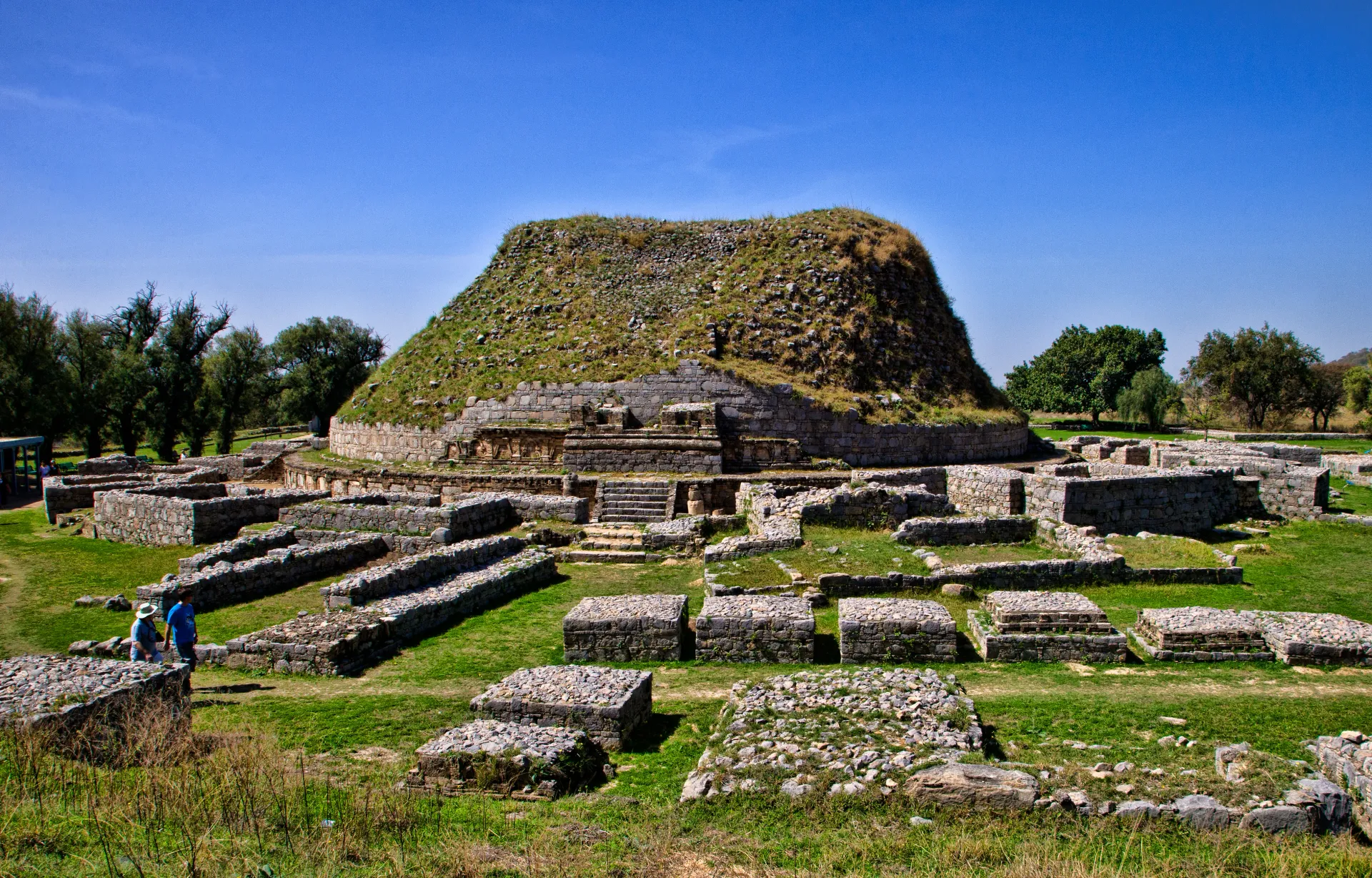
Photo: Sasha Isachenko, with thanks · CC BY-SA 3.0 · via Wikimedia Commons · temporary stand-in photo

Taxila
The ruins of several ancient cities and Buddhist monasteries near Islamabad, inscribed by UNESCO in 1980. Taxila was a crossroads of Gandhara, Greek, Persian and Kushan culture, with a fine museum.
Overview
Taxila is one of the richest archaeological areas in South Asia. It lies on the Pothohar Plateau about 30 km north-west of Islamabad and Rawalpindi. The ruins are not one place but a scatter of old cities, stupas and monasteries across a wide, farmed valley. UNESCO inscribed Taxila as a World Heritage Site in 1980, for ruins that show how towns developed on the Indian subcontinent over more than five centuries.
Taxila was a trading and learning centre on the road between the Indus plains and Central Asia. Buddhist pilgrims came here, and the name is still tied to the Gandhara school of Buddhist art.
Plan your visit
- Opening hours
- Taxila Museum (official site, undated page, copyright 2021): the header says Saturday to Thursday, 9 am to 4 pm in winter and 8:30 am to 5 pm in summer, but the text also says it is open every day except the first Monday of each month and Islamic holidays, so Friday is unclear. No official hours found for the open-air sites. Call the museum on +92 51 9315476 to confirm.
- Getting there
Taxila is about 32 km (roughly 30 minutes by car) north-west of central Islamabad, and about 34 km from Rawalpindi, by road (OSRM). Take the motorway or the Grand Trunk Road towards Hasan Abdal. More
Best months
Oct – Apr
- Taxila
- Related places nearby: Dharmarajika Stupa, Jaulian, Bhamala Stupa, Mankiala Stupa, Islamabad, Rawalpindi, Wah Gardens (Mughal Garden), Wah, Wah Cantonment, Hasan Abdal
History
- From about 1000 BCE: the earliest settlement at Hathial mound; the Bhir Mound town followed from roughly the 6th century BCE.
- 326 BCE: the local king, called Taxiles by Greek writers, accepted Alexander the Great without a battle.
- After Alexander: the Mauryan emperors held Taxila. Tradition says Ashoka governed here before becoming emperor, and the city became a Buddhist centre.
- 2nd century BCE: Greco-Bactrian rulers built a new city at Sirkap, laid out on a regular grid.
- 1st century CE onward: Indo-Scythians, Indo-Parthians and then the Kushans ruled. The Kushans founded Sirsukh.
- 5th century CE: raids by the Huns ruined the monasteries. By the time the Chinese monk Xuanzang came in 630 CE the city was in decline.
- 1863-64: Alexander Cunningham identified the site. Sir John Marshall excavated it from 1913 onwards.
Gandhara art and the museum
The Taxila Museum holds one of Pakistan's most significant collections of stone Buddhist sculpture, dated from the 1st to 7th centuries CE and known as Gandharan art (Wikipedia). Its core comes from Sir John Marshall's excavations in the valley, with later gifts and items seized by customs and police. Look for the coins, which trace the Indo-Greek, Scythian and Kushan rulers, and for small finds from Sirkap and Bhir Mound such as stone palettes and jewellery. Starting here makes the ruins easier to read.
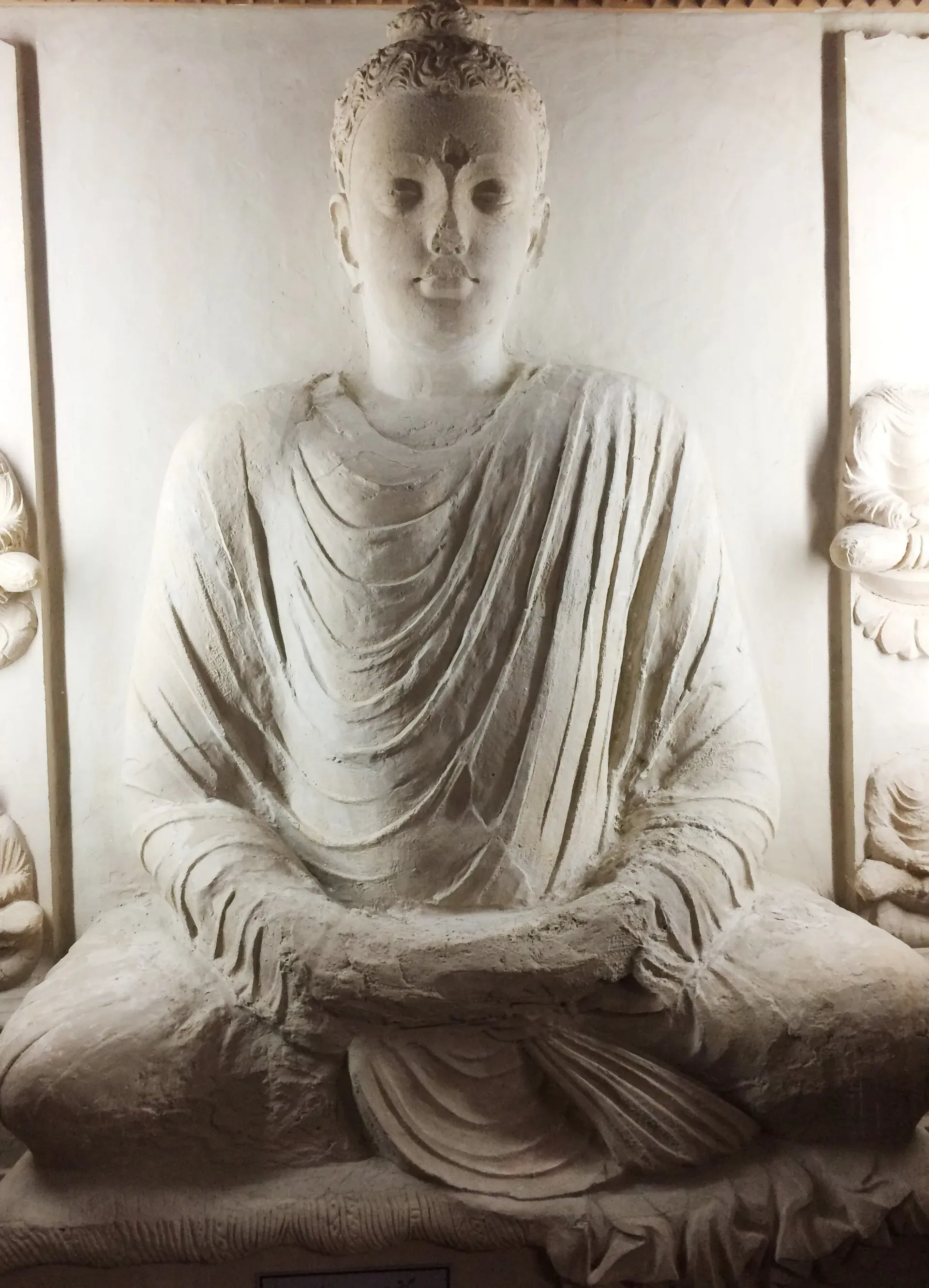
Photo: CR Guru PK, with thanks · CC BY-SA 4.0 · via Wikimedia Commons · temporary stand-in photo

What to see and do
- Taxila Museum. Start here. The foundation was laid in 1918 and building went on until 1928. It holds Gandhara sculpture, coins, jewellery and everyday objects from the sites around it.
- Dharmarajika stupa. The largest stupa in the area, linked by tradition to Ashoka and rebuilt in Kushan times.
- Sirkap. The ruined Greco-Bactrian city, with its straight main street, house plans and a double-headed eagle stupa.
- Jaulian. A 2nd-century monastery on a hilltop with stupas, chapels and stucco figures.
- Sirkap Jain temple. Marshall identified two blocks along the main street as Jain temples, because of their likeness to the stupa at Kankali Tila, Mathura (Wikipedia). One stupa base there carries Hindu, Buddhist and Greek temple fronts, a sign of how mixed the city was.
- Mohra Moradu and Bhir Mound. A quieter monastery and the oldest of the historic towns.
Allow a full day to see the museum and three or four sites. Most sites are open-air, shadeless and a few kilometres apart, so a car or rickshaw for the day helps.
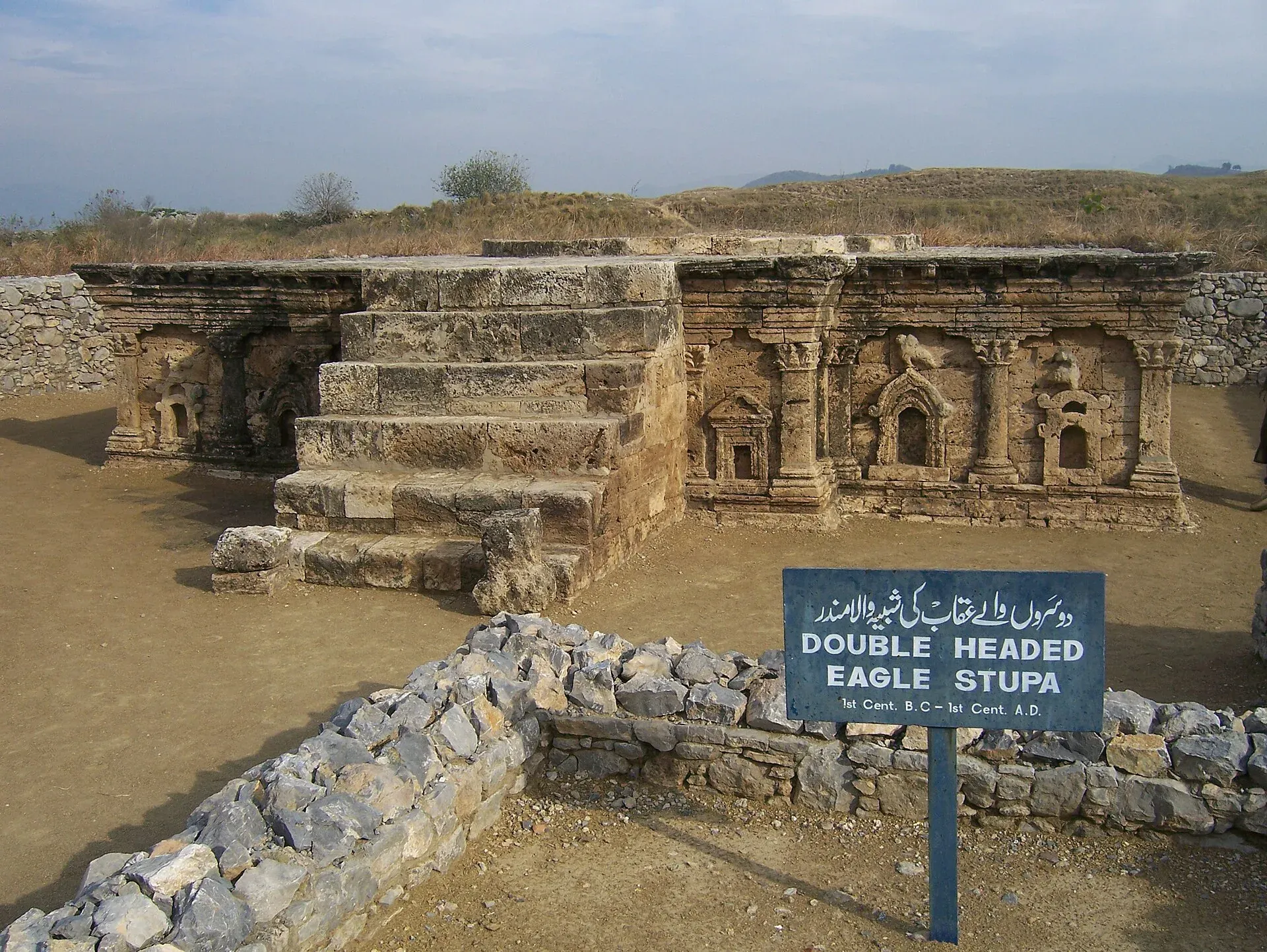
Photo: Dawoodmajoka, with thanks · Public domain (CC0) · via Wikimedia Commons · temporary stand-in photo

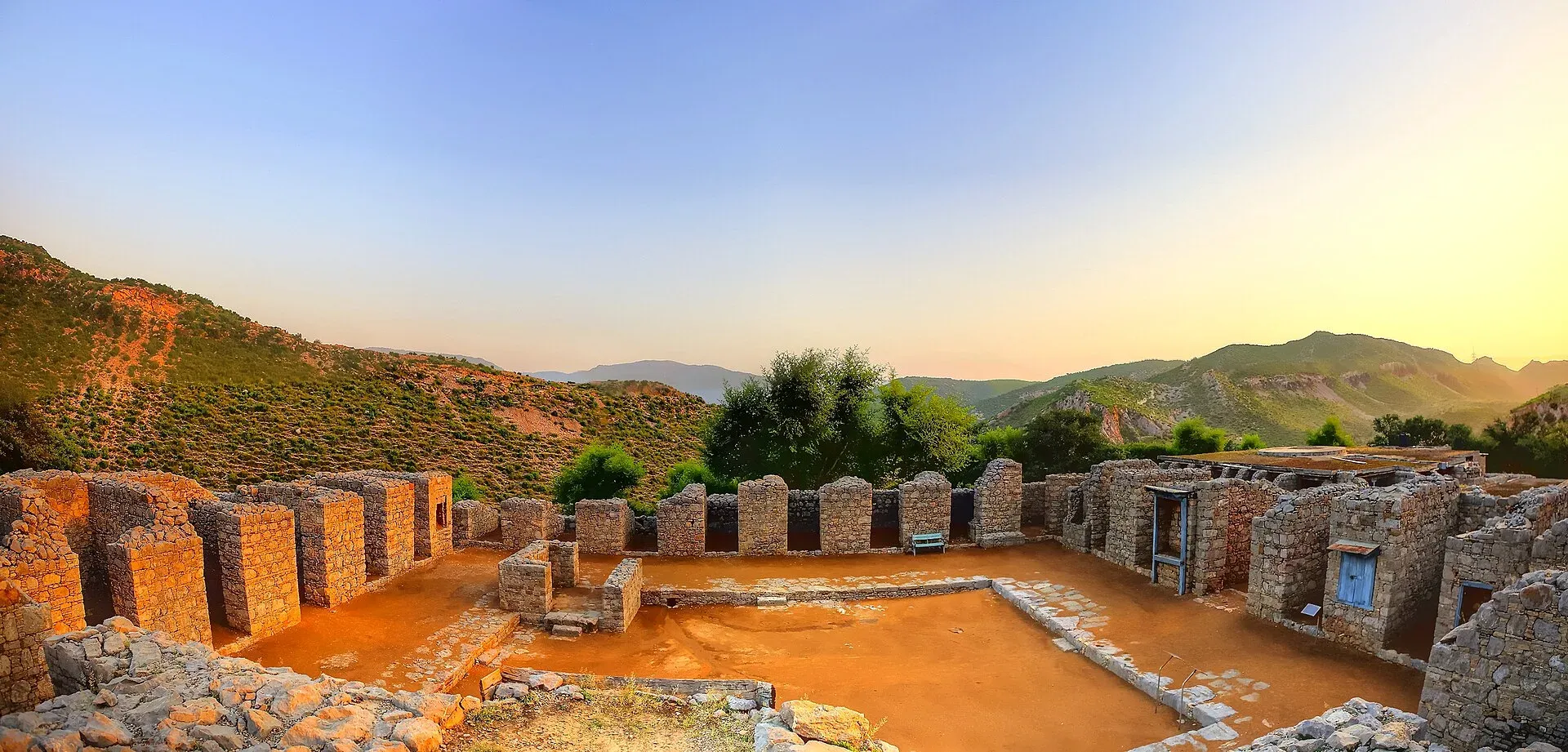
Photo: ClicksByMohammadOmer, with thanks · CC BY-SA 3.0 · via Wikimedia Commons · temporary stand-in photo

Learning at Taxila
Indian texts name Taxila (Takshashila) as a place of learning, and later writers call it an early university. Wikipedia reports both views. Students are said to have come at about sixteen from cities such as Kashi, Kosala and Magadha to study the Vedas, law, medicine, military science and crafts, and names such as Chanakya, Panini and the physician Jivaka are linked to it. Other scholars point out that there were no lecture halls or residences like those found at Nalanda, so it is better described as teachers taking pupils than as a campus. The ruins on the ground are cities and monasteries, not a university site.
A suggested day
Start at the museum when it opens, then drive to Dharmarajika and Jaulian before the heat builds. Eat in Taxila town in the middle of the day. Finish at Sirkap, whose straight main street is easiest to follow in lower afternoon light. Mohra Moradu and Bhir Mound can be added if you have time, but check first which sites are open (see the conservation note below). Bhamala Stupa, near Haripur, needs a separate half-day.
When to visit
October to April is comfortable. The plateau is hot from May to September, and the stone ruins reflect the heat. Go early in summer.
Where to stay and eat
Most visitors stay in Islamabad or Rawalpindi and come for the day. Taxila town has simple eateries; take water and a hat to the ruins.
Good to know
- Etiquette. The Buddhist sites are protected monuments and also hold meaning for Buddhist pilgrims. Do not climb on stupas, touch stucco, or take away stones or pottery. Dress modestly.
- Safety and advice. Taxila is not named in the UK FCDO's current list of areas it advises against (page updated 27 October 2026, checked 16 November 2026). Check the page again before you travel.
- Conservation dispute. Dawn reported on 2 July 2026 that UNESCO asked Pakistan to reverse "reconstructions" by the Punjab archaeology department at Mohra Moradu and Sirkap, where original walls were replaced with new masonry, and warned of the danger list. Wikipedia repeats this. There is no known report on whether these sites are closed, so check locally.
- Nearby. Dharmarajika and Jaulian have their own pages. Bhamala Stupa near Haripur and Mankiala Stupa near Rawalpindi are good add-ons.
Highlights
- UNESCO World Heritage Site since 1980
- Ruins of Bhir Mound, Sirkap and Sirsukh cities
- Dharmarajika stupa and Jaulian monastery
- Taxila Museum with Gandhara sculpture
- About 30 km from Islamabad
Getting there
Taxila is about 32 km (roughly 30 minutes by car) north-west of central Islamabad, and about 34 km from Rawalpindi, by road (OSRM). Take the motorway or the Grand Trunk Road towards Hasan Abdal. Buses and vans run from Rawalpindi's Pir Wadhai area to Taxila town, and the sites are a short rickshaw or taxi ride from there. A day-hire car from Islamabad is the easiest way to link the sites.
Tips
- See the museum first; it explains the scattered sites.
- Hire a car for the day: the sites are several kilometres apart.
- Bring water and sun protection; there is little shade.
- Check the museum is open: it closes on the first Monday of each month and on Islamic holidays.
Photos we still need: Bhir Mound and Mohra Moradu (not located in an open-licence image). Send us yours
Sources and last checked
Last checked Confidence medium6 sources4 still to check
- Last checked
- Method
- Desk research from published sources
- Confidence
- medium
- Checked by
- trek.pk research team
Researched from published sources; not yet checked on the ground by our team. Spot something out of date? Report a mistake.
Sources
- Taxila (Wikipedia) · Wikipedia · checked
- Taxila Museum: timings and history · Archaeological Museum Taxila (Government of the Punjab) · checked
- List of World Heritage Sites in Pakistan · Wikipedia · checked
- Pakistan Tourism Guide 2021 · Tourism Development Corporation of Pakistan (TDAP) · checked
- Pakistan travel advice: warnings and insurance (updated 27 October 2026) · UK Foreign, Commonwealth & Development Office · checked
- Govt asked to undo 'reconstruction' at Taxila sites (2 July 2026) · Dawn · checked
Still to be checked on the ground (4)
- Museum timings, especially Friday: the official page contradicts itself (header Saturday to Thursday; text says every day except the first Monday and Islamic holidays) and is undated
- Opening hours and any fees for the open-air sites (none found from an official source)
- UNESCO website (whc.unesco.org) returned 403; inscription year 1980 confirmed only from Wikipedia
- Which sites are open on the day, including Mohra Moradu and Sirkap after the 2026 UNESCO reconstruction dispute
Nearby and related

Dharmarajika Stupa
The largest stupa in the Taxila region, linked by tradition to Emperor Ashoka and later rebuilt under the Kushans. Part of the Taxila World Heritage Site, inscribed in 1980.

Jaulian
A 2nd-century Buddhist monastery on a hilltop at Taxila, with stupas, chapels and stucco carvings. Part of the Taxila World Heritage Site, inscribed in 1980.

Bhamala Stupa
A Buddhist monastery complex beside the Haro River near Khanpur Dam, Haripur, with a rare cross-shaped stupa. It joined UNESCO's tentative list in 2026.

Mankiala Stupa
A large ruined Buddhist stupa at Tope Mankiala near Rawalpindi, linked to the Kushan emperor Kanishka and a Jataka tale of a prince feeding tiger cubs. Not on the UNESCO lists.

Islamabad
Pakistan's green, planned capital at the foot of the Margalla Hills: Faisal Mosque, hillside trails, cafes and the gateway to the north.

Rawalpindi
Islamabad's older twin city: a busy bazaar and cantonment, the north's main rail and bus hub, and an easy base for Taxila and Murree.

Punjab
Pakistan's most populous province: Mughal Lahore, ancient Taxila and Harappa, Sufi shrines, the Salt Range, the Cholistan desert and the hills of Murree.
Wah Gardens (Mughal Garden), Wah
A Mughal garden of the 16th to 17th centuries beside the Grand Trunk Road at Wah, near Hasan Abdal, with spring-fed pools and twelve-door pavilions. Visited by Jahangir, Shah Jahan and Aurangzeb.
Wah Cantonment
Garrison city on the Grand Trunk Road in Taxila Tehsil, about 30 km north-west of Islamabad and Rawalpindi, home to the Mughal Wah Gardens. 400,733 people (2023 census).

Hasan Abdal
Historic town on the Grand Trunk Road in Attock District. Known for Gurdwara Panja Sahib, a major Sikh pilgrimage site, and Mughal-era tombs.