

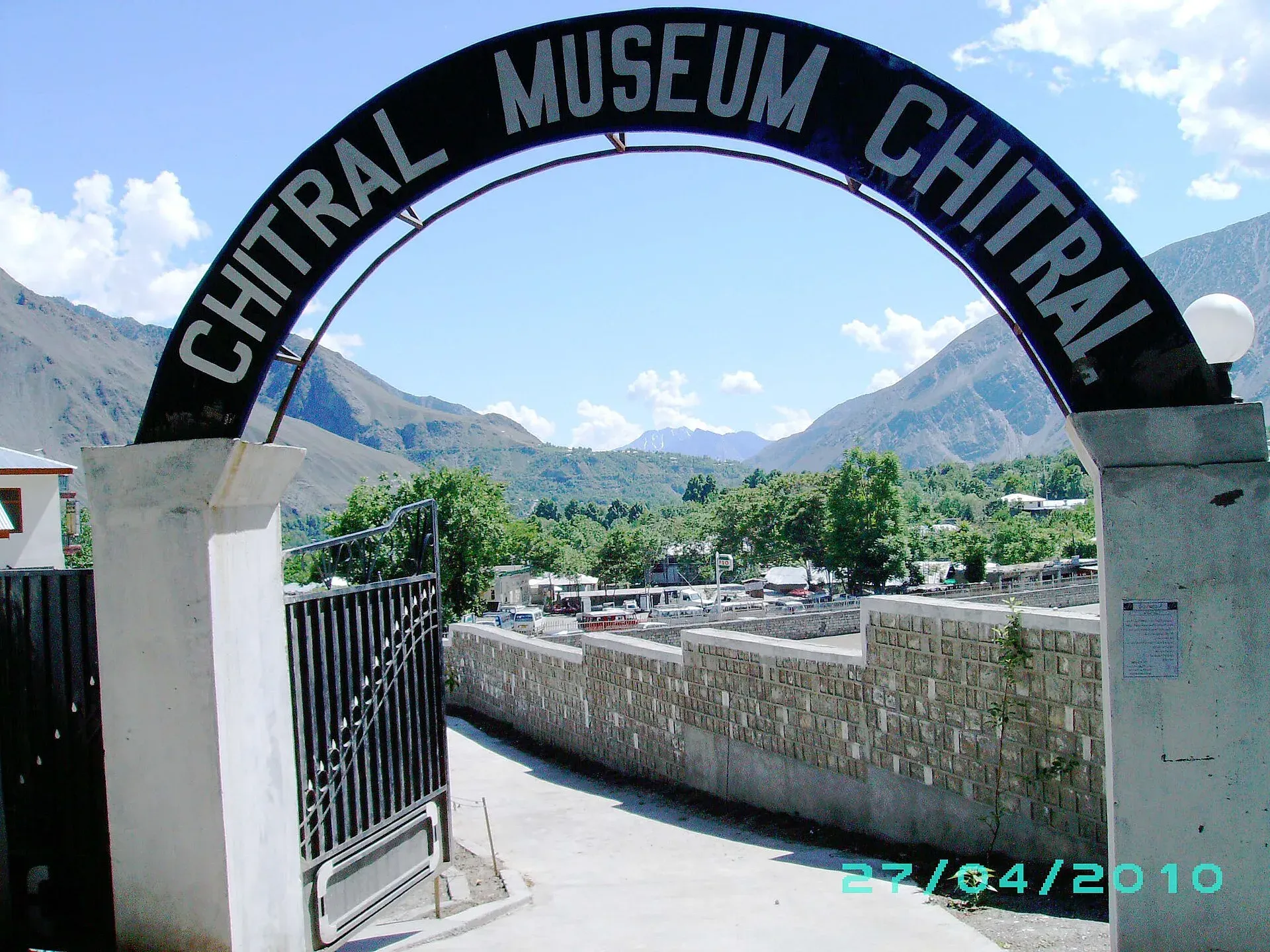
Photo: Junaid Ahmad, with thanks · CC BY 3.0 · via Wikimedia Commons · temporary stand-in photo

Chitral Museum
A small museum in Chitral town, established in 2010, with galleries on Chitrali life, weapons, and Kalash and Gandhara Grave archaeology.
Overview
The Chitral Museum is in Chitral town, in Chitral district of Khyber Pakhtunkhwa. According to Wikipedia it was established on 8 July 2010 and is owned by the Government of Khyber Pakhtunkhwa. Its aim is to protect and show Chitral's cultural heritage. It is a small museum, and little detail about it has been published.
Plan your visit
- Nearest town
- Chitral
- Getting there
The museum is in Chitral town. Check how to reach Chitral before you go (see the travel advice above for the N-45). Within town, ask locally about taxis or rickshaws. There is no known street address. More
Best months
May – Oct
- Chitral Museum
- Related places nearby: Chitral Valley, Kalash Valleys (Bumburet, Rumbur, Birir), Kalasha Dur Museum
Chitral in brief
Chitral town stands on the Chitral River at about 1,500 m. Wikipedia says the area was part of the Kushan Empire in the 2nd century CE, and that the Katur dynasty made it their capital from 1571. In 1895 a British garrison held out in Chitral Fort for about a month during the Chitral Expedition before it was relieved. The British then installed Shuja ul-Mulk as mehtar (ruler), and he ruled for the next 41 years. Another mehtar, Muzaffar ul-Mulk, took Chitral into Pakistan in 1947. It became a district of Pakistan between 1969 and 1972.
See Chitral Fort and Chitral Valley for the setting.
What to see and do
Wikipedia describes two galleries.
- Ethnological gallery. Daily life and culture of Chitral: embroidery, jewellery, weapons, ceramics, musical instruments, hunting tools, furniture and household objects.
- Archaeological and Kalash gallery. Material from the Kalash valleys, such as architectural pieces, headdresses, effigies and wooden commemorative figures. The archaeology is mostly Gandhara Grave finds (pottery, stone beads, spearheads, arrowheads, bangles, rings and pendants) from excavations at Sangoor and Parwak by the provincial Directorate of Archaeology and Museums.
The weapons collection includes pistols, guns, cannon, daggers and swords. No individual star objects are named in the source.
The Gandhara Grave finds
The Gandhara Grave culture (also called the Swat protohistoric graveyards) is known from cemeteries across northern Pakistan. Its core area is the middle Swat valley, and it spread into Dir, Kunar, Chitral and the Peshawar valley. Italian archaeologists date the Swat graves to about 1400 to 800 BCE, though some scholars argue the tradition ran later. More than thirty cemeteries are known across Swat, Dir, Buner, Malakand, Chitral and the Peshawar valley.
Burial practice changed over time. Early graves hold single burials, and the main type is a cist grave, a box lined with stone slabs and capped with a flat stone. Later phases include cremation, with ashes placed in jars, and multiple burials. Burnished grey and red pottery is the commonest find, with terracotta figurines, bronze and gold objects in the middle phase, iron in the later phase, and horse remains and horse gear in late graves. Wikipedia places similar burial traditions near Singoor village in Chitral, spelled Sangoor in the museum's description, from the 8th century BCE to the 17th century CE. The museum's cases of pottery, beads and arrowheads belong to this tradition.
Visiting with other sights
The museum pairs naturally with the other sights in town. A half-day on foot could take in the museum, Chitral Fort, the Chitral polo ground and Chitral Bazaar. Go to the museum first if you plan to visit the Kalash valleys or the Kalasha Dur Museum, which has a related focus.
When to visit
Chitral is usually visited between spring and autumn, but check road and flight conditions in advance.
Where to stay and eat
Chitral town has hotels and restaurants. This guide does not name businesses.
Good to know
- Ask the district administration or local police about current conditions before you go. Travel advice: For foreign visitors: the UK FCDO (updated 27 October 2026, checked 16 November 2026) advises against all travel on the N-45 highway up to the edge of Chitral city, including the Kalash valley. It does not name Chitral city itself. It also notes emergency measures and Governor's Rule in Khyber Pakhtunkhwa since 11 October 2026. Check the live advice, and how you plan to reach Chitral, before you travel.
- Hours, tickets and address: not found on an official source. Wikipedia lists the Directorate's website and the museum's social media page. Check with the Directorate of Archaeology and Museums (0092-91-9211488). Current fees will be added soon.
- Photography and accessibility: not stated.
Highlights
- Opened 2010 by the Government of Khyber Pakhtunkhwa
- Chitral ethnology: embroidery, weapons, instruments
- Kalash material and Gandhara Grave finds from Sangoor and Parwak
Getting there
The museum is in Chitral town. Check how to reach Chitral before you go (see the travel advice above for the N-45). Within town, ask locally about taxis or rickshaws. There is no known street address.
Tips
- Check the FCDO advice on the N-45 and how you will reach Chitral.
- Phone the Directorate for hours.
- Visit before heading into the valleys for cultural context.
Photos we still need: the museum galleries (ethnological and Kalash collections). Send us yours
Sources and last checked
Last checked Confidence low6 sources5 still to check
- Last checked
- Method
- Desk research from published sources
- Confidence
- low
- Checked by
- trek.pk research team
Researched from published sources; not yet checked on the ground by our team. Spot something out of date? Report a mistake.
Sources
- Chitral Museum · Wikipedia · checked
- Peshawar Museum (official page, for Directorate contact details) · Directorate of Archaeology and Museums, Khyber Pakhtunkhwa · checked
- Foreign travel advice: Pakistan (updated 27 October 2026) · UK Foreign, Commonwealth & Development Office (FCDO) · checked
- Pakistan Tourism Guide 2021 (museums list) · Trade Development Authority of Pakistan (TDAP) · checked
- Gandhara grave culture · Wikipedia · checked
- Chitral · Wikipedia · checked
Still to be checked on the ground (5)
- Everything except the founding date and gallery list is still sourced mainly from Wikipedia (Lonely Planet returned 403; kparchaeology.com would not resolve)
- Opening hours, tickets, street address (not on Wikipedia; no official page opened)
- Whether both galleries are currently open
- Photography rules and accessibility
- Whether the Gandhara Grave finds are on show (Wikipedia lists them in the gallery description)
Nearby and related

Chitral Valley
The long Chitral River valley at the foot of the Hindu Kush, with Chitral town's fort and Shahi Mosque, the Lowari Tunnel route, Tirich Mir views and side valleys leading to Kalash and Shandur.

Kalash Valleys (Bumburet, Rumbur, Birir)
Three side valleys of the Chitral River, home to the Kalasha people, who keep their own religion, language and festivals. Visit with respect and check security advice first.

Khyber Pakhtunkhwa
Mountains, Buddhist ruins and old bazaars in north-west Pakistan: Swat, Kaghan, Chitral, the Kalash valleys, the Khyber Pass and Peshawar.

Kalasha Dur Museum
A cultural centre and museum in Bumburet, the largest of the Kalash valleys, with about 1,300 objects from Kalash life and the wider Hindu Kush.