

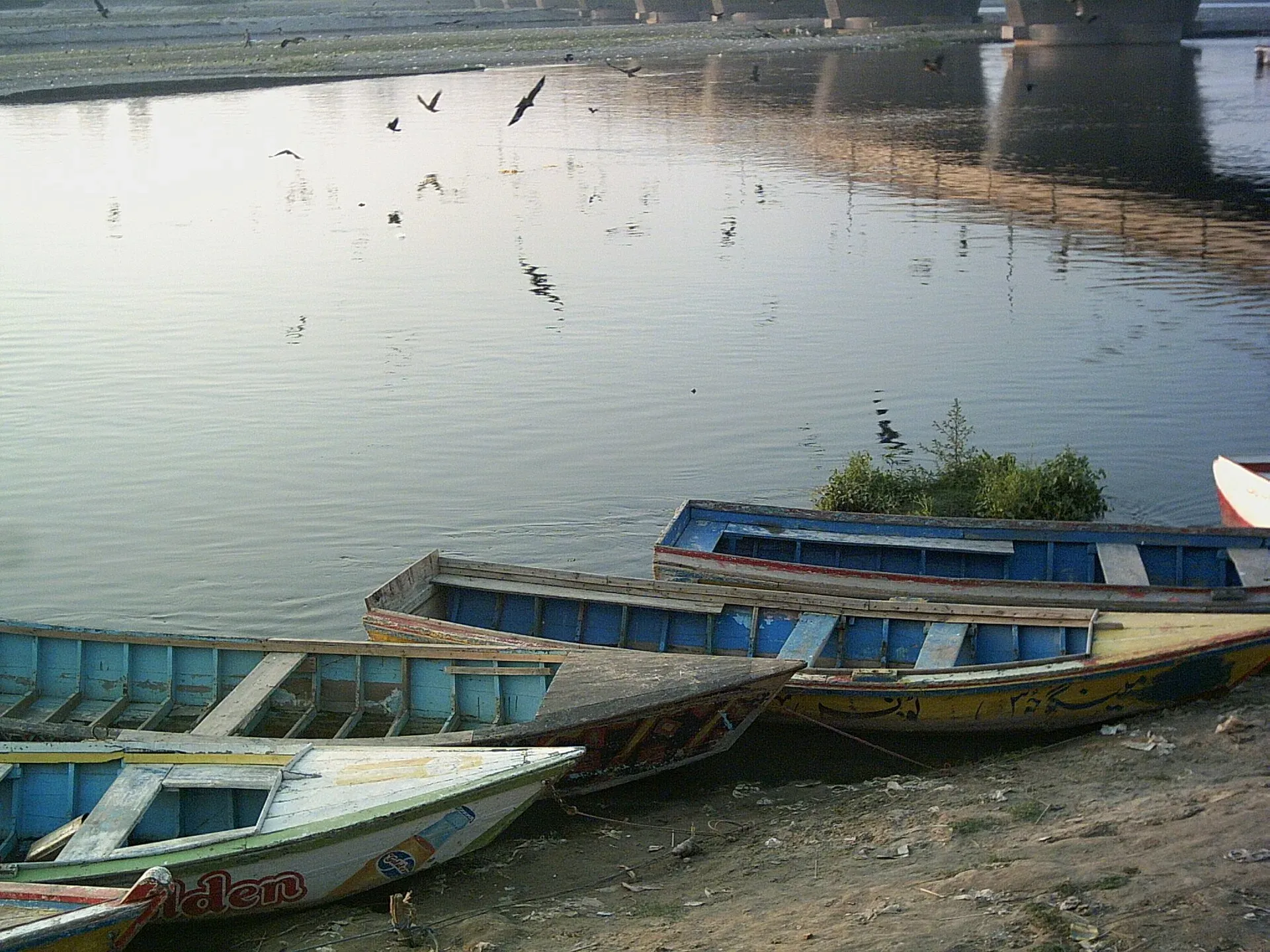
Photo: Wisesabre, with thanks · CC BY 2.5 · via Wikimedia Commons · temporary stand-in photo

Ravi River
The river of Lahore, about 720 km long, rising in Himachal Pradesh and running along the Indo-Pakistan border before passing Shahdara, Jahangir's tomb and Lahore, then joining the Chenab. Heavily polluted and often low.
Overview
The Ravi is about 720 km long and is one of the five rivers of the Punjab. It rises in the Bara Bhangal area of Himachal Pradesh, India, and flows through the Pir Panjal and Dhauladhar ranges, passing Chamba and Dalhousie. It cuts a gorge in the Dhauladhar and enters the Punjab plain near Madhopur and Pathankot. It then runs about 80 km along the Indo-Pakistan border before entering Pakistan.
Wikipedia calls it "the river of Lahore" because the city lies on its eastern bank, about 26 km below Amritsar. After Lahore it turns at Kamalia and joins the Chenab south of Ahmadpur Sial.
Plan your visit
- Nearest town
- Lahore
- Getting there
Lahore is the main base, with an airport, railway and motorway links. Shahdara is on the opposite bank, reached by road bridge from central Lahore. Balloki is about 25 km south-west of the city. More
Best months
Oct – Mar
Tributaries and flow
Wikipedia lists the Budhil and Nai (Dhona), the Seul (whose valley is called "the garden of Chamba"), the Seva and the Ujh among the tributaries. The Ujh rises near Bhaderwah, runs about 100 km and joins the Ravi at Nainkot in Pakistan. Average discharge near Mukesar is about 267.5 cubic metres a second, and the highest recorded flow, near Baloki, is 11,015 cubic metres a second. The river is perennial and mostly fed by snowmelt in the upper catchment.
Water, canals and treaty
The Madhopur Headworks in India and the Balloki Headworks in Kasur District, completed in 1915, feed canals that irrigate central Punjab. Wikipedia's Ravi page says Balloki is about 25 km south-west of Lahore, but its Balloki Headworks page says 70 km and gives coordinates that agree with the longer figure, so the distance is shown here as about 70 km. See Balloki Headworks. Sidhnai Headworks is the only other Ravi barrage in Pakistan that Wikipedia names. In India the Ranjit Sagar Dam, 160 m high with four 150 MW units, stands on the main river about 24 km above Madhopur.
Under the Indus Waters Treaty, signed on 1 April 1960, the Ravi, Beas and Sutlej were allocated to India and the Indus, Jhelum and Chenab to Pakistan. India has had full rights to the eastern rivers since 31 March 1970. The two governments disagree about the treaty's current state; this does not affect travellers.
What to see and do
- Shahdara Bagh. On the western bank, across the water from Lahore, stand the Tomb of Jahangir and the tomb of Noor Jahan. See the tomb of Jahangir and Akbari Sarai.
- Lahore riverside. The Ravi bridges give views of the river. Lahore Fort and Badshahi Mosque are a short drive from the bank. See Lahore.
- Balloki. The headworks site is a working irrigation structure; ask before visiting.
- Fishing and boating. There is no known official source describing licensed fishing or boating on the Ravi.
History and culture
In Vedic texts the river is Iravati, or Purushni, and the Greeks called it the Hydraotes. The river's banks have long been a stage for Lahore's history and for the Mughal emperor Jahangir's burial at Shahdara.
Floods
The Ravi can rise fast in the monsoon. In late August 2025, Dawn reported that floods on the Ravi, Chenab and Sutlej affected more than 1.46 million people in 1,692 mouzas (revenue villages) in Punjab, and 17 people died. On the Ravi, Shahdara was in "exceptionally high flood" with an outflow of 219,770 cusecs, and about 80 villages were under water, 75 of them in Narowal. The river flooded suburbs of Lahore and several housing societies. Check PDMA alerts between July and September.
When to visit
October to March is the best time. In summer the river can swell with monsoon rain and surprise riverbank visitors.
Where to stay and eat
Lahore has hotels and restaurants for all budgets. There are no facilities at Balloki beyond simple stalls.
Good to know
- Pollution. Wikipedia reports very high pollution in Lahore's urban stretch from industrial and farm waste. A 72 km stretch from Lahore Siphon to Balloki shows heavy metal contamination. Do not swim or eat fish caught here.
- Ask the district administration or local police about current conditions before you go. For foreign visitors: the UK FCDO (updated 27 October 2026, still current when checked on 17 November 2026) advises against all but essential travel within 5 miles of the Pakistan-India border, with exceptions for the Wagah route and the Kartarpur Corridor. Lahore city is not listed as an area to avoid.
Highlights
- About 720 km, rising in Himachal Pradesh
- Flows past Lahore, "the river of Lahore"
- Banks hold the Tomb of Jahangir at Shahdara
- Balloki Headworks, completed 1915
- Joins the Chenab south of Ahmadpur Sial
Getting there
Lahore is the main base, with an airport, railway and motorway links. Shahdara is on the opposite bank, reached by road bridge from central Lahore. Balloki is about 25 km south-west of the city.
Tips
- See Jahangir's tomb, not the water, as the main stop
- Do not swim or eat fish from the river near Lahore
- Check PDMA flood alerts in monsoon
- Respect the border zone rules near Wagah
Photos we still need: Balloki Headworks or a Ravi bridge in Lahore showing the river at normal flow; Shahdara Bagh riverbank. Send us yours
Sources and last checked
Last checked Confidence medium4 sources3 still to check
- Last checked
- Method
- Desk research from published sources
- Confidence
- medium
- Checked by
- trek.pk research team
Researched from published sources; not yet checked on the ground by our team. Spot something out of date? Report a mistake.
Sources
- Ravi River (Wikipedia) · Wikipedia · checked
- 1.5m affected as Punjab reels from worst flood in decades (2025) · Dawn · checked
- Pakistan travel advice (updated 27 October 2026) · UK Foreign, Commonwealth & Development Office · checked
- Balloki Headworks · Wikipedia · checked
Still to be checked on the ground (3)
- Length within Pakistan (Wikipedia gives only the 720 km total and 80 km along the border)
- Barrage names inside Pakistan other than Balloki and Sidhnai (no further source)
- Madhopur dates (Wikipedia gives 1875 and 1902; unresolved)
Nearby and related

Lahore
Punjab's capital and Pakistan's cultural city: Mughal forts, mosques and gardens, a lively Walled City, and some of the best food in the country.

Lahore Fort
The Mughal citadel at the north end of Lahore's Walled City, with palaces, a marble mosque and a long tiled Picture Wall. Inscribed by UNESCO in 1981 together with the Shalimar Gardens.

Badshahi Mosque
Lahore's great Mughal mosque, built for Emperor Aurangzeb in 1671-73 from red sandstone and marble. It faces Lahore Fort and has been on UNESCO's tentative list since 1993.

Tomb of Jahangir and Akbari Sarai
The Mughal emperor Jahangir's mausoleum at Shahdara in Lahore, finished in 1637, with the Akbari Sarai gateway and the tomb of Asif Khan. The group is on UNESCO's tentative list (1993).

Chenab River
A river of about 974 km formed in Himachal Pradesh where the Chandra and Bhaga meet. It enters Punjab at Marala near Sialkot, passes four headworks, takes in the Jhelum at Trimmu and joins the Sutlej as the Panjnad.

Sutlej River
The longest of Punjab's five rivers, about 1,450 km from Lake Rakshastal in Tibet. It enters Pakistan east of Kasur, passes Sulemanki and Islam headworks, and meets the Chenab north of Uch Sharif to form the Panjnad.
Balloki Headworks
A British-era headworks on the Ravi in Kasur district, opened in 1915. It feeds the Lower Bari Doab Canal and lies about 70 km from Lahore.

Mughal Lahore and the Grand Trunk Road
A four-day journey from Lahore's Mughal monuments up the Grand Trunk Road to Rohtas Fort. History from Akbar to Aurangzeb, OSRM-measured day plan and current safety notes.